


Telemedicine app development is becoming a core priority for healthcare providers as virtual care moves into everyday patient journeys. Telehealth has improved healthcare delivery, with 79% of U.S. hospitals now offering virtual services and 80% of consumers having used telemedicine in 2024.
This article explores what businesses need to know before building a telemedicine solution. We will cover common types of telemedicine apps, essential features, estimated cost and the step by step development process.
What is a Telemedicine App?
A telemedicine app is a digital healthcare platform that allows patients to connect with healthcare providers remotely through a smartphone, tablet, or computer. It supports virtual consultations, secure messaging, and health data sharing, such as blood pressure or symptoms, so patients can receive care without visiting a clinic in person.

Telemedicine Apps Market Overview
The telemedicine market has evolved from a pandemic-driven necessity into a core component of modern healthcare delivery. According to Fortune Business Insights, the global telemedicine market was valued at USD 113.04 billion in 2025 and is projected to reach USD 113.04 billion in 2025.
Growth is being driven by rising healthcare costs, increasing adoption of digital health technologies, and growing demand for convenient access to medical services.
Additionally, the rising incidence of chronic conditions is also a key driver of market expansion, especially when non-communicable diseases (primarily cardiovascular issues, cancer, respiratory ailments, and diabetes) now account for over 74% of all global deaths.
Benefits of Developing a Telemedicine App
Developing a telemedicine app can create value for both patients and healthcare providers. Patients benefit from more convenient access to care, while providers can improve operational efficiency, expand service reach, and deliver better healthcare outcomes through digital channels.
Increased accessibility
Telemedicine app allows patients to connect with healthcare providers without being limited by location, mobility, or clinic hours. People in rural areas, elderly patients, and those with chronic conditions can receive timely medical support from home. This reduces travel burden, shortens waiting time, and helps patients access care before minor symptoms become serious health issues.
Improved patient engagement
Telemedicine apps improve patient engagement by making care more continuous, convenient, and easier to follow. Patients can receive reminders, access test results, contact providers, and attend follow-up consultations without unnecessary delays. This convenience helps them stay involved in their care and follow treatment plans more consistently.
Better health outcomes
RAND reports that 60% of American adults live with at least one chronic illness. Telemedicine can help these individuals achieve better health outcomes by supporting more consistent management of chronic conditions through virtual consultations, remote follow-ups, video-based education, and personalized lifestyle guidance.
Enhanced Safety for Patients
Telemedicine apps help improve patient safety by limiting exposure to infectious diseases that can spread in crowded waiting rooms, hospitals, and clinics. This is especially valuable for immunocompromised patients, older adults, pregnant individuals, and those living with chronic health conditions.
Telemedicine also supports people with mental health concerns who may feel anxious or uncomfortable in traditional clinical environments, providing a more private and reassuring way to access care.
Cost efficiency
Telemedicine apps can improve cost efficiency for providers by reducing missed appointments, optimizing staff schedules, and helping clinics use resources more effectively.
For example, research suggests that just one patient no-show can cost healthcare providers around $260. By making consultations easier to attend from home or work, telehealth can reduce the odds of no-shows by 29%, helping providers protect revenue, improve appointment utilization, and deliver care with fewer operational gaps.
Increased security and compliance
Custom telemedicine app development strengthens security and compliance through end to end encryption, role based access, secure cloud storage, and audit logs. These protections help meet regulations like HIPAA, reduce data breach risks, and build patient trust by keeping sensitive health information safe.
4 Popular Types of Telemedicine App
Synchronous telemedicine apps
Synchronous telemedicine apps enable real-time communication between patients and healthcare providers through video calls, voice calls, or messaging. They recreate the experience of an in-person visit while eliminating geographical barriers.
Their key advantage is immediate access to medical care. Providers can assess symptoms, answer questions, and recommend treatments during the consultation, making them ideal for time-sensitive healthcare needs.
- Best for: urgent care, mental health care, primary care, follow up consultations, specialist consultations.
- Leading examples: Teladoc Health, Amwell, MDLIVE, Doctor On Demand, Doxy.me.
Asynchronous telemedicine apps
Asynchronous telemedicine apps use a store-and-forward model, allowing patients to share medical information such as images, reports, and health updates without a live consultation. Providers, in turn, review and respond at a convenient time.
This approach improves flexibility and efficiency by removing scheduling constraints. It is well suited for routine consultations, follow-ups, and cases that do not require immediate interaction.
- Best for: dermatology, prescription refills, lab result review, second opinions, non urgent follow ups.
- Leading examples: GoodRx Care, K Health, HealthTap, Zocdoc, Sesame Care.
Remote patient monitoring (RPM)
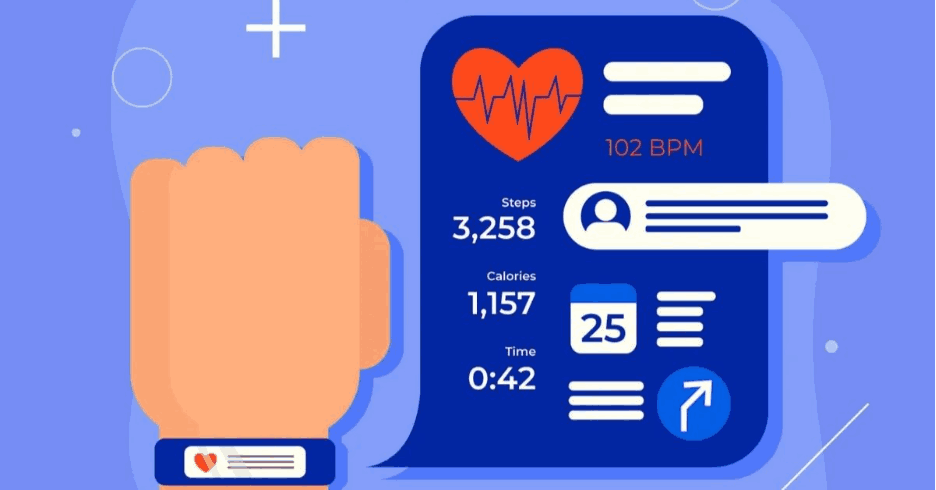
Remote patient monitoring apps collect health data through connected devices and sensors outside traditional healthcare settings. The data is securely transmitted to providers for ongoing observation and analysis.
RPM supports proactive care by enabling continuous monitoring of patient health. It helps detect potential issues early, improve chronic disease management, and reduce unnecessary hospital visits.
- Best for: chronic disease management, elderly care, cardiac monitoring, diabetes care, post discharge monitoring.
- Leading examples: Biofourmis, Current Health, Livongo, Omada Health, Health Recovery Solutions.
mHealth (Mobile Health)
mHealth apps are mobile-based healthcare solutions that provide access to health services, information, and self-care tools through smartphones and tablets. They often include features for tracking health metrics and managing daily wellness.
These apps encourage greater patient engagement by making healthcare more accessible and convenient. They help users monitor their health, manage medications, and stay connected with healthcare providers.
- Best for: patient portals, medication tracking, wellness support, symptom checking, appointment management.
- Leading examples: MyChart, Ada Health, GoodRx, Fitbit, Headspace.
Key Features a Telemedicine App Should Have
Telemedicine apps should offer a broad range of features that support the needs of both patients and healthcare providers. Below are some of the most common and essential features to consider when developing a telemedicine app.
Appointment scheduling
Efficient scheduling features make it easier for patients to access care while helping providers manage their availability. These tools streamline the entire appointment process, from booking to follow-up.
- Appointment scheduling: Patients should be able to search available doctors, view time slots, choose consultation types, and book appointments directly in the app.
- Automated reminders: Push notifications, SMS, or email reminders help patients remember upcoming consultations, medication schedules, and follow up visits.
- Calendar integration: Appointments are integrated with Google Calendar, Apple Calendar, or in app calendars to help patients manage healthcare visits alongside daily commitments.
- Rescheduling and cancellation: It allows patients to change appointment dates, select new available time slots, or cancel consultations directly through the app.
Video and audio consultation
To support a reliable virtual care experience, the app should include high quality video, clear audio, stable connectivity, and strong protection such as AES 256 bit encryption. This matters because more than 93% of patients consider video quality a critical factor in their overall virtual care experience (American Telemedicine Association).
In app messaging
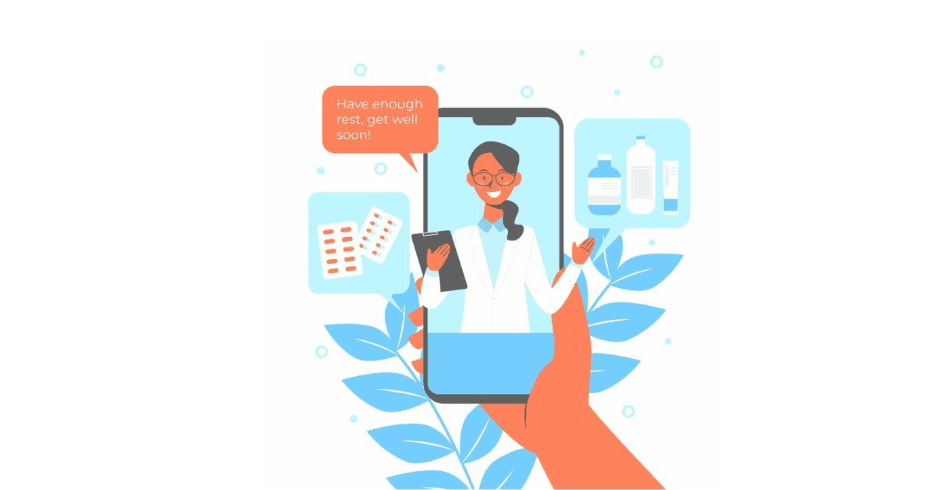
Secure in app messaging allows patients and healthcare providers to exchange questions, updates, and follow up instructions without scheduling another live consultation. Messages should be encrypted and designed to meet healthcare compliance standards such as HIPAA.
File sharing
File sharing enables patients and providers to exchange medical documents, lab results, prescriptions, images, insurance details, or treatment instructions within the app. This feature supports better clinical decision making because doctors can review relevant information before or after a consultation.
e-Prescriptions & Pharmacy integration
This feature allows patients to receive digital prescriptions directly in the telemedicine app after a consultation. They can view prescribed medications, choose a connected pharmacy, check availability, and arrange pickup or delivery where available.
Provider dashboards
A provider dashboard serves as the central workspace for doctors and healthcare staff. It gives quick access to appointment schedules, patient records, consultation requests, notifications, and performance metrics from a single interface.
EHR/EMR integration
Integration with Electronic Health Records (EHR) and Electronic Medical Records (EMR) allows providers to access complete patient histories without switching between systems. Doctors can review diagnoses, medications, lab results, and treatment plans during virtual consultations.

Automated documentation & Billing
Automated documentation tools can generate consultation notes, visit summaries, and clinical records directly from telemedicine sessions. Combined with billing automation, the system can streamline coding, claims processing, invoicing, and payment tracking.
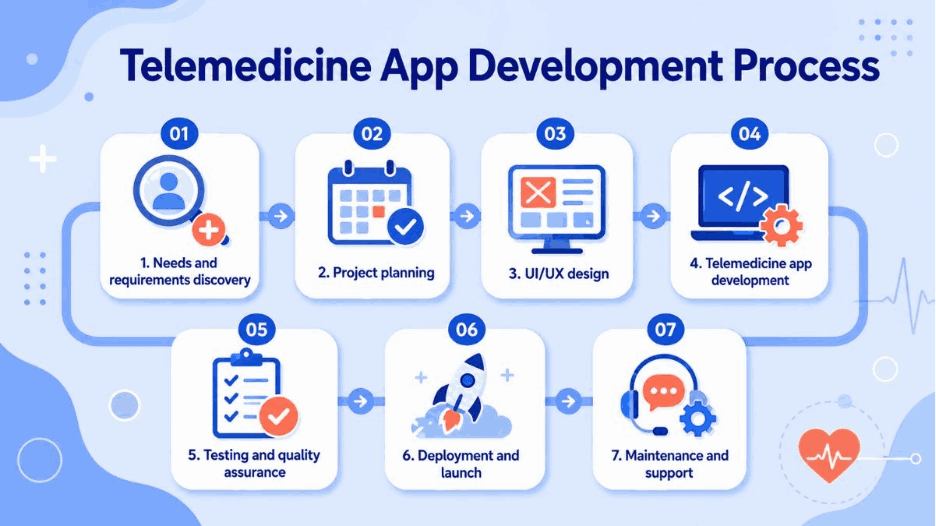
How to Develop a Telemedicine App Development
Healthcare applications must balance user experience, clinical workflows, regulatory compliance, data security, and system integrations. The development process below provides a structured approach for creating a secure, scalable, and user-friendly telemedicine solution.
1. Discovery and requirements discovery
Typical timeline: 2-4 weeks
This phase lays the foundation for the entire telemedicine project. The goal is to understand business objectives, patient and provider needs, healthcare workflows, compliance obligations, and technical requirements before any design or development begins.
- Regulatory compliance assessment: Review applicable healthcare regulations such as HIPAA, HITECH, GDPR, state licensing rules, and local data privacy requirements.
- Technical architecture planning: Identify the app’s core architecture, security model, scalability needs, and integration requirements with systems such as EHR/EMR, pharmacy platforms, payment gateways, and wearable devices.
- User experience research: Map patient, provider, and administrator journeys to understand how each group will use the platform in real clinical scenarios. This includes interviews with doctors, nurses, IT teams, and operations staff to define workflows, pain points, and usability requirements before design and development begin.
2. Define Main Features
Typical timeline: 1-2 weeks
Once requirements are validated, the next step is to define the core features that will shape the telemedicine app’s value for both patients and providers.
- Prioritize MVP features: Start with must-have features such as appointment scheduling, video consultations, secure messaging, e-prescriptions, patient profiles, and basic medical record access.
- Define patient and provider workflows: Patients need a simple way to book appointments, consult doctors, receive prescriptions, and manage health information. Meanwhile, providers need tools for schedule management, patient data access, consultation notes, communication, and basic reporting.
- Plan advanced features for scaling: Once the MVP is validated, the app can expand with features such as AI symptom checkers, wearable device integration, remote patient monitoring, analytics dashboards, insurance integration, and personalized care recommendations.
3. UI/UX design
Typical timeline: 2-4 weeks
UI/UX design defines how patients, doctors, and admins interact with the telemedicine platform. Deliverables in this phase include: UX wireframes, clickable prototypes, UI screens, user flow diagrams, and a design specification document.
- User journey mapping: Define key flows such as patient registration, doctor search, appointment booking, video consultation, prescription access, and payment.
- UX wireframing: Create low-fidelity wireframes to structure screens, navigation, content hierarchy, and user actions.
- UI prototyping: Build clickable prototypes to test how users move through the app before development begins.
- Visual design: Design patient-friendly and provider-friendly interfaces with clear buttons, readable medical information, accessible layouts, and consistent branding.
4. Telemedicine app development
Typical timeline: 2-6 months
This is the core phase where the telemedicine app is built. Development teams create the backend infrastructure, frontend interfaces, healthcare features, and integrations required to support secure virtual care delivery.
- Back-end development: Build the server-side architecture, databases, authentication, user roles, appointment logic, medical records, and admin controls.
- Front-end development: Develop patient, doctor, and admin interfaces for web, iOS, Android, or cross-platform applications.
- Core feature development: Implement appointment scheduling, video consultations, real-time chat, doctor profiles, notifications, medical history, e-prescriptions, and billing.
- Third-party integrations: Connect APIs for video calling, payment gateways, insurance systems, EHR/EMR platforms, pharmacy services, SMS, email, and push notifications.
- Security implementation: Add encryption, access control, audit logs, secure authentication, and compliance-ready data handling.
5. Testing and quality assurance
Typical timeline: Continuous throughout development
Testing ensures the telemedicine app works reliably, securely, and smoothly for all user groups. Since healthcare apps handle sensitive patient data, QA must cover not only functionality but also performance, usability, privacy, and compliance.
|
Testing Activity |
Purpose |
|
Functional testing |
Check whether appointment booking, video calls, chat, payments, prescriptions, and notifications work correctly. |
|
Usability testing |
Evaluate whether patients, doctors, and admins can complete key actions without confusion. |
|
Integration testing |
Verify that third-party APIs such as video, payment, EHR, insurance, and pharmacy systems work properly together. |
|
Security testing |
Test authentication, data encryption, role-based access, session handling, and vulnerability risks. |
|
Compliance testing |
Review whether the app supports healthcare data protection standards such as HIPAA, GDPR, or local medical privacy regulations, depending on the target market. |
|
Performance and load testing |
Check how the platform performs during peak usage, especially during video consultations and high appointment volumes. |
|
Bug fixing and optimization |
Identify, prioritize, and resolve technical issues before public release |
6. Deployment and launch
Typical timeline: 1-2 months
Deployment turns the completed telemedicine product into a live solution. A phased launch is recommended to reduce risk, collect real user feedback, and ensure the app is stable before scaling to a wider audience. Here’s what you should prepare for:
- Production setup: Configure infrastructure, databases, security settings, monitoring tools, backups, and deployment pipelines for a stable launch environment.
- Pilot and MVP launch: Release the app to a limited user group, validate real-world usage, and launch the core version with essential telemedicine features.
- App store submission: Prepare required assets, privacy documentation, and compliance information for Google Play and the App Store.
- Feedback and optimization: Collect user feedback, monitor performance, fix critical issues, improve onboarding, and prepare for full-scale rollout.
7. Maintenance and support
Typical timeline: ongoing
A telemedicine app requires ongoing support and maintenance after launch to remain secure, reliable, and compliant with healthcare regulations. Regular updates help fix bugs, improve performance, strengthen security, and keep the infrastructure up to date.
Continuous monitoring and user feedback also enable providers to add valuable features, address technical issues quickly, and adapt to evolving healthcare needs, ensuring a positive experience for both patients and healthcare professionals.
Key Compliance Standards and Certifications for Creating a Secure Telemedicine App
Compliance is a critical part of telemedicine app development because healthcare platforms handle sensitive patient data, medical records, payments, and clinical communication. Below are the main standards and certifications a telemedicine app should follow:
Regional Regulatory Compliance
Regional healthcare and privacy regulations define how telemedicine apps collect, store, process, share, and protect patient data. These requirements are especially important for apps operating in the United States, the European Union, or other regulated healthcare markets.
- HIPAA (Health Insurance Portability and Accountability Act): Required for U.S. telemedicine apps handling protected health information (PHI). It mandates secure data storage, encryption, access controls, audit trails, and safeguards to protect patient privacy.
- HITECH Act (Health Information Technology for Economic and Clinical Health Act): It strengthens HIPAA compliance and promotes the secure adoption of electronic health records (EHRs). It is particularly relevant for platforms that exchange healthcare data electronically.
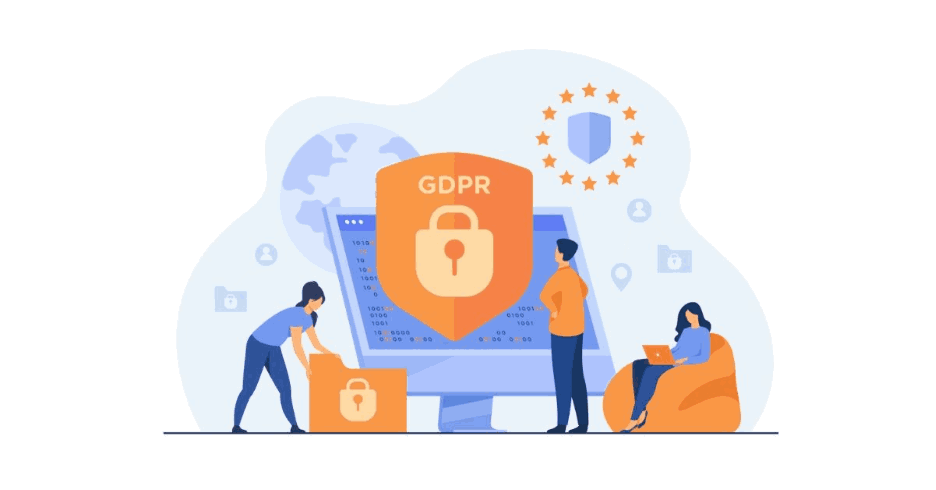
- GDPR (General Data Protection Regulation): Applies to telemedicine apps serving users in the European Union. It requires lawful data processing, user consent management, privacy-by-design practices, and protection of patient data rights.
Interoperability Standards
Interoperability standards allow telemedicine apps to securely exchange healthcare data with EHR systems, hospitals, laboratories, pharmacies, insurers, and other medical platforms.
- HL7 – Health Level Seven: HL7 is a widely adopted standard for exchanging healthcare information between clinical systems. It enables telemedicine apps to share patient records, appointments, lab results, and other medical data efficiently.
- FHIR – Fast Healthcare Interoperability Resources: FHIR is a modern standard for fast and flexible healthcare data exchange. It supports API-based integration between telemedicine platforms, EHR systems, and other digital health applications.
- 21st Century Cures Act: This U.S. law promotes patient access to health information and prevents information blocking. It encourages secure data sharing, interoperability, and patient data portability across healthcare systems.
Industry Certifications
Industry certifications help prove that a telemedicine app follows recognized security, privacy, and operational control practices. While not every certification is legally required, they can improve trust with healthcare organizations, investors, enterprise clients, and patients.
- ISO/IEC 27001: An international standard for information security management. It demonstrates that a telemedicine provider follows structured processes for risk management, access control, data protection, and incident response.
- SOC 2: Assesses how organizations manage data across security, availability, confidentiality, privacy, and processing integrity. It is commonly requested by healthcare organizations and enterprise clients.
- PCI DSS – Payment Card Industry Data Security Standard: Required for apps that process, store, or transmit payment card data. It helps secure transactions for consultations, subscriptions, and other healthcare payments.

How Much Does It Cost to Develop a Telemedicine App
The cost to develop a telemedicine app usually ranges from $25,000 to $300,000+, depending on the product scope, feature complexity, platform choice, compliance requirements, and development team location.
In most cases, startups and small clinics begin with an MVP to validate market demand, while hospitals, insurers, and large healthcare providers invest in more advanced solutions designed for scalability, compliance, and long-term digital care delivery.
|
App Type |
Estimated Cost |
Description |
Timeline |
|
Basic / MVP Telemedicine App |
$25,000-$80,000 |
A simple telemedicine app with essential features such as patient registration, doctor profiles, appointment booking, video consultations, chat, basic notifications, and payment integration. |
3-5 months |
|
Mid-Level / Standard Telemedicine App |
$60,000-$150,000 |
A more complete platform with multi-provider support, advanced scheduling, e-prescriptions, EHR/EMR integration, admin dashboards, analytics, secure document sharing, and improved patient engagement features. |
5-9 months |
|
Advanced / Enterprise Telemedicine Platform |
$150,000-$300,000+ |
A scalable, compliance-heavy solution with AI-powered tools, such as remote patient monitoring, IoT device integration, insurance integration. |
9-18+ months |







Leave a Reply