


How to Craft a Digital Transformation Strategy for Enterprises
In a business landscape where technology evolves at breakneck speed and competition intensifies daily, companies that fail to adapt risk being left behind. A carefully designed digital transformation strategy empowers enterprises to upgrade their operations seamlessly and stay ahead of competitors while unlocking long-term business value.
For organizations struggling to define or implement such a strategy effectively, this article offers a comprehensive guide. Read on to explore the essential components, types, execution roadmap, and real-world examples related to a robust digital transformation strategy.
What is a Digital Transformation Strategy?
A digital transformation strategy represents a comprehensive roadmap that organizations develop to integrate advanced technologies into core business operations, processes, and customer experiences for sustained competitive advantage. This approach extends beyond mere technology adoption because it encompasses organizational culture shifts, workflow redesigns, and leadership alignment that collectively drive enterprise-wide innovation and adaptability.
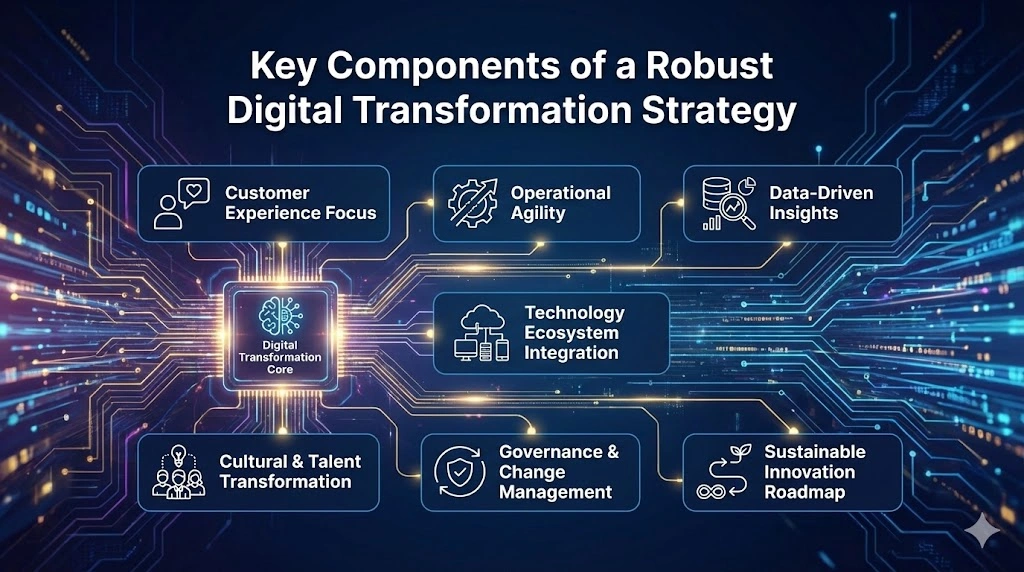
Key Components of a Robust Digital Transformation Strategy
As the components of a digital transformation strategy can be different in each enterprise, we will only focus on the main ones below:
- Customer Experience Focus: Enterprises prioritize seamless omnichannel interactions that digital strategies emphasize, which enhance satisfaction through personalized services and real-time support across touchpoints.
- Operational Agility: Organizations achieve streamlined workflows via process automation that robust strategies enable, thereby reducing costs and accelerating decision-making cycles effectively.
- Data-Driven Insights: Businesses leverage analytics platforms central to transformation strategies, which unlock actionable intelligence from vast datasets for strategic planning and risk mitigation.
- Technology Ecosystem Integration: Companies build interoperable systems through strategic roadmaps that facilitate cloud migration and AI adoption, ensuring scalability and future-proof architecture.
- Cultural & Talent Transformation: Leadership drives employee upskilling programs that incorporate fostering innovation mindsets and digital fluency across all organizational levels.
- Governance & Change Management: Executives establish oversight frameworks essential to transformation strategies, which monitor progress and manage resistance for sustained adoption.
- Sustainable Innovation Roadmap: Organizations create phased implementation plans that outline strategies, balancing quick wins with long-term technological evolution.
Main Types of Digital Transformation Strategy
Below are the 5 main types of digital transformation strategy that are being implemented widely by numerous enterprises and organizations:
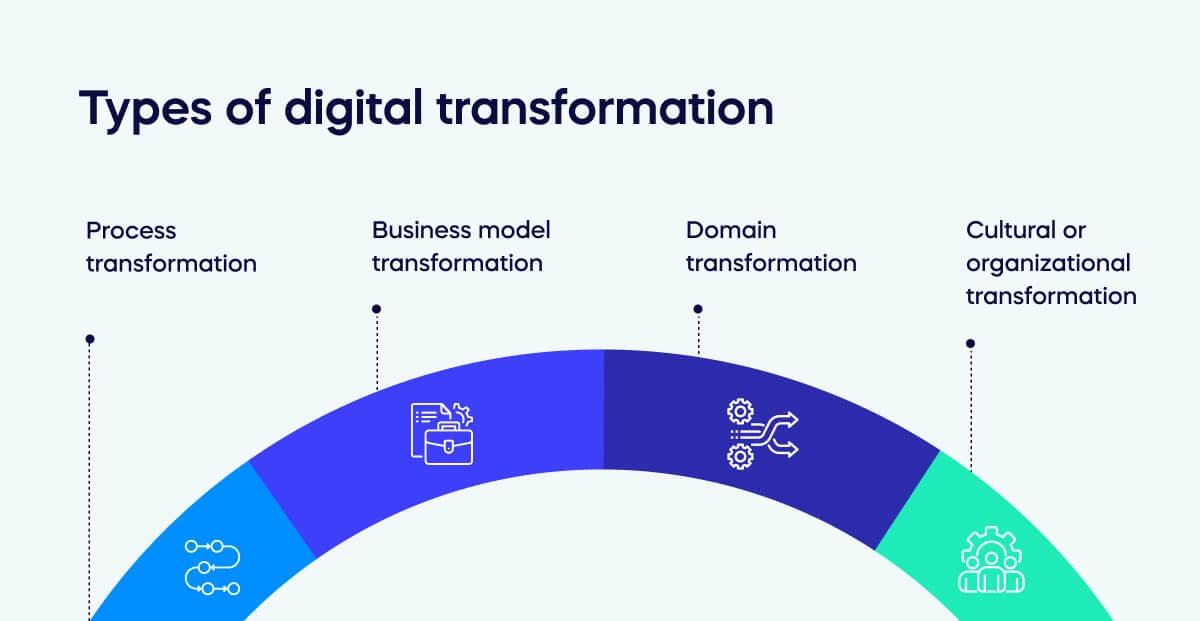
- Cultural Transformation — Enterprises undergoing deep mindset shifts often apply cultural transformation when they aim to overcome internal resistance to digital adoption. This strategy proves crucial for legacy organizations that need to rebuild corporate culture, enhance cross-department collaboration, and foster an innovation mindset among employees. As such, cultural transformation often forms the foundation that enables other types of digital change to succeed.
- Customer Experience Transformation — Companies focused on retail, services, or any customer-facing business deploy customer experience transformation to elevate satisfaction and loyalty through personalization, seamless omnichannel interfaces, and data-driven engagement. This approach emphasizes delivering consistent, high-quality experiences across web, mobile, and offline channels, which helps businesses differentiate themselves and stay competitive.
- Operational Process Transformation — Organizations that aim to streamline internal workflows, optimize supply chains, or automate repetitive tasks often resort to operational transformation. By digitizing and re-engineering core processes, these companies can reduce manual overhead, improve accuracy and speed, and enable scalable operations that support growth and efficiency.
- Business Model Transformation — Traditional enterprises that intend to pivot into new revenue streams or shift to platform-based models use business model transformation to redesign how they deliver value to customers. This strategy often involves embracing digital offerings, subscription or service-based models, platform ecosystems, or other innovative approaches that depart from legacy business logic.
- Domain (or Industry-Specific) Transformation — Businesses in regulated or niche sectors such as fintech, healthtech, or manufacturing often pursue domain transformation by leveraging specialized technology stacks, compliance-ready platforms, and industry-tailored digital capabilities. This kind of transformation enables them to meet sector-specific requirements, accelerate innovation, and benefit from digital advantages relevant to their industry context.
Why a Digital Transformation Strategy Is Critical?
- Strategic competitive positioning — In fast-evolving markets, a robust digital transformation strategy helps enterprises accelerate innovation cycles and respond swiftly to emerging trends or disruptions, thereby protecting or even improving their market standing relative to competitors.
- Operational cost optimization — Digital transformation enables organizations to streamline operations through automation, cloud adoption, and process re-engineering, which significantly reduces legacy system overheads and operational inefficiencies — savings that can be redirected into further strategic investments.
- Accelerated revenue growth and new business opportunities — By enabling data-driven decision making, personalization, and digital product/service delivery, a sound transformation strategy can unlock new revenue streams and increase lifetime value of customers through enhanced engagement and expanded offerings.
- Risk mitigation and compliance readiness — As regulatory requirements tighten and cybersecurity threats grow, a digital strategy that embeds compliance frameworks and security-centric technologies helps companies protect data, ensure regulatory compliance, and minimize exposure to breaches or legal issues.
- Talent attraction and long-term workforce capability building — Organizations that embrace digital transformation often develop cultures that appeal to tech-savvy professionals and foster continuous learning, which helps attract and retain talent while building internal capabilities to support future growth.
How to Develop a Digital Transformation Strategy
Let’s dig into the detailed steps to help you form and execute a complete digital transformation strategy:
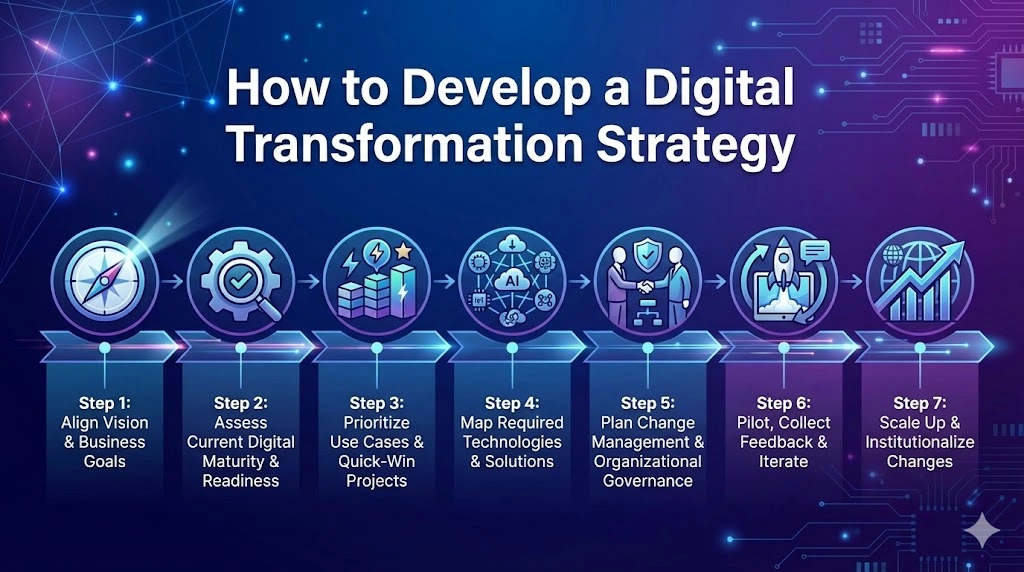
Step 1: Align Vision & Business Goals
First, corporate leadership must define a clear digital vision that maps directly to overarching business objectives such as revenue growth, market expansion, or improved customer satisfaction. This step ensures that any digital initiative contributes measurable value rather than being a standalone technology experiment.
Second, communication of this unified direction across all departments is essential so that every team understands how digital projects support the company’s strategic goals. With such alignment, resource allocation and KPI selection become more targeted and effective, reducing the risk of fragmented efforts or wasted investment.
Step 2: Assess Current Digital Maturity & Readiness
Initial assessment requires a thorough audit of existing infrastructure, workflows, data capabilities, and human-resource readiness to reveal technology gaps, process inefficiencies, and skill shortages. Such a diagnosis provides a realistic baseline for transformation and identifies the most critical areas for improvement.
As a result, companies can avoid launching digital initiatives on shaky foundations and instead build roadmaps grounded in actual readiness, which increases the likelihood of successful adoption and long-term sustainability.
Step 3: Prioritize Use Cases & Quick-Win Projects
The next step involves identifying business use cases that promise high impact with relatively fast implementation, balancing short-term value with long-term scalability. Prioritized quick-win projects help deliver early successes and build stakeholder confidence in the transformation effort.
Delivering tangible results early accelerates adoption across the organization and creates internal momentum for broader, more complex transformation phases — thereby improving overall success rates.
Step 4: Map Required Technologies & Solutions
Technology architects should evaluate potential tech stacks, platforms, and tools, conducting proof-of-concept tests to ensure compatibility with existing systems and future scalability needs. This strategic mapping should also include phased implementation plans to avoid disruption of ongoing operations.
By carefully selecting solutions and defining integration roadmaps, the organization reduces the risk of vendor lock-in, ensures flexible tech evolution, and achieves seamless convergence of the new digital ecosystem with legacy assets.
Step 5: Plan Change Management & Organizational Governance
Implementing digitization requires structured change management that includes training, communication plans, and incentives to foster employee adoption and minimize resistance. In parallel, governance frameworks must establish accountability, performance metrics, and escalation protocols to track progress and manage risks.
Such formal structure ensures that transformation becomes part of the company culture rather than a one-off project, thereby embedding digital readiness and adaptability into the organizational DNA for future growth.
Step 6: Pilot, Collect Feedback & Iterate
Launching pilot projects within a controlled scope allows organizations to gather quantitative performance data and qualitative user feedback, which inform iterative refinements before full-scale rollout. This phased experimentation helps validate assumptions, fine-tune processes, and avoid widespread disruption.
By grounding scaling decisions in real data and lived user experience, companies significantly reduce the risk of failure in full deployment — resulting in more stable roll-outs and higher adoption rates across the enterprise.
Step 7: Scale Up & Institutionalize Changes
Once pilot successes are validated, operations leaders should standardize deployment processes across departments or global locations, embedding new workflows into core operations through updated policies and performance dashboards. This institutionalization ensures consistency, repeatability, and governance in the delivery of digital services.
In doing so, the organization transforms temporary projects into lasting change — securing competitive advantage and positioning itself as a digitally mature enterprise capable of sustained innovation and growth.
Digital Transformation Strategy: 3 Popular Examples
1. Netflix’s Content & Customer Experience Transformation
Netflix executed a customer experience transformation strategy by migrating from DVD rentals to streaming platforms powered by AI recommendation engines that analyze viewing patterns. This pivot generated $33 billion+ annual revenue while dominating global entertainment markets through data-driven personalization at scale.

2. Walmart’s Operational Excellence Strategy
Walmart implemented operational process transformation through IoT-enabled supply chain tracking and AI demand forecasting across 11,000+ stores worldwide. The strategy reduced out-of-stocks by 30% and dramatically accelerated delivery times, maintaining market leadership against e-commerce competitors.

3. GE’s Industrial IoT Transformation
General Electric pursued domain-specific transformation via the Predix platform, connecting industrial assets for predictive maintenance across the aviation and energy sectors. This initiative saved customers $1 billion+ annually in downtime costs while establishing GE Digital as an industrial software leader.

If you wish to brainstorm and implement your digital transformation strategy successfully (like the above case studies), you can consult our latest article on the best digital transformation companies and choose the partner that can support your process.
Conclusion
Throughout this article, we have unpacked the key components of a digital transformation strategy, described the main types of transformation, outlined a detailed step-by-step implementation process, and illustrated the concepts with real-life examples. Armed with this knowledge, enterprises can confidently build and adapt a transformation strategy that aligns technology initiatives with business goals and drives sustainable growth.
If your organization still faces challenges in planning or executing digital transformation, let Newwave Solutions assist you. With over 14 years of experience in providing high-quality web/app/software development and IT outsourcing services, we deliver high-quality technology solutions supported by skilled teams of developers, designers, and QA engineers. Contact us today to discuss how a tailored digital transformation strategy can help your business thrive in the digital age.
Contact Information:
- Head Office (Hanoi): 1F, 4F, 10F, Mitec Building, Cau Giay Ward, Hanoi City, Vietnam
- Branch Office (Tokyo): 1chōme118 Yushima, Bunkyo City, Tokyo 1130034, Japan
- Hotline: +84 985310203
- Website: https://newwavesolution.com
- Email: [email protected]
To Quang Duy is the CEO of Newwave Solutions, a leading Vietnamese software company. He is recognized as a standout technology consultant. Connect with him on LinkedIn and Twitter.



Read More Guides
Get stories in your inbox twice a month.
Let’s Build Something Extraordinary
Sign up for a 30 min no-obligation strategic session with us. Transform your Ideas into scalable reality.
Leave a Reply