


What is Drupal? A Complete Detail Guide To Get Started
Among the many content management systems (CMS) available, Drupal has earned a reputation as one of the most powerful and reliable platforms. Whether you are a startup exploring your first website or an enterprise looking for complex digital solutions, understanding what is Drupal and how it works can guide you to make smarter choices for your next project. Let’s begin!
What is Drupal?
Drupal is an open-source content management system (CMS) that allows you to build, manage, and scale websites and applications of all sizes. Unlike many CMS platforms that are mostly used for simple blogs or small business sites, Drupal is known for its flexibility, robust features, and enterprise-grade capabilities.
At its core, Drupal is more than just a CMS; it’s also considered a Drupal framework and a Drupal platform because it gives developers a foundation to build custom applications, not just websites. It has been trusted by governments, universities, media companies, and enterprises worldwide. Its ability to handle structured content, complex workflows, multiple languages, and high-security needs makes it stand out.
Drupal development refers to the process of creating, customizing, and extending websites or applications using Drupal. Developers can use Drupal web development to build everything from corporate portals to a Drupal website for e-commerce, social communities, or education. It involves working with Drupal’s modules, themes, and APIs to customize functionality and design.
For example:
- A government portal may use Drupal to manage multilingual content and citizen services.
- A university may leverage Drupal for its scalable platform to handle millions of students’ data and content.
- A business can adopt Drupal for its custom software development needs to integrate with APIs, CRMs, and e-commerce systems.
With Drupal, you’re not locked into pre-set templates—you can mold it exactly as your business requires.
Why Choose Drupal?
Organizations choose Drupal because it provides unmatched flexibility, scalability, and security, making it ideal for businesses that expect growth and complexity in their digital platforms. Beyond just being a CMS, Drupal is a strategic tool for building future-ready solutions. Let’s explore the main reasons:
1. Flexibility and Customization
Drupal allows you to define unlimited content types, taxonomies, workflows, and user permissions. With over 40,000 free modules available, you can create anything, from a simple blog to a multi-site network with thousands of users which without being limited by rigid templates.
If a pre-made module doesn’t exist, skilled developers can build custom functionality tailored precisely to your business processes. This makes Drupal an ideal platform for custom software development and complex web portals development.
2. Security
Security is one of Drupal’s strongest features. Drupal has a dedicated security team that proactively hunts for and patches vulnerabilities. Its rigorous code review process for contributed modules makes it one of the most secure CMS platforms available, trusted by entities like the NASA and the Australian Government.
3. Scalability
Drupal can handle high traffic and massive content databases. With proper hosting and optimization, it scales effortlessly as your business grows. Whether you’re publishing thousands of articles or experiencing a massive surge in visitors (like during a product launch or news event), Drupal’s architecture ensures your site remains stable and fast. This scalability is crucial for growing businesses.
4. Multilingual Support
Drupal supports over 100 languages out of the box. This makes it perfect for global companies that want to connect with diverse audiences, making it easy to create and manage content in multiple languages from a single backend. This built-in capability eliminates the need for complex add-ons for multilingual support.
5. Accessibility
Drupal follows accessibility standards, ensuring websites are usable by people with disabilities. It is committed to adhering to WCAG (Web Content Accessibility Guidelines) and other standards, providing tools to help developers build accessible experiences from the ground up.
6. Cost-Efficiency
Since Drupal is open-source, there are no license fees. The investment goes into the expertise required for Drupal development, which is hiring a skilled team to build and customize your software development solution. This often results in a lower total cost of ownership for enterprise-level projects compared to proprietary software.
7. Strong Community
Drupal has one of the strongest developer communities. With over 1.3 million members, Drupal’s community is a powerful engine for innovation, support, and knowledge-sharing. This ensures the platform is constantly improving and that help is always available.
What is Drupal Used For?
Drupal is used for building websites and applications that need flexibility, security, and the ability to grow with your business. It’s not just for small blogs or basic sites—it shines when organizations need to manage lots of content, handle many users, or serve different regions in multiple languages. Drupal can power everything from enterprise portals to global e-commerce platforms, making it one of the most adaptable solutions in the digital world. Let’s see the most common applications:
1. Corporate and government websites
These sites need to be secure, reliable, and able to manage vast amounts of structured information. Drupal’s robust security and ability to create complex content types make it perfect for this.
Large organizations often need different departments, regions, or teams to manage content independently while still keeping everything consistent. Drupal’s role-based permissions make this easy. Meanwhile, Governments value Drupal for its high security standards, transparent codebase, and accessibility compliance.
Benefits of Drupal:
- Centralized content management across multiple sites.
- Strong security measures suitable for sensitive data.
- Custom workflows to manage approvals and publishing.
Example: NASA’s website uses Drupal to provide reliable access to research, images, and public updates, while maintaining strict security controls.
2. Educational institutions
Universities and schools are essentially networks of smaller sites (departments, faculties, research centers) that need autonomy while maintaining a cohesive brand identity. Drupal’s multi-site capability allows a central IT team to manage a single codebase while deploying dozens of individual sites. This simplifies updates and security while empowering each department with its own content management tools under controlled permissions.
Benefits of Drupal:
- Flexible structure for different departments or faculties.
- Multilingual support for international students.
- Integration with external systems like LMS or CRMs.
Example: Harvard and Stanford University rely on Drupal to manage vast amounts of academic content and resources.
> >> View more of what we can do for edtech software development services
3. E-commerce platforms via modules like Drupal Commerce
Drupal Commerce is not merely a shopping cart plugin; it is a framework for building deeply integrated commerce experiences. It is ideal for businesses that require e-commerce web development solutions to be a seamless part of a larger content strategy, such as selling memberships alongside physical goods, implementing complex pricing rules, or creating a B2B portal that integrates directly with ERP and CRM systems.
Benefits of Drupal:
- Full control over product catalogs and pricing.
- Custom checkout workflows and promotions.
- Ability to integrate with ERP, CRM, and third-party APIs.
Example: High-end retailers use Drupal Commerce for flexible product catalogs that align with their branding and customer experience goals.
4. Social networking and community platforms
Building a community-driven site requires features that facilitate user interaction and content creation. Drupal provides a foundation for sites with user profiles, groups, forums, and activity streams. Modules allow users to create their own content, form groups with specific privacy settings, and interact with each other, turning a passive audience into an active community.
Benefits of Drupal:
- Customizable user roles and permissions.
- Tools to moderate and manage community content.
- Scalable enough to support thousands of active users.
Example: Sports communities and fan networks often use Drupal to host forums and event-based discussions.
5. Media and publishing portals
Publishing houses need to produce high volumes of content, categorize it instantly, and distribute it across multiple channels. Drupal’s powerful taxonomy system allows for incredibly detailed tagging and categorization. Coupled with robust content creation tools, scheduling, and multi-channel publishing capabilities (including headless CMS setups), it streamlines the entire editorial workflow.
Benefits:
- Advanced content categorization and tagging.
- Workflow management for editors, writers, and publishers.
- Easy integration with ad platforms and analytics.
Example: The Economist uses Drupal to publish daily articles, handle millions of readers, and maintain performance at scale.
6. Non-profit and community platforms
For non-profits, a website is a hub for storytelling, fundraising, and mobilization. Drupal facilitates this by easily integrating with fundraising and CRM platforms, allowing for the creation of donation forms, event calendars, and petition systems. Its ability to manage multilingual content is also crucial for international organizations.
Benefits:
- Donation and fundraising integrations.
- Volunteer sign-up and event management tools.
- Multi-language support for global outreach.
Example: Many NGOs use Drupal to connect with international donors and volunteers, ensuring their mission reaches a wide audience.
7. APIs and headless CMS architectures
In a “headless” architecture, Drupal serves as a content powerhouse in the backend, managing all content and business logic, while its RESTful APIs deliver that content to any frontend application. This approach is perfect for creating omnichannel experiences, powering mobile apps, kiosks, digital signage, or interactive JavaScript-powered frontend websites.
Benefits:
- Flexibility to publish content across multiple channels.
- Decoupled architecture for modern, app-like experiences.
- Easy integration with React, Angular, or mobile apps.
Example: A media company can use Drupal to manage articles but deliver them to both a website and a mobile news app seamlessly.
>> Need more options for API? Check out our API Development services
How Does Drupal Work?
Drupal works by combining core modules, contributed modules, and themes to deliver tailored websites and applications. Understanding how Drupal works helps clarify its power. At its core, Drupal is a request-response system. Here is a basic workflow for you for more easier imagine:
- A user requests a page: You type a website’s URL into your browser and hit enter.
- Drupal bootstraps: The server receives the request, and Drupal starts its engine. It loads its core files, connects to the database, and identifies the user.
- It determines what to show: Drupal uses the URL to figure out what content you asked for—is it an article, a product page, or a user profile?
- It assembles the page: Drupal fetches the relevant content from the database. Then, it applies the website’s theme (the design and layout) and gathers output from any necessary modules (like a shopping cart block or a related articles list).
- It sends the response: Drupal compiles everything into final HTML and sends this package back to your browser, which displays it as a complete web page.
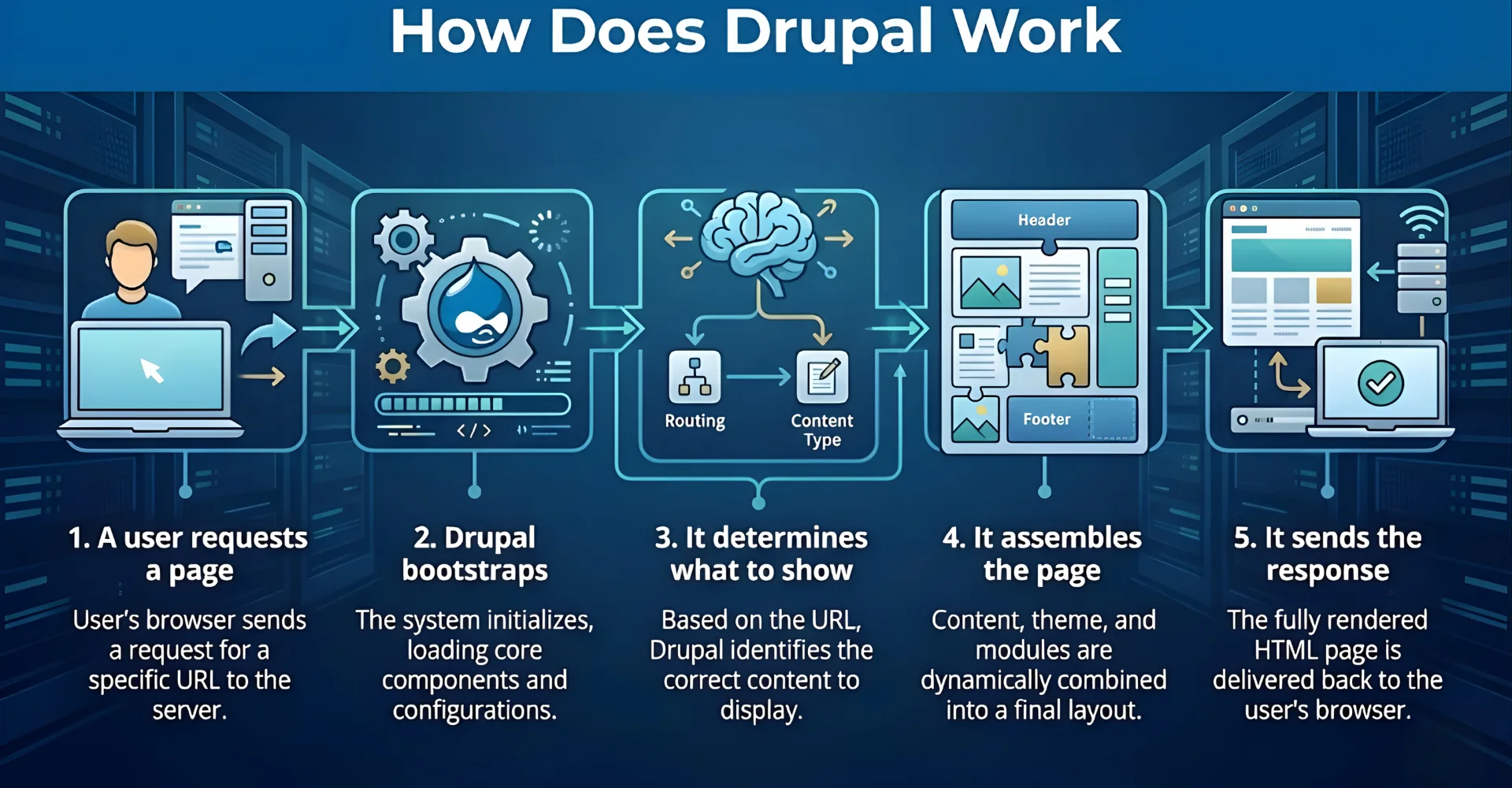
This process happens in milliseconds. The key components that make this happen are:
- Core: Provides user management, content types, menus, and security features.
- Modules: Add functionality like e-commerce, SEO tools, or analytics.
- Themes: Control how the website looks.
- APIs and Hooks: Let developers customize or extend behaviors without touching the core.
- Database Integration: Content and settings are stored in a database such as MySQL or PostgreSQL.
- Caching and Performance Tools: Ensure sites run fast even under heavy traffic.
When a user visits a Drupal website, the system routes the request, checks permissions, pulls the right content from the database, applies the theme, and delivers the final page to the browser.
So, Who Should Use Drupal?
Drupal is the right choice for your organization if you identify with one or more of the following profiles:
1. The Large Enterprise or Government Agency
Your operations are complex. You need a website that integrates seamlessly with legacy systems (like ERP or CRM), handles sensitive data with ironclad security, and can scale to serve millions of users without downtime. You require granular control over user permissions and content workflows across different departments.
2. The Content-Rich Publisher or Educational Institution
Content is your core product. You publish a high volume of articles, reports, or learning materials that need sophisticated organization, tagging, and multi-channel distribution. You need advanced workflow tools for editorial teams and a system that can grow with your expanding content library.
3. The Organization with Unique Business Logic
Your digital experience cannot be achieved with off-the-shelf templates and plugins. Your business model requires custom features, complex user interactions, or a unique architecture that demands a flexible framework to build upon. You need custom software development rather than a pre-packaged solution.
4. The Ambitious Growth-Focused Business
You are planning for the future. You need a platform that won’t limit your growth or require a costly platform migration in two years. You anticipate needing advanced features like personalization, multi-regional support, or a headless commerce setup and want a platform that can accommodate that evolution.
In short: Choose Drupal if your project requires scalability, complex integrations, enterprise-level security, and highly customized functionality. If your needs are simple, a basic blog or a small business brochure site, lighter platforms may suffice. But for mission-critical, ambitious digital projects, Drupal is the proven, powerful choice.
Pros and Cons of Drupal
Like any technology, Drupal has its strengths and weaknesses. Understanding these pros and cons of Drupal is key to deciding if it’s the right fit for your project.
Pros
- Unmatched Flexibility: You are not boxed in. Drupal can be molded to fit virtually any business requirement, making it perfect for custom software development.
- Top-Tier Security: Its robust security protocols and dedicated team make it one of the most secure CMS options available.
- Superior Scalability: It is proven to handle some of the web’s highest-traffic sites without breaking a sweat.
- Powerful Content Architecture: Its taxonomy and custom content type systems are second to none for organizing complex information.
- Strong Community & Cost-Efficiency: The free software and massive community support reduce costs and future-proof your investment.
Cons
- Steep Learning Curve: Drupal is more complex than simpler platforms. This can make it harder for beginners to grasp and requires more skilled developers.
- Higher Initial Development Cost: While the software is free, the expertise required for Drupal development often means a higher initial investment compared to setting up a simple WordPress or Squarespace site.
- Performance Can Require Tuning: A very complex Drupal site with many modules may require expert caching and performance optimization to keep it lightning-fast.
How to Get Started with Your Drupal Project?
Starting a Drupal project requires careful planning and the right partners to transform your vision into a successful digital reality. The process involves strategy, technical expertise, and continuous refinement.
1. Brainstorm & Strategy
Before a single line of code is written, you must define your project’s goals, target audience, key features, and budget. This phase is about answering the “why” and “what.” What problem are you solving? What do you want users to do on your site? Creating wireframes and a clear project plan at this stage is crucial for success and aligns with the first step of any MVP development solutions or software product journey.
2. Choosing the Right Drupal Development Team
This is the most critical decision you will make. The right team brings experience, technical mastery, and strategic insight. They will guide you, avoid common pitfalls, and build a quality product that saves you time and money in the long run.
Tips for Choosing:
- Look for a proven track record with case studies and client testimonials.
- Ensure they have certified Drupal developers.
- Choose a partner that asks deep questions about your business goals, not just your technical requirements.
- Consider offshore software development partners like Newwave Solutions for access to top-tier talent at competitive rates.
3. Design & Prototyping
With a strategy in place, designers create the look and feel of your website. This involves building prototypes and mockups that show how the site will function and flow. This stage ensures everyone is aligned before moving to the more costly development phase, a core part of our UI/UX design services.
4. Development & Testing
Here, developers bring the designs to life. They configure Drupal, build custom modules, integrate third-party services, and apply the theme. Simultaneously, rigorous QA testing services are performed to find and fix bugs, ensure compatibility across devices, and verify that all features work as intended.
5. Launch and Scale
After final testing and approval, your website is deployed to a live server. However, launch is not the end. It’s the beginning of a new phase involving monitoring performance, analyzing user behavior, planning for future enhancements, and providing ongoing software maintenance.
Why Newwave Solutions is Your Trusted Drupal Partner
At Newwave Solutions, we have more than 13 years of experience delivering IT outsourcing services for clients worldwide. Ranked among the Top 10 IT outsourcing companies in Vietnam, we provide trusted Drupal web development as well as offshore development services. Our clients span across industries, from education to e-commerce and government projects.
Our team of certified Drupal experts provides end-to-end services:
- Strategic consulting and Software Development planning.
- Custom Drupal development and module creation.
- UI/UX Design Solutions that are both beautiful and functional.
- Software Maintenance services to keep your site secure and up-to-date.
- Offshore Software development models that offer exceptional quality and value.
If you’re ready to start your journey with Drupal and need a reliable partner, let’s build it together with Newwave Solutions.
To Quang Duy is the CEO of Newwave Solutions, a leading Vietnamese software company. He is recognized as a standout technology consultant. Connect with him on LinkedIn and Twitter.



Read More Guides
Get stories in your inbox twice a month.
Let’s Build Something Extraordinary
Sign up for a 30 min no-obligation strategic session with us. Transform your Ideas into scalable reality.
Leave a Reply