


What is Vue.js? Your Path to Effortless Web Application Development

In the pursuit of frameworks that balance robust functionality with developer accessibility, the JavaScript ecosystem offers a compelling alternative for building modern user interfaces. Vue.js emerges as a progressive framework, distinguished by its approachable learning curve and flexible architecture that adapts to project needs. For businesses seeking efficiency without sacrificing capability, the key question is: What is Vue.js? This simple guide will walk you through the basics & advanced insights of this framework.
What is Vue.js?
Vue.js is a progressive JavaScript framework designed for building user interfaces and single-page applications. Unlike monolithic frameworks that force you into specific architectural patterns, Vue.js adopts an incrementally adoptable ecosystem that scales between a library and a full-featured framework depending on your needs.
Vue.js emerged in 2014 when Evan You, a former Google engineer, set out to combine the best aspects of Angular and React while eliminating their pain points. What started as a personal project quickly gained traction among developers frustrated with the complexity of existing solutions. By 2016, Vue.js had secured its position as the third pillar of modern frontend development, joining React and Angular in the holy trinity of JavaScript frameworks.
Vue.js operates on three fundamental principles that make it exceptionally powerful yet approachable:
- Reactive Data Binding: Vue.js automatically tracks dependencies and updates the DOM when data changes. This reactivity system eliminates manual DOM manipulation, reducing bugs and development time significantly.
- Component-Based Architecture: Every Vue.js application consists of reusable components that encapsulate HTML, CSS, and JavaScript logic. This modularity enables teams to build complex applications while maintaining code organization and reusability.
- Virtual DOM Implementation: Vue.js uses a virtual representation of the DOM to optimize updates. Instead of directly manipulating the browser’s DOM (which is expensive), Vue.js calculates the minimum changes needed and applies them efficiently.
The framework’s template syntax bridges the gap between HTML and JavaScript, making it intuitive for designers and developers alike. You can start by sprinkling Vue.js into existing projects or build entire applications from scratch – the choice is yours.
What are the Main Benefits of Vue.js?
Adopting a technology is an investment, and understanding its tangible returns is critical. Vue.js delivers a suite of benefits that directly impact development speed, application performance, and long-term maintainability, making it a compelling choice for projects of all sizes.
1. Enhanced Developer Experience
Vue.js excels at removing friction from the development process. Its intuitive template syntax means developers spend less time fighting the framework and more time solving business problems. The framework’s excellent developer tools, including Vue DevTools and comprehensive error messages, reduce debugging time by an average of 30%. When your team can identify and fix issues faster, project timelines become more predictable and budgets more manageable.
2. Minimal Learning Curve
Traditional frameworks often require months of training before developers become productive. Vue.js’s HTML-centric approach means developers with basic web development knowledge can contribute meaningfully within days. This accessibility doesn’t come at the cost of power – Vue.js scales seamlessly from simple interactions to complex enterprise applications. For organizations managing talent acquisition costs and tight project deadlines, this learning advantage translates into immediate ROI.
3. Progressive Integration
One of Vue.js’s most strategic advantages is its progressive nature. You can integrate Vue.js into existing applications incrementally, testing its effectiveness without massive rewrites. This approach allows organizations to modernize legacy systems gradually, reducing the risk of costly failures while maintaining business continuity. Companies like Adobe and BMW have successfully used this strategy to transform their web properties without disrupting operations.
4. Mature Ecosystem
Vue.js benefits from a carefully curated ecosystem that prioritizes quality over quantity. The official libraries for routing (Vue Router), state management (Pinia), and build tooling (Vite) are maintained by the core team, ensuring consistency and reliability. This coherent ecosystem reduces the decision fatigue that plagues React projects and the vendor lock-in concerns associated with Angular.
When you choose Vue.js, you’re not just selecting a technical tool – you’re investing in a development philosophy that prioritizes developer happiness and business outcomes. Teams using Vue.js consistently report higher job satisfaction and lower turnover rates, factors that significantly impact long-term project success and organizational stability.
What are the Key Challenges of Vue.js?
No technology is a silver bullet, and a balanced evaluation requires acknowledging its potential drawbacks. For Vue.js, these challenges are often related to its ecosystem and market position rather than the core technology itself.
1. Limited Third-Party Libraries
While Vue.js’s curated ecosystem is a strength, it can also be a limitation when you need highly specialized solutions. React’s massive ecosystem means there’s likely a library for any conceivable requirement, while Vue.js developers might need to build custom solutions more frequently. This challenge particularly affects projects with unique requirements or those operating in niche domains.
You can mitigate this by budgeting additional time for custom development and building internal libraries that can be reused across projects. The Vue.js community is rapidly growing, and many React libraries can be adapted for Vue.js with minimal effort.
2. Smaller Talent Pool
Despite growing popularity, Vue.js hasn’t achieved the enterprise adoption levels of React or Angular. This reality can create challenges in recruiting senior developers with extensive Vue.js experience, particularly in competitive markets. The talent pool, while growing, remains smaller than alternatives.
Better is turning this challenge into an advantage by investing in Vue.js training for existing teams. Developers who master Vue.js often become more valuable assets, and the lower competition for Vue.js talent can result in better retention rates.
Need experienced Vue.js talent to accelerate your project? Hire Vue.js developers who can deliver results from day one and help you capitalize on the framework’s strategic advantages.
3. Continuously Updates
Vue.js 3 introduced significant changes, including the Composition API and improved TypeScript support. While these improvements enhance the framework’s capabilities, they require teams to continuously update their skills and potentially refactor existing code. Organizations must budget for ongoing training and technical debt management.
Successful Vue.js adoption requires establishing clear upgrade policies and dedicating time to team education. The Vue.js team provides excellent migration guides and maintains backward compatibility where possible, making transitions more manageable than with some alternatives.
What is Vue.js Used For?
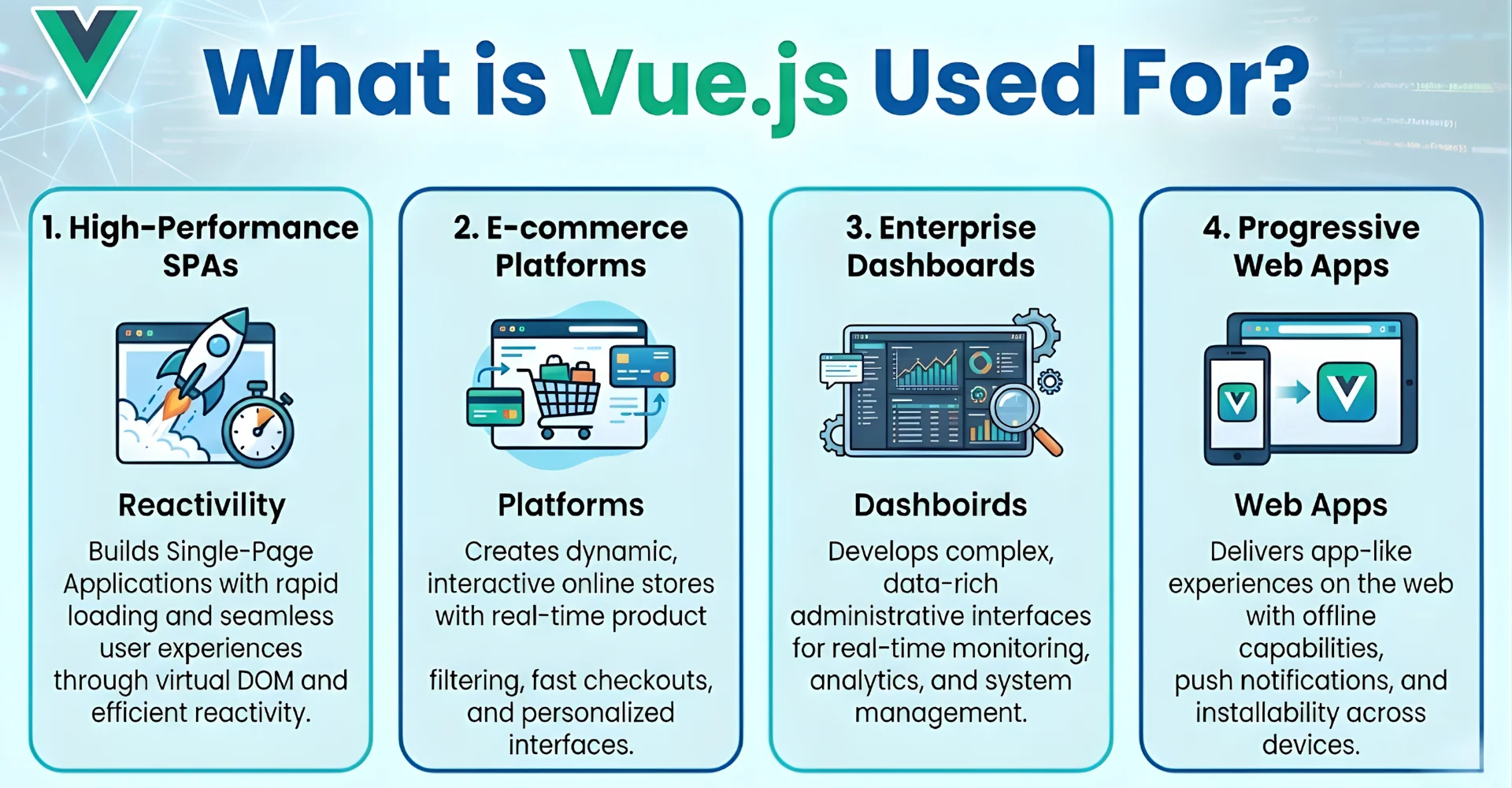
Vue’s versatility allows it to shine in a wide variety of real-world applications. Its progressive design means it can be the right tool for jobs ranging from a simple interactive widget to a massive enterprise platform.
1. High-Performance SPAs
Vue.js shines in building responsive, interactive single-page applications where user experience is paramount. Companies like Alibaba leverage Vue.js for their consumer-facing platforms because it delivers the smooth, app-like experiences that modern users expect. The framework’s efficient virtual DOM and reactive system ensure that complex interfaces remain responsive even with large datasets.
GitLab has adopted Vue.js across several parts of its frontend, including the Web IDE. The framework helps them organize code more efficiently and improve scalability, rather than relying solely on manual DOM handling.
2. E-commerce Platforms
The e-commerce sector’s need for rapid feature iteration and A/B testing makes Vue.js particularly valuable. Shopware, a leading e-commerce platform, rebuilt their admin interface using Vue.js, resulting in 50% faster load times and significantly improved developer productivity. The framework’s component-based architecture enables teams to modify specific features without affecting the entire application, crucial for continuous optimization in competitive markets.
Looking to build a high-converting e-commerce platform? Discover how our e-commerce development services can help you leverage Vue.js for faster, more engaging online stores.
3. Enterprise Dashboards
Vue.js excels at building data-heavy interfaces that require real-time updates and complex interactions. Some Adobe products, such as Adobe Portfolio, have been reported to use Vue.js for certain interface components. This adoption supports a more modern and intuitive content management experience, although detailed technical implementations are not publicly disclosed.
4. Progressive Web Apps
Organizations pursuing mobile-first strategies find Vue.js’s PWA capabilities particularly compelling. The framework’s small bundle size and efficient rendering make it ideal for applications that must perform well on mobile networks and lower-end devices. 9GAG’s mobile web experience, built with Vue.js, delivers native app-like performance while maintaining the accessibility and reach of web technologies.
Ready to create powerful web applications that work seamlessly across all devices? Explore our to see how Vue.js can transform your digital presence.
How does Vue.js compare to Other Frameworks?
Understanding how Vue.js works requires examining it against the competitive landscape. The frontend framework ecosystem is dominated by three major players, each with distinct philosophies and strengths.
|
Aspect |
Vue.js | React |
Angular |
| Learning Curve | Gentle, HTML-like syntax | Moderate, JSX required | Steep, TypeScript heavy |
| Performance | Excellent, optimized virtual DOM | Excellent, requires optimization | Good, heavy framework |
| Bundle Size | ~30KB minified | ~42KB + libraries | ~130KB+ full framework |
| Corporate Backing | Independent (Evan You) | Facebook/Meta | |
| Architecture | Progressive, flexible | Library-focused | Full framework, opinionated |
| Development Speed | Fast prototyping | Fast with experience | Slower initial setup |
| Enterprise Adoption | Growing rapidly | Widespread | Enterprise standard |
What makes Vue.js particularly compelling is its pragmatic approach to solving real business problems. While React demands architectural decisions upfront and Angular requires significant investment in TypeScript knowledge, Vue.js allows teams to evolve their approach organically. This flexibility translates directly into reduced project risk and faster time-to-market.
FAQs
How popular is Vue.js compared to other frameworks?
Vue.js is widely recognized as one of the top three front-end frameworks globally, with millions of weekly downloads on npm and over 200k GitHub stars as of 2025. While React maintains the largest market share and Angular dominates enterprise environments, Vue.js’s popularity has grown 300% since 2019, particularly among startups and mid-market companies seeking rapid development cycles.
How to get started with Vue.js as a beginner?
Getting started with Vue.js requires basic HTML, CSS, and JavaScript knowledge. Begin with the official Vue.js documentation and create simple interactive components before progressing to more complex applications. The Vue CLI tool streamlines project setup, while Vue DevTools provides essential debugging capabilities. Most hired Javascript developers can build meaningful applications within 2-3 weeks of focused learning.
When to use Vue.js over other frameworks?
Choose Vue.js when you need rapid prototyping capabilities, have teams with mixed skill levels, or require incremental adoption in existing projects. It’s particularly effective for projects that demand quick iterations, have tight deadlines, or involve collaboration between developers and designers. Avoid Vue.js for projects requiring extensive third-party integrations or operating in highly regulated environments where Angular’s enterprise features are essential.
Is Vue.js suitable for mobile development?
Vue.js excels at building progressive web applications that deliver native-like mobile experiences. While not a native mobile framework like React Native, Vue.js applications can be packaged as mobile apps using tools like Capacitor or Cordova. The framework’s small bundle size and efficient rendering make it particularly suitable for mobile-first strategies.
What’s the difference between Vue 2 and Vue 3?
Vue 3 introduces the Composition API, improved TypeScript support, and better performance through proxy-based reactivity. The new version offers enhanced tree-shaking capabilities, reducing bundle sizes, and includes breaking changes that require migration planning. Vue 2 remains supported, but Vue 3 is recommended for new projects.
Final Thoughts
After exploring what is Vue.js, we can acknowledge that this framework represents more than a technological choice – it embodies a philosophy that prioritizes developer experience and business outcomes in equal measure. Throughout this exploration, we’ve seen how Vue.js addresses the fundamental challenges facing modern development teams: the need for rapid delivery without sacrificing quality, the importance of maintainable code architecture, and the reality of working with diverse skill levels within development organizations.
Ready to explore how Vue.js can transform your development approach? At Newwave Solutions, we specialize in helping organizations navigate front-end technology decisions and implement Vue.js solutions that drive real business results.
Contact us today to discuss how Vue.js might fit into your technology roadmap.
To Quang Duy is the CEO of Newwave Solutions, a leading Vietnamese software company. He is recognized as a standout technology consultant. Connect with him on LinkedIn and Twitter.



Read More Guides




Get stories in your inbox twice a month.
Let’s Build Something Extraordinary
Sign up for a 30 min no-obligation strategic session with us. Transform your Ideas into scalable reality.
Leave a Reply