


What is Hibernate? A Guide to Efficient Data Persistence in Java

Behind many modern applications lies a persistent engineering challenge: the fundamental mismatch between object-oriented code and relational databases. This divide forces developers to write and maintain vast amounts of “glue” code—code that doesn’t implement business features but merely shuttles data back and forth. This translation layer is not just tedious; it’s error-prone and diverts focus from core application logic. This is the central problem that defines what is Hibernate and the need for it. In this guide, we will explore how this framework turns this complex, manual process into a managed and declarative standard.
What is Hibernate?
Hibernate is an open-source Object-Relational Mapping (ORM) framework for Java that simplifies database operations by bridging the gap between object-oriented programming and relational databases. At its core, Hibernate allows developers to work with database data as if it were regular Java objects, eliminating the need for complex SQL queries and manual data mapping.
The journey of Hibernate began in 2001 when Gavin King created this revolutionary framework to address the fundamental mismatch between object-oriented programming languages and relational database systems. Initially developed as an alternative to Enterprise JavaBeans (EJB), Hibernate quickly gained traction in the Java community and eventually became the foundation for the Java Persistence API (JPA) standard. Today, it stands as the most widely adopted ORM solution in the Java ecosystem.
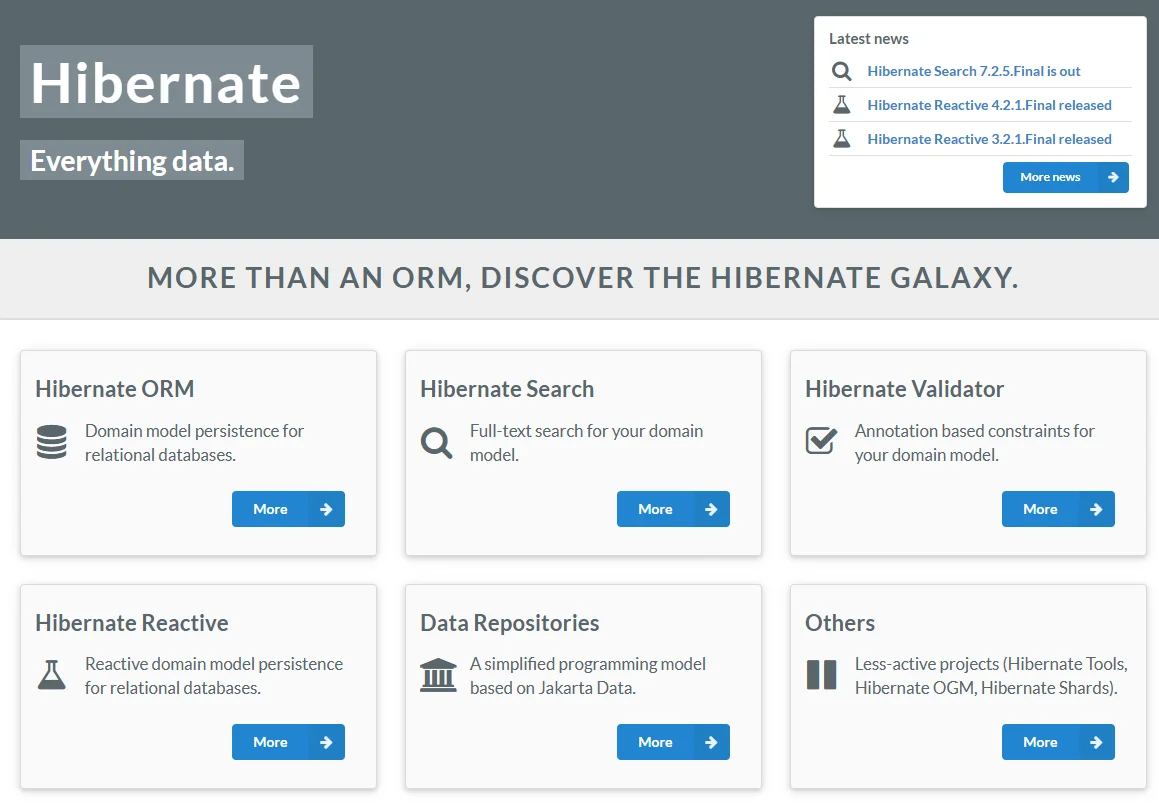
Hibernate operates on several fundamental principles that make database interaction seamless:
- Object-Relational Mapping (ORM): Hibernate automatically maps Java classes to database tables and Java data types to SQL data types. This mapping is configured through annotations or XML files, allowing developers to define relationships between objects and their corresponding database representations.
- Automatic Table Creation: The framework can automatically generate database schemas based on your Java entity classes, significantly reducing setup time and ensuring consistency between your object model and database structure.
- Transparent Persistence: Objects can be saved, updated, and deleted without writing explicit SQL statements. Hibernate handles the translation of object operations into appropriate database commands.
- Lazy Loading: Hibernate implements lazy loading strategies, meaning associated objects are loaded from the database only when they’re actually accessed, optimizing memory usage and improving application performance.
- Caching Mechanisms: The framework provides both first-level (session) and second-level (application-wide) caching to minimize database hits and enhance application speed.
- Transaction Management: Hibernate integrates seamlessly with various transaction management strategies, ensuring data consistency and integrity across complex operations.
- Database Independence: Applications built with Hibernate can switch between different database systems with minimal code changes, thanks to its database-agnostic approach and dialect system.
These interconnected capabilities represent more than just technical features – they embody a fundamental shift in enterprise development strategy. As cloud-native architectures and microservices patterns dominate modern software design, Hibernate has evolved from a simple ORM tool into a strategic enabler for digital transformation initiatives.
Start small with a Hibernate demo, or connect directly with one of our Java Developers to get a clearer vision for your project.
What are the Main Benefits of Hibernate?
Adopting Hibernate isn’t just about using a new tool; it’s about fundamentally improving your software development lifecycle. The benefits translate directly into tangible business outcomes, from reduced costs to faster time-to-market.
1. Reduced Development Time
The most immediate impact of Hibernate is a dramatic reduction in repetitive code. Without an ORM, developers can spend 30-40% of their time writing CRUD (Create, Read, Update, Delete) SQL statements. Hibernate eliminates this. In pure JDBC, this might require 50-100 lines of code across multiple methods. With Hibernate, the same operation reduces to a simple session.save(customer) call. This reduction isn’t just about line count – it represents hours saved per feature, allowing your development team to focus on business logic rather than infrastructure concerns.
2. Enhanced Application Maintainability
Hibernate’s object-oriented approach creates more maintainable codebases by establishing clear separation between business logic and data access concerns. When your application logic works with Java objects instead of raw SQL results, the code becomes more intuitive and easier to understand for developers at all levels.
The framework’s mapping configuration serves as living documentation of your database structure, making it easier for new team members to understand the application’s data model. Additionally, changes to database schemas can often be handled through mapping adjustments rather than extensive code rewrites, reducing the risk of introducing bugs during maintenance cycles.
3. Database Vendor Independence
One of Hibernate’s most strategic advantages is its database independence. The framework uses database dialects to handle vendor-specific SQL variations, meaning your application code remains unchanged when switching from MySQL to PostgreSQL, Oracle, or any other supported database system.
This independence provides significant business value by preventing vendor lock-in and enabling you to choose database solutions based on technical requirements, cost considerations, or performance characteristics rather than application compatibility constraints. For organizations planning multi-cloud strategies or considering database migrations, this flexibility represents substantial risk mitigation.
4. Superior Performance Optimization
Hibernate incorporates numerous performance optimization features that would be challenging and time-consuming to implement manually. The framework’s caching system operates at multiple levels, from session-based first-level caches that prevent redundant database queries within a single transaction to application-wide second-level caches that persist data across sessions.
Lazy loading strategies ensure that your application only retrieves data when necessary, while batch processing capabilities allow efficient handling of large datasets. The framework also supports connection pooling and provides detailed statistics for performance monitoring and tuning, giving you visibility into database interaction patterns that might otherwise remain hidden.
5. Streamlined Testing and Development
Hibernate’s abstraction layer simplifies unit testing by allowing developers to work with mock objects and in-memory databases during development phases. The framework’s session-per-conversation pattern enables predictable transaction boundaries, making it easier to reason about data consistency in complex business scenarios.
The comprehensive logging and debugging features provide detailed insights into generated SQL queries, helping developers optimize performance and troubleshoot issues more effectively than traditional database access methods.
What Challenges Does Hibernate Present?
Hibernate’s power is not free. It demands a deep comprehension of its lifecycle and query generation; otherwise, the framework designed to simplify your data layer can become your primary source of performance bottlenecks.
1. Learning Curve and Configuration Complexity
Hibernate’s extensive feature set comes with a steep learning curve that can initially slow development velocity. Developers must understand concepts like session management, transaction boundaries, caching strategies, and lazy loading patterns – knowledge that extends beyond basic Java programming skills.
Overcoming this challenge requires a commitment to training and the use of monitoring tools to inspect the generated SQL, ensuring developers are always aware of the database impact of their code.
2. Performance Overhead and Complexity
The abstraction layer that makes Hibernate powerful can also introduce performance overhead in certain scenarios. The framework generates SQL queries dynamically, and while these queries are generally efficient, they may not always match the performance of hand-tuned SQL statements written by experienced database developers.
This challenge manifests particularly in applications requiring complex reporting queries or high-volume data processing operations. The N+1 query problem, where Hibernate generates multiple queries for related object access, can significantly impact performance if not properly addressed through fetch strategies and query optimization techniques.
3. Difficulty in Debugging Generated SQL
When a query behaves unexpectedly, debugging can be more challenging than with explicit SQL. You are debugging your Java code and the Hibernate mapping, not the direct query that runs on the database. Figuring out why a particular object isn’t being fetched or updated can require tracing through Hibernate’s lifecycle and cache states. Mitigating this involves robust logging configuration to output all generated SQL to the console and using integrated development tools that can visualize the persistence context.
4. Challenges with Database-Specific Optimizations
If your application relies heavily on advanced, database-specific features like PostgreSQL’s JSONB columns or geospatial queries, Hibernate’s abstraction can become a hindrance. While support for these features is continually improving, it can lag behind and sometimes feel less natural than using the database’s native driver. The key here is to evaluate whether your use case is truly generic or relies on specific database strengths, and choose your persistence strategy accordingly.
What is Hibernate Used For?
Hibernate is not a niche tool; it’s the backbone of data persistence for a vast ecosystem of Java app development solutions, from bustling e-commerce platforms to critical financial systems. Its use cases are defined by scenarios where object-oriented modeling and relational data storage must coexist harmoniously.

1. Enterprise Business Systems
Many large organizations use Hibernate to manage complex business data in systems like ERP and CRM platforms. A typical implementation might involve a financial services company using Hibernate for its risk management systems, where complex financial instruments require mapping dozens of related entities. The framework’s annotation-based configuration can replace thousands of JDBC mapping lines with manageable entity definitions that business teams can validate.
Key implementation aspects often include:
- Complex transaction management using @Transactional annotations
- Regulatory compliance support through audit trails
- Second-level caching for performance optimization
- Rapid adaptation to changing business requirements
In such implementations, companies typically see significant improvements: transaction code can be reduced from hundreds of lines to just a few, database load decreases during peak operations, and regulatory adaptation time can be substantially reduced. The abstraction layer enables faster compliance with new requirements, helping transform potential business risks into competitive advantages.
Need to unify your customer data and streamline operations? Let’s architect your custom CRM solution with a robust Hibernate foundation.
2. Web Application Development
Many e-commerce and content platforms demonstrate Hibernate’s effectiveness at scale. A typical online retail platform might use Hibernate for managing user preferences, shopping cart relationships, and product metadata across millions of users. Such implementations require sophisticated caching strategies to ensure sub-second response times while maintaining consistency across user interactions.
Common technical approaches include:
- Intelligent lazy loading to optimize data transfer
- Redis or similar integration with Hibernate to reduce database queries
- Batch fetching to optimize complex data retrieval
- Scalable architecture supporting rapid feature development
These implementations typically support business growth from startup to enterprise scale, enabling features like personalized recommendations and complex inventory management without requiring fundamental architecture changes.
3. System Modernization Projects
Many media companies choose Hibernate for content management platform modernization, handling article metadata, multimedia assets, and editorial workflows. A typical challenge involves managing hierarchical content structures while maintaining version control and publishing workflows across large content archives.
Common implementation features include:
- Flexible inheritance mapping for multiple content types
- Automated version control and audit trails
- Memory usage optimization through lazy loading
- Support for rapid platform evolution
Such approaches typically increase editorial productivity through streamlined content creation tools. Platforms can successfully manage historical archives alongside current publications, supporting complex workflows while delivering content to readers efficiently.
4. Microservices Architecture
Many technology companies demonstrate Hibernate’s role in microservices environments, where the framework manages data persistence within individual service boundaries while supporting distributed system patterns. Each microservice typically maintains its own Hibernate configuration optimized for specific domain requirements.
Common architectural patterns include:
- Service-specific optimization for different business domains
- Consistent development patterns across services
- Domain event integration for service independence
- Standardized data access while preventing database complexity
This approach often enables companies to decompose monolithic applications into multiple microservices, increasing deployment frequency while maintaining system reliability. Different services can achieve better response times and accuracy while preserving developer productivity.
Across these diverse applications, successful Hibernate implementations share common characteristics. Organizations that achieve the best results typically match Hibernate features to specific business needs rather than applying the framework generically. They invest in team training to ensure a deep understanding of the framework’s capabilities and limitations.
FAQs
What is Hibernation definition in software terms?
In the software development context, hibernation refers to the process of persisting object state to a permanent storage medium (typically a database) and later restoring that state when needed. Unlike the biological concept of hibernation, software hibernation maintains data integrity and relationships across application restarts. Hibernate framework implements this concept by automatically mapping object properties to database columns and managing the complete lifecycle of data persistence operations.
Is Hibernate suitable for small projects?
Hibernate can benefit small projects by accelerating initial development and providing room for future growth. However, the framework’s complexity might be overkill for simple applications with minimal data requirements. Small projects with straightforward database interactions might achieve better results with simpler solutions like Spring JDBC Template or MyBatis. The decision should consider team expertise, project timeline, and anticipated future complexity rather than just current requirements.
What databases work with Hibernate?
Hibernate supports virtually all major relational databases through its dialect system, including MySQL, PostgreSQL, Oracle, SQL Server, DB2, H2, and many others. The framework automatically generates database-specific SQL based on the configured dialect, ensuring optimal performance and compatibility. This database independence means applications can switch between different database vendors with minimal code changes, providing significant strategic flexibility for deployment and scaling decisions.
How does Hibernate manage dirty checking?
Hibernate automatically tracks the state of persistent objects within a Session. At flush time, it compares the current state of the objects with their state when they were first loaded (the “snapshot”). If any differences are detected, Hibernate automatically generates and executes the necessary SQL UPDATE statements. This is a core feature that eliminates manual update queries.
Does Hibernate completely replace the need to know SQL?
Absolutely not. In fact, not knowing SQL is a major disadvantage when using Hibernate. A strong SQL knowledge is critical for understanding and tuning the queries that Hibernate generates, especially for diagnosing performance issues.
Understanding what is Hibernate goes far beyond a technical definition. It’s about recognizing a strategic solution to a universal problem in software engineering. It represents a trade-off: you accept the responsibility of learning a complex framework to gain massive improvements in developer productivity, application maintainability, and architectural flexibility. For the vast majority of enterprise Java web development services, this is a trade-off worth making. The key to success lies not in avoiding the framework, but in investing in the expertise to wield it effectively.
Are you grappling with how to implement a robust and efficient data layer for your next project? Would you like to leverage the expertise of a team that deeply understands these trade-offs?
Contact Newwave Solutions today, and our developers will help you build a high-performance, maintainable application that stands the test of time.
To Quang Duy is the CEO of Newwave Solutions, a leading Vietnamese software company. He is recognized as a standout technology consultant. Connect with him on LinkedIn and Twitter.



Read More Guides

Get stories in your inbox twice a month.
Let’s Build Something Extraordinary
Sign up for a 30 min no-obligation strategic session with us. Transform your Ideas into scalable reality.
Leave a Reply