


Single Cloud vs Multi Cloud Architecture: A Strategic Decision Guide
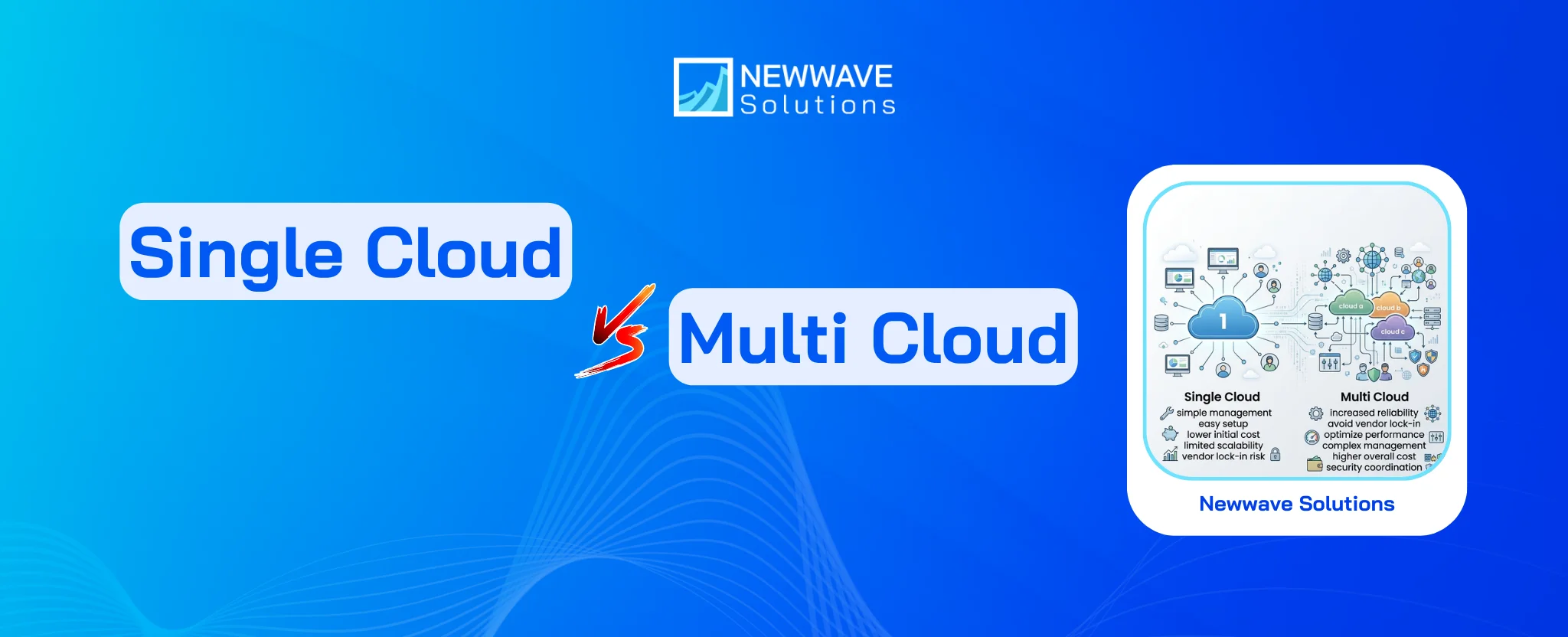
Cloud computing has become the backbone of modern digital infrastructure, enabling enterprises to scale, innovate, and operate with unprecedented flexibility. However, the debate around single cloud vs multi cloud continues to shape executive-level technology decisions, particularly in areas such as cost optimization, risk mitigation, and operational complexity. This blog explores both architectural models in depth, helping your organization determine which approach best aligns with your long-term infrastructure and business strategy.
What Is a Single Cloud Architecture?
A single cloud architecture refers to an infrastructure strategy where an organization relies on one cloud provider—such as AWS, Microsoft Azure, or Google Cloud—to host and manage all applications, workloads, and services. In this model, compute, storage, networking, security, and DevOps pipelines are centralized within a single ecosystem, enabling streamlined governance and operational simplicity. Enterprises often adopt this approach to maintain tighter integration, consistent policy enforcement, and simplified vendor management.
Example: Netflix primarily operates on Amazon Web Services (AWS) as its single cloud provider for streaming infrastructure. By consolidating its infrastructure within AWS, Netflix achieved global scalability, high availability, and consistent performance delivery across millions of users worldwide, while simplifying vendor coordination and cloud governance.
Pros & Cons
Pros
- Simplified vendor management and contractual governance
- Unified billing structure and clearer cost visibility
- Easier integration within a single ecosystem
- Streamlined identity and access management
- Lower operational complexity for DevOps teams
- Faster deployment cycles within one standardized environment
- Centralized security policy enforcement
- Reduced need for cross-platform integration tools
Cons
- Increased vendor lock-in risk
- Higher exposure to single-provider outages
- Limited negotiation leverage over long-term pricing
- Reduced flexibility in selecting best-of-breed services
What Is a Multi Cloud Architecture?
A multi cloud architecture involves using two or more cloud providers to host applications, distribute workloads, or manage different operational domains. In this model, organizations strategically allocate services across platforms to improve redundancy, avoid vendor dependency, or leverage specialized capabilities from different providers. Enterprises typically adopt multi cloud to enhance resilience, increase negotiation flexibility, and support geographically diverse or regulatory-sensitive operations.
Example: Spotify leverages Google Cloud for data analytics and machine learning while maintaining additional infrastructure components across other platforms to optimize workload performance and regional distribution. This approach allows Spotify to benefit from provider-specific strengths while maintaining operational redundancy and global service reliability.
Pros & Cons
Pros
- Reduced dependency on a single vendor
- Improved resilience through distributed infrastructure
- Enhanced disaster recovery capabilities
- Greater flexibility in selecting specialized services
- Stronger negotiation leverage with providers
- Support for regional compliance and data sovereignty requirements
- Optimized workload placement based on performance needs
- Strategic risk diversification
Cons
- Increased architectural complexity
- Higher operational overhead and monitoring requirements
- Fragmented billing and cost tracking
- Greater demand for advanced DevOps and governance expertise
Single Cloud vs Multi Cloud: Core Differences
After understanding the foundational principles and primary advantages and disadvantages of each model, it becomes essential to examine the structural differences between them. By analyzing these distinctions in detail, your organization can better evaluate which approach aligns with its hosting, storage, scalability, and security strategy. The following comparison provides a strategic lens for decision-makers assessing long-term cloud infrastructure direction.
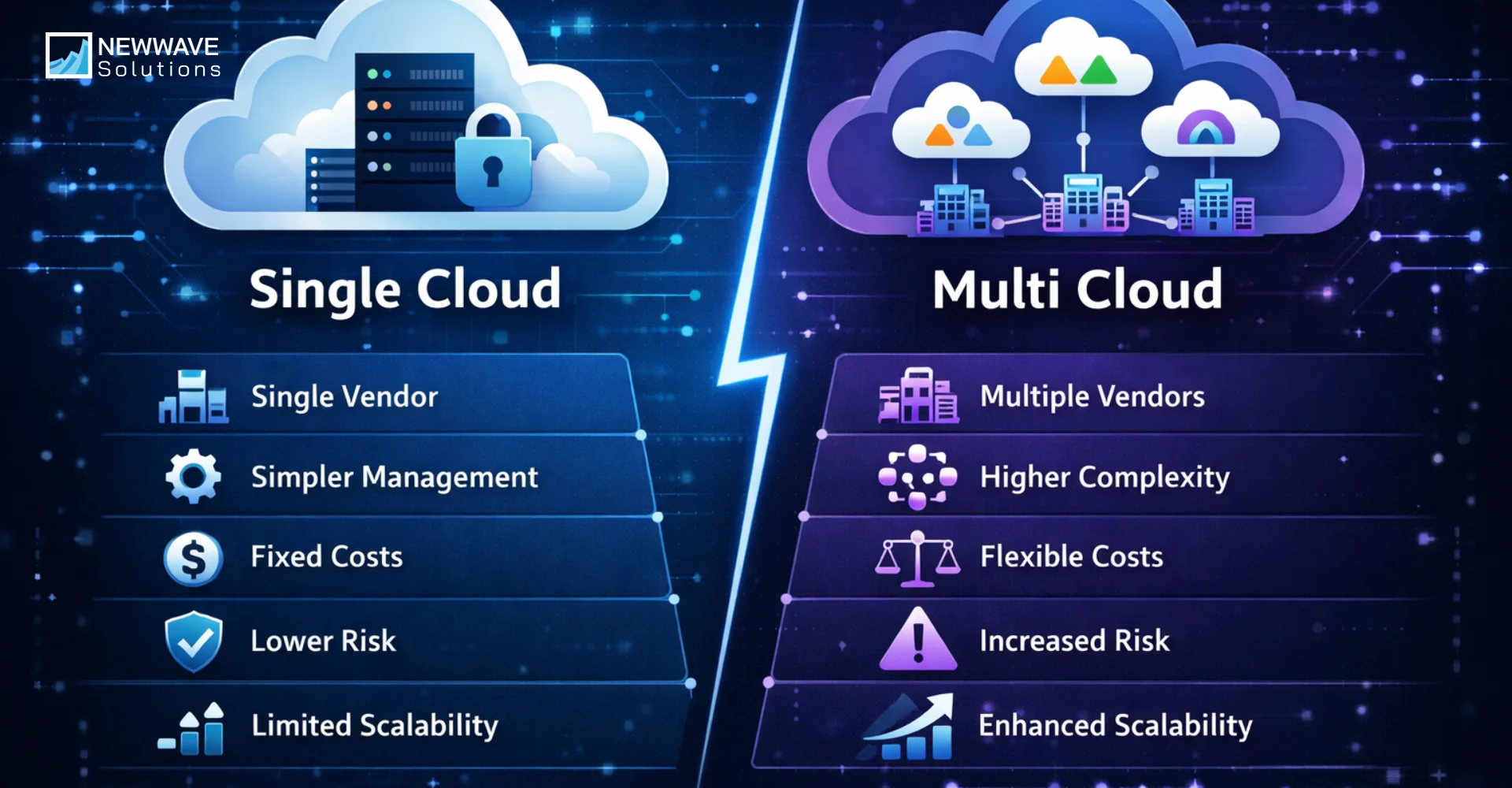
| Criteria | Single Cloud |
Multi Cloud |
| Vendor Strategy | One primary cloud provider | Multiple cloud providers |
| Complexity | Lower architectural complexity | Higher integration complexity |
| Cost Structure | Unified billing and predictable pricing | Distributed billing, complex cost tracking |
| Risk Exposure | Vendor dependency risk | Diversified provider risk |
| Scalability | Scales within one ecosystem | Cross-provider scaling flexibility |
| Operational Overhead | Simplified governance | Advanced orchestration required |
Vendor Strategy
A single cloud model relies entirely on one provider, which simplifies vendor governance and contract management but increases dependency on that vendor’s pricing structure and roadmap. This approach strengthens ecosystem integration but limits bargaining leverage.
In contrast, a multi cloud strategy distributes workloads across multiple providers, reducing vendor lock-in and improving negotiation flexibility. However, it introduces contractual and coordination complexity across platforms.
Verdict: Multi cloud offers better vendor risk diversification, while single cloud remains optimal for organizations prioritizing simplicity and centralized governance.
Complexity
Single cloud environments are inherently less complex because infrastructure, security policies, and DevOps pipelines operate within a unified platform. This reduces integration challenges and lowers the barrier for internal IT teams.
Multi cloud architectures demand advanced orchestration, cross-platform monitoring, and interoperability management. Organizations must invest in stronger DevOps maturity and governance frameworks.
Verdict: Single cloud is preferable for operational simplicity, whereas multi cloud requires higher technical maturity to manage complexity effectively.
Cost Structure
Single cloud typically offers predictable billing models, consolidated invoicing, and volume-based pricing benefits within one ecosystem. Cost visibility and forecasting are generally easier to manage.
Multi cloud introduces fragmented billing across providers and potential hidden integration costs. While it may offer competitive pricing leverage, financial governance becomes more complex.
Verdict: Single cloud provides clearer short-term cost control, while multi cloud may offer long-term pricing leverage for large enterprises.
Risk Exposure
Relying on one cloud provider increases exposure to service outages or ecosystem disruptions. A major incident at the provider level can impact all hosted workloads.
Multi cloud reduces single-point-of-failure risks by distributing infrastructure across providers. This improves disaster recovery options and operational resilience.
Verdict: Multi cloud delivers stronger resilience and risk diversification for mission-critical systems.
Scalability
Single cloud supports vertical and horizontal scaling within one ecosystem, often with seamless internal service integration. However, scaling remains limited to that provider’s regional footprint and capabilities.
Multi cloud enables workload distribution based on regional availability, performance optimization, or regulatory requirements across providers.
Verdict: Multi cloud provides broader scalability flexibility, particularly for global enterprises.
Operational Overhead
Single cloud environments simplify governance, monitoring, compliance, and access management. Teams operate within a standardized toolchain.
Multi cloud environments require unified monitoring platforms, centralized logging solutions, and more sophisticated governance policies.
Verdict: Single cloud reduces operational overhead, while multi cloud demands greater operational discipline and automation maturity.
Understanding the architectural gap between these two approaches becomes a lot clearer when you zoom out to how modern applications are actually built around them. For a deeper look at what that means in practice, Cloud Native Applications: A Complete Guide for Modern Enterprises covers the foundational concepts that make this decision matter at scale.
Single Cloud vs Multi Cloud: Which is Better?
There is no universally superior model; the better option depends on organizational maturity, workload distribution, compliance requirements, and long-term growth strategy. Single cloud delivers operational simplicity, predictable costs, and easier governance, while multi cloud provides risk diversification, scalability flexibility, and strategic vendor independence.
In recent years, enterprise trends indicate a gradual shift toward multi cloud adoption, particularly among large corporations seeking resilience, compliance flexibility, and negotiation leverage. However, many organizations begin with single cloud and evolve toward multi cloud as infrastructure complexity and global expansion increase.
Ultimately, determining which approach is better requires evaluating specific business criteria and operational capabilities. Continue reading to explore concrete scenarios that clarify which cloud model aligns best with your enterprise objectives.
When Should Enterprises Choose Single Cloud vs Multi Cloud?
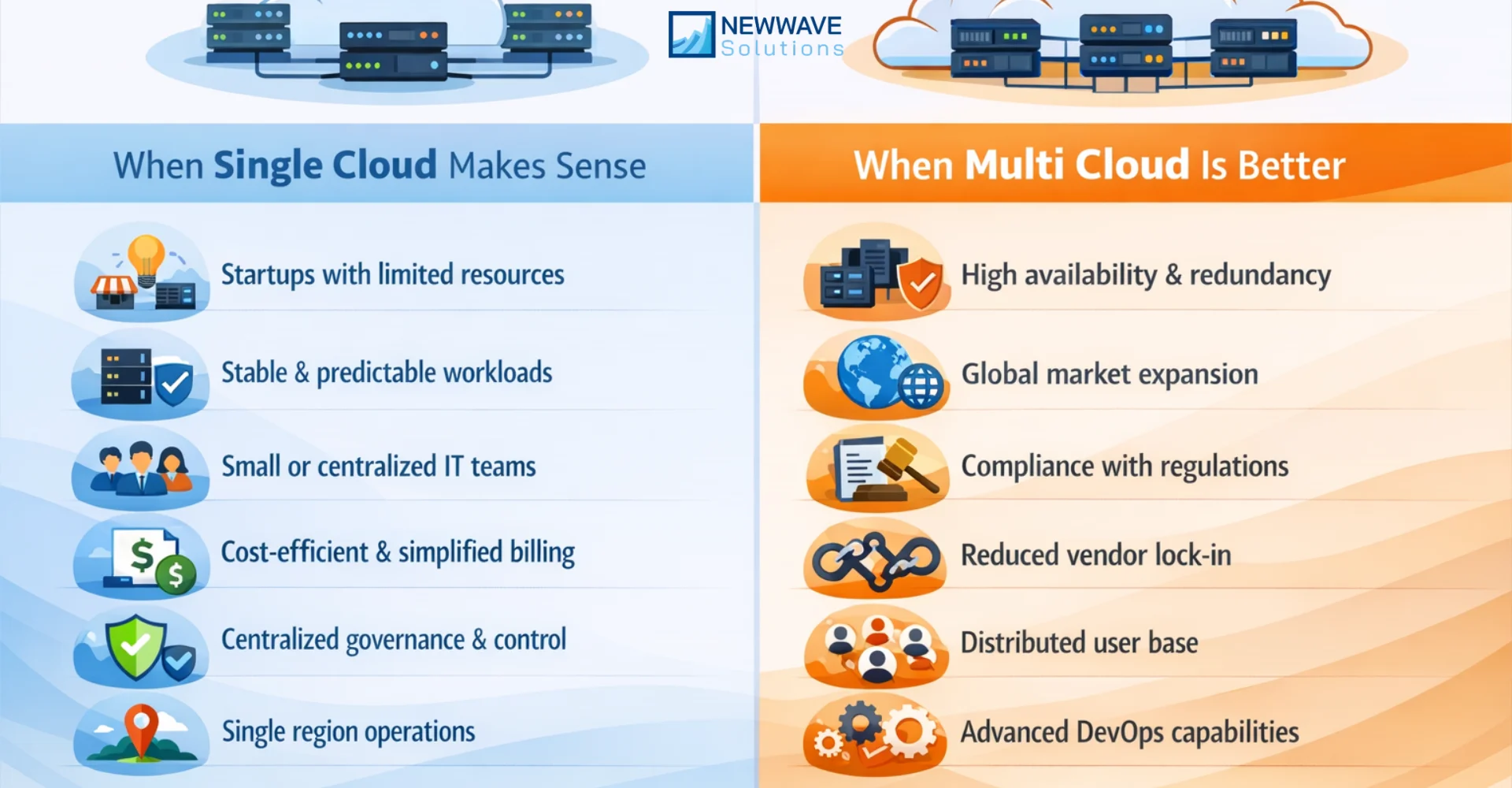
When Single Cloud Makes Strategic Sense
- Early-stage startups with limited cloud architecture maturity
- Organizations with predictable and stable workload patterns
- Enterprises with small or resource-constrained IT teams
- Cost-sensitive environments requiring simplified billing
- Businesses prioritizing centralized governance and compliance control
- Companies operating within a single geographic region
- Projects requiring rapid deployment within a unified ecosystem
When Multi Cloud Is the Better Strategy
- Enterprises requiring high availability and redundancy
- Organizations expanding into multiple global markets
- Industries subject to diverse regulatory frameworks
- Companies aiming to reduce vendor dependency risk
- Large-scale platforms with distributed user bases
- Enterprises with mature DevOps and automation capabilities
- Workloads requiring specialized services across providers
The right architecture often comes down to where your organization is in its cloud journey — and how fast that’s likely to change. If you’re currently evaluating broader infrastructure shifts, our breakdown of Top 5 Cloud Migration Trends Shaping Modern IT is worth a read before locking in a direction.
Why Multi Cloud Matters in Offshore Software Development?
As enterprises increasingly rely on offshore software development to accelerate delivery and reduce operational costs, infrastructure strategy becomes a critical success factor. Multi cloud architecture directly impacts how offshore teams manage deployment, scalability, compliance, and service continuity across global markets. For organizations leveraging offshore software development services, adopting a multi cloud model can unlock tangible advantages in resilience, cost efficiency, and execution capability.
Risk Management and High Availability
Multi cloud architecture reduces dependency on a single cloud provider, which helps enterprises avoid vendor lock-in and maintain stronger negotiation leverage over long-term contracts. For offshore software development projects, this flexibility ensures that infrastructure decisions remain aligned with evolving business needs rather than being constrained by one ecosystem.
In addition, multi cloud improves operational resilience by distributing workloads across multiple regions or providers. If one provider or geographic zone experiences downtime, systems remain functional, allowing offshore teams to maintain development timelines, testing schedules, and deployment cycles without disruption.
Cost Optimization and Resource Allocation
Offshore teams can strategically allocate workloads across different cloud providers to take advantage of pricing advantages and service specialization. For example, an organization may use AWS for scalable compute resources while leveraging Google Cloud for AI-driven analytics, optimizing both performance and cost efficiency.
By selecting the most cost-effective services from different providers, offshore teams can design architectures that reduce total infrastructure expenses for clients. This approach is particularly valuable in long-term product development engagements where operational expenditure directly impacts return on investment.
Regulatory Compliance and Global Execution Capability
When offshore development supports clients operating in regions such as the European Union or the United States, data residency and regulatory compliance become essential considerations. Multi cloud architecture enables data to be stored and processed within specific geographic jurisdictions, helping organizations comply with frameworks such as GDPR and other local data protection regulations.
Moreover, the ability to design and operate multi cloud infrastructure demonstrates a higher level of DevOps maturity within the offshore partner. This capability signals technical expertise, global scalability readiness, and the ability to support enterprise-grade systems that require distributed deployment across multiple regions.
In the context of offshore software development, multi cloud is not just an architectural choice but a strategic approach to enhance resilience, compliance, and cost efficiency. Enterprises aiming to scale globally while reducing infrastructure risks should collaborate with experienced offshore software development services such as Newwave Solutions to design and manage flexible, high-performing multi cloud environments.
Conclusion
The debate around single cloud vs multi cloud ultimately centers on balancing operational simplicity with strategic flexibility. While single cloud offers streamlined governance and predictable cost management, multi cloud provides stronger resilience, vendor independence, and global scalability for enterprises with evolving infrastructure needs.
For organizations leveraging offshore software development services, adopting a well-designed multi cloud strategy can significantly improve risk control, cost efficiency, and long-term performance stability.
To Quang Duy is the CEO of Newwave Solutions, a leading Vietnamese software company. He is recognized as a standout technology consultant. Connect with him on LinkedIn and Twitter.



Read More Guides
Get stories in your inbox twice a month.
Let’s Build Something Extraordinary
Sign up for a 30 min no-obligation strategic session with us. Transform your Ideas into scalable reality.
Leave a Reply