


Top 20+ Best Argumentative Reality Apps: Top list to the World’s Leading AR Experiences

Augmented reality app is no longer a futuristic concept. It has become one of the most practical, versatile, and influential technologies shaping how people shop, learn, play, communicate, and interact with the world. This guide provides a comprehensive look at the top 20+ best argumentative reality apps with various industries in the world today. It will help you understand what makes each app successful, how AR contributes to user impact, and why these experiences set the standard for the next generation of immersive digital products.
What is an argumentative reality (AR) app?
An Argumentative Reality app (AR App) is an type of app that blends digital content with the physical world by overlaying 3D models, animations, labels, instructions or interactive elements through a smartphone or tablet camera, which is called AR Development Technologies. Unlike Virtual Reality (VR), which transports users into a fully digital environment, an argumented reality app enhances real surroundings. It uses computer vision, spatial mapping, depth sensing and object recognition to anchor digital objects convincingly into physical space.
An AR app can visualize furniture in your living room, scan a room into a 3D model, overlay product information onto real items, or convert your bedroom into a game arena. These capabilities make AR valuable for sectors like retail, education, real estate, manufacturing, gaming and healthcare. Companies adopting AR typically combine it with broader applications such as eCommerce development, Game development, and real estate software development, depending on their market.
AR also plays an increasingly important role in improving learning experiences and product training. Education-focused businesses often integrate AR into educational software development solutions, creating interactive lessons, simulations and visual explanations that students can explore from different angles. These multi-modal experiences improve comprehension and engagement far better than traditional media.
So how AR enhances user experience?
- Reduce decision-making uncertainty with virtual try-ons, object visualization and real-time overlays
- Increase user engagement through interactive, playful, personalized content
- Improve accessibility with camera-based tools like real-time translation or digital measuring
- Support learning by transforming abstract concepts into 3D, interactive experiences
- Enable creative expression with AR drawing, stickers and immersive storytelling
- Strengthen brand connection through memorable, immersive digital interactions
Today’s leading AR experiences deliver far more than visual novelty. They offer real utility—helping users preview purchases, visualize environments, learn complex concepts, express creativity, or complete tasks more efficiently. Modern companies increasingly incorporate AR into broader transformation strategies through AR development, VR development, and multi-channel product ecosystems. For startups, AR prototypes often form part of early MVP development to validate demand quickly. Established enterprises integrate AR into their long-term Software development life cycle plans as a core capability rather than an experimental add-on.
Top 20+ Best AR Apps in the World
Retail & E-commerce
1. IKEA Place
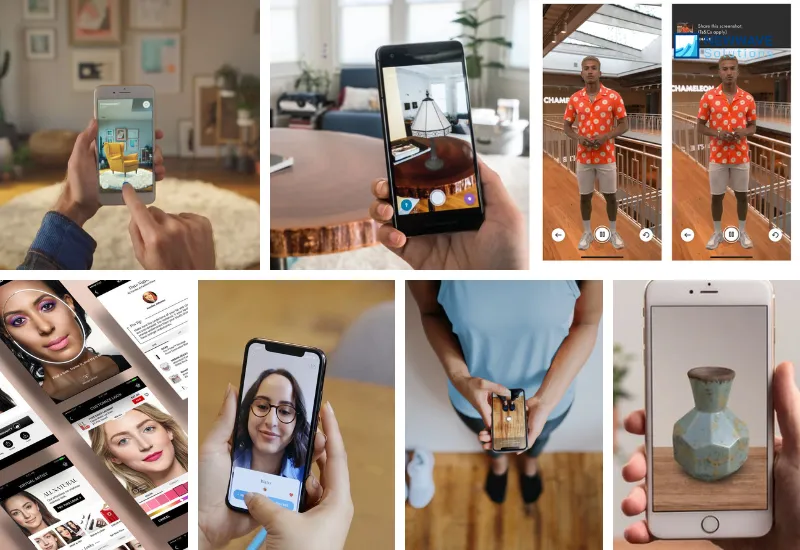
IKEA Place allows users to preview true-to-scale IKEA furniture in their actual homes by using spatial detection to anchor objects to floors and surfaces. The app recognizes room layout, lighting, dimensions and elevation, enabling accurate visualization of how furniture fits within a space. This makes it easier for users to understand product proportions, color coordination and suitability before purchasing. The AR experience replicates in-store evaluation but in the user’s real environment, increasing decision confidence. This combination of real-time visualization and product catalog integration drives higher user engagement. Over time, IKEA Place has become a standard reference for retailers exploring AR development strategies.
Impact: Reduced product returns, increased conversion rates, and stronger digital-first customer behavior.
2. Wayfair
Wayfair’s AR capabilities help customers visualize furniture and décor within their own homes by placing multiple items simultaneously in a single scene. The app supports environmental scanning, enabling users to walk around furniture with realistic perspective and depth. Wayfair’s AR engine maintains object stability even as users move through the space. This creates a showroom-like experience inside the user’s home. AR also helps users test color themes, match styles and measure proportions. This immersive planning experience has reshaped Wayfair’s digital sales model and influenced industry-wide adoption across eCommerce development services.
Impact: Larger cart sizes, improved user satisfaction, and lower product uncertainty.
3. ASOS AR App
The ASOS AR feature allows customers to preview clothing on virtual models that match their body type, height and measurements. Users can see how outfits drape, how fabric behaves and how different styles combine before buying. The AR engine applies dynamic body tracking and 3D animation to simulate realistic movement. For users uncertain about online fashion purchases, this is a major confidence boost. ASOS tested AR in early MVP development and used real customer feedback to refine the experience, demonstrating how AR can reduce friction in highly subjective markets like clothing.
Impact: Reduced return rates, higher conversion for new styles, and improved online try-on accuracy.
4. Sephora Virtual Artist
Sephora Virtual Artist uses facial mapping to apply thousands of makeup combinations onto the user’s face in real time. The app detects facial features—including lips, eyes, skin shade and contours—with high accuracy, enabling precise placement of virtual cosmetics. Users can compare shades, mix styles, and switch between looks instantly. By simulating lighting, texture and color realism, Sephora bridges the in-store “try-before-you-buy” experience with online shopping. This AR solution has set a new standard for digital beauty product evaluation.
Impact: Higher product discovery, increased customer satisfaction, and reduced mismatch-related returns.
5. Warby Parker
Warby Parker’s AR try-on tool allows users to virtually try glasses using realistic frame proportions and accurate head tracking. By layering 3D eyewear models onto the user’s face, the app helps them evaluate size, fit, shape and style more precisely. The depth detection and facial geometry scanning ensure frames remain aligned naturally as the user moves. This eliminates the need for in-store visits for initial selection and significantly accelerates the decision-making process.
Impact: Higher online sales, improved style confidence, and reduced try-on overhead for customers.
6. Nike Fit / Nike AR
Nike Fit uses AR-powered foot scanning to capture precise measurements of each user’s feet. Using depth data and advanced computer vision, the app recommends exact sizes for specific Nike models. This level of accuracy keeps sizing consistent even when models differ in fit or shape. Customers can also store their scanned measurements across devices and products. As footwear sizing can be inconsistent, Nike Fit enhances reliability and strengthens customer trust. Its scanning technology is frequently referenced in enterprise-focused Software development life cycle case studies.
Impact: Fewer sizing complaints, higher conversion for footwear, and better mobile shopping adoption.
7. Shopify AR
Shopify AR extends AR capabilities to thousands of online merchants by enabling them to embed 3D product models directly into product pages. Customers can view products in their environment instantly without needing to download a separate app. Shopify’s integration simplifies 3D asset management, making AR accessible even to small businesses. This democratizes AR adoption and ensures that retailers of all sizes can offer immersive shopping experiences.
Impact: Higher conversion rates for high-consideration products and faster customer decision-making.
Gaming & Entertainment
8. Pokémon GO
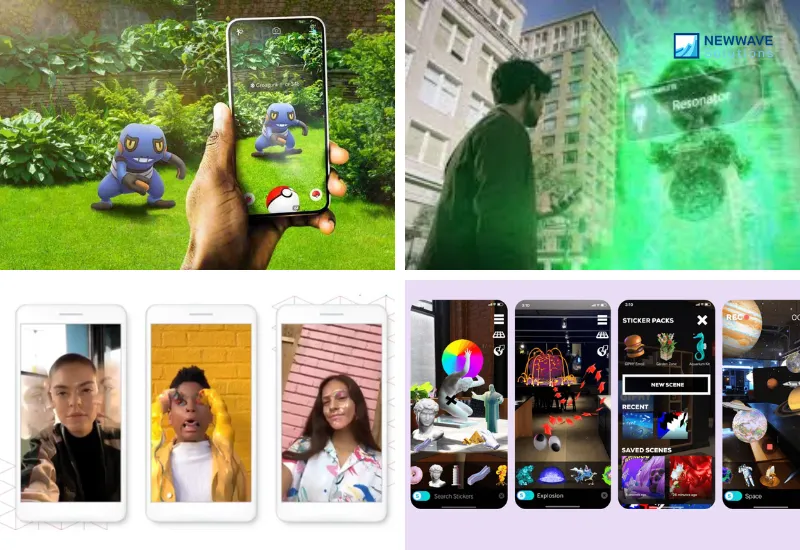
Pokémon GO overlays Pokémon characters and interactive game elements onto streets, parks and buildings using geolocation and AR. The app encourages players to explore real-world locations to capture characters, join battles, or participate in events. AR creates a sense of discovery, making gameplay more immersive and emotionally rewarding. Thanks to its dynamic spatial placement and camera-based interactions, players feel connected to virtual creatures in a real-world context. Pokémon GO has influenced countless other titles and set a global benchmark in Game development services.
Impact: Unprecedented community engagement, increased physical activity, and long-term player retention.
9. Ingress Prime
Ingress Prime uses AR to turn real-world landmarks into portals that players capture, defend and link. The app blends narrative storytelling with real-world exploration, encouraging users to interact with their environment in new ways. AR highlights these portals with animations and effects, making digital elements feel embedded within real locations. Its strategic gameplay promotes teamwork, planning and territorial control.
Impact: Strong player communities, deeper immersion, and longevity through real-world integration.
10. Instagram & Snapchat AR Filters
Social platforms like Instagram and Snapchat use AR filters to add virtual effects—such as makeup, 3D masks, animations or objects—onto users’ faces and surroundings. These filters use facial tracking, expression detection and environmental sensing to produce accurate overlays. AR filters transform everyday selfies into creative expressions shared across platforms. For brands, sponsored AR lenses generate massive visibility and user interaction.
Impact: Increased content creation, longer session times, and new interactive advertising opportunities.
11. GIPHY World
GIPHY World enables users to place animated GIFs and stickers in real-world space and record scenes with these elements attached. AR anchors floating GIFs onto surfaces, giving creators the ability to design playful micro-scenes. This transforms static GIF culture into immersive experiences. By blending digital humor with real environments, GIPHY World encourages creativity and sharing.
Impact: Enhanced social content, viral interactions, and new forms of expressive storytelling.
Utilities & Education
To Quang Duy is the CEO of Newwave Solutions, a leading Vietnamese software company. He is recognized as a standout technology consultant. Connect with him on LinkedIn and Twitter.



Read More Guides




Get stories in your inbox twice a month.
Let’s Connect
Let us know what you need, and out professionals will collaborate with you to find a solution that enables growth.
Leave a Reply