


In-house vs Outsourcing Software Development: Which to Choose?
For many businesses, in-house vs outsourcing software development is not a simple choice between building internally or hiring an external team. It is a strategic decision about control, cost, speed, expertise, and long-term product growth. In this guide, we will explore both development models, compare their strengths and limitations, and help you understand which approach aligns best with your business goals, so you can make a more confident software development decision.
Key Takeaways
- In-house development is best for control, context, and long-term ownership. It protects sensitive IP and ensures deeper alignment with internal operations.
- Outsourcing works well when speed, flexibility, and specialized expertise matter. It provides access to global talent and helps scale quickly without long-term hiring commitments.
- The hybrid model balances ownership with execution capacity. Internal teams retain control while external teams support delivery and scalability.
What Is In-House Software Development?
In-house software development is the process of building, managing, and maintaining applications using a dedicated internal team of full-time employees rather than hiring an external agency, outsourcing provider, or freelancers. This approach gives businesses greater control over development and allows teams to build a deeper understanding of company goals, processes, and long-term product strategy.
Pros:
- Businesses manage the software project end to end, from priorities and decisions to delivery direction.
- Internal teams understand the company’s culture, goals, workflows, and decision-making process deeply.
- Over time, the team becomes a valuable source of product, technical, and business knowledge.
- With strong internal context, the team can build solutions that fit business needs more closely.
Cons:
- Recruitment, salaries, benefits, training, and retention make in-house development a long-term investment.
- Hiring and onboarding qualified developers can take time, especially in competitive talent markets.
- It is harder to scale the team up or down quickly when project demand changes.
- Companies may face skill gaps if the required expertise is not available locally.

What Is Software Development Outsourcing?
Software development outsourcing is the practice of hiring an external third-party firm or individual developers to handle all or part of a software project, rather than building and maintaining a full in-house engineering team. This model helps companies access specialized expertise, expand development capacity, and reduce costs without managing every role internally.
Pros:
- Businesses can work with developers who have specialized skills in specific technologies, platforms, or industries.
- Outsourcing can reduce hiring, training, salary, and infrastructure expenses compared with building a full internal team.
- External teams can often begin quickly because the talent, tools, and delivery process are already in place.
Cons:
- Differences in time zones, language, or working styles can lead to delays or unclear requirements.
- Companies may have less visibility over daily workflows and technical decisions than with an in-house team.
- Long-term success may depend on the provider’s quality, stability, transparency, and delivery standards.
Common types of software development outsourcing include:
|
Types of outsourcing |
Description |
| Nearshore outsourcing | Working with teams in neighboring countries with similar time zones. This model supports easier real-time collaboration and is often cost-effective.
For example, U.S. companies may work with teams in Central or South America. |
| Offshore outsourcing | Working with teams in neighboring countries with similar time zones. This model supports easier real-time collaboration and is often cost-effective.
For example, U.S. companies may work with teams in Central or South America. |
| Onshore outsourcing | Partnering with an external team within the same country, often through a local or boutique agency. This model is usually more expensive but helps avoid major cultural, language, and legal barriers. |
In House vs Outsourcing Software Development: Key Differences
The practical difference is where capability lives and how you buy it. In house builds capability as an asset; outsourcing rents capability as a service. In house optimizes for control, continuity, and IP depth. Outsourcing optimizes for speed to talent, flexibility, and predictable spend. Your constraints—time, budget, risk, and skill gaps—determine which advantages you value most.
Here is a detailed breakdown of the critical aspects to consider when comparing in house vs outsource strategies:
1. Cost & Finance
In-House involves high, fixed, and ongoing costs. You are responsible for the full employee lifecycle: recruitment costs, salaries, benefits, payroll taxes, office space, equipment, and ongoing training. While this can be predictable, the initial and long-term financial commitment is substantial. It’s often more justifiable for long-term, core projects.
Outsourcing is characterized by variable and often lower upfront costs. You typically pay a fixed project fee or a monthly rate based on team size. This converts capital expenditure into operational expenditure, freeing up cash flow. The advantages of IT outsourcing from a financial perspective include accessing competitive rates from the best offshore software development countries, like Vietnam, without the burden of long-term financial commitments.
Moreover, outsourcing software development cuts costs by 30-70% compared to in-house teams, with US engineer salaries averaging $250k–$300k/year including overhead, versus $30–$150/hour offshore rates. According to Innowise’s 2026 analysis, vendor onboarding adds 15–20% oversight spend but delivers predictable project-based pricing—our experience at Newwave shows clients saving 40% on MVP builds within 3 months.
2. Control & Management
In-House: You retain absolute control over the project. You can dictate the development methodology, make instant priority changes, and have full visibility into the daily workflow. Your team is an extension of your management structure, allowing for direct and immediate oversight.
In-house teams provide full day-to-day control and cultural alignment, while outsourcing demands SLAs and checkpoints, with 26% of business staff now influencing tech decisions per Gartner. Dedicated outsourcing models offer high delivery control via KPIs, as AgileEngine notes; we’ve found structured governance reduces oversight time by 25% for our US clients managing remote sprints.
Outsourcing: Control is shared and managed through contracts and service level agreements (SLAs). You rely on the vendor’s project manager for updates and deliverables. While you set the vision and requirements, the “how” and “when” of the daily work are largely in the hands of the external team. This requires a relationship built on trust rather than direct authority.
3. Quality & Knowledge
In-House: Quality is directly managed by your internal processes. The deep institutional knowledge your team builds becomes a valuable company asset. They understand the “why” behind the product, which often leads to more thoughtful and integrated solutions. However, quality is capped by your team’s existing expertise.
Also, in-house development boosts code maintainability through embedded expertise, but outsourcing taps global talent pools for faster CI/CD adoption—DevOps Institute predicts 2025 teams embracing this will outperform peers in quality and speed. Our projects reveal outsourced AI integrations achieve 20% higher modularity scores via specialized vendors.
Outsourcing: Quality is dependent on the partner’s standards and expertise. A key benefit is gaining access to specialized knowledge and best practices from across the industry. However, this knowledge often leaves when the project ends, unless a strong knowledge transfer process is part of the agreement.
4. Human Resources & Operations
In-House: This requires a full HR lifecycle: writing job descriptions, recruiting, interviewing, onboarding, and managing performance. It’s time-consuming and requires significant operational overhead. Scaling the team is a slow process that involves all these steps again.
Outsourcing: The vendor handles all HR-related hassles. You get a fully formed, managed, and operational team without any administrative burden. Scaling is as simple as requesting more resources from your partner, making it highly agile and efficient from an operational standpoint.
Especially, outsourcing scales HR flexibly for peaks like seasonal hiring, costing $45k–$75k for 50 employees versus $80k–$150k in-house, per 2026 benchmarks. In-house excels in cultural fit and instant access, yet we’ve observed outsourced operations streamline processes 30% faster by offloading admin to experts.
5. Communication & Culture
In-House: Communication is typically seamless. The team shares the same office (or virtual space), language, and company culture. This fosters a strong sense of shared purpose and enables rapid, informal collaboration and decision-making.
Furthermore, in-house ensures deep cultural immersion and quick resolutions, minimizing misalignments, while outsourcing requires intentional onboarding—AgileEngine emphasizes role clarity to cut bottlenecks. In practice, our hybrid models with SLAs have lifted team morale 15% through integrated ceremonies, blending alignment with scalability.
Outsourcing: This can present challenges like language barriers, different communication styles, and working across time zones. Success requires extra effort in establishing clear communication channels, regular sync-ups, and documentation. Cultural differences in work ethic or approach need to be actively managed.
How to Choose Between In-House and Outsourcing Software Development
Choosing between in-house and outsourcing software development depends on urgency, business context, internal capability, control needs, and long-term product direction. Before choosing a model, businesses should assess whether they need a permanent internal capability, temporary delivery capacity, or a balanced hybrid structure.
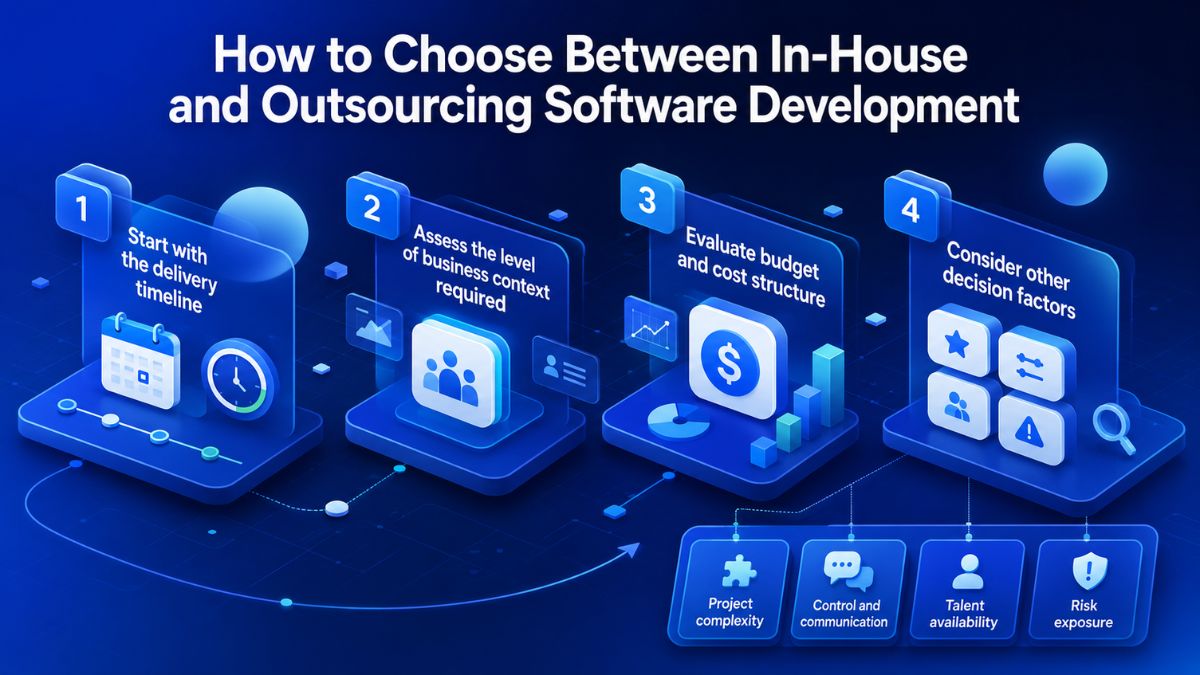
Start with the delivery timeline
Urgency is the clearest decision signal. If you need to launch within one to three months, building an in-house team is usually not realistic because hiring and onboarding can take longer than the project window.
A three to twelve-month timeline gives you more options. In-house and outsourcing can all work, depending on budget, skills, and control needs. For twelve-month-plus strategic products, in-house becomes more viable because the team has time to build product context.
Assess the level of business context required
High-context work usually favors in-house development. This includes core IP, customer-facing product strategy, sensitive internal systems, and workflows that depend on deep institutional knowledge.
Lower-context work is easier to outsource. APIs, integrations, cloud migration, legacy modernization, QA, and clearly scoped feature delivery can often be handled well by an external team if requirements are clear.
Evaluate budget and cost structure
In-house development carries higher fixed costs. Salaries, benefits, recruitment, tools, training, management overhead, and retention costs make it better suited for continuous long-term product development.
Outsourcing is more flexible because costs scale with the engagement. It fits businesses that need temporary capacity, specialized skills, or faster delivery without committing to permanent headcount.
Consider other decision factors
Beyond timeline and business context, several practical factors can influence whether in-house development or outsourcing is the better fit:
- Project complexity: Long, evolving products favor in-house because context compounds over time. Short, well-defined projects are easier to outsource efficiently.
- Control and communication: If real-time control is your priority, in-house or nearshore outsourcing works better. Offshore can add delays if communication gaps are not managed tightly.
- Talent availability: If local hiring is slow or specific skills are scarce, outsourcing gives faster access to specialists. In-house makes sense when those skills are needed permanently.
- Risk exposure: In-house brings hiring, retention, and capability risks. Outsourcing brings vendor selection and delivery risks.
When Should You Choose In-House Development?
In-house development often works best when the business needs deep internal knowledge, strong security governance, continuous collaboration, and stable ownership over the product roadmap.
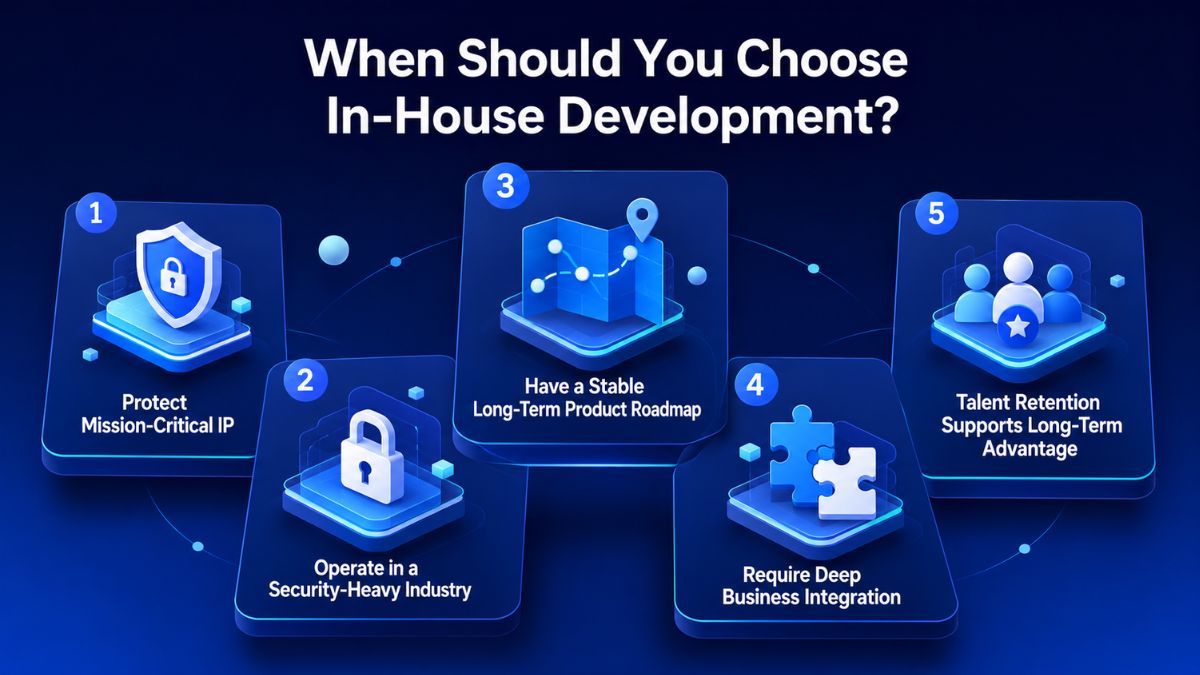
Need to protect mission-critical IP
Choose in-house development when the code, algorithm, or system architecture is a core part of your competitive advantage. Keeping development internal helps reduce exposure and protect sensitive innovations. This is especially important for products such as proprietary trading algorithms, advanced data models, aerospace systems, or any technology where leakage could damage trust, revenue, or market position.
Operate in a security-heavy industry
In-house development is often more suitable for finance, healthcare, defense, government, and other regulated sectors. These industries require strict compliance, secure workflows, and fast responses to regulatory changes. For example, a banking platform that handles PCI DSS requirements may need continuous internal oversight across payment flows, access control, audit trails, and data protection practices.
Have a stable long-term product roadmap
If your business has a clear multi-year product plan, an in-house team can become a strategic asset. Internal developers build deeper product knowledge over time and can make better decisions as features evolve. This model works well for platforms that require continuous improvement, such as business intelligence systems, enterprise SaaS products, or internal tools that grow with user feedback and business priorities.
Development requires deep business integration
In-house development is valuable when the software must work closely with multiple business units such as operations, retail, logistics, manufacturing, or supply chain. Direct collaboration helps the team understand real operational issues and respond faster.
Talent retention supports long-term advantage
Building an internal team makes sense when technical talent is part of your long-term business strategy. For tech startups, fintech firms, and product-led companies, retaining engineers and data specialists can strengthen product ownership, innovation, and engineering culture. Over time, this internal expertise becomes difficult for competitors to copy because it combines technical skill with deep knowledge of the company’s product and market.
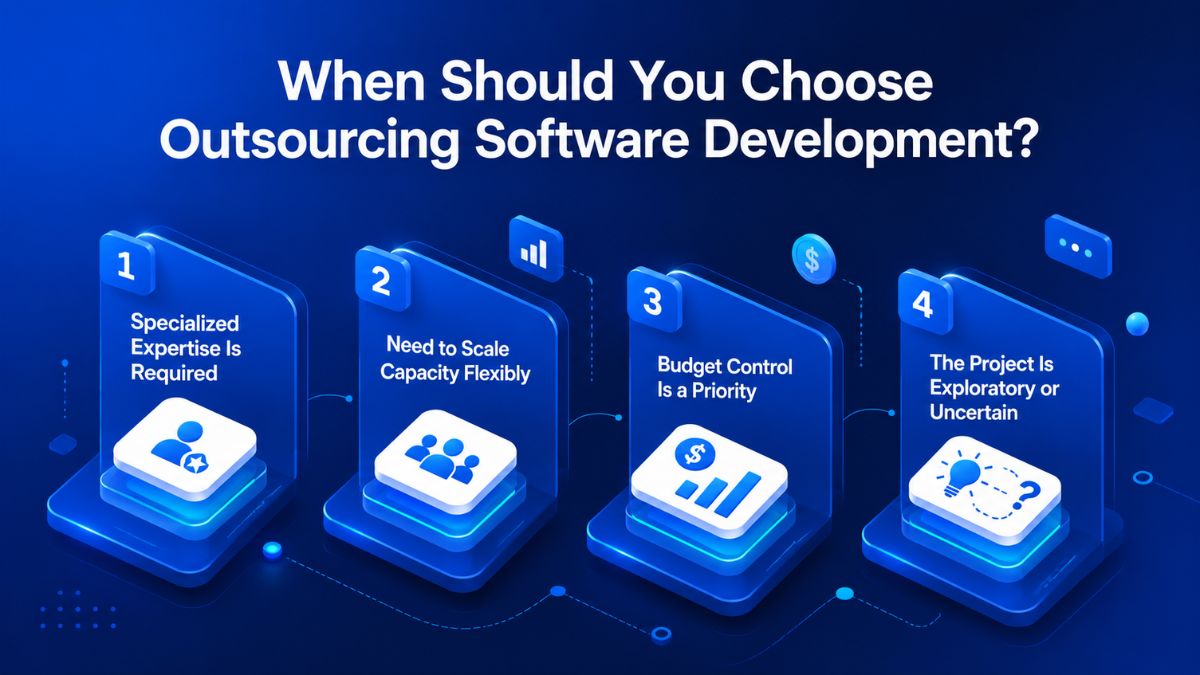
When Should You Choose Outsourcing Software
Outsourcing software development is often the better choice when businesses need faster execution, specialized expertise, or flexible development capacity without committing to permanent headcount.
Specialized expertise is required
Choose outsourcing when your project requires technical skills that are difficult to hire or maintain internally. This is common for areas such as AI and machine learning, blockchain development, cloud engineering, cybersecurity, data engineering, or legacy modernization.
Need to scale capacity flexibly
Outsourcing is useful when project demand changes quickly. For example, your business may need extra developers during a product launch, MVP build, feature sprint, migration project, or seasonal peak. Instead of hiring permanent employees who may be underused later, outsourcing allows you to scale the team up or down based on workload, timeline, and budget.
Budget control is a priority
Outsourcing can help businesses manage development costs more flexibly. Instead of paying year-round salaries, benefits, training, tools, and infrastructure, companies pay for the expertise and capacity they need during a defined period. This is especially valuable for startups, growing companies, or teams that need to preserve budget for other priorities such as marketing, sales, product validation, or customer acquisition.
Pproject is exploratory or uncertain
Outsourcing is a practical option when businesses are testing new ideas, markets, technologies, or product features. External teams can help build prototypes, MVPs, proofs of concept, or pilot versions without overloading internal resources. This allows companies to validate demand and technical feasibility before committing to a larger internal team or long-term development investment.
Next Steps After Choosing Your Development Model
After choosing between in-house, outsourcing, or a hybrid model, the next step is to turn the decision into an execution plan. Each path requires clear roles, governance, documentation, quality standards, and risk control. The goal is to create a structure that supports delivery, accountability, and long-term product success.
If you choose in-house Ddevelopment
- Build clear hiring requirements: Create detailed job descriptions that define skills, responsibilities, experience levels, and reporting structures. Set competitive salary ranges to attract and retain qualified talent.
- Create a structured interview process: Use a consistent interview process that evaluates technical skills, problem-solving ability, and cultural fit. Include coding assessments and collaboration-focused discussions where appropriate.
- Use a trial project before full hiring: Assign a short paid project to assess real-world performance before making a long-term commitment. This helps evaluate coding quality, communication, and ownership.
If you choose outsourcing software development
- Prepare a detailed project scope: Create a clear Product Requirements Document outlining goals, features, timelines, constraints, and acceptance criteria. Define the Definition of Done to align expectations.
- Create an RFP checklist: Develop an RFP that covers scope, deliverables, pricing, security, IP ownership, communication, and service expectations. This makes vendor comparisons more objective.
- Vet vendors carefully: Review case studies, client references, technical expertise, and industry experience. Focus on quality, communication, and reliability rather than cost alone.
- Run a pilot sprint: Start with a short pilot sprint to evaluate the vendor’s delivery process, technical capabilities, and responsiveness. This reduces the risk of choosing the wrong partner.
If you choose a hybrid model
- Define ownership between internal and external teams: Clearly assign responsibilities between internal and external teams. Internal leaders typically own strategy and approvals, while external teams support execution and specialized work.
- Create shared documentation and workflows: Use a common backlog, documentation system, and communication process for both teams. Shared workflows improve transparency and reduce misunderstandings.
- Keep internal leaders close to delivery: Ensure internal product and technical leaders remain involved in planning, reviews, and key decisions. This maintains control while benefiting from external support.
- Plan for knowledge transfer: Schedule regular knowledge-sharing sessions, documentation updates, and code reviews. This prevents dependency on external partners and preserves internal expertise.
Partner with Newwave Solutions for Software Outsourcing
As a reliable software development outsourcing partner based in Vietnam, Newwave Solutions helps businesses access skilled engineering teams, flexible engagement models, and proven delivery processes without the cost and complexity of building a full in-house team.
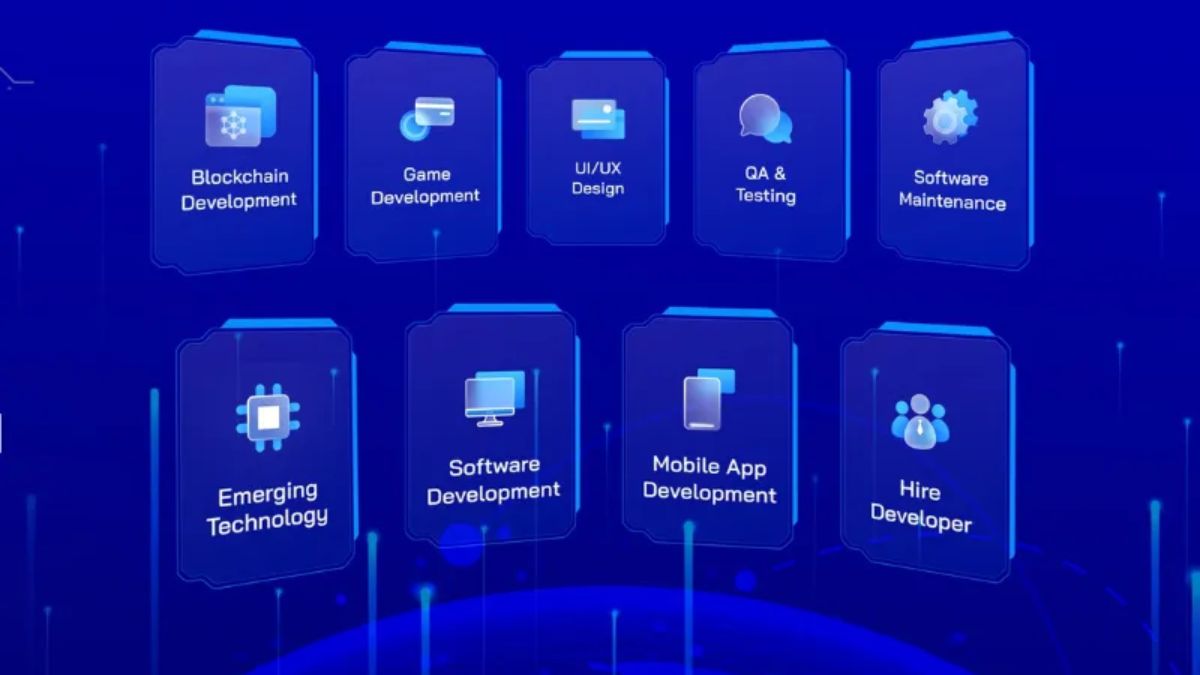
Backed by 14+ years of experience and 800+ successful projects, we have earned the trust of clients across industries including fintech, banking, healthcare, education, real estate, and enterprise software by consistently delivering high-quality solutions and long-term value.
- Proven technical expertise: Our team includes experienced developers, designers, QA engineers, project managers, and technology specialist. We combine modern technologies with agile delivery to turn ideas into scalable software solutions.
- Cost-effective development from Vietnam: Based in Vietnam, Newwave Solutions gives clients access to high-quality technical talent at competitive rates. This helps reduce hiring costs, operational burden, and long-term overhead while maintaining strong delivery standards.
- Flexible outsourcing models: Whether you need a dedicated team, staff augmentation, project-based support, or a hybrid setup, we adapt to your requirements. This flexibility allows you to scale resources and engagement as your business evolves.
- Security and IP protection: We prioritize data security and intellectual property protection through secure development practices, NDAs, controlled access, and ISO 27001-certified processes. Your business assets remain protected throughout the engagement.
- A dedicated partnership mindset: More than a service provider, we act as an extension of your team. By understanding your goals, challenges, and product vision, we deliver solutions that support long-term business growth.
If your business is ready to scale software development with a reliable outsourcing partner, contact us now for a FREE consultation.
Final Thoughts
There is no universal answer to in-house vs outsourcing software development. The right choice depends on how urgent the project is, how much business context it requires, and whether your company needs permanent capability or flexible external support. A hybrid approach may also work when you want both ownership and scalability.
With 14+ years of experience and 800+ successful projects, Newwave Solutions provides software outsourcing services that help businesses reduce delivery risks and accelerate development. Contact Newwave Solutions to build your software with the right team.
FAQs
1. What is the main difference between in-house and outsourcing?
The main difference between in-house and outsourcing lies in control, cost, and execution speed. In-house teams offer full control and alignment with internal processes, while outsourcing provides cost efficiency and faster access to external expertise.
2. Is outsourcing cheaper than in-house development?
Outsourcing is generally more cost-effective because companies avoid expenses related to hiring, training, and infrastructure. In contrast, in-house teams require fixed costs such as salaries, benefits, and operational overhead.
3. What are the four types of outsourcing?
The four types of outsourcing are onshore, nearshore, offshore, and onsite outsourcing. Onshore outsourcing means working with a vendor in the same country, while nearshore outsourcing involves partnering with teams in nearby countries with similar time zones.
Offshore outsourcing means hiring teams in distant countries, often to reduce costs or access broader talent. Onsite outsourcing happens when external specialists work directly at the client’s location for closer collaboration and control.
4. What are the benefits of in-house vs outsourcing?
In-house development gives businesses stronger control, deeper product knowledge, better cultural alignment, and long-term ownership of technical expertise. Outsourcing provides faster access to specialized talent, lower operational overhead, flexible scalability, and quicker project starts.
5. What is one of the main disadvantages of outsourcing?
One of the main disadvantages of outsourcing is reduced visibility and control over the development process. Since the team works externally, businesses may face communication gaps, unclear progress tracking, or misalignment around priorities.
To Quang Duy is the CEO of Newwave Solutions, a leading Vietnamese software company. He is recognized as a standout technology consultant. Connect with him on LinkedIn and Twitter.



Read More Guides



Get stories in your inbox twice a month.
Let’s Connect
Let us know what you need, and out professionals will collaborate with you to find a solution that enables growth.
Leave a Reply