


Programming Languages and Frameworks: A Strategic Guide to Choosing the Right Tools for Your Project
In the rapidly evolving landscape of digital transformation, choosing the right technological foundation can determine the success or failure of your enterprise applications. As organizations strive to build scalable, efficient, and robust digital solutions, understanding the distinction between programming languages and frameworks becomes crucial. This comprehensive guide will help you navigate these critical decisions with confidence, ensuring your technology investments align with your business objectives and operational requirements.
Get to Know Programming Languages

Before diving into the complex ecosystem of development tools, it’s essential to understand the fundamental building blocks of software creation. Programming languages serve as the foundation upon which all digital solutions are built, providing the syntax and structure that enable developers to communicate instructions to computers.
What is a Programming Language?
A programming language is a formal system of syntax and rules that allows developers to write instructions for computers to execute. Think of it as the vocabulary and grammar of software development—it defines how you can express logic, manipulate data, and create functionality. Each programming language has its unique characteristics, strengths, and ideal use cases, making the choice of language a critical strategic decision that impacts your project’s performance, scalability, and maintainability.
Just as human languages evolved for different contexts and purposes, programming languages have developed to solve specific types of problems. Some excel at mathematical computations, while others are optimized for web development or system programming. Understanding these distinctions is the first step toward making informed technology decisions for your enterprise applications.
Types of Programming Languages
Programming languages can be categorized based on their paradigm, abstraction level, and primary use cases. The table below outlines the major categories with their characteristics and typical applications:
| Type | Description | Suitable For | Example Languages |
|---|---|---|---|
| Object-Oriented Programming (OOP) | Organizes code around objects containing data and methods, modeling real-world entities | Large-scale enterprise applications, complex business systems | Java, C++, Python, C# |
| Functional Programming | Treats computation as mathematical function evaluation, emphasizing immutability | Data processing, financial systems, concurrent applications | Haskell, Scala, Erlang, F# |
| Procedural Programming | Follows a linear, step-by-step approach using procedures or functions | System utilities, performance-critical applications | C, Pascal, Go |
| Scripting Languages | Interpreted languages focused on automating tasks and rapid prototyping | Web development, automation, DevOps | JavaScript, Python, Ruby, PHP |
| Low-Level Languages | Provide minimal abstraction from hardware with direct memory access | Operating systems, embedded systems, drivers | Assembly, C |
| Domain-Specific Languages (DSL) | Specialized languages designed for specific application domains | Database queries, configuration, scientific computing | SQL, HTML/CSS, R |
Each category serves distinct purposes in software development. Object-oriented languages like Java remain popular for large-scale systems due to their encapsulation and modularity, while functional languages are gaining traction for data-intensive applications. The choice ultimately depends on your specific requirements for performance, maintainability, and development efficiency.
Get to Know Frameworks
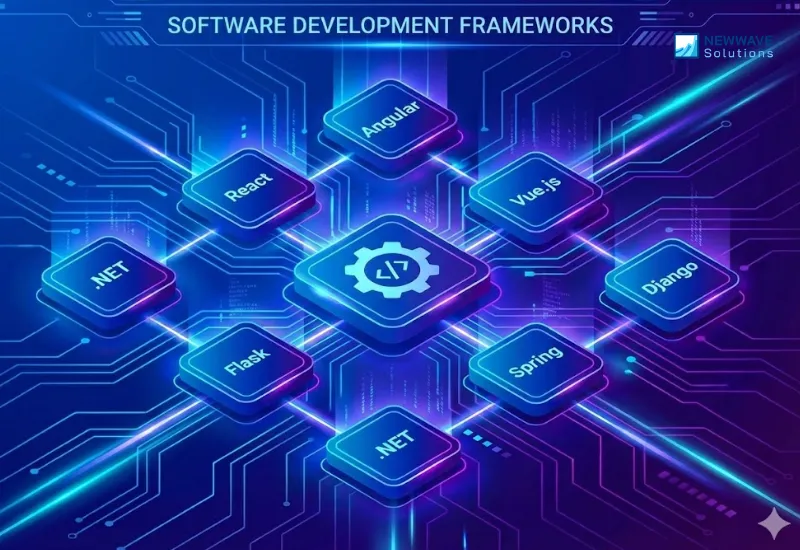
While programming languages provide the fundamental tools for software creation, frameworks offer structured environments that accelerate development and enforce best practices. Understanding how frameworks complement programming languages is essential for building efficient, maintainable applications across various domains.
What is a Framework?
A framework is a comprehensive platform that provides a structured foundation for developing software applications. It consists of pre-written code, libraries, tools, and conventions that standardize development processes and solve common problems. Unlike standalone libraries, frameworks typically implement inversion of control—meaning they call your code rather than your code calling them, establishing a specific architecture and workflow for your application.
Frameworks dramatically reduce development time by providing ready-made solutions for common tasks such as database access, security implementation, and user interface components. They embody collective wisdom and best practices, helping development teams avoid common pitfalls and maintain consistency across projects. For organizations considering outsource programming, frameworks provide additional benefits by establishing clear conventions that facilitate collaboration between distributed teams.
Types of Frameworks
Frameworks specialize in different aspects of application development, from user interface creation to backend processing. The following table outlines the major framework categories with their specific applications:
| Type | Description | Suitable For | Example Frameworks |
|---|---|---|---|
| Web Application Frameworks | Provide structure for building dynamic websites and web applications | Enterprise web portals, e-commerce platforms, SaaS applications | Spring Boot (Java), Django (Python), Ruby on Rails (Ruby) |
| Frontend Frameworks | Focus on user interface development and client-side functionality | Interactive web applications, single-page applications, dashboards | React, Angular, Vue.js |
| Mobile Development Frameworks | Enable cross-platform or native mobile application development | Enterprise mobile apps, customer-facing mobile solutions | React Native, Flutter, Xamarin |
| Backend Frameworks | Specialize in server-side logic, database integration, and API development | RESTful APIs, microservices, server components | Express.js, Laravel, ASP.NET Core |
| Data Science Frameworks | Provide tools for machine learning, data analysis, and computational mathematics | Business intelligence, predictive analytics, AI solutions | TensorFlow, PyTorch, Pandas |
| Blockchain Frameworks | Offer infrastructure for developing decentralized applications and smart contracts | Financial applications, supply chain tracking, secure transactions | Ethereum, Hyperledger, Corda |
The choice of framework significantly impacts development velocity, application performance, and long-term maintainability. For business applications, web application frameworks like Spring Boot provide robust security features, scalability, and integration capabilities essential for production systems.
Programming Languages and Frameworks – What’s Different?
At its core, a programming language defines what you can express, while a framework defines how you structure that expression. A language provides the basic vocabulary and grammar, whereas a framework provides the architectural blueprint and pre-built components. This relationship is symbiotic—frameworks are built using specific programming languages and extend their capabilities with specialized functionality.
Understanding the distinction between programming languages and frameworks is fundamental to making informed technology decisions. While these concepts are often discussed together, they serve distinct purposes in the software development lifecycle. This difference between programming language and framework becomes particularly important when planning your SDLC (Software Development Life Cycle) and allocating development resources.
The table below highlights the key distinctions:
| Aspect | Programming Language | Framework |
|---|---|---|
| Primary Purpose | Defines syntax and core functionality for writing instructions | Provides structure, tools, and conventions for application development |
| Control Flow | Developer controls the program flow and architecture | Framework dictates the architecture and calls developer code (Inversion of Control) |
| Learning Curve | Requires understanding syntax, semantics, and core concepts | Requires understanding framework-specific conventions and APIs |
| Flexibility | High flexibility to implement any approach or pattern | Guided flexibility within the framework’s architectural constraints |
| Development Speed | Building from scratch requires more time and effort | Accelerates development through pre-built components and patterns |
| Examples | Java, Python, JavaScript, C# | Spring Boot, Django, React, .NET |
This programming language and framework relationship is particularly evident in enterprise environments where consistency, maintainability, and scalability are paramount. Choosing the right combination enables organizations to build robust applications efficiently, whether through in-house development or outsource coding partnerships.
The Core Principle: Language First, Framework Second
In software development, technology decisions follow a logical hierarchy. The fundamental principle is that you must select a programming language before choosing a framework. This approach ensures that your technological foundation aligns with your technical requirements, performance needs, and long-term strategic goals.
Why does this sequence matter? The programming language defines the boundaries of what’s possible in your application—it determines performance characteristics, ecosystem availability, integration capabilities, and the pool of available talent. Frameworks, while influential, operate within these constraints. They enhance productivity and enforce structure but cannot overcome fundamental limitations imposed by the underlying language.
This principle becomes especially important when engaging in custom software development services, as the choice of language impacts everything from development timelines to operational costs. Understanding this hierarchy helps teams make more strategic technology decisions that support both immediate and future requirements.
When Your Primary Focus Should be on the Programming Language?
Certain project requirements demand careful language selection before framework considerations. You should prioritize language choice when:
Performance and Scalability are Critical
When building high-throughput systems that must handle thousands of concurrent users or process large datasets efficiently, the language choice directly impacts performance. For example, Go’s concurrency model makes it ideal for distributed systems, while Rust might be chosen for performance-intensive computing tasks requiring memory safety.
Integration with Existing Systems
If your application needs deep integration with legacy systems or specific platforms, the language may be predetermined. Organizations heavily invested in Microsoft technologies might prioritize C#, while those with existing Java infrastructure would naturally extend with Java-based solutions.
Specialized Domain Requirements
Certain domains have established language preferences based on ecosystem maturity. Blockchain technology development often utilizes Solidity or Go, while data science teams typically work with Python or R. These domain-specific ecosystems influence language selection significantly.
Team Expertise and Talent Availability
The existing skills within your organization or the availability of talent in your region should inform language decisions. This is particularly relevant for outsource software Vietnam partnerships, where language popularity affects resource availability and cost efficiency.
Long-term Maintainability and Ecosystem
Consider the language’s longevity, community support, and update frequency. Established languages like Java offer extensive libraries, robust tooling, and predictable evolution paths—critical factors for enterprise applications with multi-year lifecycles.
When Your Primary Focus Should be on the Framework
Once the programming language is established, framework selection becomes the critical decision point. Focus on framework choice when:
Development Velocity Matters
Frameworks dramatically accelerate development through pre-built components and established patterns. When time-to-market is crucial, selecting a comprehensive framework like Spring Boot (for Java) or Django (for Python) can reduce development time by 30-50% compared to building from scratch.
Architectural Consistency is Required
For large teams or multiple squads working on connected systems, frameworks enforce architectural consistency and coding standards. This is especially valuable in distributed teams or when using outsource programming models, as established conventions facilitate collaboration.
Specific Application Patterns are Needed
If you’re building a single-page application, React or Angular would be natural framework choices. For microservices architectures, Spring Cloud or Micronaut provide specialized capabilities. The framework should align with your architectural vision.
Ecosystem Integration Requirements
Frameworks often provide seamless integration with complementary tools and services. For example, Spring Boot’s extensive ecosystem simplifies integration with databases, messaging systems, and cloud platforms—reducing integration effort and complexity.
Proof of Concept and MVP Development
When validating business ideas through MVP development solutions, frameworks enable rapid prototyping with production-ready foundations. The right framework allows you to build, test, and iterate quickly while maintaining a path to full-scale application development.
The Practical Decision Workflow
Choosing the right technology stack requires a systematic approach that balances technical requirements with business objectives. This structured workflow will guide you through the critical decision points, ensuring your choices align with both immediate needs and long-term goals.
Step 1: Analyze Project Requirements and Constraints
Begin by thoroughly understanding what you’re building and under what constraints. Document functional requirements, performance expectations, integration needs, and non-functional requirements like security and compliance. Consider:
- Application Domain: Is this a web application, mobile app, data processing system, or something else?
- Scale Requirements: How many users will it support? What data volumes must it handle?
- Integration Points: What existing systems must it connect with?
- Timeline and Budget: What are the constraints around delivery and cost?
- Team Size and Structure: How many developers will work on the project and what’s their distribution?
This foundational analysis informs all subsequent decisions and helps avoid costly mid-course corrections during development.
Step 2: Identify Candidate Languages Based on Requirements
With requirements documented, identify 2-3 programming languages that align with your needs. Consider:
- Performance Characteristics: Does the language support your performance requirements?
- Ecosystem Maturity: Are there sufficient libraries and tools for your domain?
- Team Capabilities: Does your team have expertise, or is there accessible talent?
- Long-term Viability: Is the language actively maintained with a strong community?
- Learning Curve: How quickly can new team members become productive?
For business applications, languages like Java, Python, and JavaScript often emerge as strong candidates due to their robust ecosystems and proven track records.
Step 3: Evaluate and Select the Primary Programming Language
Compare your candidate languages against critical success factors:
- Development Efficiency: How quickly can features be developed?
- Operational Performance: How will the language perform in production?
- Maintenance Overhead: What are the long-term maintenance implications?
- Talent Availability: How easy is it to find developers with these skills?
- Community Support: What resources are available for troubleshooting?
Making this decision requires balancing technical merits with practical considerations about team capabilities and project constraints.
Step 4: Research and Evaluate Framework Options
With the language selected, identify frameworks that align with your application’s architecture and development approach:
- Architecture Alignment: Does the framework support your preferred architecture (monolith, microservices, etc.)?
- Feature Completeness: Does it provide the components you need?
- Learning Curve: How quickly can your team become productive?
- Community and Support: Is there active development and community support?
- Documentation Quality: How comprehensive and accessible is the documentation?
For web application development services, consider full-stack frameworks like Django or Ruby on Rails for rapid development, or more lightweight options like Express.js for specific use cases.
Step 5: Prototype and Validate the Selection
Before full commitment, build a proof of concept or prototype using your selected language and framework combination:
- Validate Technical Decisions: Confirm that the stack meets performance and functionality requirements
- Assess Developer Experience: Gauge team productivity and comfort with the technology
- Identify Integration Challenges: Uncover any unexpected integration issues early
- Evaluate Tooling: Test the development tools, debugging capabilities, and deployment processes
This validation step is particularly valuable when engaging in outsource coding arrangements, as it establishes a shared understanding of the technology approach before significant investment.
Step 6: Plan for Implementation and Evolution
Finally, develop a rollout strategy that considers:
- Team Training: Ensure developers have the necessary skills through workshops or targeted learning
- Development Environment Setup: Establish standardized development environments
- CI/CD Pipeline: Implement automated testing and deployment processes
- Knowledge Management: Document architecture decisions and patterns for future reference
- Monitoring and Optimization: Plan for ongoing performance monitoring and optimization
Remember that technology decisions aren’t permanent—establish processes for periodically reevaluating your stack as requirements and technologies evolve.
Final Thought
Choosing between programming languages and frameworks isn’t about finding a universal “best” option, but rather identifying the right combination for your specific context, technical requirements, and strategic objectives. The difference between programming language and framework fundamentally comes down to foundation versus acceleration—languages provide the core capabilities while frameworks enhance productivity and maintainability.
This distinction becomes particularly important when planning your software projects. The right programming language and framework combination can significantly impact your development velocity, application performance, and total cost of ownership. Whether you’re building customer-facing applications, internal tools, or innovative solutions using specialized programming languages for blockchain, thoughtful technology selection lays the groundwork for success.
At Newwave Solutions, we bring both technical expertise and practical perspective to these critical decisions. Our experience across multiple languages and frameworks positions us uniquely to guide your technology choices. We understand that each project has unique requirements, and we’re committed to helping you identify the optimal technology stack for your specific needs.
Our comprehensive software development services approach ensures that technology choices align with business objectives throughout the entire SDLC. From initial discovery and MVP development to full-scale implementation and optimization, we help you navigate the complex landscape of programming languages and frameworks. For organizations considering outsource programming partnerships, our outsource software Vietnam model delivers expertise with cost efficiency.
The technology decisions you make today will influence your development capabilities for years to come. Don’t leave these critical choices to chance. Contact Newwave Solutions for a complimentary technology consultation. Our architects will analyze your specific requirements and recommend the optimal programming language and framework combination to accelerate your development while ensuring scalability, security, and long-term maintainability.
Let’s build something remarkable together—with the right foundation for your success.
To Quang Duy is the CEO of Newwave Solutions, a leading Vietnamese software company. He is recognized as a standout technology consultant. Connect with him on LinkedIn and Twitter.



Read More Guides

Get stories in your inbox twice a month.
Let’s Connect
Let us know what you need, and out professionals will collaborate with you to find a solution that enables growth.
Leave a Reply