


DevOps Trends 2026: Key Innovations Shaping Modern Software Delivery
DevOps has moved well beyond its origins as a set of collaboration principles — today, it is a strategic capability that directly determines how fast and how reliably a company can ship software. For engineering leaders navigating a landscape shaped by AI, cloud-native infrastructure, and rising security demands, understanding the latest DevOps trends is no longer optional. This guide covers the most significant shifts defining DevOps in 2026 and explains what they mean for enterprises at every stage of their digital transformation journey
What are DevOps Trends?
DevOps is a set of practices, tools, and cultural principles that unify software development and IT operations into a single, continuous delivery workflow. In the context of DevOps software development, “trends” refer to the emerging methodologies, technologies, and organizational shifts that are reshaping how teams build, test, deploy, and monitor software at scale. Staying current with these trends matters because the tools and practices that defined DevOps three years ago are already being replaced by faster, more automated, and more intelligence-driven approaches — and teams that fall behind face real consequences in delivery speed and system reliability.
Key Benefits of Adopting Modern DevOps Trends
Before exploring what is changing, it is worth grounding the conversation in why these changes matter to the business. Each trend discussed in this article connects back to one or more of the following core benefits that modern DevOps practices deliver to organizations that adopt them effectively.
- Faster software delivery cycles — Modern DevOps practices compress the time between a feature being written and reaching end users. Automation, CI/CD pipelines, and AI-assisted deployment decisions all contribute to release cadences that were unachievable with manual processes.
- Improved system reliability and performance — Observability practices, automated incident response, and infrastructure-as-code reduce the frequency and severity of production incidents. Teams that invest in these capabilities spend less time firefighting and more time building.
- Better collaboration between teams — Platform engineering and shared tooling eliminate the silos that slow down cross-functional work. When developers, security engineers, and operations staff operate within the same workflow, decisions move faster and accountability is clearer.
- Reduced operational costs — FinOps integration and serverless architectures help organizations right-size their infrastructure spend. Cost awareness built directly into engineering workflows prevents the cloud bill surprises that erode the ROI of digital transformation investments.
- Higher product quality — DevSecOps practices and automated testing catch defects earlier in the development cycle, where they are far cheaper to fix. The result is fewer production bugs, faster remediation, and a more stable experience for end users.
Top DevOps Trends Shaping the Future of Software Development
The DevOps landscape in 2026 is defined by a convergence of forces — AI integration, security-first thinking, cost discipline, and platform-based engineering — that are collectively raising the bar for what modern software delivery looks like. Each of the trends below represents a significant shift in how leading engineering organizations operate, and together they paint a clear picture of where DevOps is heading.
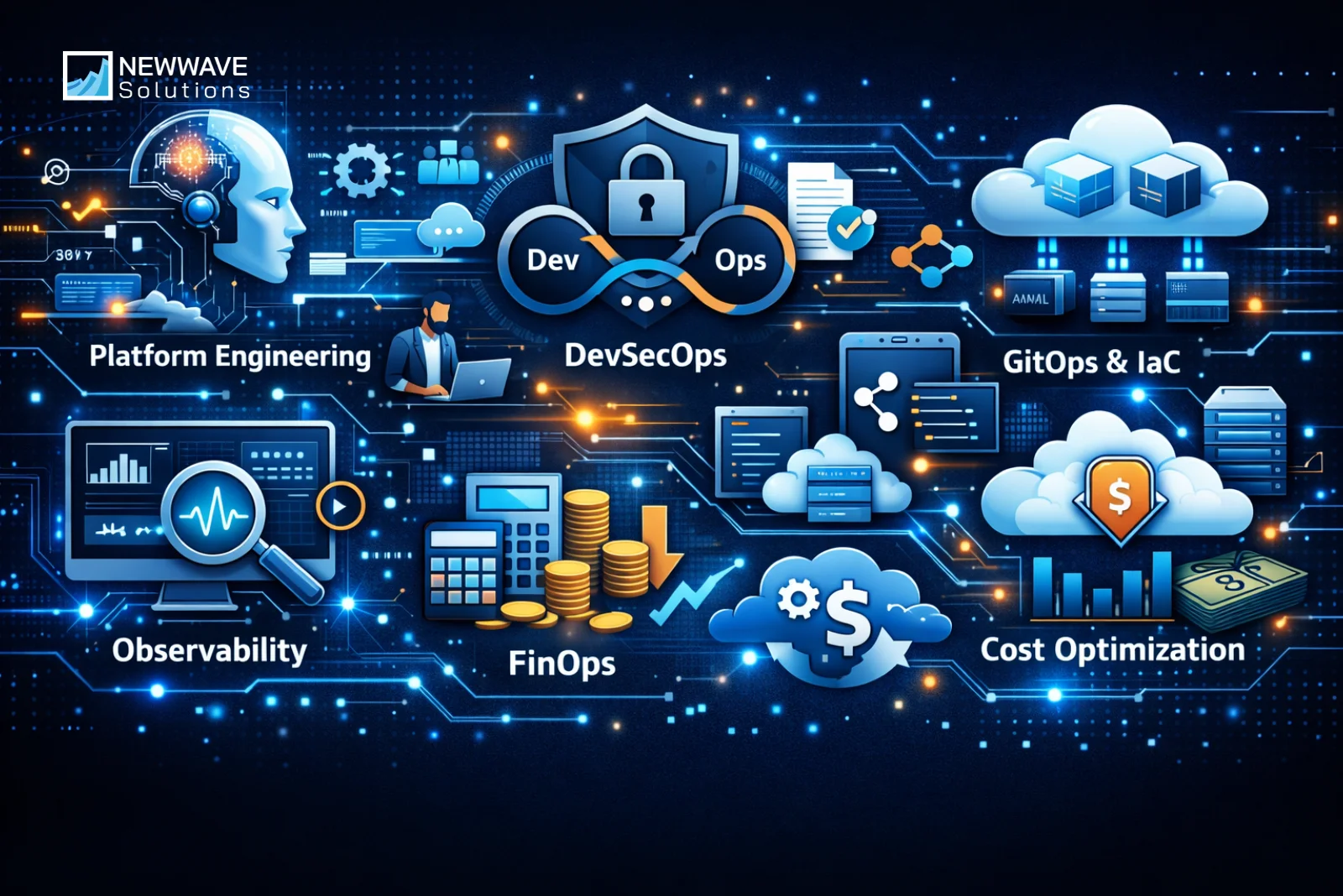
AI-Driven DevOps (AIOps)
Artificial intelligence is no longer a future consideration for DevOps teams — it is already embedded in the pipelines of the most competitive engineering organizations. The teams adopting AIOps earliest are seeing measurable returns: studies report 30–40% faster deployment cycles among teams that integrate AI tooling into their delivery workflows.
- AI-enhanced pipeline automation — Machine learning models analyze deployment patterns and system behavior to make smarter, faster decisions at each stage of the pipeline — from test prioritization to rollback triggers — without requiring manual intervention.
- Predictive incident management — AI-powered monitoring tools identify anomalies and predict failures before they reach production. This shifts teams from reactive firefighting to proactive reliability management, reducing both incident frequency and mean time to resolution.
- Intelligent observability — Rather than flooding teams with raw metrics, AI systems correlate signals across logs, traces, and performance data to surface the insights that actually require attention — dramatically reducing alert fatigue.
Platform Engineering and Internal Developer Platforms
As engineering organizations grow in complexity, the cost of tool sprawl and inconsistent workflows becomes a serious productivity drag. Platform engineering addresses this by creating standardized, self-service environments that let developers focus on building rather than configuring.
- Internal Developer Platforms (IDPs) — Organizations build centralized platforms that standardize tooling, deployment workflows, and environment configuration across teams. Developers access pre-approved infrastructure and pipelines through self-service interfaces, removing the dependency on operations teams for routine provisioning.
- Reduced developer friction — When the path from local development to production is well-paved and consistent, developers ship faster and with less cognitive overhead. Platform engineering teams treat developers as internal customers — and measure success by developer experience metrics.
- Self-service infrastructure as a core capability — The ability for any team to spin up compliant, production-ready infrastructure on demand is becoming a baseline expectation in mature engineering organizations, not an advanced capability.
DevSecOps and Policy-as-Code
Security has historically been a gate at the end of the development process — a checkpoint that slowed releases and created friction between engineering and compliance teams. DevSecOps eliminates that gate by embedding security directly into the CI/CD pipeline, making it a continuous property of every build rather than a periodic review.
- Shift-left security — Security checks, vulnerability scanning, and dependency audits run automatically at every commit and pull request. Teams catch and remediate vulnerabilities in minutes rather than discovering them weeks later in a security review.
- Policy-as-code — Compliance rules and security policies are codified and version-controlled alongside the application code itself. This makes compliance auditable, automated, and consistently enforced — a critical requirement in regulated industries such as healthcare, finance, and government.
- DevSecOps as a regulatory requirement — Increasingly, enterprise clients and industry regulators are treating DevSecOps practices not as a best practice but as a baseline expectation. Organizations that have not integrated security into their pipelines are finding themselves at a disadvantage in both procurement and compliance contexts.
GitOps and Infrastructure as Code (IaC)
The principle that infrastructure should be defined, versioned, and managed through code — rather than through manual configuration — has matured from a forward-thinking idea into a production standard for leading engineering teams. GitOps takes this further by making the Git repository the single source of truth for both application and infrastructure state.
- Git as the deployment source of truth — Every infrastructure change is expressed as a code commit, reviewed through a pull request, and applied automatically by a reconciliation agent. This eliminates configuration drift and provides a complete, auditable history of every change to the production environment.
- Consistency across environments — IaC ensures that development, staging, and production environments are defined identically in code, removing the class of bugs and incidents that arise from environment-specific configuration differences.
- Reduced human error — Automating infrastructure provisioning and deployment through code removes the manual steps where mistakes most commonly occur, improving both deployment reliability and recovery speed when incidents do arise.
Cloud-Native and Serverless DevOps
Cloud infrastructure has become the default operating environment for modern software, and DevOps practices are evolving in step with that reality. Cloud-native and serverless approaches are reshaping how teams think about infrastructure, scaling, and operational responsibility.
- Kubernetes and containerization — Container orchestration with Kubernetes remains the dominant model for deploying and managing cloud-native applications at scale. The ecosystem continues to mature, with improved tooling for multi-cluster management, cost optimization, and security policy enforcement.
- Serverless computing — Serverless platforms abstract away infrastructure management entirely, allowing teams to deploy functions and services without provisioning or managing servers. This reduces operational overhead significantly and shifts engineering attention from infrastructure maintenance to application logic.
- Continued cloud adoption as a DevOps driver — As more organizations complete their initial cloud migration, the focus shifts from “getting to the cloud” to “operating well in the cloud” — optimizing architectures, reducing costs, and building the automation capabilities that cloud environments enable.
Observability and Reliability Engineering
Monitoring tells you when something is broken. Observability tells you why — and increasingly, it tells you before the break becomes visible to users. This distinction is driving a significant evolution in how DevOps teams think about system health.
- Full-stack observability — Modern observability platforms integrate logs, metrics, distributed traces, and real user monitoring into a unified view of system behavior. This gives engineering teams the context they need to understand complex failures in distributed, microservices-based architectures.
- Site Reliability Engineering (SRE) practices — The SRE model — which applies software engineering discipline to operations problems — is becoming mainstream. Service Level Objectives (SLOs) and error budgets give teams a data-driven framework for balancing feature velocity against reliability investment.
- DevOps as a risk management function — Reliability engineering positions DevOps as a business risk function, not just an infrastructure function. Uptime, latency, and user experience metrics are increasingly reported at the executive level as direct indicators of business performance.
FinOps and Cost Optimization
Cloud spending is now one of the largest line items in many engineering budgets — and for organizations that scaled quickly without building cost visibility into their workflows, that spending is frequently higher than it needs to be. FinOps addresses this by making cost awareness a first-class concern in DevOps practice.
- Cost as a DevOps metric — FinOps integrates cloud cost tracking directly into CI/CD workflows and sprint reviews. Teams see the cost implications of architectural decisions in real time, which fundamentally changes the trade-offs they make when designing and deploying services.
- Right-sizing and resource optimization — Automated tooling identifies overprovisioned resources, idle infrastructure, and inefficient workload scheduling — translating those findings into actionable savings without requiring manual cloud cost audits.
- FinOps as a cultural shift — The most mature FinOps implementations treat cost optimization not as a finance team responsibility but as a shared engineering accountability. When developers, architects, and operations staff all have visibility into spending, cost efficiency becomes a natural output of good engineering practice.
Challenges in Adopting DevOps Trends
Progress in DevOps is rarely linear. Even organizations with strong technical capability encounter significant obstacles when trying to adopt new practices at scale, and acknowledging these challenges is the first step toward addressing them effectively.
- Skill gaps in DevOps and DevSecOps — The demand for engineers with combined development, operations, and security expertise consistently outpaces supply. Many organizations find that their existing teams need significant upskilling before they can effectively implement AI-driven pipelines, policy-as-code, or advanced observability practices.
- Complexity of toolchains — The DevOps tooling ecosystem is vast and evolving rapidly. Teams frequently struggle with tool sprawl — maintaining integrations across dozens of platforms — which increases cognitive load, slows onboarding, and creates brittle pipelines that are difficult to maintain.
- Cultural resistance to change — DevOps transformation is as much a cultural challenge as a technical one. Shifting from siloed development and operations teams to shared ownership of delivery outcomes requires organizational change management that many technology-focused leaders underestimate.
- Security and compliance challenges — Integrating security into fast-moving CI/CD pipelines without creating bottlenecks requires tooling, process design, and cross-functional alignment that takes time to establish. Regulated industries face additional complexity in demonstrating compliance to auditors whose frameworks were not designed with automated pipelines in mind.
- Integration with legacy systems — Many organizations carry significant legacy infrastructure that does not fit neatly into cloud-native or containerized deployment models. Bridging modern DevOps practices with older systems requires custom engineering work that adds cost and complexity to transformation programs.
How to Successfully Adopt DevOps Trends in Your Organization
Awareness of what is changing in DevOps is only useful if it translates into action. The following steps represent a practical, sequenced approach to adopting modern DevOps practices in a way that builds momentum and delivers measurable business outcomes.
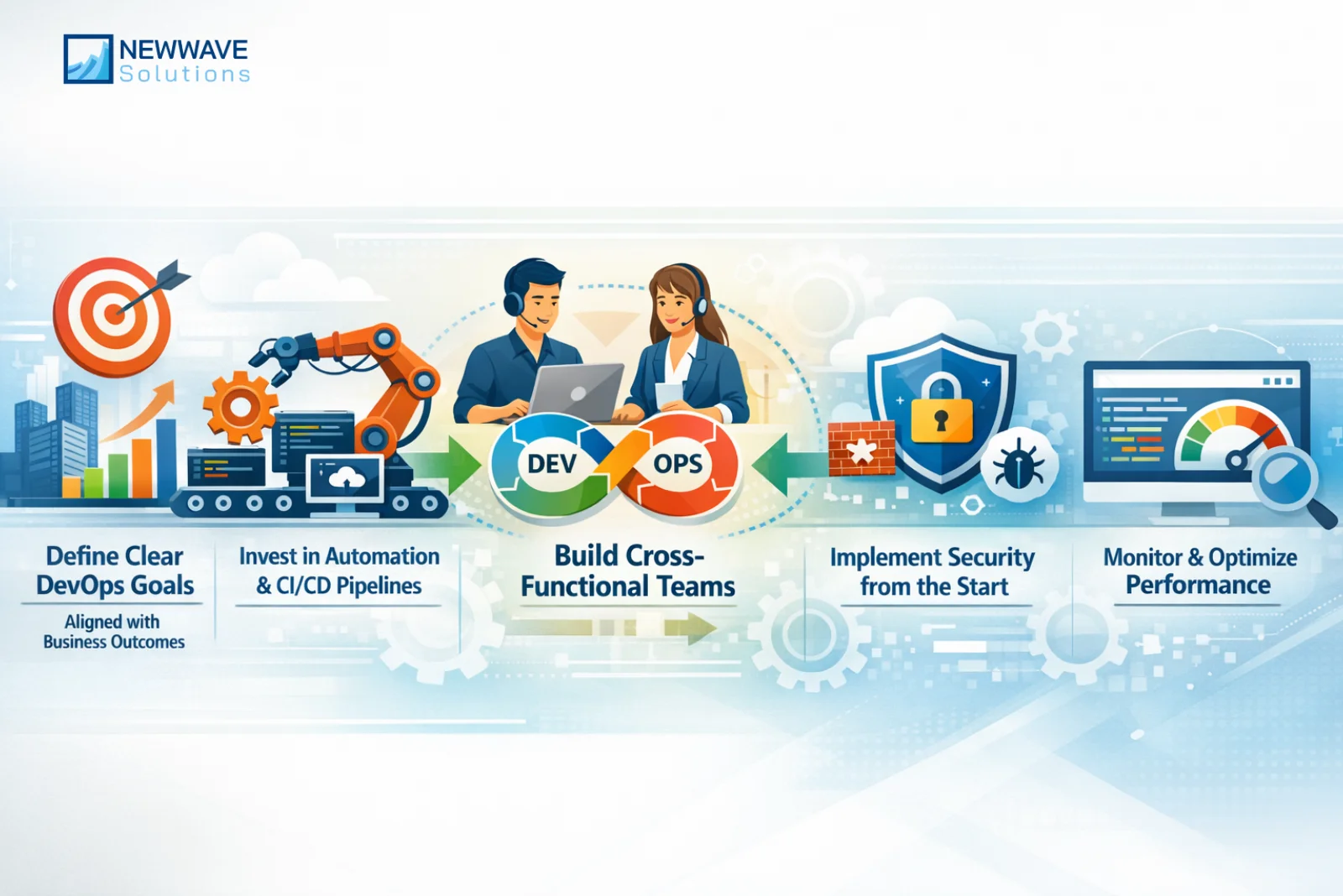
- Define clear DevOps goals aligned with business outcomes — Every DevOps initiative should connect to a specific, measurable business objective — whether that is reducing deployment lead time, improving uptime, or cutting infrastructure costs. Goals without business alignment tend to stall when they compete for resources.
- Invest in automation and CI/CD pipelines — Automation is the foundation of modern DevOps. Building reliable CI/CD pipelines early creates the infrastructure that makes every subsequent improvement — AI integration, security embedding, cost tracking — significantly easier to implement.
- Build cross-functional teams — Effective DevOps requires developers, security engineers, and operations staff to work within shared workflows rather than adjacent silos. Structuring teams around products or services — rather than functions — is the organizational design that makes this possible.
- Implement security from the start — Retrofitting DevSecOps into an existing pipeline is far more costly than building security in from day one. Establishing automated security scanning, dependency auditing, and policy-as-code as baseline pipeline requirements from the outset prevents technical debt from accumulating.
- Continuously monitor and optimize performance — DevOps maturity is not a destination — it is a continuous improvement cycle. Building observability and feedback loops into every stage of the delivery process gives teams the data they need to identify bottlenecks, reduce waste, and progressively raise their delivery capability over time.
Accelerating DevOps Transformation with Newwave Solutions
Adopting the latest DevOps trends requires more than awareness — it requires the right technical partnership to turn strategy into execution. For engineering leaders managing competing priorities, tight timelines, and limited internal bandwidth, the gap between knowing what needs to change and having the team to change it is where most DevOps transformations stall.
Newwave Solutions enables CTOs and engineering teams to bridge that gap — accelerating digital transformation strategy through scalable, modern DevOps solutions built on 14+ years of IT outsourcing and software development experience. With a track record of 800+ successfully delivered projects, the superior offshore software development services of Newwave Solutions can support enterprises in implementing DevOps practices that are aligned with the latest industry trends, built for production scale, and designed to deliver measurable business outcomes.
Why engineering leaders choose Newwave Solutions for DevOps transformation:
- Developers and engineers with hands-on DevOps expertise — The team includes specialists across CI/CD pipeline design, infrastructure automation, containerization, and DevSecOps — engineers who have implemented these practices in production environments, not just in theory.
- Broad experience across cloud, AI, and SaaS platforms — Newwave’s delivery experience spans AWS, Azure, and Google Cloud environments, as well as AI-integrated pipeline implementations and SaaS product development — giving clients access to cross-platform expertise that reduces the learning curve on complex DevOps initiatives.
- Flexible engagement models — Whether a client needs a dedicated offshore DevOps team, staff augmentation for a specific capability gap, or end-to-end project delivery, Newwave offers engagement structures that adapt to the client’s timeline, budget, and internal team composition.
- Proven delivery for global clients — Newwave has delivered DevOps and software engineering programs across North America, Europe, and Asia-Pacific — providing the cross-cultural delivery experience and communication discipline that global engagements require.
- Platform engineering and automation capability — The team designs and builds Internal Developer Platforms and automation infrastructure that reduce developer friction, standardize workflows, and accelerate the delivery velocity of engineering organizations at scale.
- DevOps cost optimization through FinOps practices — Newwave integrates cloud cost tracking and FinOps principles directly into DevOps delivery workflows, helping clients reduce infrastructure spend and build the cost visibility that turns cloud investment into a competitive advantage rather than an uncontrolled variable.
Conclusion
Staying current with modern DevOps trends is no longer a choice for organizations that want to remain competitive — it is the operating standard that separates high-performing engineering teams from those that are perpetually catching up. The DevOps trends shaping 2026 — from AIOps and platform engineering to DevSecOps and FinOps — represent a clear shift toward automation, intelligence, and engineering practices that treat reliability and cost efficiency as first-class outcomes alongside delivery speed.
For businesses ready to adapt — and to turn that adaptation into a real competitive advantage — partnering with an experienced delivery service provider like Newwave Solutions ensures that your DevOps transformation is grounded in practical expertise, not just industry aspiration.
To Quang Duy is the CEO of Newwave Solutions, a leading Vietnamese software company. He is recognized as a standout technology consultant. Connect with him on LinkedIn and Twitter.



Read More Guides



Get stories in your inbox twice a month.
Let’s Connect
Let us know what you need, and out professionals will collaborate with you to find a solution that enables growth.
Leave a Reply