


Hidden Costs of Offshoring: What Your Budget Is Missing
Offshoring promises immediate margin expansion — lower salaries, leaner overhead, and faster access to global talent — yet a significant portion of offshore initiatives either underperform their projected savings or quietly reverse course within the first 18 months. The gap between expectation and reality is rarely a talent problem; more often, it is the direct result of incomplete financial modeling that omits entire categories of cost that never appear in a vendor’s quote. This article maps every major category of hidden costs of offshoring that CTOs, CFOs, and tech leads must account for before committing to an offshore strategy — so that the business case presented to the board reflects the actual total cost of ownership, not an optimistic baseline.
Why You Need to Understand Hidden Costs Before Offshoring?
Many organizations treat offshoring as a salary arbitrage decision — a straightforward comparison of domestic rates against offshore rates, with the difference representing the savings. That framing, however, consistently produces business cases that fail to survive contact with execution of reality.
The total cost of an offshore engagement extends far beyond the payroll line. Every organization that has discovered this after the fact has paid the price in budget overruns, delayed timelines, and the organizational credibility that comes with presenting revised projections to a board that approved the original ones. There are several specific reasons why modeling these costs upfront is non-negotiable:
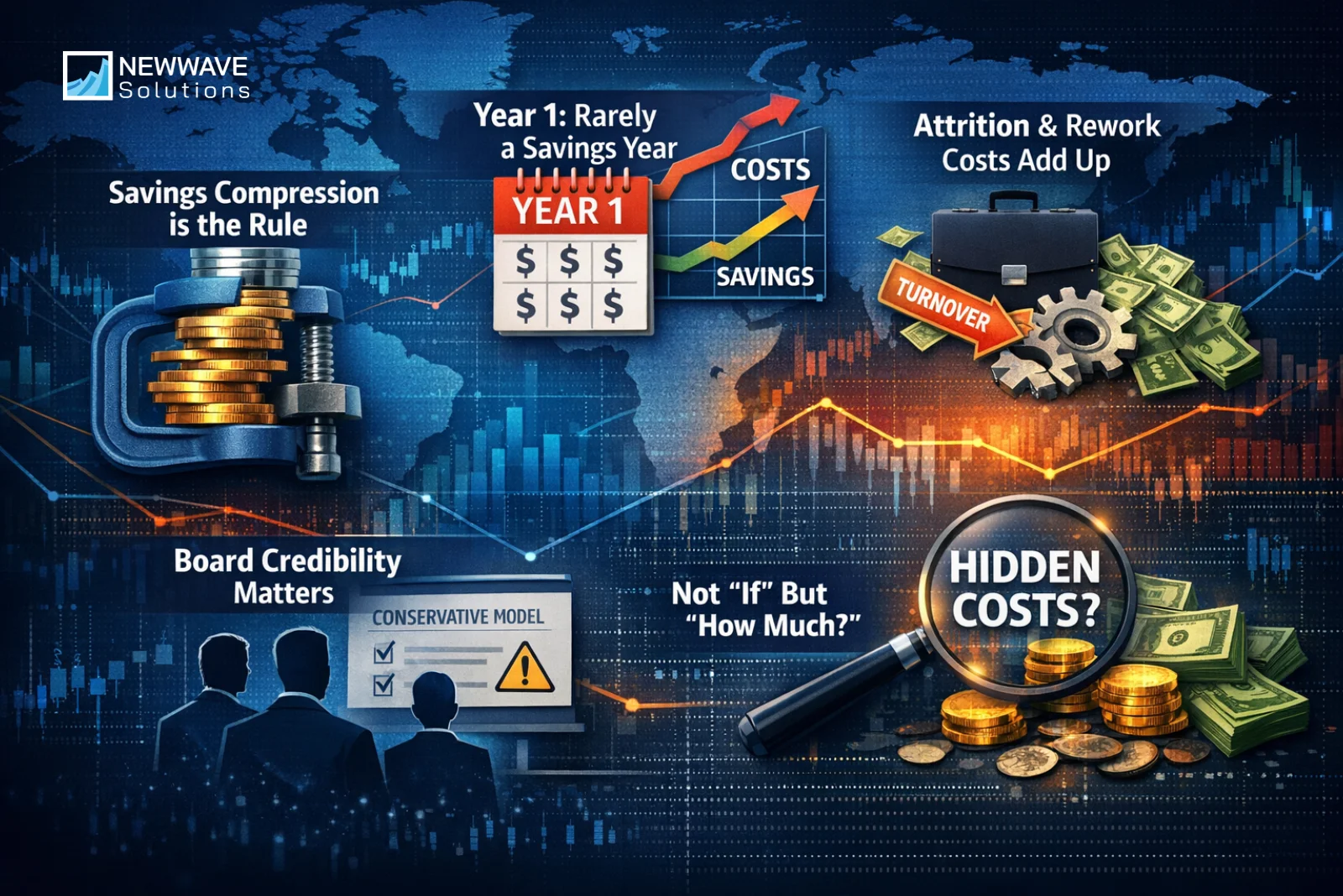
- Savings compression is the rule, not the exception: Even when fully loaded costs are modeled, offshore assumptions frequently omit employer statutory contributions, EOR fees, equipment refresh cycles, compliance tooling, and local legal advisory — each of which individually appears minor but collectively compresses real savings significantly.
- Year 1 is rarely a savings year: The transition period — which typically spans 3–12 months — involves knowledge transfer, infrastructure replication, and senior staff diversion that generates cost before it generates value.
- Attrition and rework costs accumulate silently: Unlike direct labor costs, replacement expenses and quality-related rework do not appear as distinct line items; they surface as timeline delays and budget variance that erode ROI over a multi-year horizon.
- Board credibility depends on conservative modeling: Organizations that present transparent, fully-costed offshore business cases — including risk scenarios — consistently achieve higher approval rates and encounter fewer post-implementation financial surprises than those that present optimistic baselines.
- The right question is not whether hidden costs exist: They always do. The right question is whether, after accounting for all of them, offshoring still improves capital efficiency — and that question can only be answered with a complete model.
>>> Read more: Outsourcing vs Offshoring: Which Is Better for Making Strategic Business Decisions?
The Hidden Costs of Offshore Outsourcing — A Full Breakdown
Most offshore cost discussions stop at salary differentials and infrastructure. The categories below represent the cost layers that typically go unmodeled — and that collectively determine whether an offshore program delivers its projected ROI or requires a difficult conversation with leadership twelve months into the engagement.
1. Evaluation and Vendor Selection Costs
Choosing an offshore partner is a significant investment of time and organizational resources — one that most project budgets treat as a background activity rather than a discrete cost center.
What this cost covers: RFP creation and distribution, vendor due diligence, legal contracting, and the time spent evaluating provider strengths, weaknesses, and alignment with project objectives.
The selection process typically absorbs 6–12 months of internal staff time before a single line of productive work is delivered. Legal fees for contract negotiation add further to the upfront investment — and the cost of a misaligned vendor selection, if due diligence is compressed, can far exceed the cost of the evaluation itself.
How to manage it: Build vendor evaluation explicitly into the project timeline and budget as a capital allocation activity. Treat it with the same rigor as any other major procurement decision — because it is one.
2. Transition and Knowledge Transfer Costs
The transition period is consistently the most expensive phase of an offshore engagement — and the one most frequently excluded from Year 1 financial projections.
What this cost covers: Training the offshore team on proprietary systems and business processes, potential on-site visits where offshore staff are paid domestic wages, infrastructure replication at the offshore location, and the senior staff time diverted from productive work to onboarding oversight.
Financial exposure is more concrete than it appears. A senior US engineer earning $200,000 per year who allocates 20% of their time to offshore onboarding for three months represents a direct economic cost of approximately $10,000 — and that figure multiplies across every hire in the first cohort. Research from Meta Group found that productivity loss from transition can add up to 20% in additional costs during the first two years of an offshore contract.
Estimated cost per offshore hire: $10,000–$25,000 in transition and productivity drag, depending on role complexity.
How to manage it: Model transition costs explicitly in Year 1 projections. Use incremental handoff structures — rather than full simultaneous transitions — to reduce single-point knowledge risk and distribute the onboarding cost across a longer ramp period.
3. Management Bandwidth and Governance Overhead
Distributed teams require structured governance to function at the level of quality and velocity that justified the offshore investment in the first place — and that governance consumes real organizational resources.
What this cost covers: Additional sprint alignment meetings, documentation discipline, cross-timezone scheduling overhead, code review intensity, security protocol enforcement, and the dedicated project management required to oversee the engagement end-to-end.
The financial framing is straightforward. If governance demands increase management bandwidth by 10–15%, that cost must be allocated to the offshore program. A $1,000,000 offshore payroll, for instance, carries an effective $100,000–$150,000 governance burden that rarely appears in the initial business case. A dedicated offshore project manager — which most organizations require — adds $75,000–$150,000 annually; vendor contract management adds a further 6–10% in ongoing administrative overhead.
How to manage it: Factor governance overheads the program budget before the engagement begins. Establish documented escalation paths, meeting cadences, and accountability structures as prerequisites to the transition — not afterthoughts.
4. Fully Loaded Employment Costs
The single most common error in offshore cost modeling is comparing base salary to base salary. That comparison is insufficient — and it consistently overstates projected savings before the engagement even starts.
What this cost covers: All employment-related costs beyond base compensation that are frequently excluded from initial offshore cost models.
|
Cost Category |
Typical Annual Impact (Per FTE) |
| EOR / Payroll Administration | $3,000 – $10,000 |
| Statutory Contributions | 10% – 25% of salary |
| Security & Compliance Tools | $1,000 – $3,000 |
| Equipment & Replacement | $2,000 – $4,000 |
| Local Legal / Advisory | Variable |
| Annual Travel (if required) | $2,000 – $5,000 |
Individually, these line items appear minor. Aggregated across a 15-person offshore team, however, they meaningfully compress savings — often before a single productivity output has been delivered.
How to manage it: Model fully loaded offshore costs with the same rigor applied to domestic employment costs. Use the table above as a minimum checklist and validate statutory contribution rates with local legal counsel before finalizing financial projections.
5. Attrition and Replacement Costs
Attrition in high-growth offshore markets is structurally higher than in established domestic teams — and each departure triggers a replacement cost cycle that directly erodes the savings the engagement was designed to generate.
What this cost covers: Recruitment expense, productivity loss during vacancy, ramp reset time, and the knowledge transfer inefficiency that accompanies every replacement hire.
Replacement cost for skilled offshore engineers typically ranges from 30–50% of annual salary when accounting for lost productivity across the full vacancy and ramp cycle.
|
Offshore Salary |
Replacement Cost (40%) |
Ramp Reset |
| $80,000/year | ~$32,000 per departure | Variable |
At 15% annual attrition across a 20-person team, replacement cost becomes a material budget line over a three-year horizon — one that most initial business cases do not model.
How to manage it: Model attrition conservatively in multi-year projections. Invest in retention mechanisms — competitive compensation benchmarking, defined career progression structures, and cultural integration practices — from the engagement start, not after the first wave of departures.
6. Quality Control and Rework Costs
Quality issues in distributed teams are not inherently an offshore problem — they are a process discipline problem that distributed working environments amplify significantly.
What this cost covers: Increased QA cycles, code refactoring, architectural misalignment, and rework resulting from documentation gaps and communication friction across time zones and organizational boundaries.
The hidden nature of this cost lies in how it manifests. Rework rarely appears as a discrete budget line; instead, it surfaces as timeline delays and sprint velocity compression. For product-led organizations where release cadence directly influences revenue capture, a delivery delay carries a financial impact that can outweigh the payroll savings the offshore engagement was intended to generate.
How to manage it: Invest in documentation standards, code review protocols, and QA automation infrastructure before the offshore transition begins. Treating process discipline as a prerequisite — not a corrective measure — is the most cost-effective approach.
7. Security and Compliance Infrastructure Costs
Organizations operating under SOC 2, HIPAA, GDPR, or equivalent regulatory frameworks face incremental compliance costs when distributing teams internationally — costs that are manageable in scope but consistently excluded from initial offshore budgets.
What this cost covers: Endpoint security monitoring, data access segmentation, cross-border employment legal advisory, compliance audits, and IP protection measures.
- Security and compliance tooling alone adds approximately $1,000–$3,000 per FTE annually.
- Full compliance infrastructure for regulated industries — healthcare, financial services, legal — can add $30,000–$100,000 to the total program cost.
- Retrofitting these controls after the team is already operational is consistently more expensive than building them into the engagement design from the outset.
How to manage it: Engage legal and compliance specialists during the vendor selection phase — before any data flows cross borders — to scope the compliance cost accurately and incorporate it into the initial business case.
8. Travel and Cultural Integration Costs
High-performing distributed teams do not build cohesion through video calls alone. The investment required to align culture, establish trust, and reduce communication friction across geographies is a real cost — and one that delivers measurable returns in retention and delivery of quality when planned for appropriately.
What this cost covers: Initial onboarding travel, annual team alignment visits, and leadership site visits.
| Category | Estimated Annual Cost (Team of 10) |
| Initial Onboarding Travel | $15,000 – $25,000 |
| Annual Alignment Visit | $10,000 – $20,000 |
| Leadership Travel | Variable |
Beyond the travel budget, cultural and language differences add a structural efficiency cost. Meta Group research found that these differences can add 3–27% to offshore outsourcing costs, with IT organizations typically experiencing a 20% decline in application development efficiency during the first two years as teams work through communication and work-style differences.
How to manage it: Budget for at least one annual in-person alignment event per team. The investment is small relative to payroll savings and consistently yields returns in retention, velocity, and output quality that exceed its direct cost.
9. Currency Risk and Vendor Lock-In
Two additional hidden cost categories tend to surface later in an offshore engagement — typically after the initial savings have been committed against, and the organization’s leverage has diminished.
Currency risk introduces variability into offshore labor costs for organizations paying in foreign currency. While manageable at small scale, exchange rate fluctuations become a material planning variable in large, multi-year programs. Incorporating currency buffers and evaluating fixed-rate versus floating-rate contract structures against the organization’s risk tolerance is a standard component of responsible offshore financial modeling.
Vendor lock-in is a hidden cost in the form of optional loss. When offshore hiring is routed exclusively through a single vendor, switching costs accumulate silently — and if delivery performance declines or rates escalate, the cost of transitioning to an alternative provider may substantially exceed the projected benefit. Mitigation strategies include diversified sourcing, direct employment model options, and explicit contract flexibility provisions negotiated upfront.
What Hidden Costs Do to Your Projected Savings
A single overlooked cost category rarely breaks offshore business cases on its own. What derails projections — and board credibility — is the cumulative compression that results when multiple hidden cost categories are omitted simultaneously.
The table below illustrates this dynamic for a team of 10 offshore engineers, using conservative estimates for each cost category:
| Category | Projected Savings |
Adjusted After Hidden Costs |
| Salary Delta | $1,150,000 | $1,150,000 |
| Governance Overhead | — | ($120,000) |
| Attrition Costs | — | ($150,000) |
| Transition Productivity | — | ($80,000) |
| Travel & Compliance | — | ($60,000) |
| Net Savings | $1,150,000 | ~$740,000 |
The savings remain real — they are simply smaller than the initial projection suggested. And crucially, a $740,000 figure that has been modeled transparently is more valuable to a business case than a $1,150,000 figure that will require revision six months into the engagement.
Boards respond well to transparent risk acknowledgment, conservative modeling, and scenario planning. They respond poorly to optimistic projections that arrive later as budget overruns. Identifying the hidden costs of offshore outsourcing upfront does not weaken the business case — it makes the business case defensible.
How to Manage the Hidden Costs of Offshoring Effectively
Knowing where the hidden costs live is necessary but not sufficient — the more practical challenge is building the governance and planning infrastructure to keep them under control throughout the engagement lifecycle. The following practices represent the most consistently effective cost management levers available to CTOs, CFOs, and tech leads managing offshore programs:
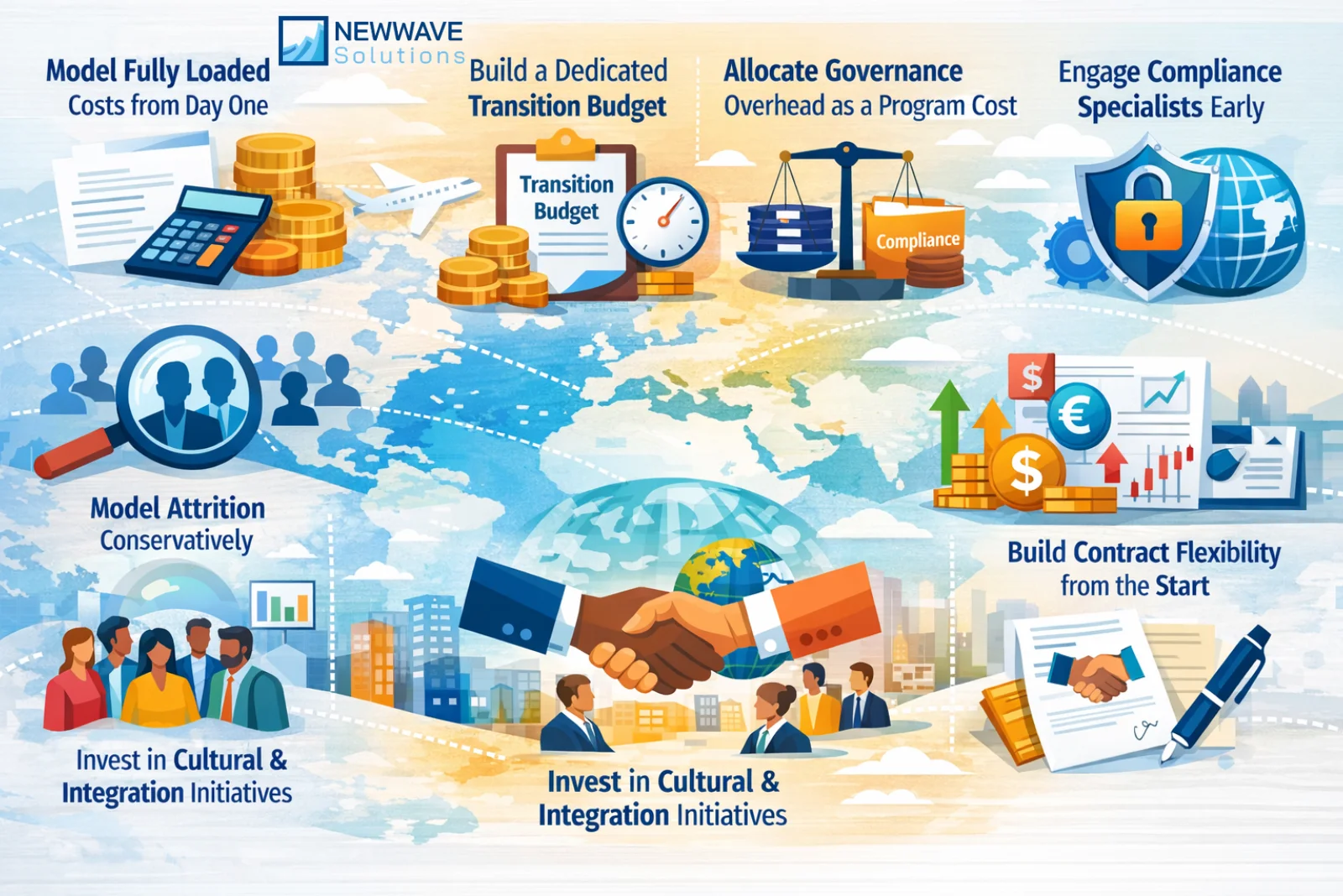
- Model fully loaded costs from day one: Every offshore budget should include EOR fees, statutory contributions, security tooling, equipment, and local legal advisory as standard line items — not post-contract discoveries.
- Build a dedicated transition budget: Year 1 projections should explicitly account for the 3–12-month ramp period, including the senior staff time diverted to onboarding and the productivity drag that accompanies knowledge transfer.
- Allocate governance overhead as a program cost: Management bandwidth, project oversight, and vendor contract administration should appear in the offshore program budget — not be absorbed invisibly by existing leadership capacity.
- Model attrition conservatively across a three-year horizon: Using a 15–20% annual attrition assumption for high-demand offshore markets reflects market reality and prevents replacement costs from arriving as surprises in Year 2 and Year 3.
- Engage compliance specialists before the first data crosses a border: Retrofitting security and regulatory controls into an already-operational offshore team is consistently more expensive than building them into the initial engagement design.
- Invest in cultural integration as a retention and velocity tool: Annual in-person alignment events and structured onboarding travel consistently reduce attrition and communication overhead at a cost that is modest relative to their impact on program ROI.
- Build contract flexibility into vendor agreements from the start: Clear performance benchmarks, transparent rate structures, and defined exit provisions protect the organization’s optionality and reduce the risk of vendor lock-in as the engagement matures.
- Run scenario planning on currency exposure: For multi-year offshore programs, incorporating currency buffers and evaluating contract payment structures against exchange rate risk is a standard component of responsible financial governance.
Why Enterprises Choose Newwave Solutions for Transparent, Fully Costed Offshore Partnerships?
Managing the hidden costs of offshoring requires more than awareness — it requires a delivery partner whose engagement model is built to surface and control those costs from the outset, not after they have already compressed the program’s financial case. Many offshore vendors compete on headline rates; the harder problem, and the one that determines program success, is financial transparency, governance maturity, and long-term team stability. Finding a partner that genuinely addresses all three dimensions can be challenging given the volume of options in the market — but Newwave Solutions is one name that deserves serious consideration.
Newwave Solutions is a pioneering offshore software development partner with over 14 years of experience delivering high-quality technology solutions across global markets. With a track record of 800+ successfully completed IT projects, a team of 300+ vetted engineers and specialists, and rigorous ISO 9001:2015 and ISO 27001 certification standards, Newwave brings the delivery maturity and institutional accountability that enterprise offshore engagements demand.
Particularly relevant to the hidden cost challenge, Newwave Solutions operates with full cost transparency — providing enterprises, CTOs, and tech leads with comprehensive budget modeling that includes governance overhead, compliance infrastructure, and total cost of ownership projections from the proposal stage, so that the numbers presented to the board reflect the real economics of the engagement.
Newwave Solutions’ Offshore Software Development Services
Newwave Solutions offers a comprehensive portfolio of offshore software development services designed to support enterprises at every stage of their technology lifecycle:
- End-to-End Development — The team manages the complete software development lifecycle — from architecture design and technical scoping through production deployment — so that enterprise clients receive a fully production-ready solution without the overhead of coordinating multiple specialist vendors.
- Custom Product Builds — Every proprietary software product is designed and built to each client’s specific business requirements, technology stack, and long-term scalability needs, rather than adapted from a generic template.
- Web & Mobile Apps — High-performance web applications and cross-platform mobile solutions are delivered across iOS, Android, and hybrid frameworks, covering everything from consumer-facing interfaces to complex internal enterprise tools.
- Enterprise Integrations — The integration practice specializes in connecting new software components with existing enterprise systems — including ERP, CRM, and legacy platforms — through robust API development and custom middleware engineering.
- Cloud & DevOps — Scalable cloud infrastructure, CI/CD pipelines, and automated deployment environments are designed and implemented to reduce operational overhead and improve delivery velocity across the full release cycle.
- Maintenance & Support — Ongoing post-launch maintenance, performance monitoring, security patching, and feature iteration support ensure that offshore-built products remain stable, secure, and aligned with evolving business requirements over time.
- Innovation & R&D — For enterprises exploring emerging technology applications — including AI, IoT, and blockchain — the R&D capability provides the technical depth required to move from concept validation to production-ready implementation with confidence.
- Quality Assurance — Both manual and automated testing coverage is delivered across functional, performance, and security dimensions, ensuring that every production release meets enterprise-grade quality and compliance standards before it reaches end users.
Conclusion
The hidden costs of offshoring are not unpredictable — they are simply unplanned for, and every cost category covered in this article is knowable, modulable, and manageable when approached with the same financial discipline applied to any other capital allocation decision. Identifying the hidden costs of offshore outsourcing upfront does not weaken the business case for offshoring; it makes that case defensible, transparent, and far more likely to deliver its projected value over a multi-year horizon.
If your organization is evaluating an offshore engagement or looking to bring greater financial discipline to an existing program, contact Newwave Solutions anytime and we are ready to help. Our team works directly with enterprises, CTOs, and tech leads to surface every cost variable upfront — ensuring that your offshoring project moves forward with full budget transparency and no financial surprises down the line.
To Quang Duy is the CEO of Newwave Solutions, a leading Vietnamese software company. He is recognized as a standout technology consultant. Connect with him on LinkedIn and Twitter.



Read More Guides


Get stories in your inbox twice a month.
Let’s Connect
Let us know what you need, and out professionals will collaborate with you to find a solution that enables growth.
Leave a Reply