


Top 7 Java Web Frameworks For Website Development
Java web frameworks have long been the backbone of enterprise-level web development, offering a structured and dependable platform for crafting complex applications. As the technological landscape continues to evolve at an unprecedented pace, developers are constantly seeking out cutting-edge frameworks that can streamline development processes and elevate the overall quality of their web creations.
In this blog, we’ll delve into the world of Java web development frameworks, exploring 7 of the most prominent and influential frameworks that you should be well-versed in if you’re a developer navigating the dynamic landscape.
What are Java web frameworks?
A Java web framework is a structured collection of libraries and tools that facilitate building web applications using the Java language. Such frameworks provide ready-made components for common tasks like HTTP request handling, session management, database interaction, and security, thereby reducing the need to build everything from scratch. By using a Java web framework, developers can accelerate development, ensure maintainability, and build scalable and secure web applications.
>>>See more: Java Software Development – All you need to know for the Beginners
Benefits of Using Java Frameworks for Web Development
Using Java web frameworks, or Java web development frameworks as they’re sometimes called, offers numerous advantages that can significantly enhance the development process and the overall quality of the resulting web applications. Here are some key benefits to explore:
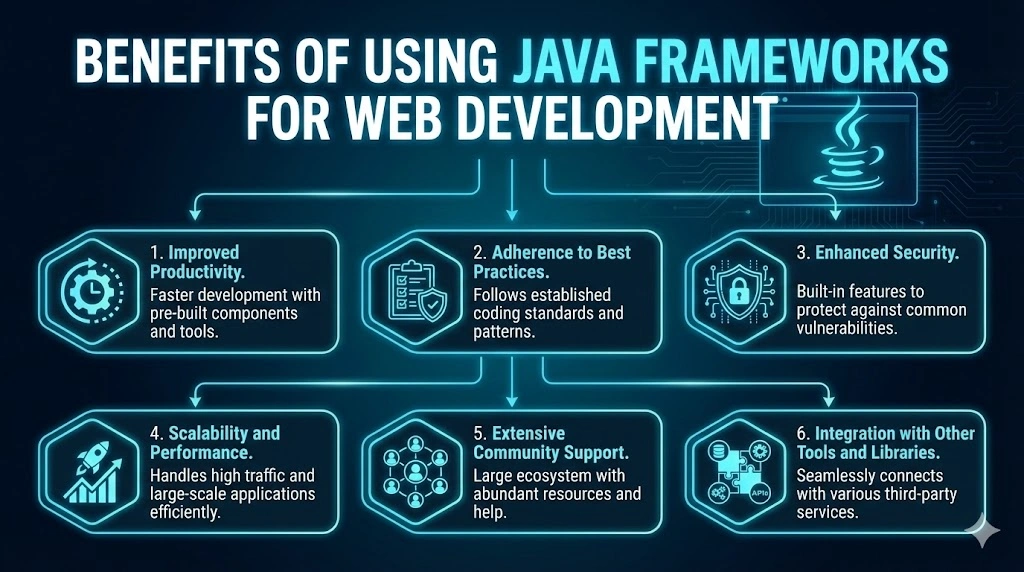
1. Improved Productivity
Java web frameworks offer a comprehensive set of tools, libraries, and pre-built components that handle common web app functionalities. This eliminates the need to constantly reinvent the wheel for each project. By abstracting away low-level details, these Java backend frameworks allow developers to focus on crafting the core business logic and delivering high-quality web apps with greater efficiency.
2. Adherence to Best Practices
Most Java web frameworks are designed to promote adherence to established industry best practices and architectural patterns, like Model-View-Controller (MVC) or Model-View-Presenter (MVP). By following these patterns, these frameworks encourage the creation of well-organized and consistent codebases. This makes it significantly easier for developers to understand and maintain the codebase over time, regardless of the chosen Java web app framework.
3. Enhanced Security
Security is paramount in web development. Thankfully, many Java web frameworks come equipped with built-in security features and mechanisms. These features safeguard applications from common vulnerabilities like cross-site scripting (XSS), cross-site request forgery (CSRF), and SQL injection attacks. These security measures empower developers to build more secure and reliable web applications.
4. Scalability and Performance
Java web frameworks are meticulously designed with scalability and performance in mind. They provide features and tools to assist applications in handling increasing loads and traffic without compromising performance. Many frameworks also offer support for caching, load balancing, and clustering, further enhancing the scalability and responsiveness of web applications.
5. Extensive Community Support
Popular Java web frameworks boast vibrant communities of developers who actively contribute to their growth. These communities provide valuable resources like documentation, forums, and support on platforms like Stack Overflow. This extensive community support ensures that developers have access to a wealth of knowledge, best practices, and solutions to commonly encountered problems within the Java web framework they choose.
6. Integration with Other Tools and Libraries
Java web frameworks frequently integrate seamlessly with other tools and libraries. This allows developers to leverage a wide range of functionalities and technologies within their web applications. This integration can encompass databases, caching systems, messaging queues, and more, providing a comprehensive ecosystem for building robust and feature-rich web applications.
Top 7 Java Web Frameworks for Efficient Development
Whether you’re searching for a Java web app framework or a more comprehensive Java web application development framework, there’s a solution to fit your needs. Let’s discover some of the best Java frameworks for web applications, exploring their key features and best use cases to guide you toward the most suitable choice for your project.
1. Spring / Spring Boot
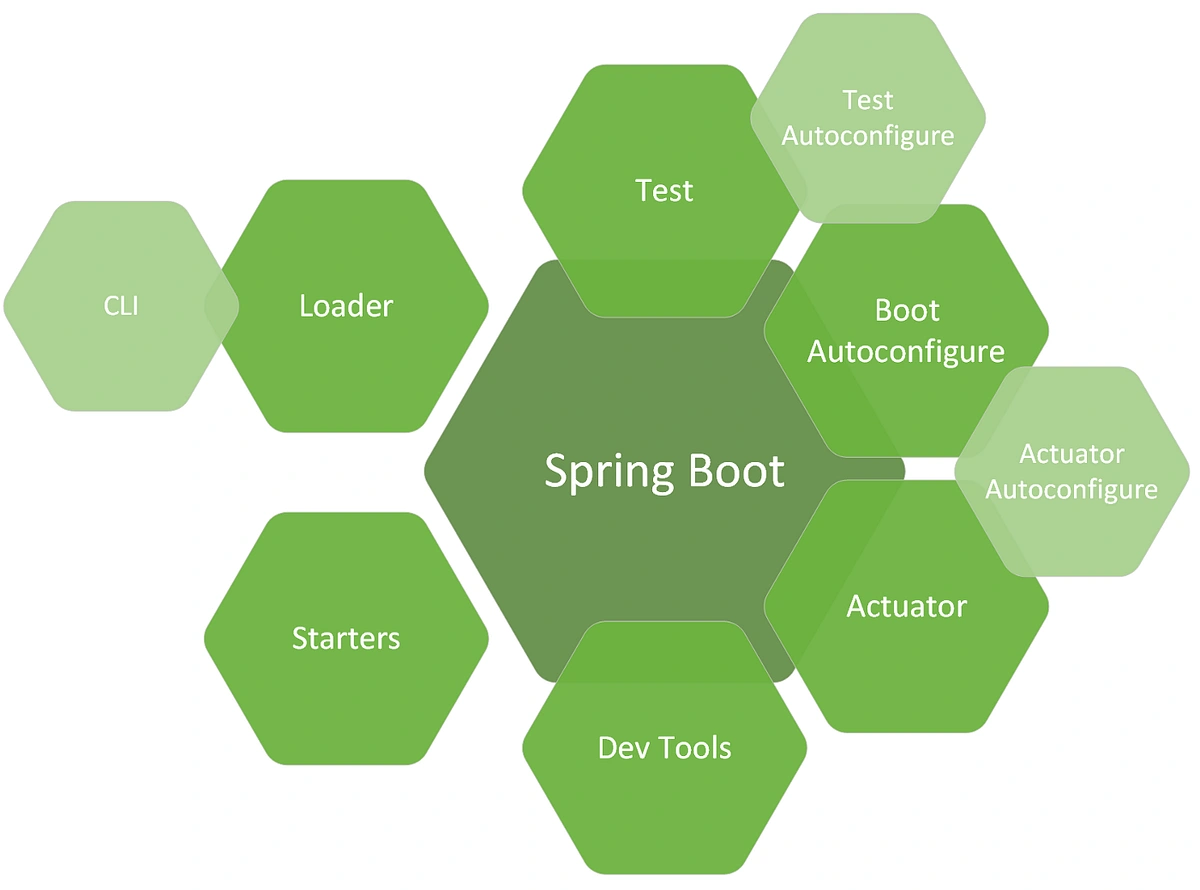
The Spring Framework (and its extension Spring Boot) is an open-source, full-stack Java framework that supports web development, microservices, dependency injection, and enterprise-grade backend infrastructure. It stands out for providing a comprehensive toolset that covers from data access to web request handling, making it a go-to choice for enterprise and large-scale applications. As of 2025, Spring remains the most widely adopted Java framework for web applications.
Key Features:
- Dependency Injection and Inversion of Control container for modular architecture
- Built-in MVC support for web request routing and controller-view separation
- Data access and transaction management with support for multiple data access frameworks (JPA/Hibernate, JDBC, etc.)
- Auto-configuration and opinionated “starter” packages via Spring Boot, enabling rapid setup and reduced boilerplate
- Strong community ecosystem, extensive documentation, and long-term support ensuring reliability and maintainability
Best for?
- Enterprise-scale web applications requiring robust architecture and modularity
- Microservices-based systems needing flexible backend services
- Web applications with complex business logic, data access, and transaction management
- Projects requiring long-term maintainability and extensible architecture
2. Hibernate (ORM-focused)
The Hibernate ORM framework is a Java-based object-relational mapping (ORM) tool that simplifies database interactions by mapping Java objects to relational database tables. It abstracts away low-level SQL and database handling, allowing developers to operate at an object-oriented level while ensuring persistent data is stored efficiently. Hibernate remains a core part of many Java web stacks when data access and complex relationships are involved.
Key Features:
- Automatic mapping between Java classes and database tables (object-relational mapping)
- Support for complex relationships (one-to-many, many-to-many, inheritance, etc.) and custom type mapping
- Lazy loading and caching mechanisms to optimize performance and reduce database load
- Abstraction of SQL queries — developers can use object-oriented code instead of direct SQL commands
- Compatibility with JPA standards and integration with frameworks like Spring for transaction management and data access layers
Best for?
- Web applications with complex data models and relational database requirements
- Projects requiring database-agnostic solutions and easy migration between DBMS
- Applications needing efficient data access and transaction management
- Enterprise systems where data integrity, relationships and persistence are critical
3. Play Framework
The Play Framework is a modern, reactive, full-stack web framework for Java (and Scala) that emphasizes stateless architecture, scalability, and high performance under load. It supports asynchronous processing, hot-reload during development, and a developer-friendly workflow, which makes it suitable for real-time, high-concurrency applications. Many modern web applications choose Play when performance and scalability matter.
Key Features:
- Asynchronous, non-blocking architecture enabling high throughput and scalability
- Hot-reload and developer-friendly workflow to accelerate development and iteration speed
- Built-in support for REST API creation, session management, and web routing
- Integrated support for JSON handling, WebSockets, and real-time communications for modern web features
- Cloud-ready architecture and ease of deployment for scalable distributed systems
Best for?
- High-traffic web applications requiring reactive, real-time updates or streaming data
- RESTful APIs, microservices back-ends, and web services expecting high concurrency
- Web applications requiring fast development cycles, agility, and frequent updates
- Applications where scalability and performance under load are important
4. Vaadin
The Vaadin framework specializes in building rich, component-based Java web UIs, allowing developers to write front-end code in Java instead of JavaScript. Vaadin is particularly attractive for enterprise internal applications or dashboards where rapid UI development and strong Java integration matter. It removes the need to use separate frontend frameworks, enabling Java developers to build interactive web interfaces directly.
Key Features:
- Server-side Java UI components — developers can build UI in Java without deep frontend technologies
- Rich set of pre-built UI components (tables, forms, charts, layouts) to accelerate UI development
- Automatic client-server communication abstraction — Vaadin handles AJAX/DOM under the hood
- Responsive design support and built-in theming for consistent UI across devices
- Seamless integration with Java backend systems — simplifying development and maintenance for enterprise applications
Best for?
- Enterprise internal web applications, dashboards, and admin portals requiring rapid UI development
- Projects where the team specializes in Java and minimal JavaScript expertise is available
- Applications needing complex UI components and interactive forms without heavy frontend coding
- Systems requiring tight backend-frontend integration in a pure Java stack
5. Apache Struts (Struts 2)
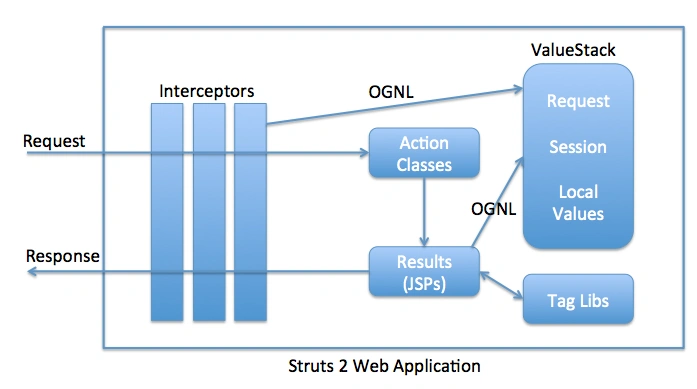
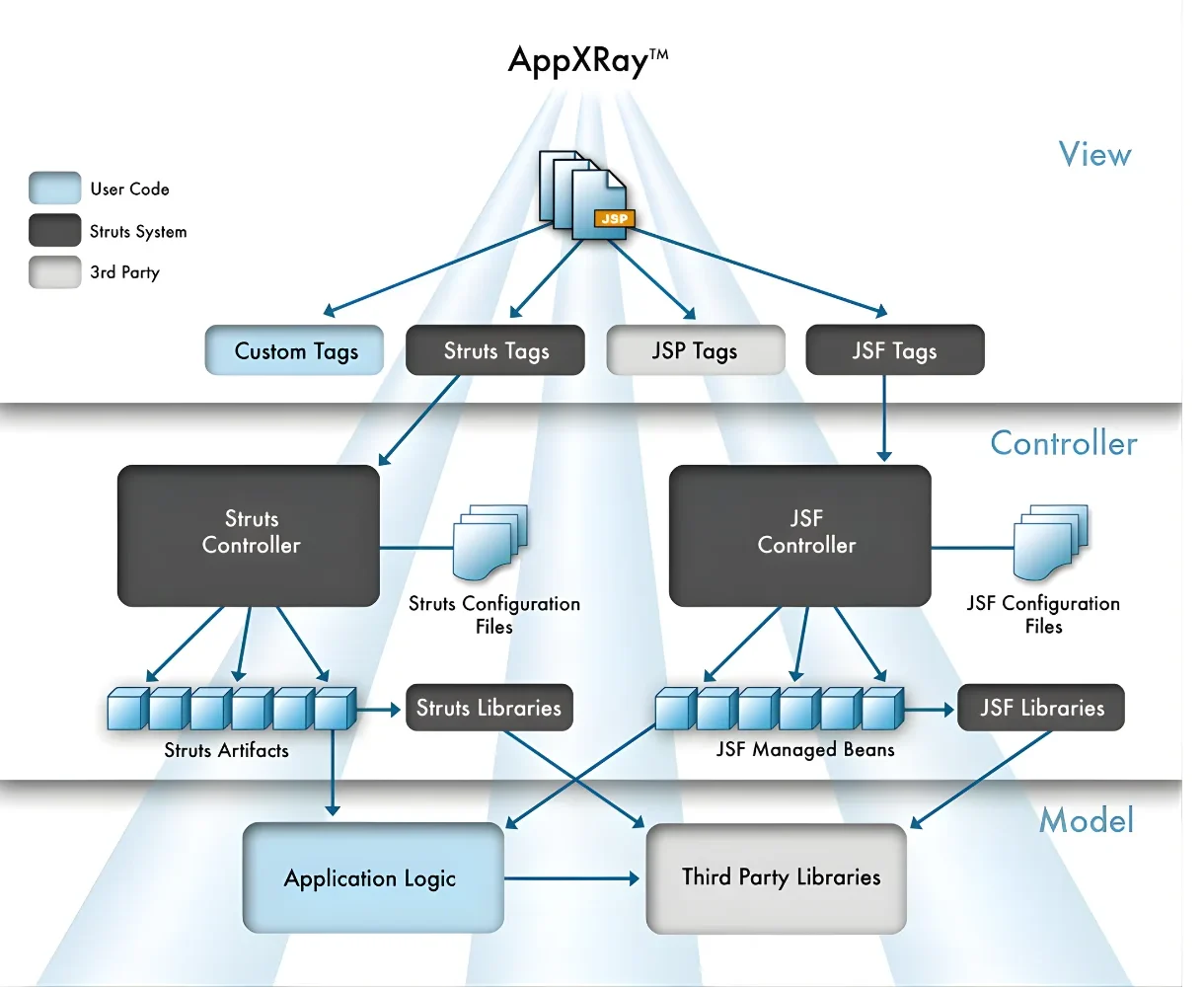
The Apache Struts framework is a classic Java MVC web framework that helped define early Java web application architecture. It offers a clear Model-View-Controller structure and many configuration options, making it suitable for traditional enterprise web applications with standard web flows. For legacy systems or businesses requiring stable, well-known framework behavior, Struts remains a valid option.
Key Features:
- MVC architecture separating business logic, view, and control layers for modularity and cleaner code organization
- Support for form validation, error handling, and internationalization out of the box
- Support for REST, AJAX, and JSON through plugins and extensions — enabling modern web features
- Configurable and extensible via plugin architecture — allowing customization to meet specific project requirements
- Wide compatibility — works with many servlet containers and Java EE servers, which makes deployment flexible
Best for?
- Legacy enterprise web applications or systems that were originally built with Struts
- Projects requiring a stable, well-documented MVC framework without heavy modern dependencies
- Web applications with traditional form-based workflows, server-side rendering, and standard web flows
- Organizations that prefer convention-based web development and broad compatibility
6. Dropwizard
The Dropwizard framework is a lightweight Java framework designed for building RESTful web services and microservices with minimal overhead. It bundles essential Java libraries for server (Jetty), JSON (Jackson), and metrics/monitoring — making it ideal for developers who want to build simple, performant backend services without large, opinionated frameworks. Dropwizard is often chosen for its simplicity and speed in building API-centric applications.
Key Features:
- Minimalistic and lightweight architecture — ideal for microservices or small web services
- Bundled with needed dependencies — HTTP server, JSON handling, metrics, logging — reducing setup complexity
- Fast startup and low memory footprint — well-suited for scalable backend services and containerized deployments
- Straightforward and convention-over-configuration approach, lowering boilerplate
- Focus on REST API development makes it ideal for mobile backends, microservices, and headless architectures
Best for?
- RESTful API backends or microservices architecture needing lightweight, performant services
- Backend services for mobile applications or single-page applications (SPA) requiring JSON-based communication
- Systems with containerized deployment (Docker, Kubernetes) where low overhead and performance matter
- Projects needing fast development cycles and minimal server-side complexity
7. JavaServer Faces (JSF)
The JavaServer Faces (JSF) framework — along with component-oriented UI frameworks — is tailored for server-side UI rendering in Java web applications. It allows developers to build UI components in Java, manage server-side state, and leverage standard component libraries, making it suitable for enterprise web apps needing strong server-side rendering and UI components. JSF remains relevant for organizations that emphasize standards compliance and stable UI frameworks.
Key Features:
- Component-based UI architecture simplifying UI construction and the reuse of UI elements
- Server-side rendering and event-driven UI processing — enabling the building of form-heavy enterprise applications
- Built-in support for lifecycle management, validation, internationalization, and theming — useful for enterprise readiness
- Tight integration with the Java EE ecosystem, including managed beans, dependency injection, and standard libraries
- Stability and long-term support due to its standardization and adoption by enterprises for traditional web applications
Best for?
- Enterprise web applications with server-side rendering requirements and complex UI forms
- Internal business applications, admin panels, and B2B portals where Java backend and UI logic are tightly coupled
- Projects that need stable, standards-compliant UI frameworks with long-term maintainability
- Applications where SEO, server-side rendering, or minimal client-side scripting are preferred
In case you are interested in other types of frameworks besides Java for web development, you can investigate our other article on the 5 best web app frameworks for web development to look for your desired options.
How to Choose the Right Java Web Frameworks
Besides the 7 main frameworks described above, there are additional Java web frameworks on the market, such as Micronaut, Quarkus, Apache Tapestry, or Vert.x — which may suit specific needs better. Choosing the optimal framework purely depends on your project requirements, business goals, and organizational constraints.
To help you make an informed decision, below are key criteria that enterprises and development teams should evaluate carefully:
- Project complexity and scalability needs — A framework should match the scale of the application: lightweight frameworks can serve small projects or microservices, while full-stack, enterprise-grade frameworks are more suitable for large, complex applications needing long-term scalability and modular architecture.
- Performance requirements and concurrency/load expectations — If the application is expected to handle high traffic, real-time data, or asynchronous processing, frameworks that support non-blocking/reactive architecture (e.g., Quarkus, Play, Vert.x) might be preferable to traditional blocking frameworks.
- Developer expertise and learning curve — The chosen framework should align with the existing team’s knowledge and skills; adopting a highly complex or niche framework may cause delays or errors if the team is not experienced, while a familiar, well-documented framework boosts productivity.
- Ecosystem, community support, and long-term maintenance — A framework with a large community, active updates, strong documentation, and wide adoption ensures better support, frequent security patches, and easier hiring of developers familiar with the framework.
- Integration requirements with tools, libraries, or architectures (e.g., microservices, cloud-native, databases) — The framework should provide or support smooth integration with required third-party services, databases, cloud, or microservices architecture to avoid costly custom work later on.
- Development speed and time-to-market constraints — For projects requiring fast delivery, frameworks that offer rapid setup, auto-configuration, and minimal boilerplate (for example, Spring Boot) help reduce development time and accelerate time-to-market.
- UI/UX and frontend vs backend balance — If the project demands a rich UI or heavy frontend logic, selecting frameworks that offer server-side UI support or easy front-end integration (e.g., component-based UI frameworks) may save effort; otherwise, simpler backend-oriented frameworks might suffice.
Partner with Newwave Solutions for quality Java Web Development Services
Successfully selecting the right Java web framework is only one part of the challenge in web development, as many other factors play critical roles. For businesses new to Java web development, understanding requirements and sourcing the right resources for the full project lifecycle can be difficult. Fortunately, Newwave Solutions’ Java Web Development Services cover the entire journey from idea conception and framework selection to launching and ongoing maintenance.
Our Java web development services empower you to build resilient, enterprise-grade platforms that combine high performance, modularity, and seamless integration capabilities. Specialized solutions include custom Java web development, cloud-based systems, and software re-architecture designed to meet your evolving business needs. Leveraging proven Java technologies and enterprise-grade architecture, Newwave Solutions ensures your applications adapt flexibly as your business grows, delivering modular and maintainable systems aligned with your strategic goals.
Key solutions we provide:
- Custom Java Web Development: Tailored Java applications aligned with your specific business logic and integration requirements for optimal workflow and functionality.
- Java API Development & Integration: Creation of robust RESTful APIs and seamless integration with third-party services to facilitate efficient data connectivity and interoperability.
- Java Microservices Development: Modular and independent service components that enhance system scalability, agility, and deployment speed for modern enterprise environments.
- Java UI/UX Design: Intuitive front-end designs harmonized with robust Java backends to ensure engaging and user-friendly interfaces.
- Maintenance & Support: Ongoing monitoring, optimization, security updates, and feature enhancements to ensure sustained performance and reliability.
- Cloud-Based Solutions: Development and deployment of cloud-native Java applications on platforms like AWS, Azure, or Google Cloud for scalable, cost-effective infrastructure.
Besides this Java web development solutions, feel free to explore other professional services of Newwave Solutions like Hire Java Developers or Java App Development Services if you are interested in Java applications across different platforms.
FAQs
1. What is the best framework for Java web development?
The best Java web framework for a particular project depends on various factors, including project requirements, team expertise, scalability needs, and community support. Popular contenders like Spring, Struts, Hibernate, GWT, Vaadin, and Grails offer unique strengths and cater to diverse project needs.
2. Which Java framework should I learn?
Spring Framework remains the most sought-after Java web framework due to its versatility, maturity, and vast community support. Learning Spring provides a solid foundation for building diverse Java web applications. Additionally, frameworks like Flutter and ReactJS are gaining traction for building Progressive Web Apps (PWAs).
Conclusion
Java web frameworks are crucial in modern web development, offering developers a structured approach to building robust and scalable web applications.
By understanding the strengths, main functions, and use cases of the above Java web development frameworks, developers can make informed decisions when selecting the best options for their specific project requirements. Whether you’re building microservices, data-driven applications, or traditional web interfaces, there’s a Java framework available to streamline development and empower you to achieve your goals efficiently.
Connect with Newwave Solutions to explore how Java web frameworks can elevate your development projects and drive success in the ever-changing tech industry.
Contact Information:
- Head Office (Hanoi): 1F, 4F, 10F, Mitec Building, Cau Giay Ward, Hanoi City, Vietnam
- Branch Office (Tokyo): 1chōme118 Yushima, Bunkyo City, Tokyo 1130034, Japan
- Hotline: +84 985310203
- Website: https://newwavesolution.com
- Email: [email protected]
To Quang Duy is the CEO of Newwave Solutions, a leading Vietnamese software company. He is recognized as a standout technology consultant. Connect with him on LinkedIn and Twitter.



Read More Guides
Get stories in your inbox twice a month.
Let’s Connect
Let us know what you need, and out professionals will collaborate with you to find a solution that enables growth.
Leave a Reply