


JavaServer Faces (JSF) Tutorials: The Complete Enterprise UI Framework Guide
In enterprise Java, where microservices and modern front-end stacks dominate, JavaServer Faces (JSF), now is Jakarta Faces, remains a battle-tested, component-based UI framework powering mission-critical applications. For teams maintaining legacy platforms or operating in regulated industries where stability, consistency, and long-term maintainability matter, understanding JSF is essential. This guide explains JSF’s enduring value, when to use it, how it works, and why it remains relevant in specific enterprise contexts.
What is JavaServer Faces?
JavaServer Faces (JSF) is a standardized, component-based web application framework for Java that simplifies building user interfaces for web applications by providing reusable UI components and a clear MVC architecture. Developed through the Java Community Process, JSF represents the official web framework standard for Java EE and Jakarta EE platforms, ensuring compatibility and integration with other enterprise Java technologies.
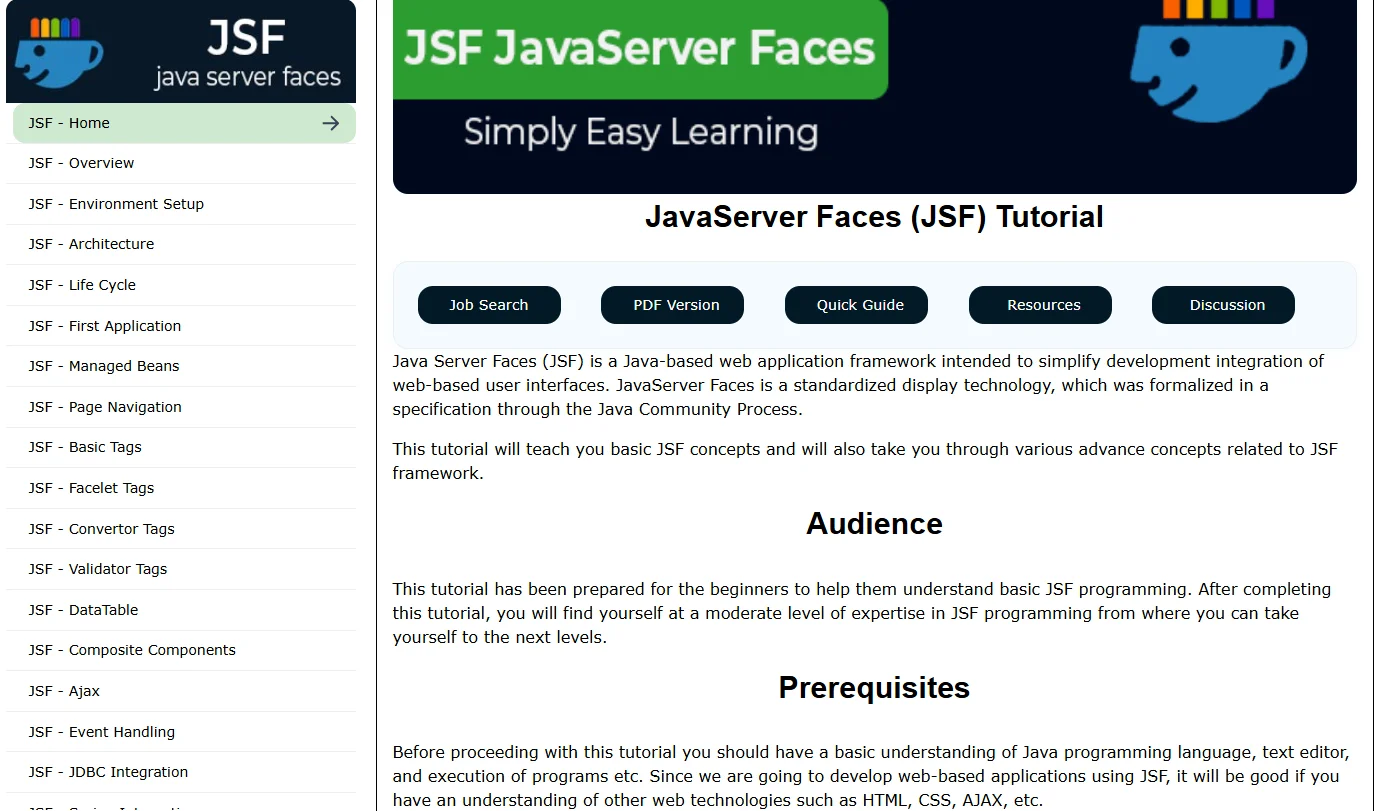
So, what is JavaServer Faces technology in practical terms? It’s a framework that brings a component-oriented approach to web development, similar to how desktop applications are built. Each UI element—from simple buttons to complex data tables—is treated as a reusable component with built-in behavior and state management. This approach significantly accelerates development for complex web app development service projects while maintaining high standards of code quality and maintainability.
Key Characteristics of JSF:
- Component-Based Architecture: Reusable UI components with built-in functionality
- Standard Java EE Integration: Seamless integration with CDI, EJB, JPA, and other Java standards
- Event-Driven Programming: Familiar event model similar to traditional desktop applications
- Rich Ecosystem: Extensive component libraries like PrimeFaces and RichFaces
- Templating System: Facelets for creating reusable page templates and layouts
Why Choose JavaServer Faces?
You should choose JavaServer Faces when developing enterprise Java applications that require standardization, component reusability, and seamless integration with the broader Java EE ecosystem. Its design philosophy makes it ideal for organizations that value long-term stability and have significant investments in Java technology.
1. Standardization and Long-Term Support
As an official Java standard, JSF provides guaranteed long-term support and compatibility with other Java technologies. This makes it ideal for banking software development services and government projects where technology stability and long-term maintenance are critical requirements that cannot be compromised.
2. Component-Based Development Efficiency
JSF’s component model allows developers to create reusable UI components that encapsulate both presentation and behavior. This significantly accelerates development for insurance software where similar form patterns and data tables appear across multiple modules, reducing development time and ensuring consistency.
3. Seamless JavaEE Integration
JSF integrates seamlessly with other Java EE technologies like Contexts and Dependency Injection (CDI), Enterprise JavaBeans (EJB), and Java Persistence API (JPA). This unified ecosystem simplifies the development of complex fintech solutions that require robust transaction management, security, and data persistence capabilities.
4. Professional UI/UX Capabilities
With rich component libraries and built-in support for UI/UX design services, JSF enables the creation of sophisticated user interfaces without extensive JavaScript coding. The framework’s component-based approach ensures design consistency across large enterprise applications.
JSF 1.x vs JSF 2.x
JSF 1.x introduced the foundation of component-based UI development in Java, but it was criticized for being verbose, XML-heavy, and difficult to extend. Developers often had to deal with complex configurations and limited templating support. Meanwhile, JSF 2.x modernized the framework with Facelets templates, annotations (reducing XML), integrated AJAX support, better state management, and CDI integration. These updates made JSF more developer-friendly, flexible, and aligned with modern enterprise needs.

JSF 1.x – The Foundation
JSF 1.x established the core component model and lifecycle that defined the framework’s approach to web application development. JSF 1.x introduced the fundamental concepts of component-based web development to the Java ecosystem. It provided the basic architecture of UI components, managed beans, and the request processing lifecycle.
However, it faced challenges with configuration complexity and limited templating capabilities. Many legacy enterprise systems built during the early 2000s still run on JSF 1.x, particularly in banking software, where system stability often outweighs the benefits of migration.
JSF 2.x – The Modern Evolution
JSF 2.x represents a significant evolution with enhanced features, reduced configuration, and improved integration capabilities for modern enterprise development. Released in 2009, JSF 2.x addressed many limitations of the initial version through features like Facelets as the default view technology, annotation-based configuration, and improved Ajax support.
This version made JSF much more productive and suitable for contemporary web app development projects. The enhanced component libraries and better performance characteristics make JSF 2.x ideal for new real estate development and other modern business applications.
What Is JavaServer Faces Used For?
JavaServer Faces (JSF) is used to build enterprise-grade web applications with a focus on user interface development, form handling, and component reuse. Its strength lies in providing a standardized, component-based framework that integrates seamlessly with the wider Java EE/Jakarta EE ecosystem. Let’s break down the main use cases where JSF is most effective:
1. Enterprise Web Portals and Management Systems
JSF is commonly used in large-scale administrative portals, dashboards, and enterprise management systems. For example, a corporate HR portal can be developed with JSF to manage employee data, payroll, and reports. Developers use pre-built components like tables, buttons, and forms, reducing the amount of repetitive code. Unlike frameworks such as Struts, which require more manual JSP development, JSF’s component-based model ensures consistency across the entire portal and accelerates delivery for enterprise clients.
2. Form-Intensive Business Applications
Applications in banking, insurance, or healthcare often involve complex forms with multiple fields, validations, and conditional rules. JSF makes this easier by automatically converting and validating input data (e.g., numbers, dates, currency formats) and displaying user-friendly error messages. This reduces coding effort and improves accuracy. Compared to Struts, where developers need to handle much of the validation manually, JSF provides these features out of the box, streamlining development for form-heavy workflows.
3. Reusable UI Components Across Projects
One of JSF’s biggest advantages is its ability to reuse UI components. Developers can create a login form, search bar, or table component once and reuse it across multiple pages and even projects. This approach ensures brand consistency, reduces maintenance overhead, and speeds up new feature development. Struts relies more on tag libraries, while JSF treats components as first-class citizens with their own lifecycle, which is closer to how modern front-end frameworks like Angular or React work.
4. Stateful User Interfaces and Multi-Step Workflows
JSF was designed to manage stateful UIs, meaning it remembers user inputs and progress across multiple requests. This is particularly valuable for multi-step workflows such as e-commerce checkout processes, online loan applications, or multi-page onboarding systems. Instead of writing custom session-handling logic, JSF automatically keeps track of user state, saving developers significant time and reducing errors. In contrast, Struts is more request-driven, making state management more complex.
5. Integration with EnterpriseJavaStack
JSF fits naturally into the Jakarta EE ecosystem, integrating seamlessly with technologies like CDI (Contexts and Dependency Injection), JPA (Java Persistence API), EJB (Enterprise JavaBeans), and Bean Validation. This makes it easier to connect user interfaces directly to backend services such as databases, security modules, and APIs. Struts can integrate too, but JSF offers a more standardized and streamlined path, which is especially helpful in large enterprise environments where multiple teams work on different layers of the system.
6. Internationalization (i18n) and Localization
Global businesses need applications that adapt to different languages, date formats, and cultural contexts. JSF simplifies this by using resource bundles that store messages and labels externally. Developers can easily add new languages without changing the application code, making JSF a strong choice for global ERP, CRM, or e-government platforms. While Struts also supports i18n, JSF ties it directly to UI components, making localized UIs easier to manage.
7. Template and Layout Management
Maintaining consistency across hundreds of pages is a challenge in enterprise applications. JSF solves this with Facelets templates, which define headers, footers, navigation bars, and other shared layouts in one place. When design updates are needed, developers only modify the template, and changes appear everywhere. This reduces duplication, enforces brand consistency, and speeds up updates. Struts uses Tiles for layout, but JSF’s Facelets system is more flexible and better integrated.
8. REST, AJAX, and Front-End Integration
JSF supports AJAX requests, JSON data exchange, and RESTful services out of the box. This allows developers to build modern, interactive web applications without reloading entire pages. For instance, a real estate search app can use JSF with AJAX to update listings dynamically while pulling data from a Struts-like backend or a REST API. JSF also integrates with JavaScript frameworks when needed, giving teams flexibility to combine server-side stability with client-side interactivity.
How does JavaServer Faces work?
JavaServer Faces operates through a well-defined request processing lifecycle that manages component state, validation, data conversion, and event handling to create a stateful web application experience.
The JSF Lifecycle Explained
Think of JSF as a sophisticated assembly line for web applications, where each request goes through a precise sequence of phases:
- Restore View – JSF rebuilds the component tree from the previous request or creates a new one
- Apply Request Values – Form values are applied to components, and events are queued for processing
- Process Validations – Input validation and data conversion occur with comprehensive error handling
- Update Model Values – Validated data updates the backend beans and business objects
- Invoke Application – Business logic executes in response to user actions and events
- Render Response – The updated UI components generate the final HTML output for the browser
This structured lifecycle ensures that data flows consistently between the browser and server while maintaining component state across multiple requests, providing a robust foundation for enterprise applications.
Component-Based Architecture in Action
JSF’s power comes from its component-oriented approach:
- UI Components – Reusable elements like input fields, data tables, and command buttons
- Managed Beans – Backing beans that handle business logic with proper dependency injection
- Facelets Templates – Reusable page layouts and templates for consistent UI/UX design services
- Navigation Handler – Manages page flow and navigation rules
- Converter and Validator System – Handles data transformation and business rule validation
Advantages and Disadvantages
JavaServer Faces offers enterprise-grade features and Java EE integration, but requires an understanding of its complex lifecycle and may have performance considerations.
Advantages
- Enterprise Standardization: Official Java EE standard with guaranteed long-term support
- Component Reusability: Rich ecosystem of reusable UI components, reducing development time
- Java Ecosystem Integration: Seamless integration with CDI, EJB, and JPA technologies
- Security Framework: Built-in integration with Java EE security standards
- Development Productivity: Rapid application development with comprehensive component libraries
Disadvantages
- Learning Complexity: Steep learning curve due to complex lifecycle and concepts
- Performance Considerations: State management overhead can impact application performance
- Configuration Requirements: Extensive configuration needed for optimal operation
- Modern Integration Challenges: Can be complex to integrate with contemporary JavaScript frameworks
Why Partner with Newwave Solutions for JSF?
Maintaining and modernizing JSF applications requires more than just Java knowledge — it takes deep framework expertise, security-first thinking, and a clear modernization strategy. That’s exactly what Newwave Solutions delivers. With our hire Java developers services, we help enterprises stabilize their existing JSF systems while planning sustainable growth for the future.
What You Gain with Newwave Solutions?
- Legacy JSF Maintenance: Reliable upkeep, performance optimization, and bug resolution to keep your systems stable and cost-efficient.
- Strategic Modernization: Roadmaps for incremental upgrades, such as CDI adoption, Bean Validation, REST integration, or hybrid UI strategies that balance old and new.
- Enterprise-Grade Security: Comprehensive audits, dependency updates, and compliance alignment to protect mission-critical applications.
- Reusable UI Libraries: Custom component kits and templates that accelerate delivery and ensure design consistency across projects.
- Knowledge Transfer & Training: Clear documentation and workshops for your in-house teams, ensuring long-term confidence and continuity.
Conclusion
We’ve covered what is JSF framework in Java – a robust, component-based solution for building sophisticated web applications that integrate seamlessly with the broader Java ecosystem. While Apache Struts served as an important predecessor in Java web development services, JSF’s component-oriented approach represents the evolution of enterprise web frameworks.
The framework’s standardization, rich component ecosystem, and integration capabilities make it particularly valuable for organizations building banking software development services, fintech solutions, and other mission-critical business systems. While JSF requires investment in learning its concepts and lifecycle, the long-term benefits in productivity, maintainability, and integration make it a strategic choice for enterprises committed to the Java platform.
JSF continues to be a reliable enterprise UI framework for businesses where consistency, governance, and long-term maintainability matter. By partnering with Newwave Solutions and leveraging our IT outsourcing services, you ensure that your JSF applications remain secure, efficient, and future-ready, without disrupting daily operations.
To Quang Duy is the CEO of Newwave Solutions, a leading Vietnamese software company. He is recognized as a standout technology consultant. Connect with him on LinkedIn and Twitter.



Read More Guides
Get stories in your inbox twice a month.
Let’s Connect
Let us know what you need, and out professionals will collaborate with you to find a solution that enables growth.
Leave a Reply