


Legacy System Modernization: Future-Proof Your Infrastructure & Budget
While legacy systems continue to power many enterprise operations, aging technologies often create significant bottlenecks that limit scalability, integration, and continuous innovation. Consequently, legacy system modernization has emerged as a vital strategy to help organizations transform outdated applications and infrastructure into agile, scalable platforms that support modern digital business models. This comprehensive guide explores the true meaning of legacy modernization, why companies invest in it, and how to find a reliable partner to navigate your modernization process effectively.
What is Legacy System Modernization?
Legacy system modernization refers to the process of upgrading outdated applications, infrastructure, and software architectures so that organizations can operate on modern technology platforms that support scalability, security, and integration. This process typically focuses on improving existing systems through architectural upgrades, cloud migration, or code optimization rather than discarding the entire application stack.
Legacy system modernization differs from full replacement because modernization preserves valuable business logic while gradually transforming the underlying technology environment into modern architectures. As a result, this transformation often plays a critical role in enterprise digital transformation initiatives by enabling companies to adopt cloud platforms, AI technologies, and data-driven services without disrupting core business operations.
Example: IBM successfully modernized its legacy COBOL mainframe systems for core banking operations using automated refactoring tools and microservices architecture, migrating over 1.5 billion lines of code across global financial services. This transformation reduced operational costs by 40% annually while achieving 99.99% uptime and enabling real-time transaction processing for enterprise clients.
Why Enterprises need Legacy System Modernization:
- Overcoming Scalability Bottlenecks: Legacy monolithic architectures often fail to handle increasing transaction volumes or high user concurrency, hindering the ability to meet evolving market demands.
- Mitigating Security & Compliance Risks: Modernizing eliminates vulnerabilities found in unsupported frameworks and outdated encryption, ensuring your system aligns with current cybersecurity and regulatory standards.
- Reducing Operational & Maintenance Costs: Enterprises can stop draining budgets on expensive legacy licenses, obsolete hardware, and the high costs of maintaining specialized, aging expertise.
- Enhancing Integration & Innovation: Modernization removes silos by creating the necessary API layers to seamlessly connect with modern cloud services, advanced analytics, and AI platforms.
- Eliminating Talent Shortages: Transitioning to modern stacks solves the challenge of finding engineers, as developers are more proficient and available for current programming languages than for legacy architectures.
Benefits of Legacy System Modernization
In an increasingly competitive digital economy, sticking with rigid, outdated software often results in missed market opportunities and inflated maintenance overhead. This section explores the transformative benefits of modernization, illustrating how upgrading your core systems can unlock superior scalability, cost efficiency, and long-term business resilience.
- Accelerated innovation and product delivery: Legacy system modernization enables engineering teams to build, test, and release new digital features faster because modern architectures support automation, CI/CD pipelines, and scalable cloud infrastructure.
- Improved system performance and reliability: Modernized platforms handle higher workloads and reduce system failures because updated architectures improve resource utilization and processing efficiency.
- Seamless integration with modern platforms: Modernized systems integrate more effectively with cloud infrastructure, APIs, and enterprise data platforms, which allows organizations to build interconnected digital ecosystems that support continuous innovation.
- Reduced maintenance and operational expenses: Modernization lowers infrastructure costs because organizations can retire expensive legacy hardware and shift workloads to flexible cloud environments.
- Enhanced security and regulatory compliance: Updated systems incorporate modern encryption protocols, identity management frameworks, and compliance mechanisms that help enterprises protect sensitive business data.
6 Best Legacy System Modernization Strategies
There is no “one-size-fits-all” approach to transformation, and choosing the wrong path can lead to wasted investment and technical failure. We detail the most effective strategies—from rehosting to complete refactoring—to provide you with a clear menu of options for revitalizing your technology stack according to your specific needs.
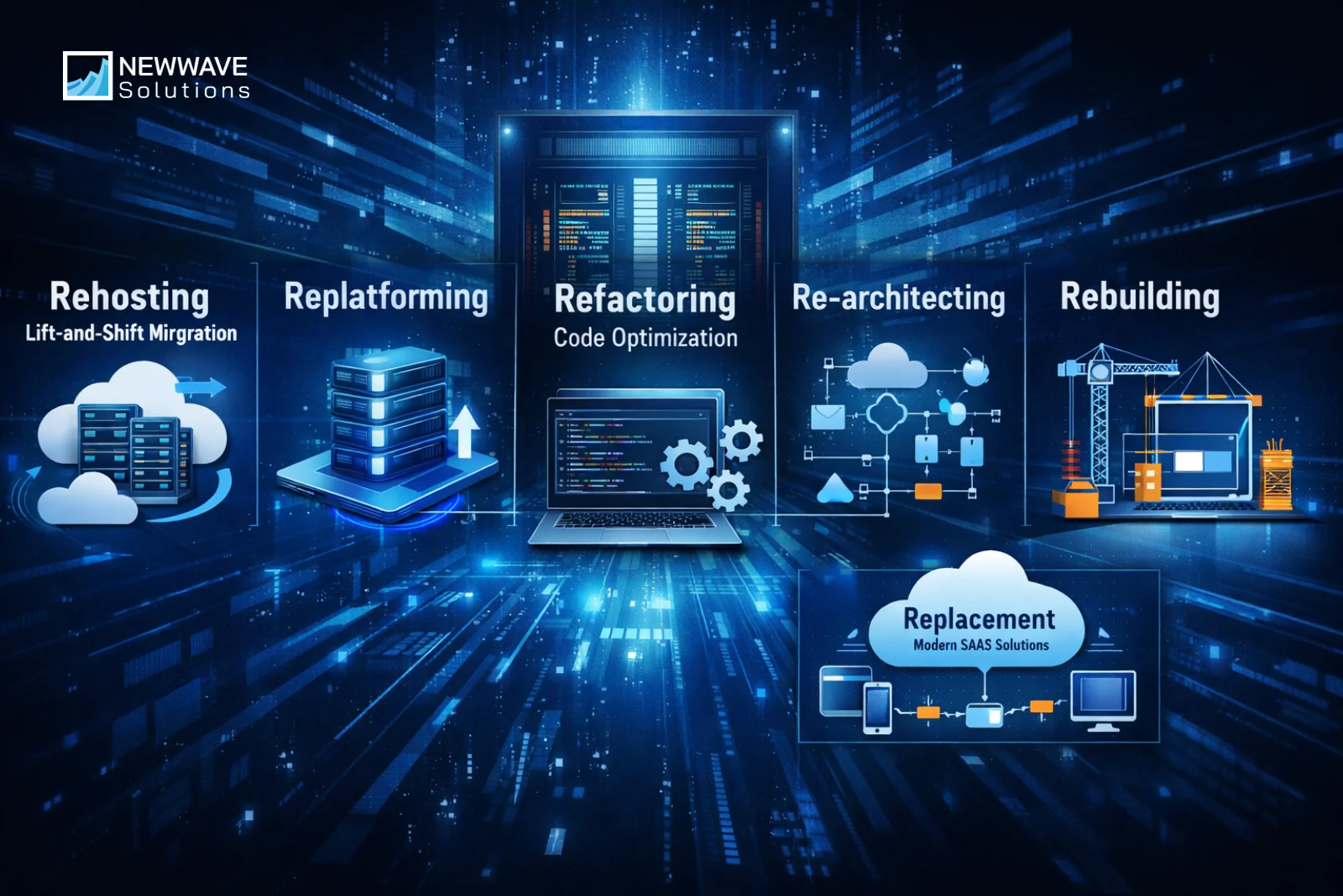
1. Rehosting (Lift-and-Shift Migration)
Rehosting involves moving an existing legacy application to modern infrastructure such as cloud platforms while preserving the original application code and architecture. This strategy focuses on infrastructure modernization and is considered one of the simplest legacy system modernization approaches because it introduces minimal changes to the application logic.
Pros
- Fast implementation timeline
- Minimal code modification required
- Lower migration risk compared to complex modernization
Cons
- Legacy architectural limitations remain
- Limited improvement in application scalability
Best For?
- Enterprises migrating workloads to AWS, Azure, or Google Cloud
- Financial services companies running stable legacy systems
- Organizations seeking rapid infrastructure modernization
2. Replatforming
Replatforming modifies selected system components so that the application can benefit from modern runtime environments, databases, or containerized platforms. This strategy allows organizations to modernize legacy systems gradually while preserving core business logic.
Pros
- Moderate performance improvements
- Balanced modernization effort and cost
- Better compatibility with cloud services
Cons
- Some legacy limitations remain
- Requires partial application adjustments
Best For?
- SaaS companies transitioning from monolithic infrastructure
- Mid-size enterprises moving toward hybrid cloud environments
- E-commerce platforms optimizing backend performance
3. Refactoring (Code Optimization)
Refactoring restructures existing application code to improve maintainability, scalability, and performance without fundamentally changing system functionality. This method often forms part of long-term legacy system modernization strategies because it reduces technical debt and prepares applications for microservices architectures.
Pros
- Improved code maintainability
- Higher scalability and performance
- Better support for modern development practices
Cons
- Higher engineering effort
- Potential temporary operational disruption
Best For?
- Technology companies preparing for microservices architectures
- SaaS platforms with long-term scalability goals
- Enterprises with complex application codebases
4. Re-architecting
Re-architecting redesigns the system architecture to support modern technologies such as microservices, event-driven systems, or cloud-native environments. This strategy allows organizations to modernize legacy systems while preserving essential business logic and improving long-term scalability.
Pros
- Major scalability improvements
- Enables cloud-native development
- Greater architectural flexibility
Cons
- Complex development process
- Higher implementation cost
Best For?
- Large enterprises undergoing digital transformation
- Fintech platforms with high transaction volumes
- Global e-commerce platforms requiring high scalability
5. Rebuilding
Rebuilding involves rewriting the legacy application from scratch using modern technologies while maintaining the original business requirements. This strategy eliminates technical debt and enables organizations to adopt a fully modern technology stack.
Pros
- Fully modern architecture
- Maximum performance improvements
- Eliminates legacy technical debt
Cons
- Long development timeline
- High investment and project risk
Best For?
- Startups replacing outdated internal systems
- SaaS platforms transitioning to cloud-native architectures
- Enterprises undergoing large-scale platform transformation
6. Replacement (Adopting Modern SaaS Solutions)
Replacement involves retiring from legacy systems and adopting modern commercial software solutions such as SaaS platforms or enterprise systems. This strategy focuses on adopting ready-made digital platforms instead of maintaining custom legacy infrastructure.
Pros
- Immediate access to modern functionality
- Lower internal development workload
- Vendor-supported infrastructure
Cons
- Limited customization options
- Potential vendor lock-in risks
Best For?
- Small and mid-size enterprises adopting SaaS platforms
- Organizations replacing outdated ERP systems
- Companies focusing on rapid digital transformation
How to pick the appropriate Modernization Strategy?
The gap between a failed project and a successful transformation often lies in the initial alignment between your current technical constraints and your ultimate business vision. This guide outlines the critical criteria—including risk appetite, budget, and system complexity—to help you identify which specific modernization strategy will yield the highest ROI for your unique environment.
- Evaluate System Criticality vs. Risk: Management should choose Rehosting (Lift & Shift) for non-essential systems to minimize downtime, whereas mission-critical applications often require Rearchitecting to eliminate deep-seated performance bottlenecks.
- Analyze Technical Debt and Architecture: Engineering teams should opt for Refactoring when the code quality is manageable but requires optimization, while highly obsolete monolithic systems may necessitate a complete Rebuild using modern microservices.
- Balance Budget with Long-term ROI: Stakeholders must determine if they prefer low-cost, immediate infrastructure updates through Replatforming or if they are ready to invest in Replacing the system with a SaaS solution to eliminate long-term maintenance overhead.
- Assess Scalability and Innovation Needs: Architects should prioritize Encapsulation (API-first) when the goal is to quickly connect legacy data to modern web/mobile apps without the risk of modifying the complex core logic.
- Align with Internal Talent and Support: Organizations should select a strategy that matches their team’s expertise or partner with a specialized modernization vendor to ensure the new tech stack can be efficiently managed and scaled after the transition.
Step-by-Step Legacy System Modernization Roadmap
Without a structured execution plan, even the most well-funded modernization initiatives can succumb to scope creep and operational disruption. Below, we break down the process into a logical, five-step roadmap designed to help your team transition from initial audit to final optimization with minimal risk and maximum efficiency.
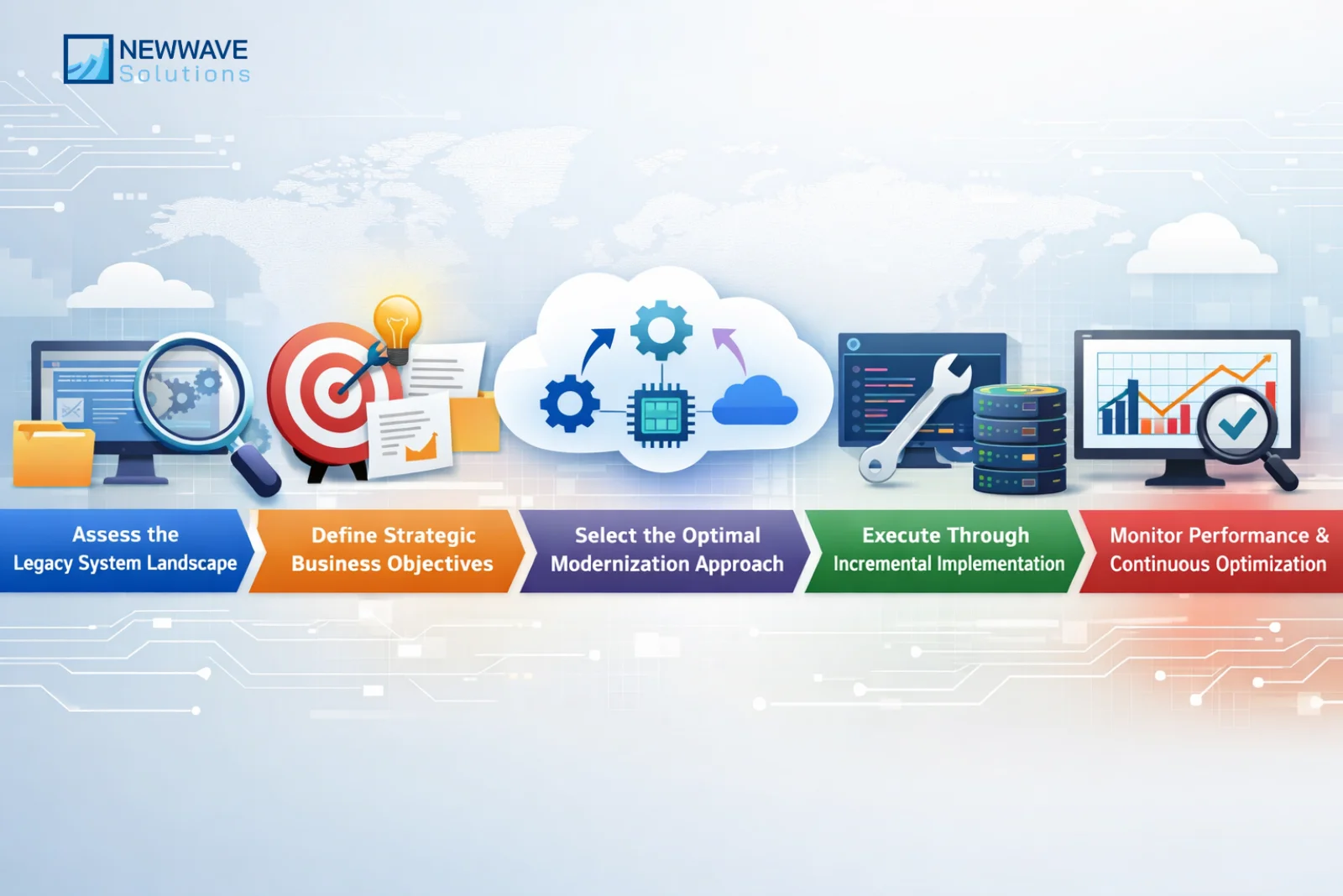
Step 1: Assess the Legacy System Landscape
A successful modernization initiative begins with a comprehensive audit of existing applications, infrastructure, and system dependencies to ensure that organizations possess a clear understanding of their current technology landscape. This assessment typically evaluates technical debt, operational risks, and performance limitations to identify which specific systems deliver the highest business value.
Furthermore, engineering teams should carefully document all integrations and data flows, as these intricate dependencies will heavily influence the strategic planning required in the subsequent stages of the project.
Step 2: Define Strategic Business Objectives
Enterprise leadership must establish clear modernization goals so that every technology upgrade aligns perfectly with strategic priorities such as scalability, operational efficiency, or digital innovation. A well-structured objective framework usually includes measurable KPIs, detailed cost-benefit analysis, and a projection of expected operational improvements.
It is vital that organizations treat this process as a holistic business transformation rather than a purely technical task, because sustainable growth depends on how well the new infrastructure supports long-term corporate strategies.
Step 3: Select the Optimal Modernization Approach
Technology leaders are responsible for evaluating various modernization models to select the most appropriate path based on application complexity, risk tolerance, and scalability requirements. During this phase, organizations typically compare strategic options such as rehosting, refactoring, or rebuilding to determine which transformation path offers the most effective results.
These critical decisions often involve a combination of multiple modernization techniques that balance the desired technological impact against the total implementation cost.
Step 4: Execute Through Incremental Implementation
Engineering teams should carry out the modernization process gradually by prioritizing high-value applications or microservices that generate the most significant operational impact. This incremental execution model allows organizations to minimize potential system downtime while continuously validating performance improvements during each transition phase.
Many successful enterprises adopt this phased approach because it provides the flexibility to modernize core systems without causing any interruptions to daily business operations.
Step 5: Monitor Performance and Continuous Optimization
Once the transition is complete, organizations must continuously measure system performance to ensure that the upgraded platform delivers tangible improvements in reliability and efficiency. This monitoring process involves the use of real-time performance metrics, governance policies, and ongoing optimization activities to maintain peak system health.
Continuous evaluation remains essential because the most effective modernization programs function as evolving technology cycles rather than isolated, one-time infrastructure upgrades.
When to modernize Legacy Systems?
It is often difficult for leadership to determine exactly when the cost of maintaining a legacy system begins to outweigh the risks of a major technical transition. We highlight the critical “red flags”—from rising maintenance fees to integration failures—that signal your organization has reached a tipping point where modernization is no longer optional, but essential.
- Growing scalability limitations – Consider modernization when legacy systems can no longer handle traffic spikes, expanding data volumes, or the addition of new digital channels.
- Frequent system maintenance and downtime – Initiate an upgrade when recurring outages and constant patching begin to compromise your service reliability and core business operations.
- Rising operational costs for outdated infrastructure – Transition to modern platforms when the financial burden of legacy licenses, hardware maintenance, and specialized support exceeds the cost of new technology.
- Difficulty adopting modern technologies – Evaluate modernization if your current systems are incompatible with cloud-native architectures, AI integration, or advanced data analytics tools.
- Reduced business agility and slower product development – Modernize your tech stack when rigid legacy codebases cause development bottlenecks and delay the launch of new products or services.
Common Challenges in Legacy System Modernization
Despite the clear benefits, the journey toward a modern stack is frequently hindered by data silos, talent shortages, and the fear of breaking mission-critical workflows. This section identifies the most frequent obstacles encountered during the modernization lifecycle and offers expert advice on how to navigate these hurdles without compromising your business continuity.
- Data migration complexity – Transferring vast historical datasets from obsolete infrastructure often leads to high operational risks and data integrity issues. To counter this, enterprises should utilize structured migration frameworks and phased deployment strategies to ensure a seamless transition without data loss.
- Knowledge gaps in legacy codebases – Many outdated applications suffer from a lack of technical documentation or depend on nearly extinct programming languages. Nevertheless, organizations can successfully mitigate these risks by performing exhaustive code audits and establishing formal knowledge-sharing initiatives before the transformation begins.
- Business disruption risks – The process of upgrading core systems can inadvertently trigger service interruptions that impact critical daily functions. Consequently, teams should leverage incremental deployment models and maintain parallel systems to guarantee uninterrupted operational continuity throughout the modernization journey.
- Budget overruns – Large-scale modernization efforts frequently exceed initial financial estimates due to unforeseen architectural complexities. However, by adopting careful resource planning and adhering to clear business performance metrics, companies can maintain strict control over long-term project expenditures.
- Integration hurdles with modern platforms – Legacy environments typically lack the standardized APIs required for fluid connectivity with contemporary cloud ecosystems. Therefore, the implementation of API-driven architectures and robust middleware solutions is recommended to bridge the gap between old and new technology stacks.
Future Trends in Legacy System Modernization
Industry analysts increasingly position legacy system modernization as a cornerstone of sustained digital transformation rather than isolated infrastructure projects, since forward-thinking enterprises recognize that neglecting outdated mainframes stifles innovation pipelines and competitive positioning in AI-driven markets. According to Gartner’s 2026 CIO Agenda, 78% of executives now classify modernization as “mission-critical” for achieving business agility, as organizations embedding AI agents and real-time analytics cannot afford the latency inherent in COBOL or VB6 monoliths. Consequently, technology leaders advocate blending automation platforms with cloud-native paradigms to systematically dismantle technical debt while unlocking scalable growth trajectories.
As emerging paradigms like agentic AI and composable architectures reshape enterprise IT landscapes, modernization strategies evolve beyond mere code translation toward intelligent refactoring that anticipates future workloads. Forrester experts emphasize that successful programs integrate platform engineering disciplines—reducing deployment cycles by 65% on average—while AI-powered analysis tools dissect legacy dependencies with unprecedented precision, enabling organizations to migrate mission-critical workloads without operational disruptions.
Key Trends Shaping the Modernization Landscape:
- Cloud-native architectures — Enterprises adopting Kubernetes-based cloud-native stacks decompose monolithic VB6 or COBOL applications into containerized microservices, which consequently deliver 10x horizontal scaling while slashing infrastructure costs through serverless resource provisioning.
- AI-assisted code migration — McKinsey analysts highlight how tools like Mobilize.Net’s VBUC leverage machine learning to achieve 85% automated refactoring of legacy Visual Basic codebases, dramatically accelerating enterprise migrations while preserving decades-old business logic.
- API-first platforms — Forward-leaning organizations construct GraphQL or gRPC API layers around refactored systems, enabling seamless integration with SaaS ecosystems and third-party AI services that legacy architectures previously could not accommodate.
- Event-driven architectures — Companies implementing Kafka or RabbitMQ event streams replace batch-processing legacy workflows with real-time data pipelines, processing 100M+ events daily while supporting reactive microservices that respond instantly to business triggers.
- Platform engineering — Spotify’s golden path methodology demonstrates how internal developer platforms standardize modernization pipelines across 2,500+ engineering teams, cutting onboarding time from months to days while enforcing golden modernization patterns enterprise-wide.
How to Choose the Best Companies for Legacy System Modernization
Many enterprises find it difficult to modernize their legacy infrastructure independently due to a lack of specialized experience, limited internal resources, and budget constraints. In such cases, partnering with a professional external service provider is essential to overcome these barriers and ensure a high success rate for your digital transformation. Below are several key tips to help you select a suitable partner who can modernize your business systems efficiently and effectively:
- Proven experience with large-scale modernization projects – Prioritize partners with a demonstrated track record of successfully migrating complex enterprise systems to ensure they can handle high-stakes technical transitions.
- Expertise in cloud-native architectures – Choose a company that excels in cloud-based development to guarantee your modernized platform benefits from maximum scalability and performance.
- Strong DevOps and automation capabilities – Seek providers who integrate automated testing and CI/CD pipelines to accelerate deployment cycles while maintaining high code quality.
- Security and compliance certifications – Verify that the partner holds certifications like ISO 27001 to ensure your sensitive business data is protected during and after the migration process.
- Scalable engineering teams – Look for agencies that can flexibly adjust their talent pool to match the evolving scope and speed requirements of your modernization program.
Newwave Solutions – One of the Best Partners for Legacy System Modernization
With a dedicated team of over 300 experts, Newwave Solutions possesses the unique ability to handle diverse tech stacks ranging from legacy programming languages to modern frameworks like Node.js, Bun, and GraphQL. We go beyond simple execution by offering strategic consultancy to help enterprises choose the right modernization path—such as Rehosting versus Rearchitecting—to optimize your budget from day one.
Our commitment to excellence is reflected in our ISO 9001 and ISO 27001 certifications, ensuring that every data migration from old to new systems is conducted with absolute security and accuracy. Furthermore, we offer flexible engagement models tailored to large-scale modernization programs, allowing businesses to scale their transformation efforts seamlessly.
How Newwave Solutions helps modernize your legacy system:
- Software Development Services: This core service focuses on refactoring or rebuilding legacy software components to run on modern, high-performance platforms while improving overall system reliability.
- API Development Services & Integration: We modernize legacy environments by building robust API layers (REST or GraphQL) that enable outdated systems to communicate seamlessly with new Cloud and Mobile applications.
- Cloud Migration: Our experts facilitate the transition from obsolete on-premises infrastructure to flexible Cloud platforms, significantly reducing operational costs and enhancing business agility.
Let Newwave Solutions be your trusted partner in achieving an efficient, cost-optimized, and successful modernization journey for your enterprise.
Conclusion
Enterprises that successfully execute legacy system modernization can unlock superior scalability, stronger security, and faster innovation while protecting the long-term value of their existing technology investments. By establishing a clear strategy and a phased implementation of roadmap, organizations can effectively transform their aging infrastructure into a resilient digital foundation prepared for sustainable future growth.
Newwave Solutions is fully committed to ensuring your legacy system modernization journey is smooth, cost-effective, and optimized for peak operational performance through our emerging technology services with expert technical guidance. Contact Newwave Solutions today to share your specific requirements and receive a detailed, accurate roadmap tailored to the unique modernization needs of your enterprise.
To Quang Duy is the CEO of Newwave Solutions, a leading Vietnamese software company. He is recognized as a standout technology consultant. Connect with him on LinkedIn and Twitter.



Read More Guides
Get stories in your inbox twice a month.
Let’s Connect
Let us know what you need, and out professionals will collaborate with you to find a solution that enables growth.
Leave a Reply