


Mobile App Development Cost: How Much To Build An App?
In an era where online shopping and mobile usage are booming, having a dedicated mobile app becomes increasingly vital for businesses aiming to stay competitive. However, building a mobile app is rarely simple; the development process often involves a variety of costs that can escalate quickly. For organizations and individuals lacking experience or a clear understanding of these cost components, misunderstanding them may lead to serious financial and strategic problems.
To help you avoid these pitfalls, this article offers a comprehensive overview of mobile app development cost — covering all major fees, hidden or additional expenses, and effective tips to optimize your budget without compromising quality.
Why Understanding Mobile App Development Cost Matters?
Estimating mobile app development cost accurately from the early stage helps businesses avoid budget overruns, make informed investment decisions, and ensure alignment between app ambitions and financial resources. Without a clear cost understanding, companies may either under-invest (resulting in poor quality) or overspend on unnecessary features. The following reasons will highlight why a precise cost estimate is critical:
- Budget alignment with project scope — Knowing cost ranges ensures that the planned app scope (MVP, standard, or complex) matches the allocated budget, preventing scope creep or budget shortfall.
- Risk management and ROI planning — Clear cost estimates allow enterprises to forecast return on investment and assess whether predicted user value justifies development expenses.
- Informed vendor selection and bid comparison — Understanding cost breakdowns helps you compare proposals from development companies fairly, evaluating design, development, integration, and maintenance components instead of opaque lump-sum bids.
- Avoiding unnecessary features in early stages — Awareness of cost drivers lets you prioritize core functionalities first, thereby controlling spending and enabling incremental development as user base grows.
- Transparent long-term cost planning — Beyond initial build, businesses must account for maintenance, updates, infrastructure, and scaling — understanding these helps manage total cost of ownership (TCO) realistically.
>>>Read more: What Is Mobile App Development? A Complete Guide for Enterprises
Mobile App Development Costs: A Detailed Breakdown
Building a mobile app involves multiple cost components beyond simple coding. Each component contributes to the total investment — from design and development to infrastructure, testing, and maintenance. Below is a breakdown of the key cost categories that nearly all app projects should budget for.
1. Planning, Discovery & Requirements Analysis Fee
This stage includes tasks like market research, requirement gathering, use-case definition, wireframing, and technical scoping — work that defines the project foundation and avoids future scope creep or misalignment. Companies typically spend around USD 5,000–15,000 on this phase for a moderately complex app, depending on how thorough the analysis and documentation need to be.
2. Backend Development & Core Functionality Fee
Cost here covers server-side logic, database design, API development, business logic, and core features such as authentication, data handling, user management, etc. For mid-to-high complexity apps (e.g., with user accounts, real-time data, backend integration), this investment typically falls in the range of USD 20,000 – 100,000+, depending on feature scope, data complexity, and security requirements.
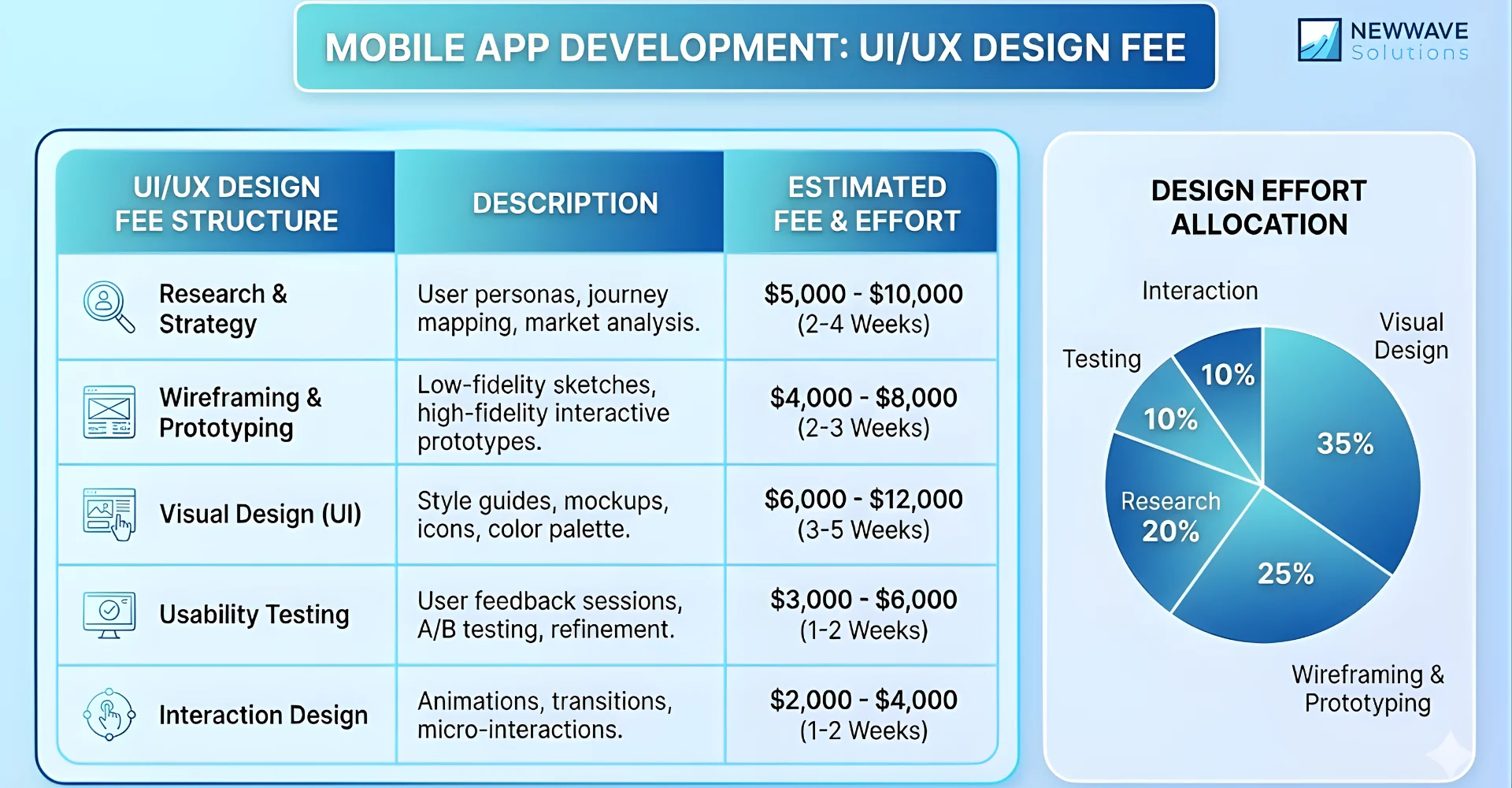
3. UI/UX Design & Front-End Development Fee
Custom interface design, interactive user flows, responsive layouts for different device types, and polished front-end implementation all fall under this cost category. For apps requiring refined design, smooth navigation, and high user experience standards, this fee frequently ranges from USD 7,000–25,000, depending on complexity, number of screens, and design customization level.
4. Third-Party Integrations & Additional Services Fee
Modern apps often require integrations such as payment gateways, push-notification services, mapping/location services, analytics, external APIs, or communication modules (chat, video). Each integration adds to development, testing, and maintenance effort — leading to additional costs often between USD 5,000 – 30,000+, depending on the number and complexity of services integrated.
5. QA, Testing & Performance Optimization Fee
Ensuring the app works reliably across devices and operating systems, handling security, load/performance under usage stress, and fixing bugs before launch are critical to app success. Most businesses allocate around 10–20% of total development budget to this stage — for a mid-size development, this often means USD 5,000 – 20,000+ dedicated to testing, quality assurance, and optimization before shipping.
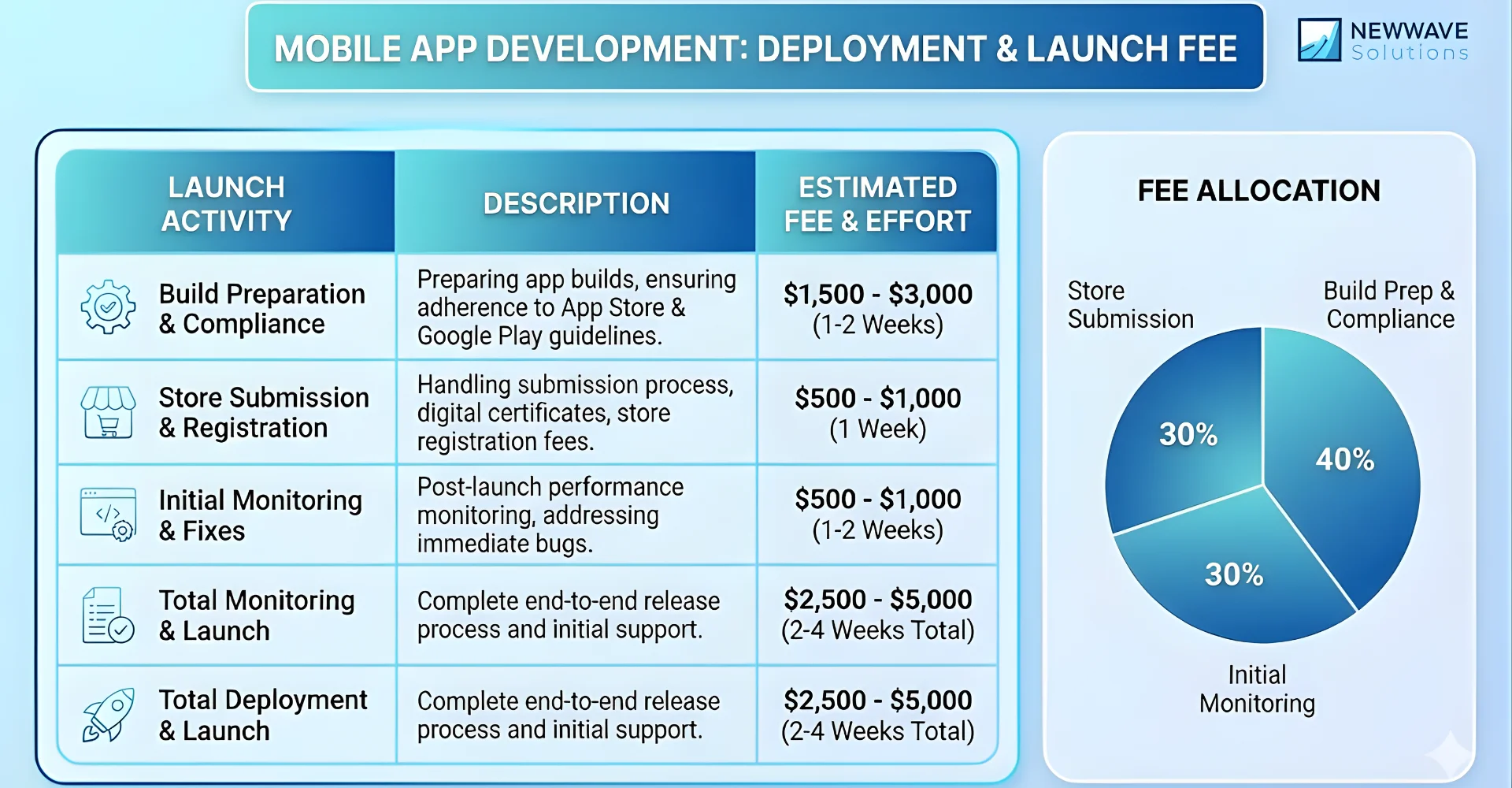
6. Deployment, Store Submission & Launch Activities Fee
Publishing an app involves preparing builds, compliance with store guidelines (App Store, Google Play), digital certificates, store registration fees, and launch-specific tasks like initial monitoring and fixes. The cost here is relatively modest — generally USD 500 – 2,000 — but remains essential for legal and functional release.
7. Ongoing Maintenance, Support & Update Fee
Once the app is live, ongoing costs include updates for OS changes, bug fixes, performance monitoring, server maintenance or scaling, security patches, and possibly feature enhancements. Many businesses budget about 15–25% of initial development cost annually for maintenance and support to ensure stability and longevity of the app.
Hidden Fees For Developing a Mobile App
Too often, project budgets omit less visible expenses — but these “hidden fees” can significantly affect total cost. It is critical for decision-makers to account for these before committing to a development plan. Let’s explore those hidden fees in detail below:
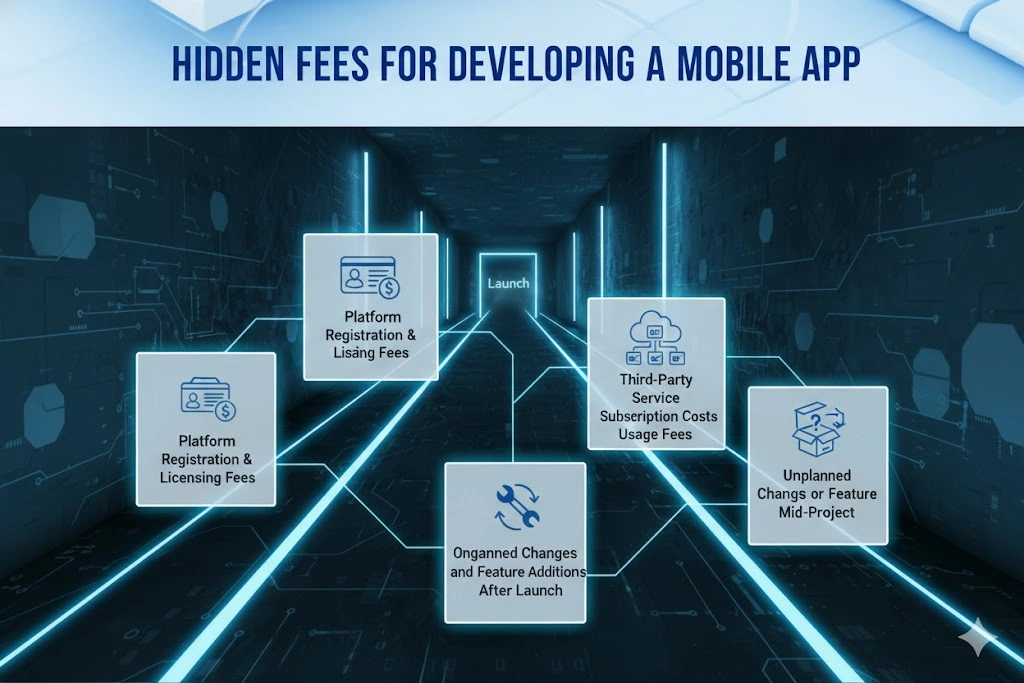
- Platform registration & licensing fees — To publish on app stores, developers must pay fees such as the Apple Developer Program ($99/year) or Google Play’s one-time registration fee. These are mandatory costs even before actual development begins.
- Third-party service subscription or usage fees — Services such as push notifications, analytics, cloud backend, or payment gateway services may require monthly or usage-based fees that accumulate over time.
- Ongoing maintenance and support costs after launch — Even if the initial development ends successfully, apps need regular updates, security patches, and sometimes performance tuning. Neglecting these can cause functional issues or user dissatisfaction.
- Unplanned changes or feature additions mid-project — If stakeholders request extra features or scope expansions after development starts, additional development time and cost (often 10-30% more) will be incurred.
- Compliance, security audits, and regulatory costs — Apps handling sensitive data (payments, personal info, etc.) might require extra security measures, encryption, data compliance processes, or even external audits — all contributing extra costs.
What Factors Affect Mobile App Development Costs?
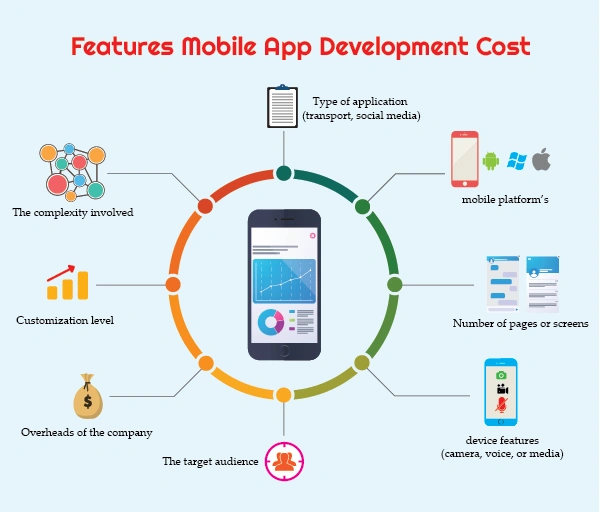
As mentioned above, your mobile app development cost depends on many factors, so it is really difficult to accurately determine the cost of app development. The cost largely depends on the type of application, platform, design, number of pages, functionality, etc.
Let’s take a closer look at the important factors that affect the cost of app development.
1. Features & Functionality
Before you search for the answer “How much does mobile app development cost?”, you need to know the complexity of the application. This is because the features and functionality will determine the actual cost of your application.
Therefore, the average cost to develop your application will depend on the complexity of the features and functionality. The more complex the features, the higher the cost, and the longer the development time.
2. Platforms
Do you want to develop an iOS or Android app? If so, you should consider the platform issue. Each platform requires different development times, and of course, the cost will also differ. When developing an app that only runs on one platform, the cost will be much cheaper compared to another app (with the same function) running on two or more platforms.
When developing Android and iOS apps, you should use cross-platform frameworks such as React-Native and Flutter to reduce costs and development time.
3. UI/UX Design
User experience (UX) and user interface (UI) are critical components that make up a successful app. Creating a unique UX/UI design is a job that requires a lot of brainstorming, time, and project costs. Your app must have an impressive UX/UI design to attract and convince users.
Please note that to have a better UX/UI design for your app, the cost of designing the app will be higher compared to another app with the same function but without investing in UX/UI design.
4. Back-end
The infrastructure and Admin Page Backend provides APIs to exchange data between the app and the database. Programmers always use the backend to monitor and analyze user activity and the performance of the app.
The cost of developing the backend for the app will vary depending on the number of parameters and the purpose of use. In addition, the admin page is used to manage and process app content, user information, and display statistics. There are many available templates on the market, but finding a suitable template for your needs is not easy. Therefore, it is important to still create your own admin page to meet your business needs.
5. Location & Team members
As previously mentioned, the geographic location of the app development team plays an important role in determining how much does it cost to develop a mobile app. The mobile app development cost in the US will be higher than in countries like Vietnam and China.
The team structure typically includes business analysts, UX/UI designers, mobile app developers, QA engineers, project managers, and other members who can contribute to the success of the app. Therefore, the hourly rate of experts may vary depending on each person’s level of expertise.
6. Mobile App Release
To distribute your app to users, you typically need to register with a third party (App Store and Google Play Store). However, the cost of displaying your app on each store will vary. Apps released on the App Store always cost more than on the Google Play Store, and that’s how they generate revenue.
7. App Maintenance Costs
App maintenance costs are also an important factor that affects mobile app development cost. Many business owners have asked, “Why is app maintenance so important to my business?” What is the actual cost of it? To be precise, app maintenance costs will range from 15% to 20% per year.
App maintenance includes tasks such as bug fixing, adding new features, upgrading the OS version, etc. In addition, the cost of app maintenance also depends on the complexity of the features.
Manage Mobile App Development Costs: 5 Popular Examples
1. Spotify
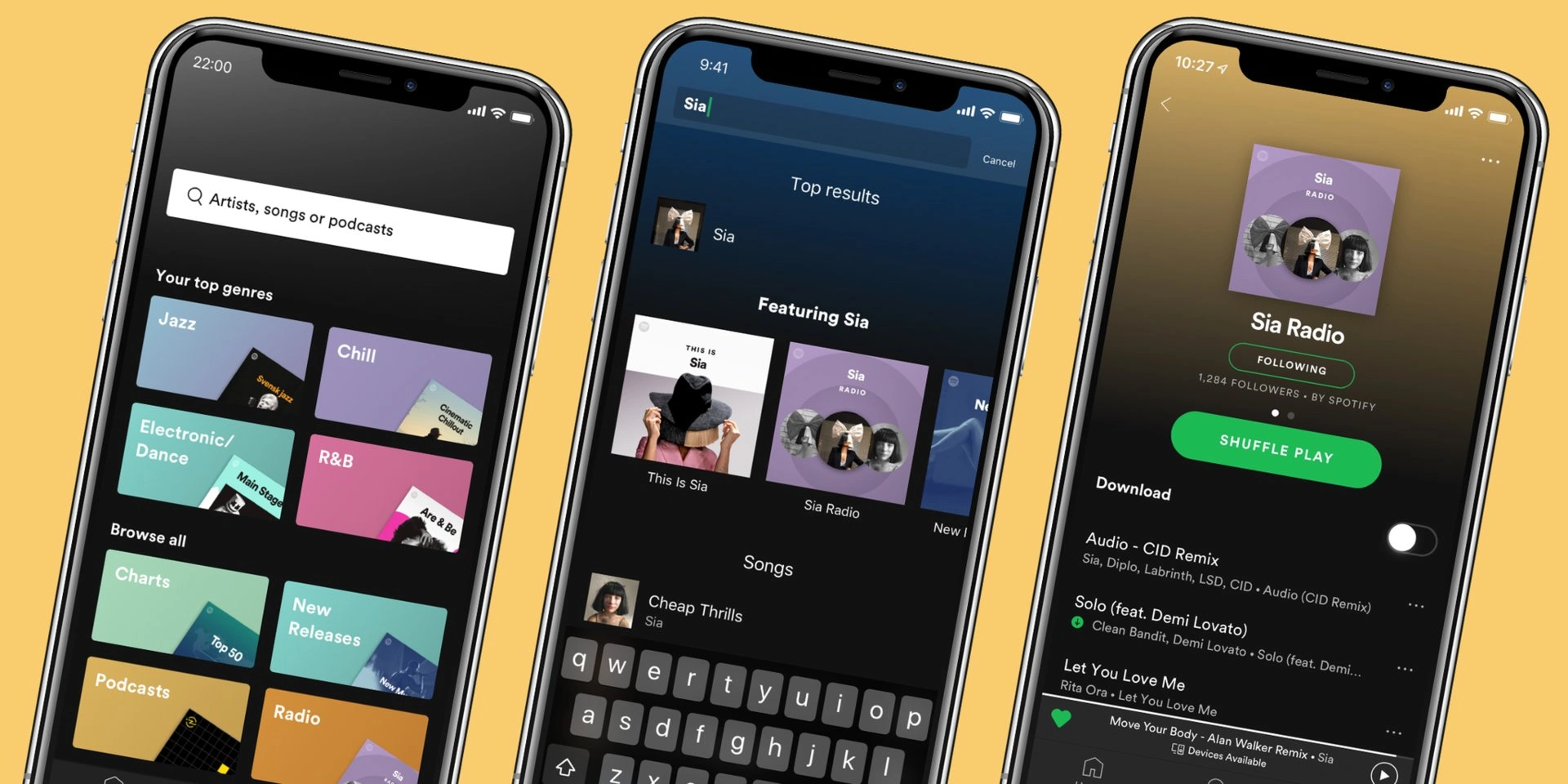
Spotify invested approximately $80,000 to $300,000 in developing its music streaming mobile app, with significant costs allocated to AI-driven personalization algorithms, offline playback functionality, and robust content licensing infrastructure. The development emphasized scalable backend systems and seamless cross-platform performance, which required substantial engineering resources. As a result, Spotify achieved massive user adoption with over 600 million monthly active users and transformed the global music industry through its freemium model.
2. Netflix
Netflix allocated between $50,000 and $200,000 for its mobile streaming app development, focusing heavily on video compression technologies, global content delivery networks (CDNs), and personalized recommendation engines. Major expenses went toward secure DRM systems and adaptive bitrate streaming to ensure smooth playback across varying network conditions. This investment enabled Netflix to dominate the streaming market, serving over 280 million subscribers worldwide with uninterrupted viewing experiences.
3. KFC
KFC spent an estimated $50,000 to $180,000 on its food ordering mobile app, with primary costs concentrated in menu management systems, real-time order tracking, and multiple payment gateway integrations. The development prioritized intuitive UI/UX design and backend synchronization with restaurant POS systems to streamline operations. Consequently, the app boosted KFC’s digital sales significantly, enhancing customer convenience and driving revenue growth through efficient mobile ordering.
4. Uber
Uber’s ride-hailing app development cost around $100,000 to $200,000 initially for a single platform, with heavy investments in real-time GPS tracking, dynamic pricing algorithms, and secure payment processing infrastructure. Costs escalated due to the need for scalable backend handling millions of concurrent users and sophisticated matching algorithms between riders and drivers. The app revolutionized urban transportation, scaling to billions in annual revenue and operations in thousands of cities globally.
5. Adidas
Adidas invested roughly $80,000 to $250,000 in its shopping and fitness tracking mobile app, channeling major expenses into AR try-on features, personalized product recommendations, and seamless eCommerce integration. Development focused on cross-platform consistency and loyalty program backend to enhance user retention. This approach resulted in higher conversion rates, stronger customer engagement, and substantial growth in direct-to-consumer mobile sales for the sportswear giant.

If you wish to manage mobile app development costs effectively but maintain the app quality like the above brands, think of outsourcing to a professional mobile app development company for assistance. Follow our blog on the top 10 Mobile App Development Companies in the USA for detailed information.
Tips for optimizing mobile app development costs
Given the multiple cost components involved in app development, many businesses — especially startups or SMEs — see the total investment as a barrier. Fortunately, there are effective strategies to manage and optimize these costs without sacrificing quality. Below are those tips & strategies to help your business optimize the mobile app development costs effectively:
- Prioritize core features first and build an MVP (Minimum Viable Product).
- Use cross-platform frameworks (e.g. Flutter, React Native) where suitable.
- Leverage existing backend services or managed backend-as-a-service solutions.
- Reuse UI/UX kits or design templates instead of building every screen from scratch.
- Outsource to reliable development teams in cost-effective regions to reduce labor costs.
- Plan for phased rollout — launch essential functionality first, add advanced features later.
- Maintain clear requirements and avoid scope creep by thorough upfront planning and documentation.
Manage Mobile App Development Costs Effectively With Newwave Solutions
If the tips above still haven’t fully helped your business manage mobile app development costs effectively, Newwave Solutions is ready to support you. With over 14 years of experience in web development, mobile app development, software engineering, and UX/UI design, we have successfully assisted hundreds of businesses in building professional mobile applications while optimizing their project budgets and expenses efficiently.
When partnering with Newwave Solutions, your business benefits from significant advantages:
- Faster Time-to-Market is achieved through agile methodologies and reusable components that accelerate development and launch stages without compromising quality.
- Cost Efficiency comes from smart project planning and flexible outsourcing models designed to reduce expenses while maintaining high development standards.
- Strong Security is ensured by robust data encryption, secure coding practices, and full compliance with industry regulations to protect sensitive user information.
- Cross-Platform Reach enables deployment across both iOS and Android platforms, allowing your app to access the widest possible audience with consistent performance.
- Continuous Support includes monitoring, updates, and feature enhancements to guarantee optimal app functionality well beyond initial release.
- Scalable Architecture offers the flexibility to grow your app effectively alongside your expanding user base and evolving business requirements.
Consider working with Newwave Solutions if you are seeking a professional, high-quality mobile app development solution that fits your business’s budget and specific demands. In addition to mobile app development, we also provide the “hire mobile app developers” services for businesses that need access to expert development teams to support their app-building efforts. Contact us for more details!
Conclusion
So, how much does it cost to develop a mobile app? As mentioned earlier, there is no clear answer to this question because each mobile app has different requirements and features. The mobile app development cost also depends on many factors such as complexity, type of app, technology, platform, design, and more.
Depending on your purpose and budget, you can choose the best option for yourself! If you still find it difficult to implement a mobile app development on your own and don’t know where to start, Newwave Solutions is ready to help you overcome the obstacles and help you with the project as soon as possible. Contact us and enjoy the full-cycle support from our professional mobile app development services today.
Contact Information:
- Head Office (Hanoi): 1F, 4F, 10F, Mitec Building, Cau Giay Ward, Hanoi City, Vietnam
- Branch Office (Tokyo): 1chōme118 Yushima, Bunkyo City, Tokyo 1130034, Japan
- Hotline: +84 985310203
- Website: https://newwavesolution.com
- Email: [email protected]
To Quang Duy is the CEO of Newwave Solutions, a leading Vietnamese software company. He is recognized as a standout technology consultant. Connect with him on LinkedIn and Twitter.




Get stories in your inbox twice a month.
Let’s Connect
Let us know what you need, and out professionals will collaborate with you to find a solution that enables growth.
Leave a Reply