


Offshore Software Development Rates by Country: Where to Outsource in 2026
More and more companies are turning offshore software development as a practical way to scale their engineering teams without inflating their budgets. However, rates vary significantly from country to country, and understanding those differences is essential for accurately projecting project ROI. This guide offers a clear, up-to-date comparison of offshore software development rates by country to help decision-makers identify where to outsource in 2026.
Offshore Software Development Rates by Country: Global Comparison
Before examining individual countries, it is worth understanding how the global outsourcing market segments at a regional level. Rate differences across geographies reflect a combination of local talent supply, infrastructure maturity, economic conditions, and the accumulated reputation each region has built with international clients — and each region offers a distinct trade-off between cost, quality, and collaboration dynamics.
The table below provides a high-level reference for average hourly rates and the primary competitive advantage of each major outsourcing region:
Offshore Software Development Rates by Country Breakdown
Regional averages provide useful context, but the real decision is made at the country’s level — where talent depth, language proficiency, infrastructure quality, and specific rate bands vary considerably even within the same geographic bloc. The breakdown below covers the three primary offshore regions in detail.
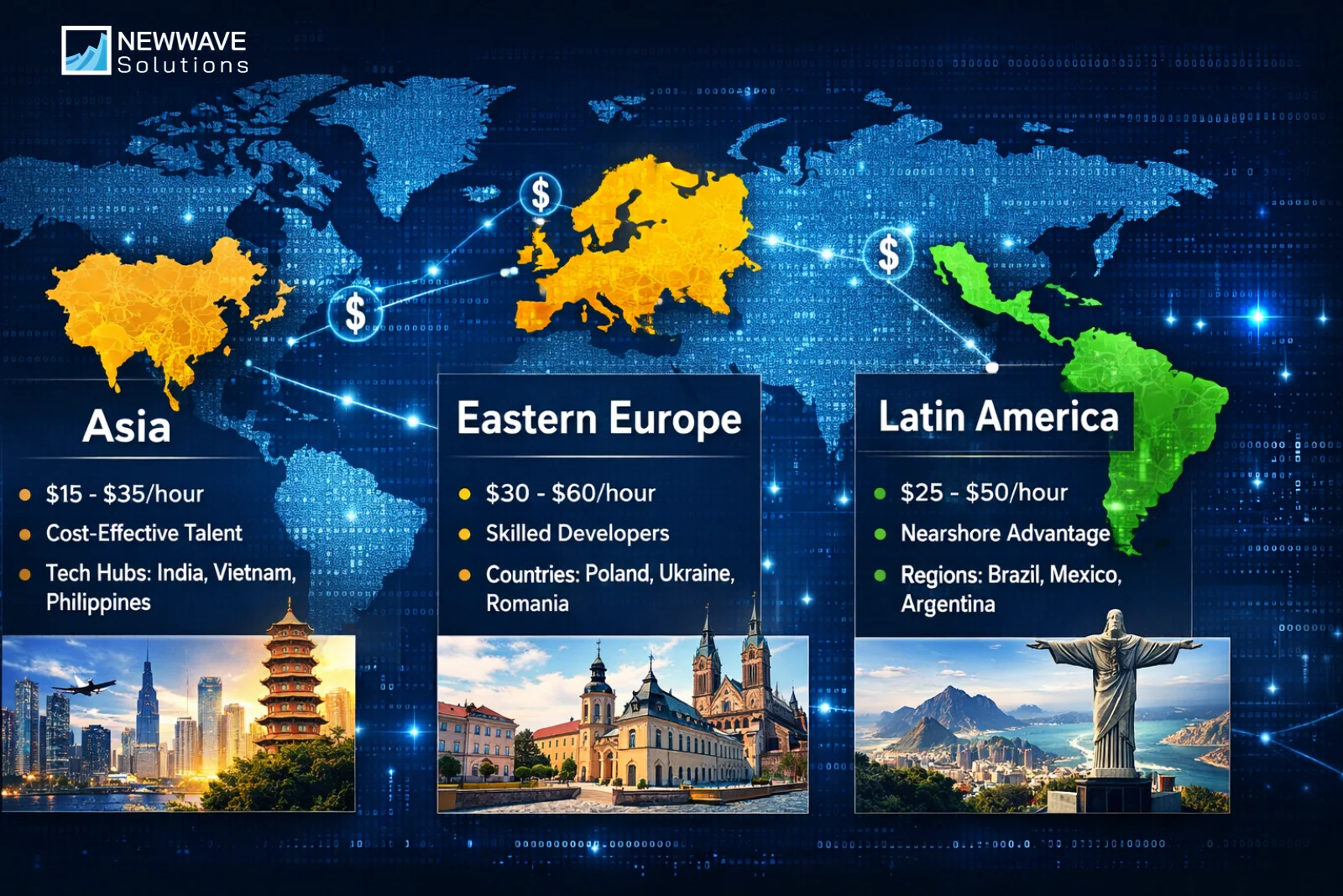
Asia
Asia remains the world’s largest and most cost-competitive offshore software development market, combining the lowest average hourly rates globally with a talent pool that spans hundreds of thousands of engineers across multiple countries and specializations.
- India: $15 – $30/hour – India is the most established offshore development destination in the world, with a deep talent pipeline built over decades of sustained IT services growth. The country’s developer pool is exceptionally large, English proficiency is strong, and the ecosystem of offshore vendors ranges from boutique specialist firms to large-scale delivery organizations. The primary trade-off is communication overhead — time zone differences with North American and European clients require deliberate scheduling discipline to maintain delivery velocity.
- Vietnam: $10 – $30/hour – Vietnam has emerged as one of the most attractive offshore destinations in Southeast Asia, combining competitive rates with a technically strong developer community that consistently performs well on complex, enterprise-grade projects. The country’s technology education infrastructure has expanded significantly over the past decade, producing a growing cohort of engineers with strong proficiency in modern development frameworks and cloud technologies. Vietnam also benefits from a stable political environment and a government policy stance that actively supports the IT services sector.
- Philippines: $5 – $14/hour – The Philippines offers the most affordable rates in the Asia region and a workforce with notably strong English communication skills — an advantage that reduces the communication friction that can increase effective project costs elsewhere. The developer community is particularly well-suited to web development, mobile applications, and IT support functions. For organizations with straightforward technical requirements and tight budget constraints, the Philippines represents a compelling cost entry point.
>>> Regional advantage: Asia’s primary competitive strength is cost efficiency combined with scale. No other region offers comparable access to large, technically capable engineering talent at these price points — making it the default starting point for organizations prioritizing cost optimization in their offshore strategy.
Eastern Europe
Eastern Europe occupies a distinct position in the global offshore market — one defined not by the lowest rates but by the strongest quality-to-cost ratio available at the mid-market price tier. The region’s developer community is widely regarded as among the most technically rigorous in the world, with particularly deep expertise in software architecture, systems engineering, and complex backend development.
- Poland: $27 – $37/hour – Poland is Eastern Europe’s most mature offshore market and consistently ranks among the top outsourcing destinations globally for quality-sensitive projects. Polish engineers are known for strong problem-solving capabilities, high English proficiency, and a professional delivery culture that aligns well with Western European and North American client expectations. The country’s EU membership also provides regulatory alignment that simplifies GDPR compliance for European clients.
- Ukraine: $25 – $55/hour – Ukraine has historically been one of Eastern Europe’s strongest offshore destinations, with a developer community renowned for technical depth in areas including embedded systems, cybersecurity, and data engineering. The rate range reflects significant variation between senior and junior talent — top-tier Ukrainian engineers with specialized expertise command rates closer to the upper end of the band. Organizations willing to invest in careful talent selection can access exceptional technical capability at rates well below Western European equivalents.
- Romania: $25 – $45/hour – Romania offers a combination of strong technical education, EU membership, and competitive rates that make it particularly attractive for Western European clients seeking regulatory alignment alongside cost optimization. Romanian developers are well-represented in enterprise software, fintech, and telecommunications — sectors that value the precision and architectural discipline that characterize the region’s engineering culture.
>>> Regional advantage: Eastern Europe’s defining strength is engineering quality. For projects where technical complexity, code maintainability, or long-term architectural integrity are priorities, the region consistently delivers outcomes that justify its mid-tier rate premium over Asia.
Latin America
Latin America’s rise as a major offshore destination has been driven primarily by a single, powerful advantage: time zone alignment with North American clients. For US-based organizations that require real-time collaboration, daily standups, and fast feedback loops, working with a team in the same or adjacent time zone removes one of the most persistent friction points in offshore development.
- Brazil: $25 – $50/hour – Brazil is Latin America’s largest technology market and home to a substantial developer community with strong representation in mobile development, fintech, and enterprise software. The country’s rate range reflects meaningful variation between São Paulo’s competitive urban talent market and more affordable regional centers. English proficiency is moderate on average, though higher in technology-focused urban areas and among developers with international project experience.
- Mexico: $20 – $35/hour – Mexico has become an increasingly prominent offshore destination for US companies, combining geographic proximity, strong cultural alignment, and a growing engineering talent pool — particularly in cities such as Guadalajara, Monterrey, and Mexico City. The nearshore dynamic — same or closely adjacent time zones, frequent travel feasibility, and similar working culture — makes Mexico a strong choice for organizations that want the cost benefits of offshore development without the collaboration overhead of large time zone differences.
- Argentina: $19 – $25/hour – Argentina offers some of the most competitive rates in Latin America alongside a developer community with a strong reputation for technical quality and creativity. Argentine engineers are particularly well-regarded in the startup ecosystem and in product-focused development contexts. Economic volatility has historically introduced some operational complexity for international clients, but many organizations have navigated this successfully through structured payment and contracting approaches.
>>> Regional advantage: Latin America’s strongest competitive differentiator is time zone and cultural alignment with North American clients. For US-based organizations where real-time collaboration is a priority, the region offers a compelling combination of accessibility and cost competitiveness that Asia-based teams cannot easily replicate.
Factors That Influence Offshore Software Development Rates
Hourly rates by country provide a useful starting framework, but the actual cost of an offshore engagement is shaped by several additional variables that can shift the effective rate — and the total project cost — significantly in either direction. Understanding these factors before finalizing a vendor selection helps organizations build more accurate budgets and avoid the scope surprises that commonly drive cost overruns.
- Developer expertise level — Senior engineers typically command rates 2–3x higher than junior developers in the same market, reflecting both technical depth and the productivity differential that reduces total hours required to deliver equivalent outcomes. Most enterprise projects require a blend of seniority levels, and the team composition decision has a more significant impact on total project cost than the country selection alone.
- Technology stack specialization — Developers with expertise in high-demand areas such as AI and machine learning, blockchain, and cloud-native architecture command a 30–50% premium over generalist rates in the same geography, reflecting the global scarcity of these skills relative to demand.
- Project complexity — Complex systems — those involving distributed architecture, high concurrency requirements, regulatory compliance engineering, or deep third-party integrations — require more senior talent, longer timelines, and more rigorous QA investment, all of which increase total cost independently of the hourly rate.
- Time zone and communication alignment — Markets with better real-time overlap with the client’s working hours — particularly Latin American countries for US clients — often command slightly higher rates than equivalent talent in more distant time zones. However, the reduction in communication overhead and rework that comes with better alignment frequently offsets this premium in total project cost.
- Local economic conditions — Salary benchmarks, developer demand, and cost of living in the offshore market all directly influence the rates that vendors can sustainably offer. Markets experiencing rapid technology sector growth — such as Vietnam and Poland — have seen rate increases over the past several years as domestic demand for developer talent has pushed compensation upward.
Hidden Costs in Offshore Software Development
The hourly rate is the most visible number in an offshore vendor conversation — but it is rarely the number that determines whether a project finishes on budget. A range of additional cost categories consistently emerge during offshore engagements, and organizations that model only the headline rate frequently encounter budget variance that erodes the projected savings that justified the offshore decision in the first place.
- Onboarding and training costs — Every new offshore team requires an investment in knowledge transfer, process familiarization, and tooling setup before it reaches full productive contribution. This ramp period represents a direct cost — in senior staff time diverted to onboarding and in the reduced output velocity of the early project phases — that is absent from the hourly rate but present on every project.
- Project management overhead — Managing an offshore team requires structured governance: sprint ceremonies, status reporting, code review processes, and vendor relationship management. This overhead typically adds 15–25% to the effective project cost and must be resourced either by diverting internal bandwidth or by budgeting for a dedicated delivery manager.
- Communication inefficiencies — Language barriers, asynchronous working patterns, and documentation gaps create friction that slows decision-making, increases the volume of clarification cycles, and ultimately extends timelines. The financial impact manifests as additional hours rather than a discrete line item — making it one of the harder hidden costs to identify in retrospect.
- Rework due to quality issues — Requirements misalignment, insufficient QA investment, or weak documentation discipline can result in significant rework cycles that add unplanned hours to a project’s total cost. This cost is particularly prevalent in engagements where the selection decision was made primarily on the lowest available rate rather than on demonstrated delivery quality.
- Infrastructure and tooling costs — Cloud environments, development tooling licenses, security infrastructure, and CI/CD pipeline setup all represent project costs that fall outside the developer hourly rate. For organizations with new to offshore development, these costs are frequently underestimated in initial project budgets.
How to Choose the Right Offshore Development Country
Rate tables and regional comparisons provide necessary context, but the country’s selection decision ultimately comes down to matching a specific set of project requirements against the trade-offs each market offers. The following criteria represent the most consequential variables in that evaluation:
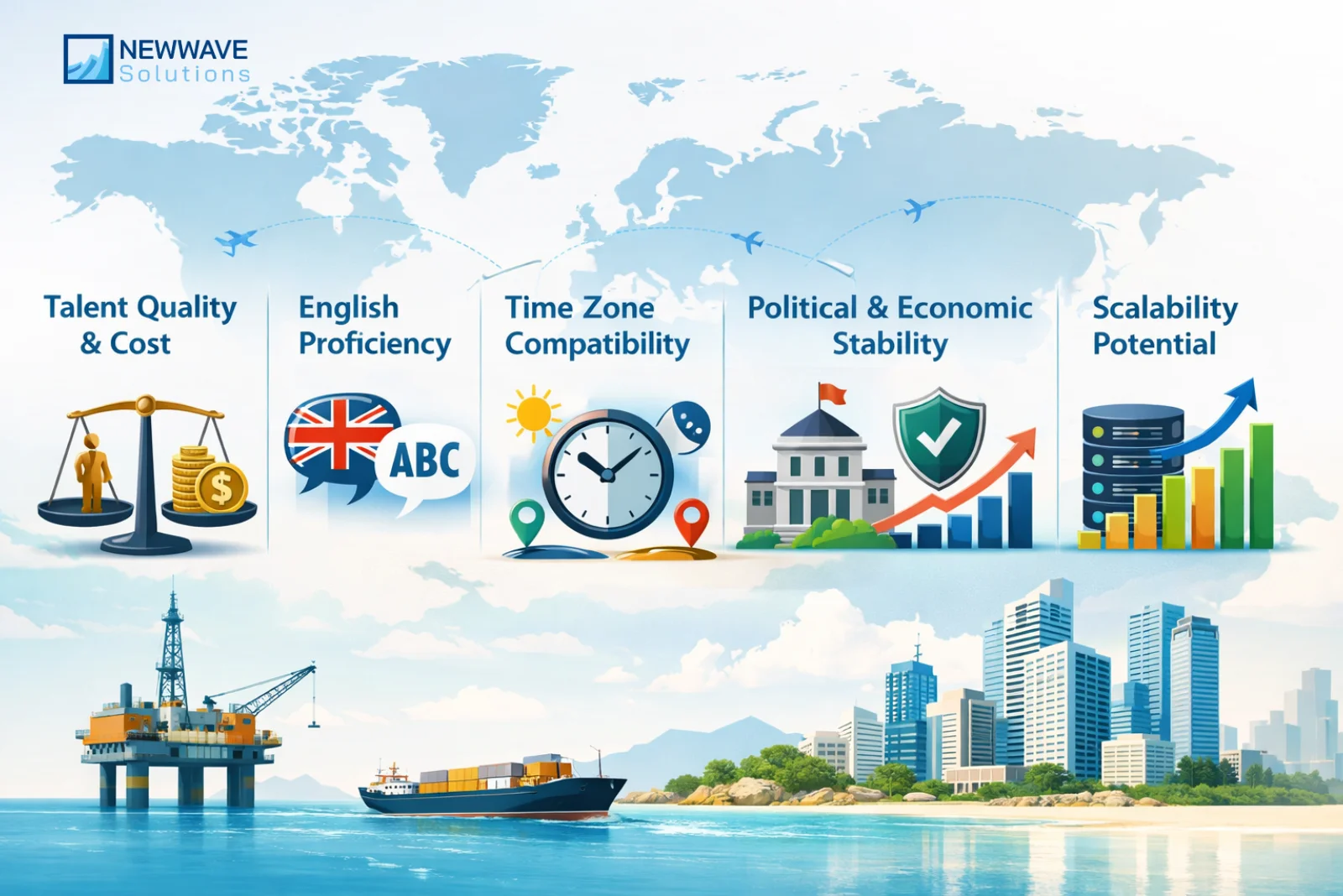
- Talent quality versus cost balance — The lowest available rate is not always the most cost-effective choice when total project cost — including rework, extended timelines, and quality remediation — is modeled accurately. Organizations should assess the quality-to-cost ratio for their specific technical requirements rather than optimizing for headline rate alone.
- English proficiency — Communication quality is a direct driver of development efficiency. Markets with consistently high English proficiency — India, the Philippines, Eastern Europe — reduce the documentation overhead and clarification cycles that inflate project costs in lower-proficiency markets.
- Time zone compatibility — The optimal time zone choice depends on the collaboration model. Fully asynchronous projects can work effectively with any geography; projects requiring daily real-time collaboration benefit significantly from Latin American or Eastern European locations for US and Western European clients respectively.
- Political and economic stability — Operational continuity depends on the stability of the offshore market. Geopolitical risk, currency volatility, and regulatory uncertainty can all disrupt delivery timelines and introduce costs that were not modeled in the initial business case. Markets with stable governance and mature IT regulatory frameworks carry lower operational risk across a multi-year engagement.
- Scalability potential — An offshore location that works well for a five-person team may become a bottleneck when the engagement scales to twenty or thirty engineers. The depth of the local talent pool — and the vendor’s ability to recruit and onboard at pace — is a critical variable for organizations planning to grow their offshore capability over time.
How Newwave Solutions Helps You Optimize Offshore Software Development Costs
Selecting the right offshore country is only one part of the cost optimization challenge — the other part is selecting a delivery partner whose engagement model is built to maximize the value of that investment. Many offshore vendors compete on headline rate; what actually determines whether a project delivers its projected ROI is the quality of the delivery process, the transparency of the cost structure, and the stability of the team managing the work.
For organizations that need a partner combining competitive offshore rates with enterprise-grade delivery standards, Newwave Solutions brings over 14 years of IT outsourcing and offshore software development experience to every engagement. With a track record of 800+ successfully delivered projects across global markets, 300+ professional developers and specialists, and rigorous ISO 9001:2015 and ISO 27001 certification standards, Newwave is structured to serve the needs of enterprises, CTOs, and technology leaders who cannot afford the delivery risk that comes with selecting a vendor on rate alone.
Why enterprises choose Newwave Solutions for offshore software development:
- Competitive Vietnam-based rates — Newwave delivers access to one of Southeast Asia’s strongest engineering talent pools at a price point that consistently outperforms equivalent quality in Eastern Europe or Latin America.
- Transparent, fully-modeled cost structure — Every engagement begins with a comprehensive cost breakdown that accounts for project management overhead, onboarding investment, and infrastructure requirements — eliminating the budget surprises that undermine most offshore business cases.
- Proven delivery framework — Newwave’s structured development process — covering requirements analysis, sprint planning, code review protocols, and QA integration — reduces the rework cycles and timeline overruns that inflate effective offshore costs on less disciplined programs.
- Stable, retention-focused team culture — Newwave’s below-market attrition rates reduce the replacement and knowledge transfer costs that consistently erode offshore savings over multi-year engagements.
- Full-lifecycle service coverage — From initial scoping and architecture through development, QA, deployment, and ongoing maintenance, Newwave manages the complete delivery lifecycle — removing the coordination overhead of managing multiple specialist vendors simultaneously.
- Scalable team model — Newwave’s recruitment infrastructure and talent pipeline support rapid team scaling, enabling organizations to grow their offshore capability in response to product roadmap demands without sacrificing onboarding quality or delivery continuity.
Conclusion
The offshore software development rates by country mapped in this guide reflect the full spectrum of options available to organizations in 2026 — from the cost-competitive markets of Southeast Asia to the quality-premium destinations of Eastern Europe — and the right choice depends on matching those trade-offs precisely to the project’s technical complexity, collaboration requirements, and long-term scalability needs.
If you are looking for an offshore development partner that brings together competitive rates, senior engineering talent, and a transparent engagement model that keeps your project on time and on budget, do not hesitate to reach out to Newwave Solutions — our team is ready to help you design and execute an offshore strategy that delivers real, sustainable value.
To Quang Duy is the CEO of Newwave Solutions, a leading Vietnamese software company. He is recognized as a standout technology consultant. Connect with him on LinkedIn and Twitter.



Read More Guides




Get stories in your inbox twice a month.
Let’s Connect
Let us know what you need, and out professionals will collaborate with you to find a solution that enables growth.
Leave a Reply