


POC vs MVP: Key Differences Every Startup Must Know
In the fast-paced startup world, the terms POC (Proof of Concept) and MVP (Minimum Viable Product) are often used interchangeably, creating confusion for founders and teams. This misunderstanding can lead to wasted resources, missed opportunities, and slower time-to-market. Knowing the PoC vs MVP distinction is crucial for saving time, cutting costs, and making smarter business decisions. In this post, we will clearly define the differences, show practical use cases, and guide you on when to use each approach to maximize your startup’s success.
What Is a Proof of Concept (PoC)?
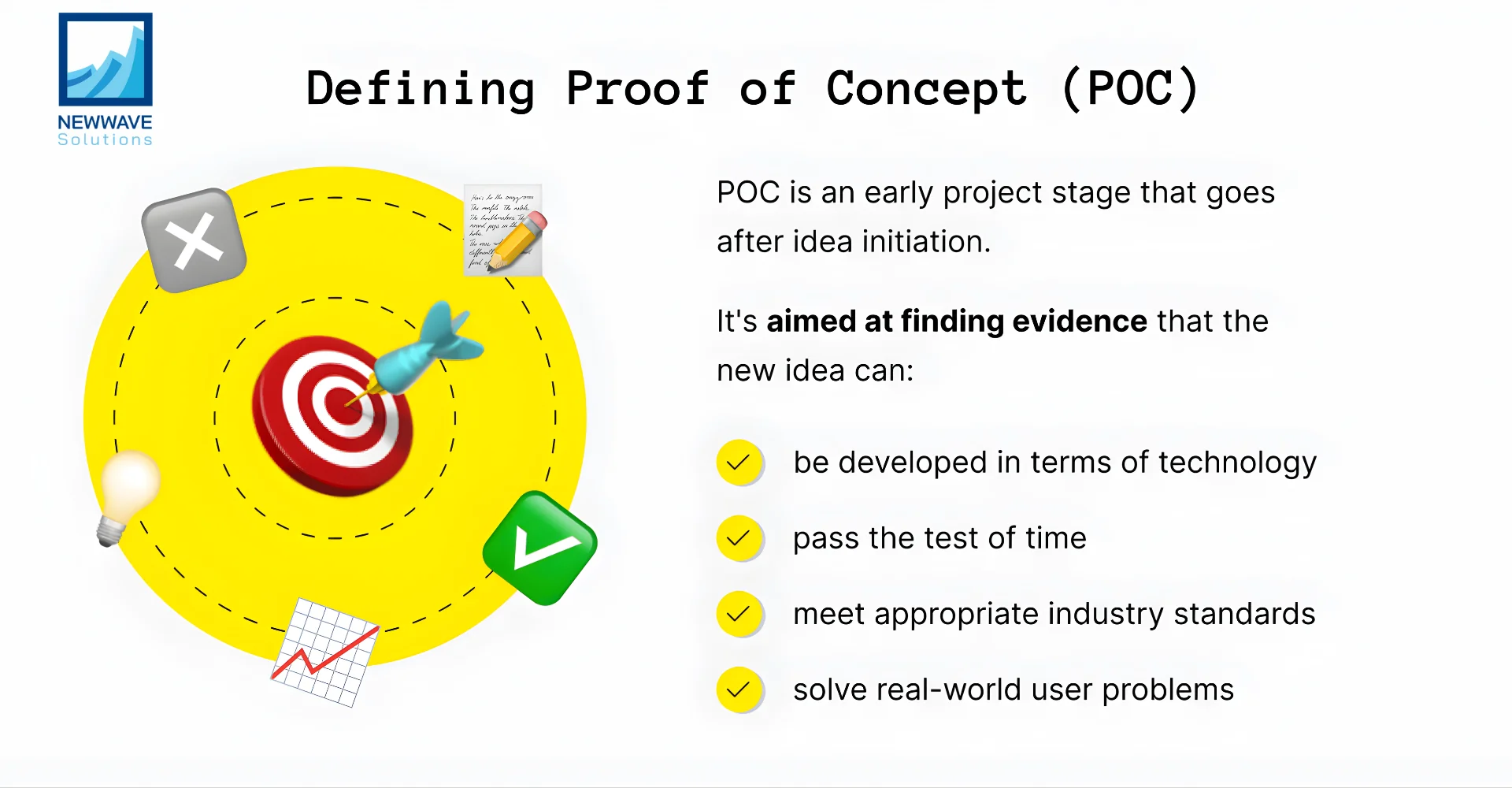
A Proof of Concept (POC) is a small, focused project that shows whether an idea or technology can actually work in practice. In the startup context, the purpose of a POC is not to create a final product but to demonstrate feasibility and reduce risk before investing more time and resources. It is often used to convince investors or stakeholders that the core idea is technically possible.
For instance, Stripe developed a proof-of-concept style model using its “Payments Foundation Model” to test whether large-scale AI could improve fraud detection across its transaction network. The result was a significant drop in “card-testing” fraud (about 64% lower), almost immediately after deployment.
Pros & Cons of PoC
| Pros |
Cons |
| Demonstrates technical feasibility before large investment | Does not test market demand or user interest |
| Helps identify technical risks early | May mislead stakeholders into thinking the product is further along than it really is |
| Supports decision-making for investment or funding | Requires resources that don’t directly generate user value |
| Allows testing of hard technical problems (e.g., AI, new integrations) | Sometimes the POC gets abandoned without progressing to MVP |
| Minimizes waste in case of infeasible ideas | Stakeholders may confuse POC success with full product readiness |
| Helps to choose between alternative technologies or approaches | May not include user experience, so usability problems get ignored |
What Is a Minimum Viable Product (MVP)?
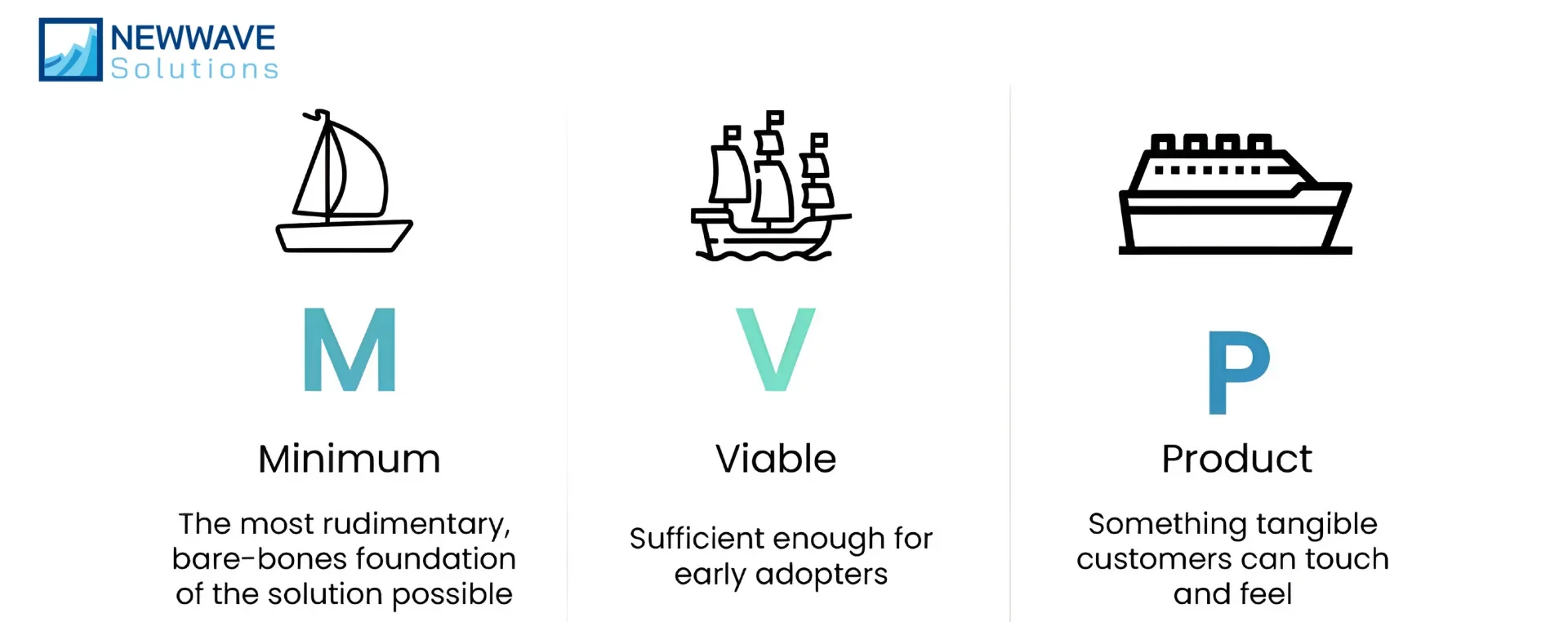
To answer what is MVP, it stands for the simplest version of a product that includes only the essential features needed to solve one core problem for users. In the startup world, the goal of an MVP is to test whether there is real market demand for the product before spending heavily on full development. By launching quickly, startups can gather feedback, validate assumptions, and improve their product with less risk.
For example, Airbnb’s founders created a simple MVP by listing air mattresses in their own apartment during a conference to see if people would actually book stays. That experiment validated that travelers were willing to pay for peer-to-peer short-term lodging, helping Airbnb grow from a small prototype into a global marketplace.
Pros & Cons of MVP
| Pros |
Cons |
| Validates market demand with real users | Requires more resources and time than a POC |
| Provides feedback for improvement and iteration | A poorly designed MVP can harm brand’s reputation |
| Attracts early adopters and builds traction | May spend effort on features that are unnecessary or underused |
| Helps secure investor confidence by proving execution ability | Balancing simplicity with usability is challenging |
| Enables learning through real user behavior | Risk of over-scope: adding too many features too soon |
| Accelerates product-market fit when focused correctly | Maintaining quality while scaling from MVP can be difficult |
PoC vs MVP: 6 Key Differences
From my own experience working with early-stage founders, I’ve seen many confuse a PoC vs MVP, which often leads to wasted time and money. The real value lies in understanding the difference between PoC and MVP, since each serves a unique purpose: one validates feasibility, while the other validates demand and usability. Let’s break this down clearly with a side-by-side comparison.
1. Goal
The goal of a PoC is to determine if an idea or technology is technically possible before committing resources. It answers the question: “Can this be built?” rather than “Will people use it?” On the other hand, an MVP aims to validate whether the product has real demand in the market by testing it with users. If your priority is to prove technical feasibility, a PoC is better; if your focus is to understand market interest and usability, then the MVP is the optimal choice.
2. Scope
A PoC has a narrow scope, usually focusing on a single feature or technical challenge, while an MVP covers a broader scope with essential features that allow users to interact with the product. The MVP doesn’t need to be perfect, but should be functional enough to generate feedback and insights from real customers. If you want to quickly test one idea in isolation, PoC is better; however, if you want to provide a working product to measure adoption, MVP is the superior option.
3. Users
A PoC is primarily intended for internal teams, stakeholders, or potential investors who need assurance that the technology works. By contrast, an MVP targets real end-users and early adopters who can provide valuable feedback on usability and value. For example, Airbnb tested its MVP directly with travelers, which validated that people would pay for peer-to-peer lodging. In this case, PoC works better for internal validation, but MVP is better for understanding real user behavior.
4. Timeframe
A PoC can often be developed in a matter of days or weeks since it only focuses on testing a single element, while an MVP typically requires weeks or months to build because it must function reliably for customers. The choice depends on urgency and purpose: if you need a fast test for feasibility, a PoC is more suitable; but if you want to launch something usable to capture real-world insights, an MVP is the better approach.
5. Cost
Since PoCs are limited in scope, they generally require fewer resources and a lower budget compared to MVPs, which need investment in design, coding, testing, and deployment. For example, Dropbox’s MVP video cost little but reached thousands of potential users and proved real market demand. If you need to minimize costs to test an idea, PoC is the right choice, but if you are ready to invest in validating demand and scaling the product, then MVP offers more value.
6. Success Metrics
The success of a PoC is measured by proving that the technology or approach works as intended, regardless of whether users find it valuable. By contrast, the success of an MVP depends on real-world results such as user adoption, retention, and feedback. If the goal is to confirm feasibility, PoC metrics are enough, but if the aim is to secure user traction and attract investors, MVP provides a better path forward.
>>> Summary:
|
Criteria |
PoC (Proof of Concept) | MVP (Minimum Viable Product) |
Verdict (Key Difference) |
| Goal | Test if an idea or technology is technically feasible | Test if the product has real market demand | Feasibility vs Demand |
| Scope | Very limited, focused on one function or feature | Broader, covers core features for user use | Narrow vs Functional |
| Users | Internal teams, stakeholders, or investors | Real end-users and early adopters | Internal vs External |
| Timeframe | Short, usually days to weeks | Longer, usually weeks to months | Quick demo vs Usable product |
| Cost | Low cost, mostly resources and time for demo | Higher cost, requires design, dev, and testing | Cheap vs Investment |
| Success Metrics | Prove the idea works technically | User adoption, retention, and feedback | Technical validation vs Market validation |
Which Option is best for your Business?
Many startups struggle with the pain of not knowing whether to build a PoC vs MVP, which often leads to wasted time, resources, and missed opportunities. From my own experience, the key is to recognize the difference between a minimum viable product vs proof of concept and apply each at the right stage of your journey. Below, I break down when to use each option so you can make an informed and confident decision.
When to Use PoC
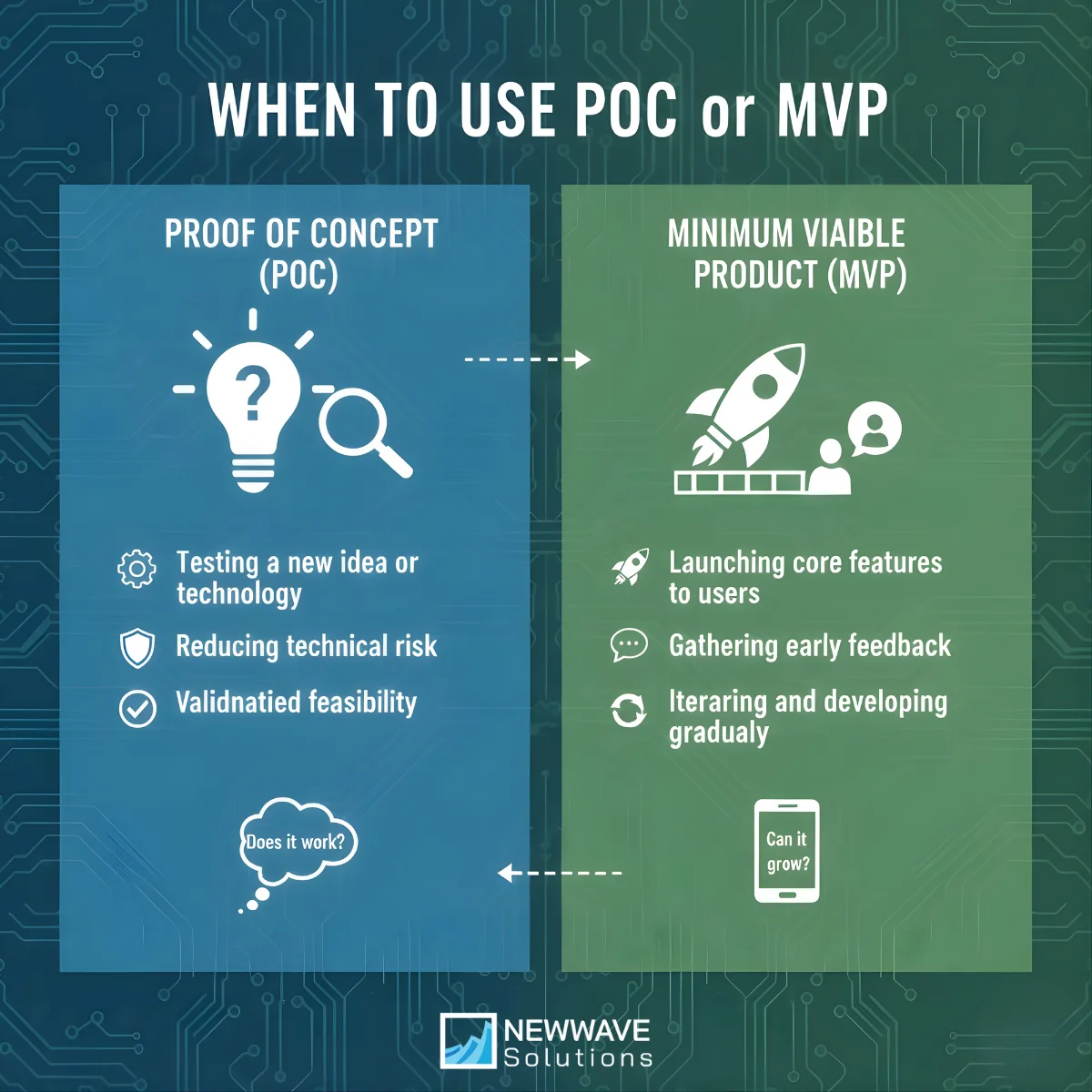
- You should use a PoC when you need to confirm if a new technology or approach can work in practice before committing larger investments.
- PoC is suitable when the main risk lies in technical feasibility, such as testing blockchain POC application for secure payments or AI for fraud detection.
- This option is best when presenting to investors or stakeholders who want proof that the idea is not only innovative but also realistic to build.
- A PoC is also useful when you want to compare multiple technologies side by side, helping you choose the most efficient and reliable approach.
When to Use MVP
- You should use an MVP when your priority is to test the market demand for your product idea with actual users.
- MVP works best if your idea is already technically feasible, but you need to see whether customers will pay for and adopt it.
- This option is valuable when gathering real-world feedback, since early adopters can help shape the product toward true product-market fit.
- MVP is also the right choice if you want to attract funding, as investors often prefer seeing a working product that already has traction over just a concept.
Examples of PoC and MVP in Real Projects
#1 – Example PoC – Stripe’s AI-Driven Fraud Detection Proof
Overview
Stripe, a major payments platform, created a proof of concept to test whether new AI models could detect fraud behavior more accurately in payments flows. They needed to ensure that the technology behind fraud detection was feasible before rolling it out broadly across their whole network.
How they built the PoC
They developed a small-scale AI prototype, trained on limited transaction data, to simulate fraud detection and measure performance without impacting live production systems. The system likely ran alongside existing models to compare results.
Results
The PoC demonstrated a significant improvement in fraud detection accuracy, reducing false positives and losses. Because of this, Stripe proceeded with wider implementation of improved AI detection methods (Note: exact performance numbers weren’t publicly disclosed in full detail in the sources I found).
#2 – Example MVP – “Amazon’s Early Website MVP”
Overview
Amazon began its business in the mid-1990s as a simple online bookstore, which served as its MVP: a minimal site where users could browse books and place orders. They built this MVP to test whether people would use the internet to buy books online—testing real demand in a scalable way.
How they built the MVP
They launched a website with basic catalog, search, and ordering functionality. There were no extra features like recommendations, advanced UI, or complex shipping options initially.
Results
The MVP worked: Amazon confirmed strong market demand, early customer adoption, and was able to iterate rapidly—adding more book categories, improving customer service, and scaling up operations. Over time, this grew into one of the largest e-commerce platforms in the world.
FAQs
1. Can a startup skip POC and go straight to MVP?
Yes, a startup can skip POC if the technology is already proven and the main risk is market demand. In that case, building an MVP is more useful to test real users and gather feedback.
2. Which is cheaper: POC or MVP?
A POC is cheaper because it only checks if the idea works technically. An MVP costs more since it requires design, coding, and testing for real users.
3. Do investors prefer POC or MVP?
Investors usually prefer MVPs because they show real market traction, not just technical feasibility. A working MVP with early users often makes funding easier.
4. What’s the difference between POC, prototype, and MVP?
- A POC proves if the idea can work technically.
- A prototype shows how the product might look or flow, but is not fully functional.
- An MVP is a working product with just enough features for users to test and give feedback.
5. Can large enterprises also use POC and MVP strategies?
Yes, large enterprises often use both. A POC helps them test new technologies safely, while an MVP lets them launch new ideas quickly without committing to full-scale development.
To sum up
Understanding the differences between POC vs MVP allows startups to validate technical feasibility, test market demand, and make smarter product decisions. By applying the right approach at the right stage, businesses can save time, reduce risks, and accelerate growth.
Don’t worry if you lack experience in building a brand new MVP since Newwave Solutions provides end-to-end MVP development services, from ideation and design to launch and post-release support. With our expertise, startups can build high-quality MVPs that not only validate their ideas but also lay a strong foundation for future scalability and long-term success.
By contacting Newwave Solutions, we can together build a quality MVP and later on develop a complete product/ service of high quality.
To Quang Duy is the CEO of Newwave Solutions, a leading Vietnamese software company. He is recognized as a standout technology consultant. Connect with him on LinkedIn and Twitter.



Read More Guides

Get stories in your inbox twice a month.
Let’s Connect
Let us know what you need, and out professionals will collaborate with you to find a solution that enables growth.
Leave a Reply