


Spatial UX Solutions: How to Modernize Your Enterprise Applications
The digital landscape is currently shifting from traditional flat screens to immersive environments, where Spatial UX plays a pivotal role in defining how users interact with three-dimensional data. Consequently, designers must now move beyond two-dimensional constraints to create intuitive experiences that blend seamlessly with the physical world through augmented and virtual reality. This guide explores the fundamental principles of spatial design and provides actionable insights for businesses looking to lead in the era of spatial computing.
What is Spatial UX?
Spatial UX refers to the design of user experiences within three-dimensional digital environments where users interact with content positioned in physical or virtual space. Unlike traditional screen-based interfaces, spatial UX focuses on immersive interaction models powered by AR, VR, and mixed reality technologies that allow users to engage with digital elements around them rather than through flat displays.
In modern immersive platforms, this approach connects interface design with spatial computing systems so that digital information behaves naturally within the surrounding environment.
Core Technologies Behind Spatial UX
- Augmented Reality (AR): Augmented Reality overlays digital objects, text, or animations onto the real world, allowing spatial interfaces to appear directly within a user’s physical environment.
- Virtual Reality (VR): Virtual Reality creates fully immersive digital environments where spatial interaction becomes the primary method for navigating and manipulating objects in simulated 3D spaces.
- Mixed Reality (MR): Mixed Reality blends physical and digital environments by enabling digital objects to interact with real-world surfaces, making spatial interactions feel persistent and realistic.
- Computer vision and sensors: Computer vision systems and environmental sensors detect surfaces, track movement, and analyze surroundings so that spatial interfaces can adapt dynamically to user context.
- AI-driven spatial recognition: AI-driven spatial recognition technologies interpret spatial relationships, object locations, and user behaviors to enable intelligent interaction within immersive systems.
Core Components of Spatial UX
- Spatial interfaces: Spatial interfaces present digital content as objects positioned in a three-dimensional environment rather than confined to traditional screen layouts.
- Gesture-based interaction: Gesture recognition enables users to control digital elements through natural hand movements or body gestures within immersive environments.
- Voice and eye tracking inputs: Voice commands and eye tracking technologies allow systems to interpret user intent and provide intuitive interaction without relying on physical controllers.
- 3D UI elements: Three-dimensional UI components such as floating panels, holographic buttons, and volumetric menus enable users to interact with digital systems in immersive spaces.
- Environmental mapping: Environmental mapping technologies scan and reconstruct physical surroundings so that digital objects can remain anchored and interact correctly within real-world spaces.
Spatial UX vs Traditional UX
While traditional UX focuses on optimizing interactions within the rigid boundaries of a flat screen, Spatial UX breaks these glass barriers to turn the user’s entire physical environment into an active digital canvas. This comparison highlights the fundamental shifts in navigation, visual hierarchy, and input methods to help you understand how to transition your design thinking from static pixels to dynamic, three-dimensional spaces.
| Element | Traditional UX |
Spatial UX |
| Interface environment | Two-dimensional screen interfaces | Three-dimensional immersive environments |
| Interaction methods | Mouse, keyboard, touch input | Gesture, gaze, voice, and body movement |
| Context awareness | Limited to application interface | Integrates surrounding physical environment |
| Information layout | Fixed layouts and menus | Dynamic objects positioned in space |
| User navigation | Screen-based navigation patterns | Spatial exploration and movement-based interaction |
| User immersion | Low to moderate immersion | Highly immersive interaction experience |
Key Principles of Spatial UX Design
Designing for a three-dimensional space requires a fundamental shift in mindset, as traditional 2D grid systems often fail to translate into intuitive or comfortable immersive experiences. This section breaks down the essential design pillars—such as depth perception, spatial audio, and haptic feedback—to provide you with a blueprint for creating natural interactions that feel grounded in reality.
Spatial Awareness
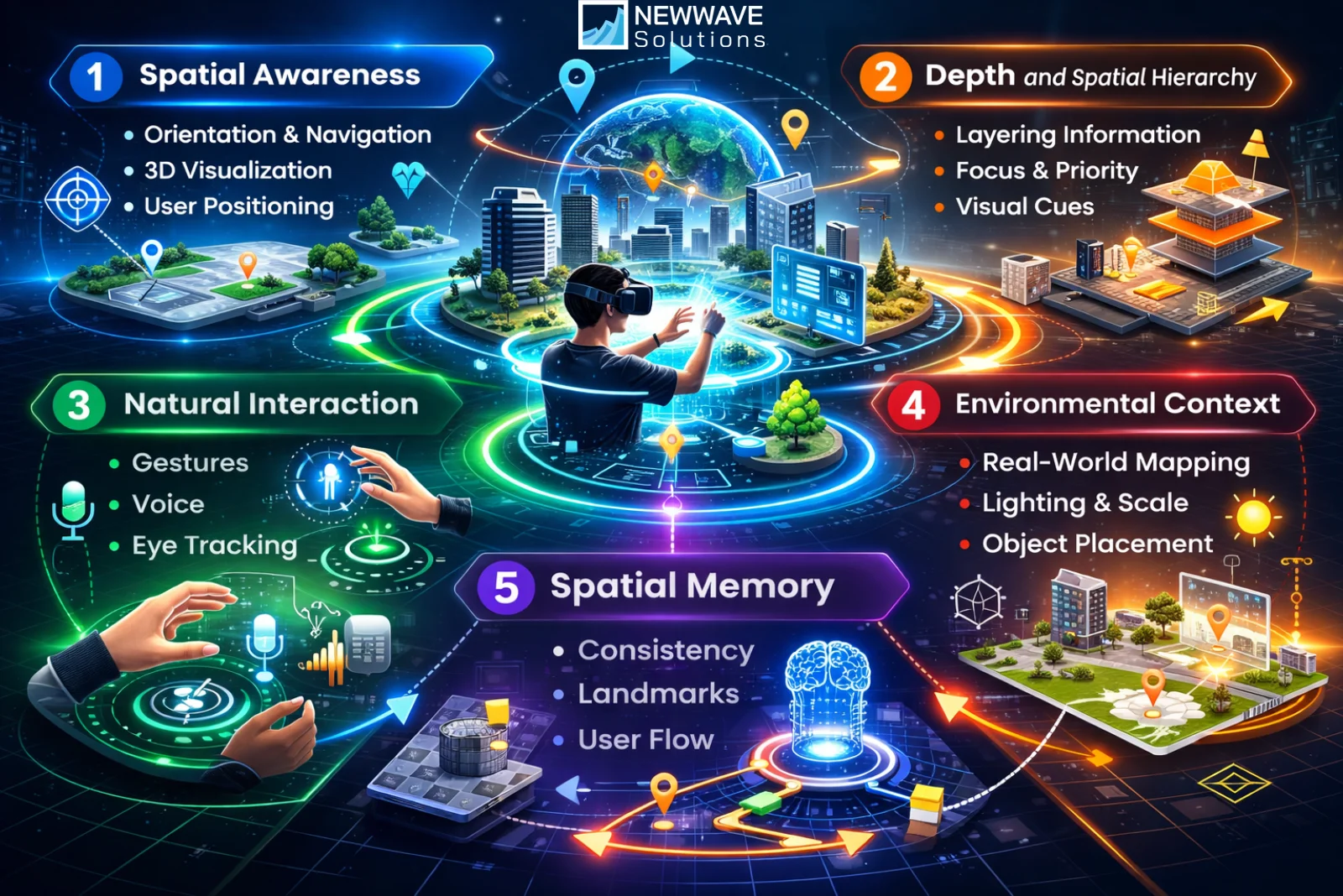
Spatial awareness ensures that digital interfaces respect the user’s physical position and surrounding environment when presenting information. Designers must consider factors such as user orientation, reachable space, and physical obstacles when positioning spatial interface elements. When implemented effectively, this principle allows digital objects to feel naturally integrated into the user’s environment rather than artificially imposed.
Depth and Spatial Hierarchy
Depth and spatial hierarchy determine how visual elements are arranged within three-dimensional environments to guide user attention. Objects positioned closer to the user typically receive higher visual priority, while distant elements provide contextual information. Proper depth management helps designers reduce cognitive overload and create intuitive navigation within spatial ux design environments.
Natural Interaction
Natural interaction focuses on enabling users to interact with digital systems using familiar human behaviors such as gestures, gaze, and body movement. Instead of relying on conventional UI controls, spatial interfaces allow users to manipulate objects as if they exist physically within the environment. As a result, this interaction model improves usability and reduces the learning curve in immersive applications.
Environmental Context
Environmental context requires spatial systems to adapt interfaces according to the user’s surroundings. Designers must consider factors such as lighting conditions, available space, and nearby objects when building immersive experiences. This contextual awareness ensures that spatial computing ux systems provide relevant and comfortable interactions in real-world environments.
Spatial Memory
Spatial memory refers to the user’s ability to remember where digital objects are positioned within a physical or virtual environment. Designers must maintain consistent placement of interface elements so that users can reliably locate information across sessions. Stable spatial positioning improves usability and helps build trust in immersive digital environments.
Real-World Applications of Spatial UX
Many businesses struggle to see past the “hype” of immersive tech, often missing out on how three-dimensional interfaces can solve tangible operational and commercial problems. We will explore diverse use cases across industries like retail, healthcare, and real estate to demonstrate how Spatial UX can move beyond novelty to drive real-world engagement and measurable ROI.
1. XR Gaming Experiences
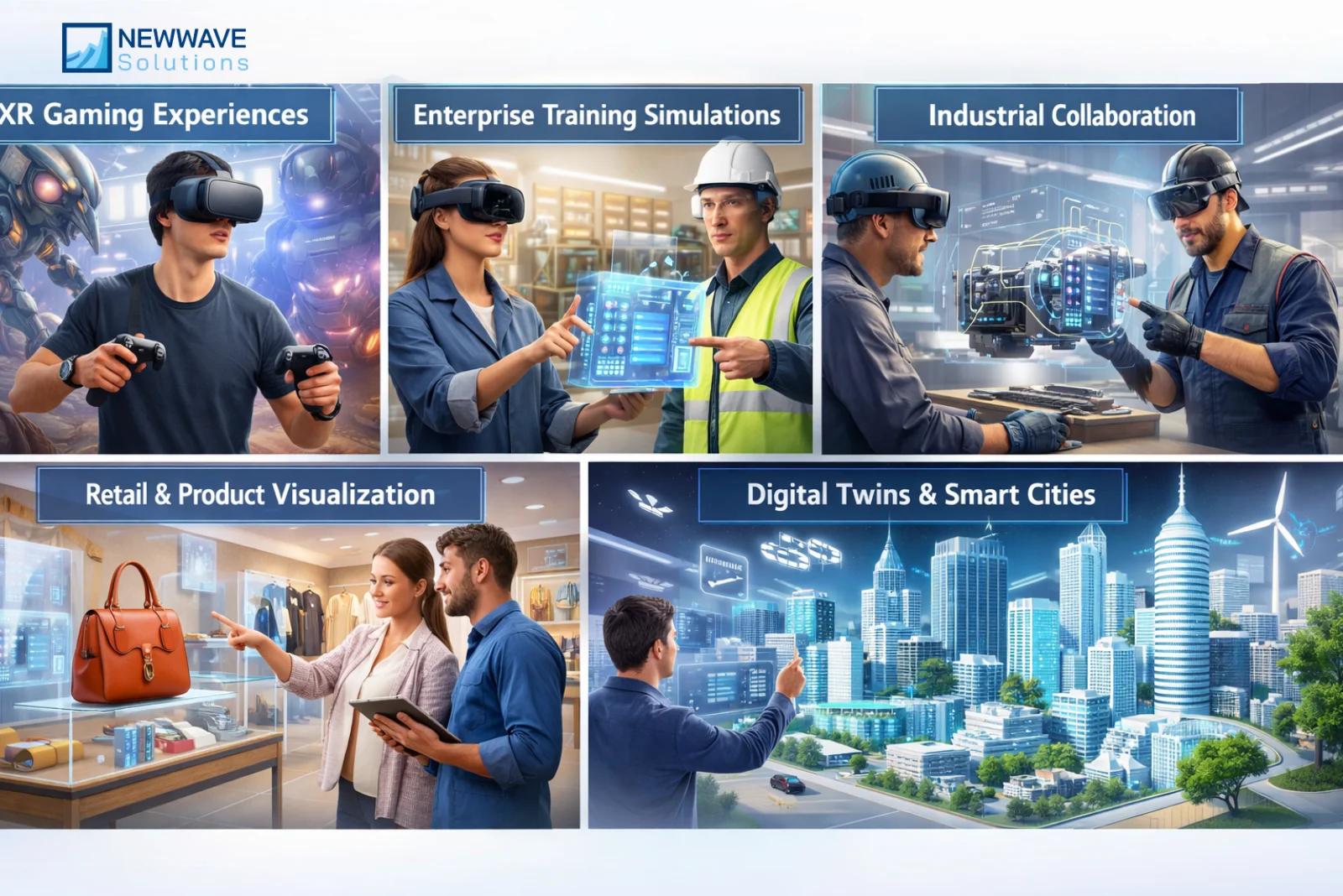
XR gaming platforms rely heavily on spatial ux to create immersive gameplay where users interact with digital environments using body movement, gaze control, and gesture-based navigation. These systems transform traditional gaming mechanics into real-time spatial interactions that respond dynamically to user position and movement.
Example: Epic Games deploys XR gaming experiences through Unreal Engine’s spatial anchors in Fortnite, enabling players to interact with persistent 3D environments across VR headsets and mobile AR development devices during live events. This approach attracted 350M+ registered users and generated $5B+ revenue in 2025 by creating shared metaverse spaces that blend real-time multiplayer battles with holographic object manipulation.
2. Enterprise Training Simulations
Many organizations deploy VR-based training simulations to help employees practice complex tasks in controlled digital environments. Spatial interfaces enable realistic interaction with equipment, machinery, and virtual environments, which significantly improves learning outcomes in industries such as aviation, healthcare, and manufacturing.
Example: Boeing utilizes VR development training simulations on HoloLens for 787 Dreamliner assembly training, where technicians practice wiring harness installations in virtual aircraft mockups that replicate exact factory conditions. The program reduced training time by 75% from 40 hours to 10 hours per module while improving first-time quality rates by 30% across 10,000+ global assembly workers.
3. Industrial Collaboration
Engineering and manufacturing teams increasingly use spatial collaboration platforms that allow professionals to analyze holographic 3D models in shared environments. Through immersive interfaces, engineers can review prototypes, adjust designs, and communicate technical insights more efficiently than with traditional visualization tools.
Example: Airbus engineers collaborate via Microsoft HoloLens holographic models during A350 XWB wing design reviews, projecting 1:1 scale 3D CAD assemblies for remote teams to annotate and simulate stress tests in shared mixed reality sessions. This spatial collaboration cut physical prototype iterations by 40%, saving €15M annually while accelerating certification cycles by 3 months for composite wing components.
4. Retail and Product Visualization
Retail companies use AR-based spatial experiences to help customers visualize products within their real surroundings before purchasing them. Customers can place furniture in their living rooms, preview fashion accessories, or explore product features through immersive digital overlays.
Example: IKEA employs AR product visualization through its IKEA Place app, where users scan rooms via smartphone to place 3D furniture models at scale for purchase decisions. The feature boosted conversion rates by 22% for AR sessions and reduced return rates by 25% on visualized items, driving $1B+ in AR-enabled sales across 50+ countries.
5. Digital Twins and Smart Cities
Urban planning and infrastructure management increasingly rely on digital twin systems that replicate real-world environments in interactive 3D models. Spatial interfaces allow engineers, analysts, and city planners to explore complex infrastructure systems and analyze urban data through intuitive spatial interaction models.
Example: Singapore’s Virtual Singapore platform leverages digital twins with spatial interfaces on HoloLens for urban planners to analyze traffic flows and flood risks across 728 km² city models fed by IoT sensors. This system optimized 5G tower placements, reducing deployment costs by 20% while improving emergency response planning accuracy by 35% through interactive 3D scenario simulations.
Challenges in Designing Spatial UX
Despite its immense potential, the path to a seamless spatial experience is often obstructed by technical hurdles like hardware constraints and the physiological risk of motion sickness. The following analysis identifies the most critical obstacles designers face today, offering strategic insights into how your team can navigate these complexities without compromising user comfort or system performance.
- User orientation and spatial navigation: Users often feel disoriented when they enter a vast 3D environment because traditional navigation cues like “back” buttons or scroll bars do not exist in an open spatial interface. To address this confusion, designers can implement persistent environmental anchors or visual breadcrumbs that provide a clear sense of location and direction within the virtual space.
- Hardware limitations in XR devices: Current extended reality (XR) headsets frequently struggle with weight distribution and limited battery life, which significantly restricts the duration of comfortable user sessions. Nevertheless, engineering teams can mitigate these physical constraints by optimizing interaction models to require less strenuous movement and focusing on short, high-value user tasks.
- Performance and rendering constraints: Achieving a high frame rate is critical for Spatial UX because any visual lag can immediately break immersion and cause a disconnect between user input and system response. In light of these requirements, developers often utilize foveated rendering and level-of-detail (LOD) techniques to prioritize processing power for objects that are directly within the user’s focal point.
- Motion sickness and ergonomic issues: A significant portion of users experiences nausea when virtual movement does not perfectly align with their physical equilibrium, leading to a negative perception of the technology. Accordingly, successful spatial designs incorporate “teleportation” movement mechanics and fixed peripheral frames to stabilize the user’s inner ear during transition periods.
- Accessibility in immersive environments: Immersive interfaces often rely heavily on visual and physical cues, which can unintentionally exclude users with motor or visual impairments from fully participating in the experience. Consequently, it is essential to integrate multimodal feedback—such as spatial audio and haptic vibrations—to ensure that the digital environment remains inclusive and functional for everyone.
Future of Spatial UX
In my perspective, Spatial UX is currently at a critical turning point where it is evolving from a niche experimental tool into a foundational standard for daily digital interaction. While early iterations focused primarily on gaming, the current shift toward productivity and social collaboration suggests that spatial interfaces will soon become as ubiquitous as our current smartphone screens.
I believe that the rapid integration of sophisticated sensors and artificial intelligence will make these environments much more context-aware and responsive to human intent. As a result, we can expect the boundary between our physical reality and digital data to blur even further, leading to a world where information is naturally woven into the objects and spaces around us.
- AI-assisted spatial interface generation: Intelligent algorithms are now capable of automatically generating adaptive 3D layouts that reorganize themselves based on the user’s specific environment and current behavioral patterns.
- Spatial operating systems (VisionOS, XR platforms): The industry is moving toward standardized operating systems that provide a unified framework for multitasking and managing multiple spatial applications within a single persistent view.
- Real-time digital twins: Enterprises are increasingly using spatial interfaces to interact with live, 3D replicas of physical assets, allowing for remote monitoring and complex data visualization in a natural format.
- Holographic collaboration environments: Future workspaces will likely utilize holographic projections to allow remote participants to feel physically present in the same room, thereby enhancing the quality of remote teamwork.
- Metaverse-style spatial interfaces: The development of interconnected virtual worlds is driving a shift toward persistent digital identities that can move seamlessly between different spatial experiences without losing data or context.
Why Newwave Solutions is the Ideal Choice for Professional Spatial UX Design?
Many enterprises today face significant hurdles when attempting to transition from traditional interfaces to immersive environments, often struggling with a lack of specialized talent and the high complexity of 3D spatial logic. Consequently, hiring a professional service provider becomes essential to ensure that your spatial initiatives are not only visually stunning but also technically robust and user-friendly.
Newwave Solutions stands at the forefront of this technological shift, offering end-to-end support for businesses ready to embrace the future of interaction. Our team provides the strategic depth and technical precision required to navigate the entire Spatial UX lifecycle, helping you turn complex concepts into high-performing digital realities.
How Newwave Solutions Empowers Your Spatial UX Journey
- Advanced Mobile App Development Services: We specialize in developing sophisticated mobile applications integrated with cutting-edge AR features, such as virtual furniture placement or digital try-ons, that function seamlessly on modern smartphones.
- Next-Gen UI/UX Design Services: Our design experts possess deep spatial thinking capabilities, allowing them to transform static 2D interfaces into interactive, intuitive 3D environments that enhance user presence.
- Strategic Emerging Technology Services: We assist organizations in adopting emerging technologies like VR training simulations and Metaverse platforms to significantly improve operational efficiency and brand marketing.
- End-to-End Lifecycle Management: From initial conceptualization and MVP development to full-scale launching and continuous maintenance, Newwave Solutions ensures your project remains agile and scalable.
- Performance Optimization for XR: Our engineering teams focus on rigorous rendering optimization and low-latency execution to eliminate motion sickness and ensure a fluid experience across all XR devices.
Whether you are looking to revitalize your retail experience or implement complex industrial simulations, our tailored approach ensures that your technology stack is perfectly aligned with your business goals. By leveraging our proven expertise, your company can minimize the risks associated with immersive development while maximizing customer retention through superior spatial interactions.
Let our experts help you boost your brand’s digital experience with our world-class Spatial UX/ UI design services!
Conclusion
Mastering Spatial UX requires a delicate balance between technical optimization and human-centric design to ensure that immersive environments remain both powerful and accessible. By addressing current challenges and staying ahead of emerging trends, organizations can build a resilient digital foundation that thrives in the three-dimensional era.
If you are looking for an expert collaborator to navigate this transition, Newwave Solutions is a trusted partner capable of supporting the entire Spatial UX lifecycle from initial concept to long-term maintenance. Talk to Newwave Solutions today so that we can help your business boost customer engagement and achieve sustainable growth through cutting-edge immersive technology.
To Quang Duy is the CEO of Newwave Solutions, a leading Vietnamese software company. He is recognized as a standout technology consultant. Connect with him on LinkedIn and Twitter.



Read More Guides




Get stories in your inbox twice a month.
Let’s Connect
Let us know what you need, and out professionals will collaborate with you to find a solution that enables growth.
Leave a Reply