


What is BigCommerce? The Platform Behind Modern E-commerce
BigCommerce powers over 600,000 online stores across 150 countries, processing billions in annual sales – yet many business leaders still underestimate what this platform can truly deliver. When your e-commerce infrastructure becomes the bottleneck to growth, when technical limitations force you to choose between functionality and user experience, or when scaling costs spiral out of control, you need to understand what is BigCommerce and whether it’s the solution your business actually needs. Let’s explore what makes BigCommerce stand out in today’s competitive e-commerce landscape.
What is BigCommerce?
BigCommerce is a cloud-based, SaaS e-commerce platform that enables businesses to build, manage, and scale online stores without extensive technical infrastructure. Unlike traditional e-commerce solutions that require server management and complex installations, BigCommerce delivers a complete commerce solution through a subscription model, handling everything from hosting and security to core functionality and updates.
The platform emerged in 2009 when Eddie Machaalani and Mitchell Harper founded BigCommerce in Sydney, Australia, recognizing a gap in the market for enterprise-grade features at accessible price points. What started as a bootstrapped venture grew rapidly, securing venture funding and relocating headquarters to Austin, Texas. By 2020, BigCommerce went public on NASDAQ, cementing its position as a major player in the e-commerce infrastructure space. The platform’s evolution reflects a consistent philosophy: democratizing enterprise e-commerce capabilities while maintaining flexibility for developers and agencies.
So who will suitable with BigCommerce?
- Growing small and medium businesses that need more flexibility and scalability than simple website builders can provide.
- Retailers with large or expanding product catalogs who require powerful product management and advanced filtering options.
- Brands aiming for multi-channel selling across marketplaces like Amazon, eBay, and social platforms such as Facebook, TikTok, and Instagram.
- Companies that need built-in SEO, analytics, and marketing tools without relying heavily on third-party apps.
- Merchants looking for enterprise-level performance without the cost and complexity of self-hosted ecommerce systems.
- Businesses operating in multiple regions that need localized storefronts, multiple currencies, and global fulfillment integrations.
- Teams with limited technical resources who want a managed, secure ecommerce platform but still need customization and API flexibility.
- B2B businesses requiring features like customer groups, pricing rules, bulk ordering, and custom workflows.
- Brands planning long-term growth and needing a platform that supports high traffic, stability, and advanced scalability.
Get to know BigCommerce Highlight Features
When evaluating what a BigCommerce platform is, its feature set is what truly defines it. The platform is architected to be both comprehensive for developers and manageable for merchants.
A Headless-Commerce Ready Architecture
This is a fundamental differentiator. BigCommerce is built to separate the front-end (what the customer sees) from the back-end (the commerce engine). This means you can build a storefront with any technology (React, Vue.js, etc.) while BigCommerce securely manages all the commerce functionality in the background.
Multi-Channel Selling
BigCommerce natively integrates with Amazon, eBay, Instagram, Facebook, and Google Shopping. You can manage inventory and orders from these channels directly within your BigCommerce dashboard, creating a unified operational hub.
Unparalleled Native Features
Many platforms rely heavily on apps for basic functionality. BigCommerce includes powerful features out-of-the-box, such as:
- Native faceted search and filtering.
- Robust customer group and segmentation tools.
- Advanced discount and promotion rules.
- A wide range of secure payment gateways without transaction fees (on most plans).
Scalable Performance and Security
As a SaaS development platform, BigCommerce provides optimized hosting, a built-in Content Delivery Network (CDN), and Level 1 PCI DSS compliance, ensuring your store is fast and secure without any extra effort on your part.
The proof of a platform’s efficacy is in its adoption. BigCommerce powers brands like Ben & Jerry’s, Skullcandy, and Molton Brown, demonstrating its capacity to handle high-volume, complex businesses. Its global footprint is expanding, not just as a tool for startups but as a strategic solution for enterprises looking to future-proof their digital sales channels.
Why Should You Choose BigCommerce?
Before diving into specific advantages, understand this: choosing an e-commerce platform isn’t about features alone—it’s about matching your business trajectory with infrastructure that accelerates rather than restricts growth.
1. Built for Scale Without Platform Fatigue
Most businesses hit a growth ceiling where their e-commerce platform becomes the problem. You’ve experienced this if you’ve ever been forced to upgrade hosting, purchase additional plugins for basic functionality, or rebuild your entire store to handle increased traffic. BigCommerce eliminates platform fatigue through architectural decisions made at the foundation level. The multi-tenant SaaS model means infrastructure scales automatically, no server configuration, no performance optimization projects, no emergency upgrades during peak traffic.
What this means practically?
- No bandwidth limits or transaction throttling during flash sales
- Automatic infrastructure scaling during traffic spikes
- Same feature set from startup to enterprise scale
- Zero downtime upgrades and security patches
The economic impact here matters significantly. Traditional platforms force you to over-provision infrastructure for peak capacity, paying resources you don’t use 90% of the time. BigCommerce’s pricing remains consistent regardless of traffic volume, making budgeting predictable and eliminating surprise infrastructure costs.
2. Open SaaS Architecture Reduces Technical Debt
What is BigCommerce platform’s approach to customization? Unlike closed ecosystems that force you into proprietary frameworks, BigCommerce built on an open SaaS model that balances managed infrastructure with extensive customization freedom. It’s means your developers can build custom storefronts using React, Vue, or any modern framework while BigCommerce handles commerce logic, security, and compliance behind the scenes.
This matters because technical debt—the accumulation of customizations, workarounds, and outdated code—eventually cripples most e-commerce operations. BigCommerce’s API-first architecture means customizations happen through standardized interfaces rather than core platform modifications.
3. Enterprise Features at Mid-Market Economics
Traditional enterprise e-commerce platforms start at six figures annually before you’ve added a single product. BigCommerce disrupted this model by including enterprise capabilities in standard plans – no negotiation; no special contracts required initially.
Capabilities typically reserved for enterprise platforms:
- Multi-storefront management from single dashboard
- Customer segmentation and group pricing
- Advanced B2B features including quote management
- Built-in CDN and DDoS protection
- Professional services integration (Avalara, Vertex for tax)
For growing businesses, this changes the economics fundamentally. You’re not choosing between affordability and functionality—you get both. A mid-sized retailer can operate with the same technical capabilities as billion-dollar brands without proportional infrastructure investment.
4. SEO and Performance Optimization Built-In
BigCommerce SEO capabilities address a critical reality: technical performance directly impacts revenue. Every 100-millisecond delay in page load time costs 1% in conversion rates. Poor SEO architecture makes you invisible to potential customers searching for your products.
The platform includes technical SEO foundations that would otherwise require extensive development:
- Automatic generation of XML sitemaps and robots.txt
- Microdata markup for rich search results
- Customizable URL structures without .html extensions
- Canonical tags and 301 redirect management
- AMP (Accelerated Mobile Pages) support
- Image optimization and lazy loading
Combined with built-in CDN and optimized server response times, BigCommerce stores typically achieve better Core Web Vitals scores than custom-built or self-hosted alternatives without ongoing optimization projects.
What Challenges Should You Anticipate with BigCommerce?
No platform perfectly fits every scenario, and understanding BigCommerce’s constraints helps you make informed decisions rather than discovering limitations after migration:
1. Theme Customization Requires Technical Knowledge
While BigCommerce themes provide professional starting points, deep customization demands frontend development expertise. The Stencil framework (BigCommerce’s theming engine) uses Handlebars templating and requires understanding of how data flows from the backend to templates.
What creates friction here?
- Visual theme builders exist but offer limited control compared to code-level changes
- Achieving pixel-perfect brand alignment often requires hiring BigCommerce web design specialists
- Template logic differs from platforms like WordPress, creating a learning curve for developers
You can mitigate this through strategic planning. Many businesses start with premium themes that closely match their vision, minimizing customization needs initially. As revenue grows, they invest in custom BigCommerce development services for unique differentiation.
2. Transaction Fees on Lower Tiers
BigCommerce’s Standard and Plus plans include transaction fees if you don’t use specific payment processors. This cost structure can surprise businesses accustomed to platforms without transaction charges.
The practical breakdown?
- Using BigCommerce Payments (powered by PayPal) eliminates transaction fees
- Third-party payment processors incur fees on lower-tier plans
- Pro and Enterprise plans eliminate transaction fees regardless of payment processor
For businesses processing significant volume, this creates a decision point: accept transaction fees, switch payment processors, or upgrade plans. Many find that the broader platform’s capabilities and lack of bandwidth charges offset transaction fees, but this requires actual calculation based on your specific economics.
3. Annual Sales Volume Triggers Plan Upgrades
BigCommerce pricing ties to revenue thresholds. When your store exceeds your plan’s annual sales limit, you must upgrade or face account restrictions. For rapidly growing businesses, this can feel like penalization for success.
How thresholds work?
- Standard plan: Up to $50K annual sales
- Plus plan: Up to $180K annual sales
- Pro plan: Up to $400K annual sales
- Enterprise: Custom pricing for higher volumes
This model reflects BigCommerce’s positioning: the platform targets growing businesses and enterprises, not perpetual small stores. As your business scales, you’re expected to invest proportionally in infrastructure that supports that scale.
4. Limited Native Blogging Functionality
BigCommerce includes basic blog functionality, but it lacks the sophistication of dedicated content management systems. For businesses where content marketing drives acquisition, this limitation requires workarounds.
What’s missing?
- Advanced content organization and taxonomy
- Sophisticated editorial workflows
- Built-in content marketing tools like newsletter integration
- Comprehensive content analytics
Most businesses solve this through headless architecture—maintaining blogs on WordPress or other CMS platforms while BigCommerce handles commerce. The platform’s API-first design makes this integration straightforward, allowing content and commerce to coexist seamlessly.
What is BigCommerce Used For?
BigCommerce serves diverse commerce scenarios, but certain use cases reveal where the platform delivers maximum value:
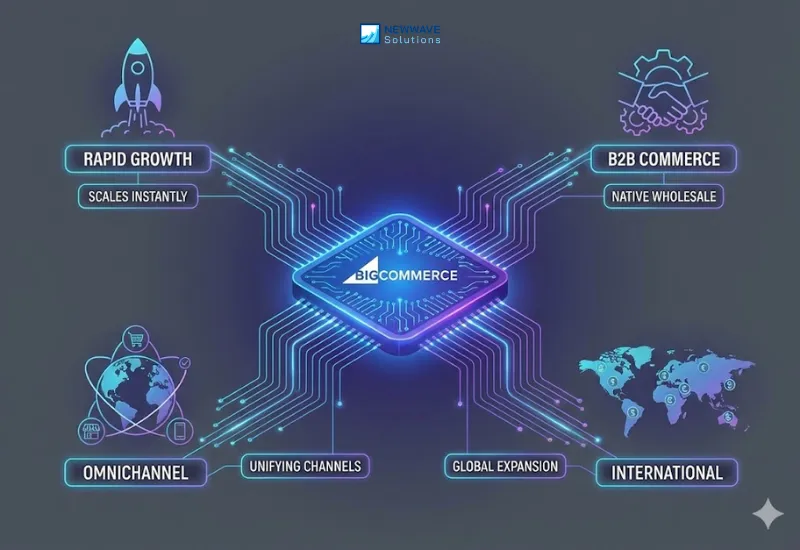
1. Rapid Growth Brands
Direct-to-consumer brands experiencing explosive growth need infrastructure that scales instantly. When a viral campaign drives traffic from 50 to 5,000 daily orders, traditional platforms crash or require emergency scaling. BigCommerce absorbs these spikes automatically.
SkullCandy migrated specifically to handle traffic volatility during launches and holiday seasons, processing 40% more peak traffic without performance issues. Fashion brand Natori saw 15% conversion improvement immediately after migration, driven purely by faster load times. These brands need enterprise performance without enterprise timelines—exactly what BigCommerce delivers.
2. Complex B2B Commerce Operations
What is BigCommerce platform’s B2B advantage? Native functionality for wholesale complexity—customer-specific pricing, quote workflows, bulk ordering, and purchase order processing—all built-in rather than requiring expensive customization.
Toyota leverages BigCommerce for parts e-commerce, managing complex catalogs with vehicle-specific fitment and dealer pricing. Industrial distributors operate B2C and B2B portals simultaneously, maintaining unified inventory while presenting different experiences to different customer segments.
Your business may not need a solution as complex as Toyota’s, but our eCommerce web development services can have custom quote management and customer group pricing features built for your BigCommerce store.
3. Omnichannel Retailers Unifying Channels
Retailers with physical and digital operations need real-time inventory synchronization across all touchpoints. Camelbak uses BigCommerce to sync inventory across their website, Amazon, retail partners, and stores—preventing overselling while enabling buy-online-pickup-in-store seamlessly.
This architectural approach means customer service sees complete purchase history regardless of channel and return process smoothly whether purchased online or in-store.
4. International Commerce
Expanding globally requires multi-currency support, localized content, regional payment methods, and tax compliance. Ted Baker operates multiple BigCommerce storefronts for different regions, each with localized currency and checkout flows optimized for regional preferences—delivering substantially better conversion than single global stores.
BigCommerce dropshipping businesses particularly benefit from built-in internationalization, allowing them to test markets efficiently without complex infrastructure investments.
BigCommerce, WooCommerce, Shopify – Which one is the best?
The e-commerce platform landscape is dominated by a few key players, and the choice between them is critical. Your selection will influence your daily operations, cost structure, and growth potential for years to come. Here’s a comparative look at how BigCommerce stacks up against its main competitors:
| Feature | BigCommerce | Shopify | WooCommerce |
| Platform Type | SaaS | SaaS | Open-Source (WordPress Plugin) |
| Hosting | Managed by BigCommerce | Managed by Shopify | Self-Hosted (You choose & manage) |
| Ease of Use | Moderate to Advanced; powerful but has a learning curve | Very Easy; most user-friendly for beginners | Varies; requires technical comfort with WordPress |
| Scalability | High; built for scaling enterprises | High; excellent for SMBs, can scale up | Unlimited, but entirely dependent on your hosting & maintenance |
| Cost Structure | Transparent subscription; no transaction fees on most plans. | Subscription + transaction fees unless using Shopify Payments. | “Free” plugin, but costs for hosting, SSL, security, themes, plugins, and developers add up. |
| Customization | High via APIs, Headless, and Themes. Checkouts are limited. | High via Apps and Liquid. Checkout customization requires Shopify Plus. | Nearly unlimited; full access to code for total control. |
| Native Features | Very extensive; reduces the need for apps. | Good, but often requires apps for advanced features. | Minimal; almost everything requires plugins. |
The insight is clear: there is no single “best” platform, only the best for you. If your priority is a hands-off, secure, and powerfully featured platform that scales you without surprise costs, BigCommerce is a compelling contender. If the ultimate simplicity is your goal, choose Shopify. If you have dedicated developer resources and demand total control, WooCommerce might be your path.
From initial strategy to final deployment, our end-to-end software development services ensure your BigCommerce implementation is optimized for performance, scalability, and user experience.
FAQs
What is BigCommerce built on?
Technically, BigCommerce is built on a modern, scalable tech stack. The backend uses a combination of Linux, Apache, Nginx, and PHP, with a MySQL database for data storage. The frontend for themes is powered by its proprietary Stencil framework, and it offers robust APIs that allow for headless commerce implementations using any frontend technology.
Is BigCommerce good for dropshipping?
Yes, BigCommerce dropshipping is a popular use case. The platform supports this model through integrations with major dropshipping suppliers like Spocket, AliExpress, and Printful via the BigCommerce marketplace for apps. This allows you to easily import products and automate order fulfillment.
Can I customize my BigCommerce store design?
Absolutely. You can choose from a wide array of pre-designed BigCommerce themes and customize them using a user-friendly editor. For deeper customization, a BigCommerce developer can use the Stencil framework or even implement a headless setup to build a completely custom storefront from the ground up.
How does BigCommerce’s multi-store functionality work for a global enterprise?
BigCommerce does not offer a native “multi-store” feature from a single admin like some competitors. Instead, for a true global presence with region-specific stores (.com,.co.uk, .de), you typically manage separate store instances. This can be orchestrated using its API and third-party tools to sync certain data, but it requires a more sophisticated operational approach than a single-panel solution.
How long does it take to launch a BigCommerce store?
Launch timelines for BigCommerce stores vary dramatically based on complexity but follow general patterns. A basic store using a premium theme with standard functionality can launch in 1-3 weeks if you have products, content, and branding ready. Mid-complexity stores requiring moderate customization, extensive product catalogs, or multiple integrations typically need 4-8 weeks.
Conclusion
Your ecommerce platform is more than a piece of software — it becomes the structural backbone of your entire digital business. Choosing BigCommerce is a strategic decision to invest in long-term scalability rather than quick fixes. It reflects a commitment to stable architecture, flexible integrations, and a platform built to grow alongside your ambitions. BigCommerce is not just a technical solution; it’s the confidence that your business will be ready for whatever the ecommerce landscape demands next.
If you’re ready to build an online store with a foundation engineered for the future, Newwave Solutions is here to help. Our Vietnam-based team specializes in BigCommerce development, custom web development services, and full-cycle ecommerce web development solutions that bring your digital strategy to life. Whether you need a tailored BigCommerce storefront, complex integrations, performance optimization, or a fully custom ecommerce ecosystem, we deliver scalable, high-quality solutions built around your goals.
Let’s discuss how Newwave Solutions can help you transform BigCommerce into a growth engine — turning your digital commerce ambitions into measurable results.
To Quang Duy is the CEO of Newwave Solutions, a leading Vietnamese software company. He is recognized as a standout technology consultant. Connect with him on LinkedIn and Twitter.



Read More Guides

Get stories in your inbox twice a month.
Let’s Connect
Let us know what you need, and out professionals will collaborate with you to find a solution that enables growth.
Leave a Reply