


What is CodeIgniter? Features, Common Use Cases & Setup Guide

PHP development has become increasingly important as businesses demand faster, scalable, and secure web applications, and there are many frameworks available to choose from. Among them, CodeIgniter stands out as a reliable option with its lightweight structure, MVC pattern, and developer-friendly tools. This article can help you explore everything about this framework — from what is CodeIgniter, pros and cons, core features, use cases, to setup guidance — and see if it can help address your challenges in PHP development.
What Is CodeIgniter?
First, let’s explore what is CodeIgniter: it is an open-source PHP framework designed for developers who need a simple yet robust toolkit to build web applications. Following the MVC (Model-View-Controller) pattern, the CodeIgniter framework approach provides a clean structure that makes development faster, easier to maintain, and scalable for enterprise projects.
With its lightweight design, CodeIgniter has become popular among companies that want efficient, cost-effective, and reliable solutions for their digital platforms.
Example: Buffer, the well-known social media scheduling platform, was initially built using CodeIgniter. The framework enabled the startup to launch quickly with a stable backend, supporting rapid growth to millions of users while keeping infrastructure costs low.
How does CodeIgniter work?
CodeIgniter works by dividing your application into three main parts so that everything is organized and easier to manage:
- Model: Handles everything related to data, such as retrieving information from the database, saving records, or updating entries.
- View: Manages how the data is shown to the user, like web pages, forms, or reports.
- Controller: Acts as the bridge between the Model and the View, taking user requests, processing them, and sending the right response back.
The flow is simple: a user sends a request → the Controller processes it → the Model works with the database → the View displays the result to the user. This structure makes applications faster to build, easier to update, and more reliable for long-term projects.
What is CodeIgniter used for?
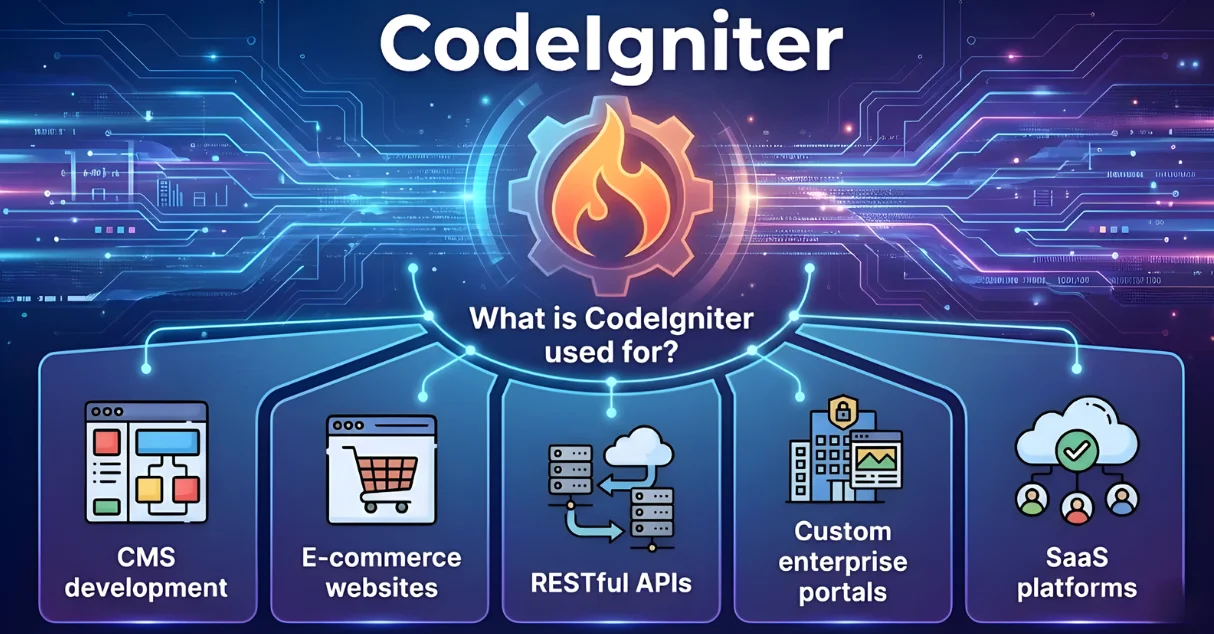
Since CodeIgniter can be used for multiple purposes, I will sum up some prominent circumstances in which businesses should apply this PHP framework:
- CMS development: Businesses can create custom content management systems quickly, reducing coding time while ensuring scalability.
- E-commerce websites: CodeIgniter supports fast-loading online stores with secure checkout and order management functions, ideal for high-traffic retail businesses.
- RESTful APIs: Enterprises use CodeIgniter to build lightweight APIs that connect with mobile apps, third-party services, and cloud systems.
- Custom enterprise portals: Organizations develop internal portals for employee management, reporting, or client interaction, benefiting from the framework’s structured approach.
- SaaS platforms: Startups and B2B companies leverage CodeIgniter for software-as-a-service products, enjoying reduced overhead and faster time-to-market.
7 Key Features of CodeIgniter
After discovering what is CodeIgniter and its core model functioning, it’s time to see what it can actually do in several scenarios:
- Lightweight and fast execution speed: CodeIgniter has a small footprint and executes quickly, making it ideal for businesses that need responsive websites and applications. This benefits e-commerce platforms, news sites, or SaaS tools where speed directly impacts user experience and engagement.
- MVC architecture for cleaner code and scalability: The framework separates data, logic, and presentation through the MVC pattern, allowing large projects to remain organized. This makes it easier for development teams to scale applications and maintain them over time.
- Built-in libraries for session management, email, and form validation: CodeIgniter includes ready-to-use libraries that handle common tasks like user logins, sending notifications, and validating form inputs. These features save time and improve consistency across enterprise applications.
- Security features, including XSS filtering and CSRF protection: With built-in safeguards, CodeIgniter protects web apps against common attacks such as malicious scripts and unauthorized form submissions. This ensures businesses in finance, healthcare, or government can meet security and compliance needs.
- Easy configuration and minimal footprint: Developers can set up CodeIgniter with minimal steps, and its lightweight core reduces server requirements. This is particularly useful for SMEs or startups that need fast deployment without heavy infrastructure costs.
- Strong documentation and active developer community: The framework is supported by detailed guides and an engaged community, which helps reduce the learning curve. Enterprises benefit from faster onboarding of developers and easier problem-solving.
- Compatible with third-party APIs and cloud deployments: CodeIgniter integrates seamlessly with APIs for payment gateways, CRMs, and cloud platforms like AWS or Azure. This flexibility helps companies extend their applications and adopt cloud-native strategies efficiently.
Pros & Cons of CodeIgniter
Like other PHP frameworks, CodeIgniter comes with its own strengths and weaknesses. These should be carefully considered to determine whether the framework matches your brand’s demands and long-term preferences. Let’s explore the details below.
| Pros |
Cons |
| Lightweight and fast: CodeIgniter runs with a small footprint and quick execution, making it suitable for responsive business applications. | Fewer advanced features: Compared to Laravel or Symfony, CodeIgniter offers fewer built-in advanced functionalities for complex enterprise systems. |
| Easy to learn: Its simple structure and clear conventions reduce the learning curve for new developers. | Smaller ecosystem: The number of available plugins and extensions is more limited than in larger frameworks, reducing flexibility for niche requirements. |
| Strong documentation: Comprehensive guides and tutorials help teams adopt the framework quickly. | Less suited for very large/complex projects: For enterprises handling massive applications, alternatives with broader ecosystems may be a better fit. |
| Flexible integration: CodeIgniter works well with third-party APIs, payment gateways, and cloud platforms. |
4 Common Use Cases of CodeIgniter
CodeIgniter is widely adopted across industries that require speed, security, and scalability in their digital solutions. From building online platforms to powering data-driven applications, the framework has proven valuable in multiple business environments. Below, we will examine its contribution and usage in four common sectors where it continues to deliver strong results.
1. Financial Services
In the financial sector or financial software development service, CodeIgniter supports the development of secure online portals, payment gateways, and lightweight transaction systems. Its built-in security features and efficient MVC structure make it a good fit for managing sensitive financial data while ensuring quick performance.
For example, iPay88, a leading online payment gateway in Asia, used CodeIgniter to build parts of its platform. This allowed the company to deliver fast and secure payment processing, improving trust among users and enabling them to scale across multiple markets.
2. E-commerce
E-commerce development services or businesses use CodeIgniter to manage product catalogs, shopping carts, and order management systems. Its speed and scalability help online stores handle traffic surges during peak seasons while maintaining smooth checkout experiences.
Shopee has leveraged CodeIgniter in parts of its earlier platform infrastructure. By using the framework’s lightweight architecture, they ensured quick page load times and seamless integration with third-party payment APIs, boosting user satisfaction during growth phases.
3. Healthcare
In healthcare, CodeIgniter is often applied to build patient management portals, medical dashboards, and HIPAA-compliant systems that protect sensitive health data. Its built-in authentication and validation features make it reliable for meeting strict compliance requirements.
One example is Oxyjon, a digital healthcare platform in India, which used CodeIgniter to develop its health tracking and emergency service modules. This enabled the company to deliver real-time access to medical information, improving both patient experience and doctor efficiency.
4. Media & Entertainment
Media and entertainment companies rely on CodeIgniter to build content libraries, user profile management systems, and streaming platforms. The framework’s speed and ability to integrate with APIs allow these businesses to deliver content smoothly to global audiences.
Buffer, the popular social media scheduling tool, was initially built on CodeIgniter. This helped the company launch quickly, handle millions of posts reliably, and grow into a platform serving over 75,000 businesses worldwide.
Basic-to-Advanced Setup of Code Igniter
Many developers face the pain point of not knowing where to begin or how to properly set up this framework. From our years of experience working with PHP models, we would like to guide you through some basic steps to set up and start using CodeIgniter effectively.
Step 1: Install PHP and Composer
Make sure the latest version of PHP and Composer is installed on your system. This ensures compatibility and gives you the package manager needed for installing CodeIgniter smoothly.
Step 2: Download or create a CodeIgniter project
Use Composer with the command composer create-project codeigniter4/appstarter project-name or download directly from the official CodeIgniter site. This will create the project structure with all the necessary files to get started.
Step 3: Configure base URL and database settings
Open the app/Config/App.php file to set your base URL and app/Config/Database.php to configure database credentials. This step connects your application with the correct environment so you can manage and display data effectively.
Step 4: Run the development server and create your first controller/view
Start the server with php spark serve and access the project in your browser. Then create your first controller and view to understand how to use CodeIgniter and see your application in action.
CodeIgniter vs Other PHP Frameworks
CodeIgniter is not alone in the PHP framework landscape, as strong competitors like Laravel and Symfony also dominate with their own strengths. To understand where CodeIgniter can outperform its rivals and where it may fall behind, the comparison table below highlights the most important criteria for businesses.
| Criteria | CodeIgniter | Laravel |
Symfony |
Verdict |
| Performance | Lightweight and very fast, ideal for small to mid-sized apps. | Good performance, but slightly heavier due to built-in features. | High performance with fine-grained control, but heavier in setup. | CodeIgniter wins for speed in smaller apps; Symfony is best for enterprise-level performance. |
| Scalability | Scales well for simple to moderately complex apps. | Handles scaling smoothly with queues, caching, and cloud support. | Highly scalable for large enterprise systems with modular components. | Symfony leads for large enterprises; Laravel fits fast-growing mid-size firms. |
| Ease of Use | Simple structure with minimal configuration, great for beginners. | Very developer-friendly with expressive syntax and rich learning resources. | Steeper learning curve due to advanced features and flexibility. | Laravel wins for ease of adoption; CodeIgniter suits those who want minimal setup. |
| Cost | Open-source and resource-light, cost-effective for SMEs. | Open-source, but may need more server resources as projects grow. | Open-source, but higher cost due to a skilled developer. | CodeIgniter is the most cost-efficient, especially for SMEs and startups. |
| Ecosystem | Smaller ecosystem with fewer extensions. | Large ecosystem with thousands of community packages and support. | Strong enterprise ecosystem with reusable components. | Laravel leads for ecosystem breadth; Symfony is strongest for enterprise tools. |
| Enterprise Adoption | Popular among SMEs and straightforward projects. | Widely used by startups and mid-market companies scaling up. | Preferred by large enterprises with complex and long-term projects. | Symfony dominates in enterprise adoption; Laravel serves as a strong middle ground. |
Overall:
- CodeIgniter is best suited for startups, SMEs, and teams looking for a lightweight, fast, and easy-to-learn framework that reduces development overhead.
- Laravel is the right choice for businesses seeking a rich ecosystem, strong community support, and scalability for fast-growing applications.
- Symfony is ideal for large enterprises with complex requirements, multiple development teams, and strict governance, where advanced tools and enterprise readiness matter most.
Which types of businesses should use CodeIgniter?
With years of experience using the framework, along with insights gathered from other users, we would like to share practical advice on the types of businesses and firms that are often a perfect match for CodeIgniter.
- Startups looking for fast MVP development
- SMEs needing cost-effective web applications
- E-commerce companies require lightweight shopping platforms
- Healthcare providers building secure patient portals
- Financial services firms are developing transactional systems
- Organizations integrating web apps with ERP or CRM systems
- SaaS businesses aiming for rapid deployment with minimal overhead
For businesses without in-house PHP expertise to launch their own project, Newwave Solutions’s PHP Web Development Service is a trusted option to consider for outsourcing. Our services cover everything from PHP Web Development and Framework Development to ongoing Maintenance, Migration, and Consulting. Backed by a strong team of PHP developers and specialists, we ensure your projects are delivered with quality, scalability, and professional support.
FAQs
1. Is CodeIgniter frontend or backend?
CodeIgniter is a backend PHP framework designed to manage server-side logic, data processing, and application workflows. It works alongside frontend technologies like HTML, CSS, and JavaScript to deliver complete web applications.
2. Is CodeIgniter free?
Yes, CodeIgniter is completely free and open-source. Businesses can use, customize, and deploy it without licensing fees, making it cost-effective for startups and enterprises alike.
3. Can CodeIgniter handle enterprise-level projects?
Yes, CodeIgniter can support enterprise projects, particularly those that prioritize lightweight, secure, and efficient solutions. However, for extremely large or complex systems, businesses may also evaluate alternatives like Symfony or Laravel, depending on their technical requirements.
4. How to check the latest version of CodeIgniter?
You can check the latest version of CodeIgniter by visiting the official CodeIgniter website or by running the php spark –version command in your project setup. Keeping your framework updated ensures security and performance improvements.
5. How does CodeIgniter compare with Laravel?
CodeIgniter is known for its simplicity, speed, and minimal configuration, making it ideal for small to mid-sized projects. Laravel, on the other hand, offers a richer ecosystem, more built-in features, and a larger community, which makes it better suited for complex and rapidly scaling applications.
Conclusion
The comprehension of what is CodeIgniter gives you a clear picture of its role as a lightweight, structured, and business-friendly PHP framework. With benefits like speed, security, and multiple use cases across industries, it continues to serve as a trusted option for developers and enterprises alike.
For newcomers, it is worth considering outsourcing to professional PHP development services like Newwave Solutions to ensure smooth execution, optimized costs, and long-term success in your PHP-driven business model. Contact us for more details on this PHP collaboration.
To Quang Duy is the CEO of Newwave Solutions, a leading Vietnamese software company. He is recognized as a standout technology consultant. Connect with him on LinkedIn and Twitter.



Read More Guides

Get stories in your inbox twice a month.
Let’s Connect
Let us know what you need, and out professionals will collaborate with you to find a solution that enables growth.
Leave a Reply