


What is Heroku? A Guide to Unlocking This Popular PaaS Platform

You’ve perfected your application code, but the path to launch is blocked by the daunting wall of server setup, infrastructure management, and scaling nightmares. These operational complexities can delay your launch for weeks or stop it completely. This is where Heroku comes in. So, what is Heroku? It’s the platform that tears down that wall. This Newwave’s guide cuts through the noise to give you a clear, unbiased look at how Heroku works, its powerful benefits and real challenges, what it’s truly used for, and how to decide if it can accelerate your project’s journey from idea to users.
What is Heroku?
Heroku is a cloud-based Platform-as-a-Service (PaaS) that enables developers to build, run, and operate applications entirely in the cloud. Rather than managing servers, configuring environments, or worrying about infrastructure maintenance, Heroku abstracts these complexities behind an elegant, developer-friendly interface that prioritizes simplicity and efficiency.
Its story began in 2007, conceived by founders frustrated by the immense overhead of deploying their own startup’s web application. They wanted a platform that embodied the principles of simplicity and developer productivity, which led to the creation of a pioneer in the PaaS space. Its acquisition by Salesforce just a few years later cemented its position as a major force for agile development.
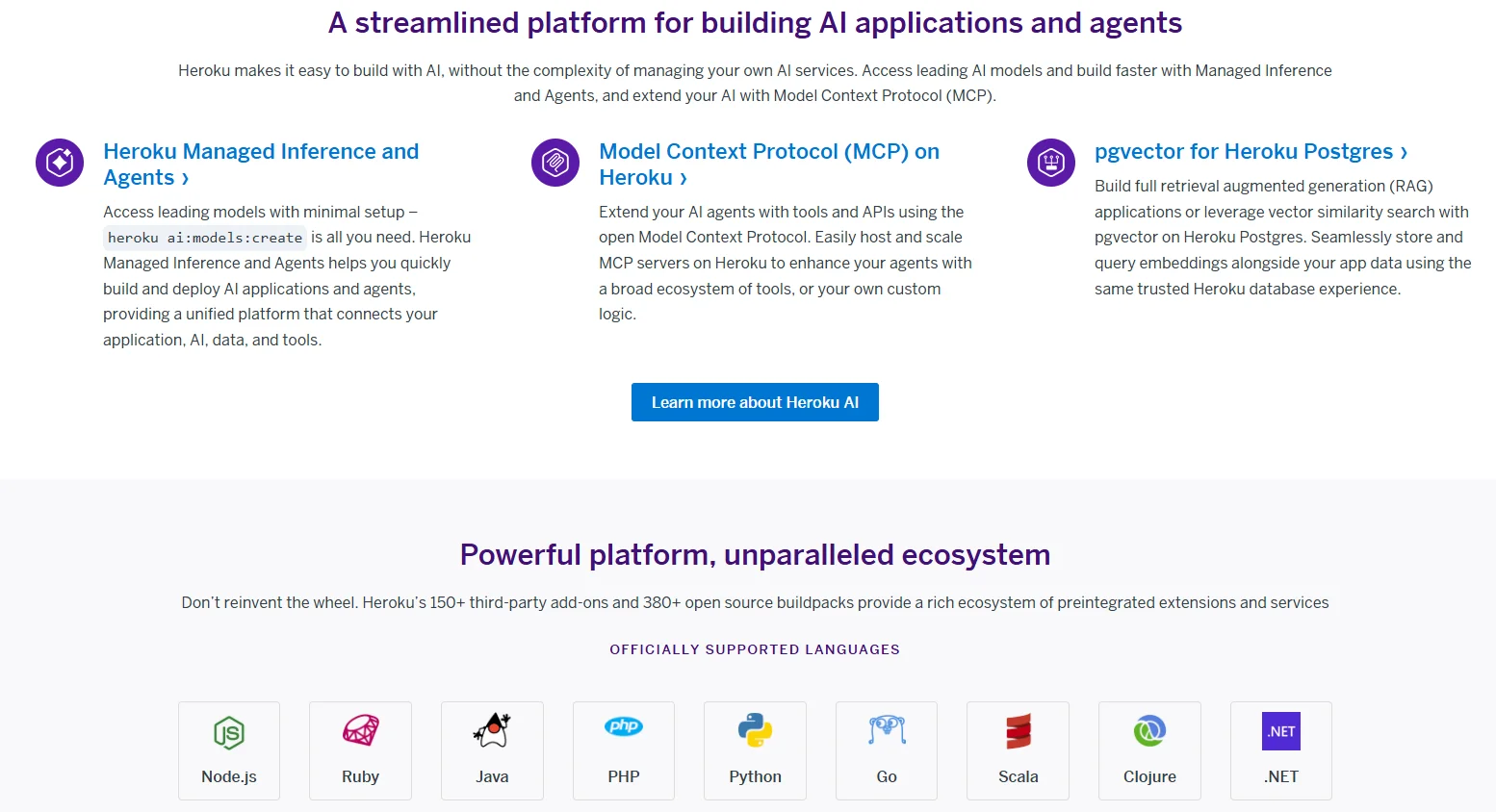
To understand its power, you need to know its core building blocks. Heroku’s architecture is built on a few elegant concepts:
- Dynos: These are lightweight, isolated Linux containers that execute your application code. They are the fundamental units of compute on Heroku. You don’t manage the server; you simply specify the number and type of Dynos needed to run your app.
- Buildpacks: These are scripts that automate the process of turning your source code into an executable application on a Dyno. They detect your application’s language (e.g., Node.js, Python, Ruby, Java) and automatically configure the environment.
- Add-ons: Heroku’s ecosystem includes a vast marketplace of third-party cloud services that can be provisioned with a single click and are seamlessly integrated into your application. This includes:
+ Databases (Heroku Postgres)
+ Monitoring tools (Papertrail, New Relic)
+ Caching systems (Heroku Redis)
+ Email and messaging services
- Git Integration: Deployment is elegantly simple. You connect your application’s Git repository to Heroku, and deploying a new version is as simple as running git push heroku main.
How Does Heroku Work?
Think of it like shipping a car. Instead of building the ship, hiring a crew, and navigating the ocean yourself (managing servers), you simply drive your car (your code) onto a pre-built, standardized container ship (Heroku). The shipping company handles the engine, the fuel, the route, and the weather. You just tell them where the car needs to go.
Technically, the workflow is:
- A developer writes code and commits it to a Git repository.
- They push the code to Heroku using Git.
- Heroku’s platform fetches the code, identifies the language using a buildpack, and compiles the application into a “slug”.
- The platform then spins up the required Dynos and loads the slug to run the application.
- The app is now live on the internet, accessible via a *.herokuapp.com URL or a custom domain.
This entire process, from git push to a live application, can take less than a minute, demonstrating the incredible velocity Heroku enables.
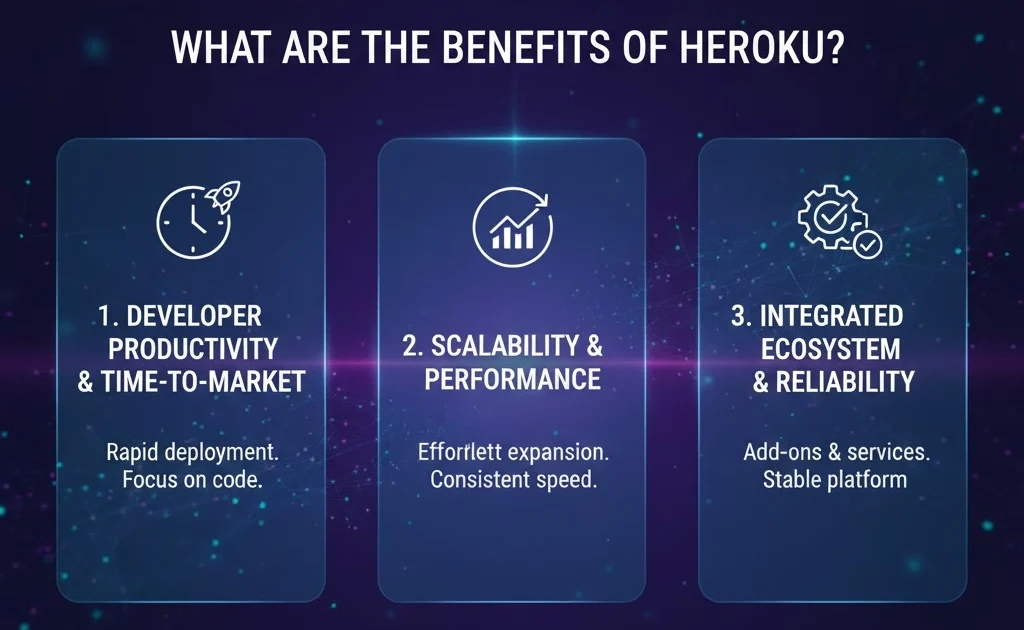
What are the Benefits of Heroku?
Heroku’s benefits extend far beyond simple hosting, creating a strategic advantage that transforms how organizations approach application development and deployment.
1. Developer Productivity & Time-to-Market
By completely abstracting infrastructure management, it eliminates countless hours traditionally spent on DevOps, server maintenance, and configuration. Traditional deployment processes create substantial friction in development workflows, but Heroku’s streamlined approach delivers transformative results:
- Instant Deployment Capability: Deploy applications within minutes of completing code, eliminating weeks of infrastructure setup and configuration delays that traditionally bottleneck product launches.
- Zero DevOps Learning Curve: Maintain focus on application logic rather than server management, enabling front-end developers to deploy full-stack applications without specialized operations knowledge.
- Seamless Integration with Development Workflows: Git-based deployment integrates naturally with existing version control practices, requiring no additional toolchain modifications or team retraining.
This acceleration creates profound business implications—startups validate market hypotheses faster, enterprises respond to competitive pressures more rapidly, and development teams iterate at previously impossible speeds.
2. Scalability & Performance
It addresses the challenge of handling unpredictable traffic patterns while maintaining optimal user experiences. Modern applications must gracefully accommodate everything from viral growth to seasonal demand fluctuations:
- Horizontal and Vertical Scaling Options: Instantly add more dynos for increased traffic or upgrade to more powerful dyno types for resource-intensive operations.
- Pay-Per-Use Cost Efficiency: Scale resources up during high-demand periods and scale down during quiet periods, optimizing costs while maintaining performance.
- Automatic Load Distribution: Built-in request routing and load balancing prevent performance bottlenecks before they impact user experiences.
3. Integrated Ecosystem & Reliability
It transforms traditionally complex service integrations into simple, one-click deployments. Heroku’s extensive add-on marketplace provides immediate access to essential services that would otherwise require lengthy procurement and integration processes:
- Pre-Configured Service Integrations: Access hundreds of managed services, including databases, monitoring tools, and third-party APIs, with minimal configuration requirements.
- Rapid Feature Implementation: Deploy features that traditionally require weeks of integration work in hours, accelerating time-to-market for new capabilities.
- Vendor-Managed Service Reliability: Leverage professionally managed services without the overhead of evaluating, procuring, and maintaining multiple vendor relationships.
What are the Challenges of Heroku?
No platform is a perfect silver bullet, and Heroku’s strengths in abstraction and simplicity come with inherent trade-offs. A savvy technical understands these to make an informed decision.
1. Cost Structure at Scale
While incredibly cost-effective for small to medium-sized applications, Heroku can become expensive as an application grows very large. The pricing model can create substantial budget pressure when compared to traditional infrastructure alternatives:
- Premium Pricing Structure: Entry-level Eco Dynos cost $5 for 1,000 compute hours per month, with no free tier available, making even basic hosting more expensive than many alternatives.
- Scaling Cost Multiplication: High-traffic applications can generate monthly costs reaching hundreds or thousands of dollars, often 2-3x more expensive than equivalent Amazon EC2 or DigitalOcean infrastructure.
- Add-on Cost Accumulation: Managed services like databases, monitoring, and caching add incremental costs that compound quickly as application complexity increases.
This cost premium reflects Heroku’s managed services value proposition, but organizations with tight budget constraints or predictable scaling patterns might find direct infrastructure management more economical. Strategic cost management involves conducting thorough projections based on expected traffic patterns and considering hybrid approaches where critical applications run on Heroku while less demanding services utilize more cost-effective platforms.
2. Vendor Lock-in and Limited Customization
Heroku’s convenience comes with reduced portability compared to containerized or infrastructure-agnostic approaches. It creates strategic risks that can limit organizational flexibility and vendor negotiation power.
- Proprietary Add-on Dependencies: Applications heavily utilizing Heroku-specific add-ons face significant migration challenges when requirements change or alternative platforms become necessary.
- Platform-Specific Configurations: Custom buildpacks, environment variable management, and deployment workflows create dependencies that complicate migration to other platforms.
- Limited Strategic Flexibility: Deep platform integration can reduce negotiating power in vendor relationships and limit the ability to respond to changing business requirements.
Organizations can mitigate these risks by maintaining platform-agnostic application architectures, utilizing standard protocols for data storage and communication, and regularly evaluating alternative deployment strategies to ensure strategic options remain available.
3. Performance Optimization Wisdom
This impacts resource-intensive applications, where Heroku’s abstraction layer introduces overhead that affects user experiences and operational efficiency:
- Shared Infrastructure Overhead: The platform’s shared infrastructure model cannot match dedicated hardware performance characteristics for compute-heavy workloads.
- Cold Start Delays: Dyno sleep behavior in lower-tier plans creates user experience issues with applications experiencing delays after periods of inactivity.
- Memory and Processing Limitations: Standard dyno memory limits may prove insufficient for applications with high memory requirements or intensive processing needs.
This awareness transforms platform selection from a binary choice into a strategic advantage. By adopting a hybrid approach, you can harness Heroku’s developer-friendly environment for innovation and time-sensitive projects, while utilizing more granular IaaS solution for large-scale, performance-critical systems.
What is Heroku Used For?
Heroku’s versatility enables diverse application scenarios, each leveraging the platform’s strengths to solve specific business challenges. Understanding these use cases helps identify where Heroku delivers maximum value while recognizing scenarios where alternative approaches might prove more suitable.
1. SaaS Platform Development and Multi-Tenant Applications
SaaS companies building customer-facing platforms find Heroku particularly valuable for managing complex multi-tenant architectures without infrastructure overhead. A project management SaaS serving thousands of organizations can leverage Heroku’s database isolation features and add-on ecosystem to maintain data security while scaling efficiently:
- Multi-Tenant Data Isolation: Built-in database separation capabilities ensure customer data remains secure and compliant without custom infrastructure design.
- Automated Security and Compliance: SSL certificate management and security updates maintain regulatory compliance across healthcare, finance, and enterprise sectors.
- Rapid Feature Testing: Review apps enable A/B testing across different tenant configurations, accelerating product development cycles.
- Integrated Service Ecosystem: Add-on marketplace provides background job processing, email delivery, and analytics without lengthy vendor evaluation processes.
This approach allows SaaS companies to focus engineering resources on product differentiation rather than infrastructure management, accelerating feature velocity and market responsiveness while maintaining enterprise-grade security standards.
2. E-commerce and High-Traffic Web Applications
E-commerce platforms benefit from Heroku’s elastic scaling capabilities during unpredictable traffic events like flash sales or viral marketing campaigns. An online retail startup can deploy their Node.js storefront with PostgreSQL inventory management, then handle massive traffic surges without infrastructure planning:
- Instant Traffic Scaling: Deploy additional dynos within seconds during Black Friday traffic spikes or viral social media campaigns.
- Revenue Protection: Automatic failover capabilities prevent downtime-related revenue losses that can reach thousands of dollars per minute.
- Performance Optimization: Integrated CDN services and Redis caching ensure consistent global performance during peak shopping periods.
- Payment Integration: Pre-configured payment processing add-ons streamline PCI compliance while maintaining security standards.
The platform’s ability to handle unpredictable traffic patterns ensures consistent user experiences during critical revenue-generating events while minimizing infrastructure complexity and operational overhead.
Are you in need of Building a high-performance web application that can handle traffic surges? Newwave Solutions specializes in creating scalable web applications optimized for platforms like Heroku, ensuring your business never loses revenue to downtime.
3. API-First Companies and Microservices Architecture
Organizations building API-centric products leverage Heroku’s containerized approach to deploy and manage distributed services efficiently. A fintech company providing banking APIs demonstrates how Heroku supports complex service architectures:
- Independent Service Scaling: Deploy separate applications for authentication, transaction processing, and reporting, each scaled based on specific usage patterns.
- Secure Configuration Management: Environment variables ensure safe API key handling across distributed services without configuration complexity.
- Continuous Deployment Support: Pipeline features enable multiple daily deployments across interconnected services without coordination overhead.
- Third-Party Integration Capabilities: Rapid integration with financial data providers and compliance reporting systems that traditional infrastructure requires months to implement.
This architecture enables API companies to maintain service reliability while supporting rapid feature development and complex integrations essential for competitive positioning in fast-moving markets.
Ready to build robust APIs that scale with your business? Newwave Solutions help fintech and enterprise companies create secure, high-performance API development solutions with seamless third-party integrations and deployment strategies tailored for modern cloud platforms.
4. Media and Content Management Platforms
Digital media companies managing content-heavy applications find Heroku’s integration capabilities essential for handling diverse content workflows while maintaining performance during viral content events:
- Scalable Content Processing: Worker dynos handle resource-intensive video encoding and image optimization without impacting user-facing performance.
- Traffic Surge Management: Automatic scaling ensures content remains accessible during viral content events or breaking news situations.
- Content Delivery Integration: Seamless Amazon S3 storage integration and specialized add-ons for media processing eliminate custom infrastructure development.
- Search and Discovery Capabilities: Elasticsearch integration provides powerful content search functionality without dedicated search infrastructure management.
Media companies can focus on content creation and audience engagement rather than managing complex content delivery infrastructure, while ensuring consistent performance during unpredictable traffic patterns.
5. Corporate Innovation Labs and Internal Tools
Large enterprises use Heroku to accelerate internal application development while maintaining corporate security and compliance standards. Fortune 500 companies demonstrate how Heroku enables rapid innovation without compromising governance:
- Rapid Prototype Deployment: Deploy employee onboarding applications, project management tools, and data dashboards without lengthy infrastructure approval processes.
- Enterprise Security Integration: Private spaces and SSO capabilities satisfy corporate security requirements while maintaining deployment simplicity.
- Compliance Certification Support: Built-in compliance features support regulatory requirements across healthcare, financial services, and government sectors.
- Seamless Scaling Path: Successful pilot projects scale to full production without infrastructure migration, maintaining deployment consistency throughoutthe project lifecycle.
This approach enables innovation teams to validate concepts quickly and demonstrate business value before committing significant infrastructure resources, accelerating internal digital transformation initiatives.
The common thread across all these use cases is the desire to redirect resources. Heroku is chosen when the goal is to invest time and money into building a business, not into managing server infrastructure.
FAQs
Can you use Heroku for free hosting?
Heroku does not have a free plan as of 2025, having discontinued their free tier in November 2022. The most affordable option is the Eco plan, which provides a cost-effective entry point for learning and small projects. However, numerous alternative platforms like Render, Netlify, and Railway offer free tiers that can accommodate basic hosting needs. These alternatives often provide similar ease-of-use while supporting free hosting for personal projects and prototypes.
What programming languages does Heroku support?
Heroku officially supports Java, Ruby, Node.js, Python, PHP, Go, Scala, and Clojure through built-in buildpacks that handle language-specific deployment requirements automatically. Additionally, the platform supports virtually any language through custom buildpacks or Docker container deployment.
What is the difference between Heroku and deploying on AWS Elastic Beanstalk?
Both are PaaS offerings but with different philosophies. Heroku is a higher-level abstraction focused entirely on developer experience and simplicity, offering a more curated and opinionated platform. AWS Elastic Beanstalk is a “wrapper” around AWS services (EC2, S3, Load Balancers) that automates deployment but still exposes much of the underlying AWS configuration. Heroku is simpler to start with; Beanstalk offers more control and potentially lower costs at high scale but with increased management complexity.
Conclusion
After explore what is Heroku, we can see that it has transformed infrastructure from a technical constraint into a strategic accelerator. Its value isn’t just in simplifying deployment, but in refocusing your team’s energy from maintaining servers to building competitive advantages. The key is leveraging its speed for the right workload while architecting around its constraints for cost and scale.
Ready to leverage Heroku to its full potential? Contact Newwave Solutions to hire expert developers who can architect, build, and deploy your high-impact applications efficiently.
To Quang Duy is the CEO of Newwave Solutions, a leading Vietnamese software company. He is recognized as a standout technology consultant. Connect with him on LinkedIn and Twitter.



Read More Guides
Get stories in your inbox twice a month.
Let’s Connect
Let us know what you need, and out professionals will collaborate with you to find a solution that enables growth.
Leave a Reply