


What is Less CSS? The Dynamic Stylesheet Language
Ever wondered why your CSS files keep getting longer, messier, and harder to maintain as projects grow? That’s the exact problem Less CSS was built to solve. So what is Less CSS? As one of the most influential CSS preprocessors available, Less has revolutionized how developers write and manage stylesheets, bringing programming concepts to CSS that save countless hours of development time. Whether you’re working on complex software development services projects or maintaining existing websites, mastering Less can significantly enhance your styling workflow. This comprehensive guide explores Less CSS from its fundamental concepts to practical implementation, demonstrating why it remains a vital tool in modern web development.
What is Less CSS?
Less CSS (which stands for Leaner Style Sheets) is a dynamic stylesheet language that extends standard CSS with programming features like variables, mixins, functions, and nesting, then compiles into regular CSS that browsers can understand. Created by Alexis Sellier in 2009, Less was designed to make CSS more maintainable, themeable, and extendable while keeping complete compatibility with existing CSS syntax.
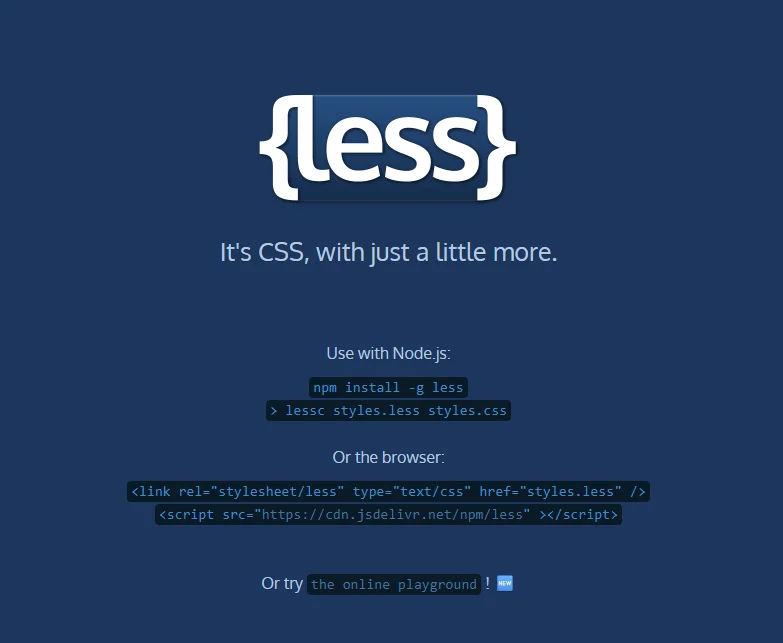
So, what is CSS Less in practical terms? Think of it as a supercharged version of CSS that adds powerful features missing from traditional stylesheets. When you write Less in CSS, you’re essentially using an enhanced syntax that gets processed and converted into standard CSS before being served to browsers. This approach maintains browser compatibility while giving developers significantly more power and flexibility in how they write and organize their styles.
Less sparked a revolution in front-end development by introducing dynamic capabilities to what was previously a static styling language. Before Less, developers faced significant challenges with code repetition, inconsistent values, and difficult maintenance in large projects. Less changed this paradigm by bringing programming concepts to CSS, influencing not only how developers write styles but also inspiring native CSS features and other preprocessors. Its impact is particularly evident in frameworks like Bootstrap, which used Less extensively in earlier versions, demonstrating how preprocessors could scale for massive projects.
Why Choose Less CSS?
You should choose Less CSS when working on projects that require maintainable, scalable stylesheets with consistent theming capabilities and reduced code repetition, particularly in team environments and large-scale applications.
1. Enhanced Maintainability and Consistency
Less dramatically improves stylesheet maintenance through features like variables and mixins that eliminate repetitive code and ensure consistency across projects. By defining colors, fonts, spacing, and other values as variables, developers can make global changes by modifying a single value rather than searching through thousands of lines of CSS. This maintainability is crucial for software development services that need to deliver consistent, high-quality results while efficiently managing client style requirements and updates.
2. Improved Developer Productivity
The language features in Less significantly accelerate the development workflow by reducing the amount of code developers need to write and debug. Nesting capabilities allow for more intuitive organization that mirrors HTML structure, while mixins enable code reuse that would be impossible with plain CSS. These productivity enhancements are particularly valuable when you need to hire back-end developers who may also need to work with front-end styles, as Less provides a more logical and approachable way to handle styling tasks.
3. Better Code Organization and Structure
Less enables developers to organize styles in a modular, logical structure that scales gracefully with project complexity. Features like import directives allow splitting stylesheets into multiple files based on components, features, or sections, while nesting provides a visual hierarchy that makes relationships between selectors immediately apparent. This organizational capability is essential for software development outsourcing services where multiple teams need to collaborate on the same codebase with a clear, maintainable structure.
What is Less CSS Used For?
Less CSS is used for creating maintainable, scalable stylesheets across various types of web projects, from simple websites to complex web applications requiring consistent theming and efficient style management.
Large-Scale Web Application Development
Enterprise-level applications with complex styling requirements benefit significantly from Less’s organizational features and variable system. The ability to maintain design tokens as variables ensures that branding remains consistent across hundreds of components and pages, while mixins and functions enable the creation of reusable style patterns that can be applied consistently throughout the application.
Themeable Applications and White-Label Solutions
Projects requiring multiple visual themes or white-label capabilities leverage Less’s variable system to create easily swappable color schemes, typography settings, and layout configurations. By abstracting design decisions into variables, developers can generate completely different visual designs from the same Less codebase, making it ideal for SaaS products and platforms serving multiple clients with branded interfaces.
CSS Framework Development
Many popular CSS frameworks, including earlier versions of Bootstrap, were built using Less due to its powerful features for creating reusable components and systems. The language’s mixin capabilities are particularly valuable for framework development, allowing creators to build flexible, configurable components that can be easily customized while maintaining consistent output.
How Does Less CSS Work?
Less CSS works by extending standard CSS syntax with additional features, then processing these enhanced stylesheets through a compiler that translates them into regular CSS that browsers can interpret natively.
The Compilation Process Explained
Think of Less as a specialized translator that converts your enhanced, feature-rich code into a language that all web browsers understand perfectly. When you write Less to CSS, you’re creating files with a .less extension that contain both standard CSS and additional Less-specific features. This code then goes through a compilation process where a Less processor analyzes your enhanced syntax and generates corresponding standard CSS.
The compilation can happen in several ways: through client-side compilation using JavaScript (primarily for development), server-side compilation using Node.js, or through build tools like Webpack or Gulp as part of an automated development workflow. The result is a pure CSS file that contains none of the original Less syntax, but implements all the features and optimizations you wrote in your Less code.
Core Language Features in Action
Less enhances CSS through several key features that work together to create more powerful stylesheets:
Variables store values like colors and fonts for reuse throughout your stylesheets
- Mixins allow you to reuse entire declarations across different selectors
- Nesting mirrors your HTML structure for more intuitive style organization
- Operations enable mathematical calculations directly within your styles
- Functions provide tools for color manipulation and other dynamic transformations
These features work together to create what is essentially a CSS Less framework for writing more maintainable and powerful stylesheets, while the final output remains pure, standards-compliant CSS.
How to Use Less CSS?
Using Less CSS involves setting up a compilation process to convert your Less code into standard CSS, then writing styles using Less’s enhanced syntax features for more efficient and organized styling.
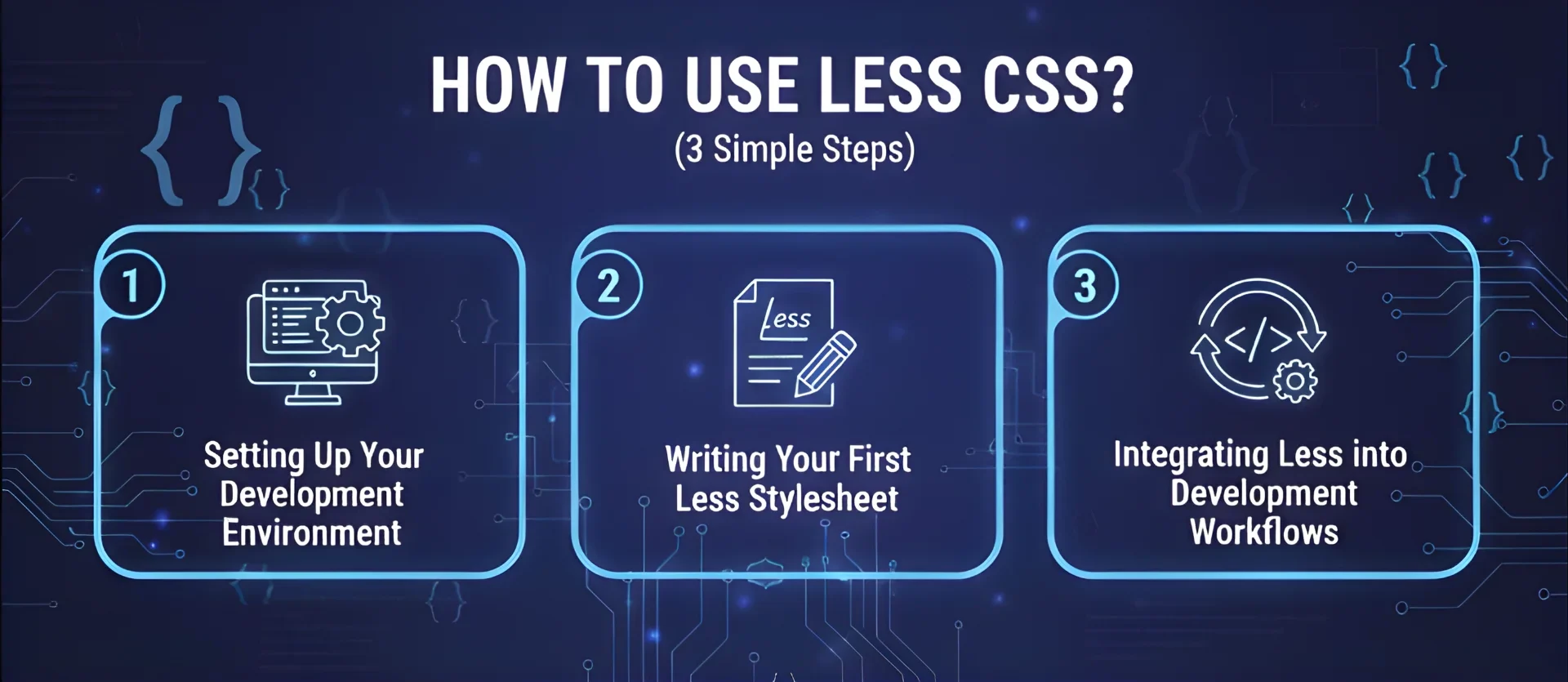
1. Setting Up Your Development Environment
To start using Less, you need to choose and configure a compilation method that fits your workflow. For beginners, the simplest approach is using the client-side Less JavaScript file, which you include in your HTML and automatically compiles Less code in the browser. For production environments, setting up Node.js and the Less compiler via npm provides better performance and more control over the compilation process.
Most modern development workflows integrate Less compilation into build tools like Webpack, Gulp, or Grunt, which automatically process Less files whenever changes are detected. This approach is ideal for software development services working on larger projects where automation and optimization are crucial for productivity.
2. Writing Your First Less Stylesheet
Creating a Less stylesheet follows the same basic principles as writing CSS, but with additional powerful features. Start by creating a file with a .less extension, then begin writing CSS as you normally would. The key difference is that you can now enhance your styles with Less-specific features:
- Use @ to define variables: @primary-color: #428bca;
- Create mixins for reusable style patterns
- Nest selectors to reflect your HTML structure
- Use mathematical operations for dynamic values
As you become more comfortable with basic features, you can explore more advanced capabilities like functions for color manipulation and import directives for modular architecture.
3. Integrating Less into Development Workflows
For team environments and production projects, integrating Less compilation into your standard development workflow ensures consistency and efficiency. This typically involves setting up task runners or module bundlers to automatically compile Less files when changes are detected, with additional steps for minification, autoprefixing, and source map generation. This level of integration is particularly valuable for software development outsourcing services where multiple developers need consistent build processes across different environments.
Benefits and Challenges
Less CSS offers significant advantages in maintainability and developer efficiency, but requires additional tooling and has a learning curve that organizations must consider for their specific projects.
Benefits
- Enhanced Maintainability: Variables and mixins reduce code duplication and make global changes straightforward
- Improved Organization: Nesting and import features create a logical, modular stylesheet architecture
- Time Savings: Reduced repetition and more intuitive syntax accelerate the development workflow
- Dynamic Capabilities: Functions and operations enable calculations and transformations impossible with plain CSS
- Backward Compatibility: All valid CSS is valid Less, allowing gradual adoption in existing projects
Challenges
- Compilation Requirement: Requires setup and maintenance of compilation processes in development workflows
- Learning Curve: Team members need to learn new syntax and concepts beyond standard CSS
- Debugging Complexity: Source maps help, but debugging can be more complex than with plain CSS
- Dependency Management: Adds another dependency to projects that requires maintenance and updates
Why Partner with a Professional Agency for Your LESS CSS Development?
While LESS CSS offers powerful capabilities for modern web development services, maximizing its potential requires specialized expertise that many in-house teams lack. Partnering with a professional agency ensures you leverage LESS CSS’s full capabilities while avoiding common pitfalls that can derail projects and increase costs.
Technical Expertise and Best Practices
LESS CSS development involves more than just understanding the syntax—it requires deep knowledge of compilation optimization, architecture patterns, and integration strategies that take years to master. Professional agencies bring:
- Advanced Implementation Strategies: Expertise in creating scalable mixin libraries and variable systems that grow with your project
- Performance Optimization: Knowledge of compilation techniques that minimize CSS output and improve loading times
- Cross-Browser Compatibility: Experience ensuring compiled CSS works seamlessly across all browsers and devices
- Integration Expertise: Proven methods for integrating LESS with frameworks like Bootstrap and modern build tools
Without this technical depth, teams often create LESS architectures that become difficult to maintain, leading to technical debt and reduced performance over time.
Efficient Project Execution and Resource Management
Building and maintaining a skilled LESS CSS team requires significant investment in recruitment, training, and ongoing education. By partnering with an agency, you gain:
- Immediate Access to Specialized Talent: Skip the lengthy process for hiring back-end developers and front-end specialists
- Reduced Overhead Costs: Eliminate expenses associated with full-time employees, including benefits, equipment, and training
- Faster Time-to-Market: Leverage established workflows and proven methodologies that accelerate development
- Flexible Scaling: Easily adjust team size based on project requirements without long-term commitments
This approach is particularly valuable for software development outsourcing services where efficiency and cost management are critical to project success.
Strategic Architecture and Long-Term Maintainability
Many organizations struggle with creating LESS CSS architectures that remain maintainable as projects scale. Professional agencies provide:
- Sustainable Code Architecture: Designs that accommodate future growth and feature additions
- Documentation Standards: Comprehensive documentation that ensures knowledge transfer and team continuity
- Code Quality Assurance: Rigorous testing and review processes that prevent technical debt accumulation
- Best Practice Implementation: Industry-standard patterns that make codebases understandable to new developers
Poor architecture decisions in LESS CSS can lead to stylesheets that become increasingly difficult to modify, ultimately requiring complete rewrites that delay projects and increase costs.
Why Choose Newwave Solutions for Your LESS CSS Development?
At Newwave Solutions, we bring a proven track record of delivering successful LESS CSS implementations for clients across various industries. Our approach combines technical excellence with strategic thinking to ensure your stylesheets become assets rather than liabilities.
Our LESS CSS Expertise Includes:
- Custom Framework Development: Building tailored LESS-based web app frameworks that match your specific design system requirements
- Legacy System Modernization: Migrating outdated CSS codebases to maintainable LESS architectures
- Team Training and Knowledge Transfer: Empowering your in-house team with LESS best practices and maintenance strategies
- Performance-Focused Implementation: Optimizing compilation processes and output for maximum efficiency
We understand that effective software development services go beyond writing code—they involve creating solutions that support your business objectives while remaining flexible for future needs. Our team stays current with the latest LESS CSS developments and complementary technologies, ensuring we deliver solutions that are both cutting-edge and practical. Consider the option to hire developers from us, and we can support your LESS-related project from scratch.
Conclusion
Throughout this comprehensive guide, we’ve explored what is Less in CSS and how this powerful preprocessor transforms the way developers write and maintain stylesheets. From its revolutionary introduction of programming concepts to CSS to its practical applications in modern web development, Less provides solutions to many of the maintainability and scalability challenges that developers face with plain CSS. Understanding how to use Less CSS effectively can significantly enhance your styling workflow, whether you’re working on small websites or large-scale enterprise applications.
While modern CSS has incorporated some features inspired by preprocessors like Less, the comprehensive feature set and mature ecosystem of Less continue to make it a valuable tool for developers seeking maximum efficiency and organization in their stylesheets. The concepts you learn from Less also provide valuable foundational knowledge that applies to modern CSS workflows and other preprocessors.
Ready to enhance your CSS workflow with the LESS framework? Contact us today to leverage our expertise in modern web development and discover how our comprehensive development services can transform your styling approach. Let our experienced team help you implement efficient, maintainable styling solutions that scale with your business needs.
To Quang Duy is the CEO of Newwave Solutions, a leading Vietnamese software company. He is recognized as a standout technology consultant. Connect with him on LinkedIn and Twitter.



Read More Guides


Get stories in your inbox twice a month.
Let’s Connect
Let us know what you need, and out professionals will collaborate with you to find a solution that enables growth.
Leave a Reply