


What is Magento? Unpacking the Platform Behind Global Brands
Imagine an ecommerce platform that powers over a quarter of a million online stores worldwide, from budding entrepreneurs to global giants like Coca-Cola and Ford. This isn’t a futuristic concept; it’s the reality of this platform. So, what is Magento? In a digital marketplace where cookie-cutter solutions often fall short, the struggle for scalability, unique brand identity, and ultimate control over your customer’s journey is real. You’re not just building a website; you’re building a business. This is where understanding the power of a dedicated Magento ecommerce platform becomes critical. Let’s peel back the layers and discover what makes this technology a cornerstone of modern digital commerce.
What is Magento?
Magento is an open source e-commerce platform designed to power highly customized, scalable, and enterprise grade online stores. Rather than functioning as simple shopping cart software, it serves as a complete commerce framework that supports complex catalogs, advanced integrations, global selling, multi store environments, and deep customization through thousands of extensions and development options. Magento gives businesses full control over the shopping experience, from storefront design to backend operations and automation.
Magento was first released in 2007 by Varien, quickly gaining traction because of its open architecture and strong developer community. Its flexibility and extensibility made it one of the most adopted e commerce solutions in the world.
The platform’s rapid growth led to a series of major milestones:
- 2011: Magento was acquired by eBay, accelerating its enterprise adoption and ecosystem expansion.
- 2015: After being spun off as an independent company, Magento continued to evolve, launching Magento 2 with major improvements in performance, modularity, and scalability.
- 2018: Adobe acquired Magento and integrated it into the Adobe Experience Cloud, transforming it into a core part of Adobe’s digital commerce and customer experience ecosystem.
Today, Magento remains a powerful, future ready commerce platform trusted by global brands and supported by a thriving community of developers, solution partners, and enterprise users.
Highlights Features of Magento
Magento stands apart in the e commerce landscape because it is engineered to support complexity at scale. Its foundation is built for businesses that demand flexibility, custom workflows, and the freedom to design commerce systems that match how they operate — not the other way around. Instead of locking brands into preset templates or rigid structures, Magento provides a deep, extensible framework capable of powering multi brand ecosystems, global storefronts, and high volume sales operations. This is why it remains the preferred choice for companies with ambitious growth plans and sophisticated digital commerce strategies.
Below are the core features that define Magento’s power:
Unparalleled Flexibility and Customization
As an open source platform, Magento grants full access to its underlying codebase. This allows developers to tailor every aspect of the storefront, checkout flow, product logic, and backend processes. From creating custom integrations to building unique user journeys, Magento supports advanced Magento web development that ensures the platform aligns precisely with evolving business requirements.
Scalable Architecture
Magento is designed to grow without friction. When implemented with a strong architecture, it can support rapid increases in product volume, concurrent users, and order transactions — all while maintaining stability and performance. This scalability makes Magento ideal for businesses expecting heavy traffic spikes, seasonal peaks, or international expansion.
Powerful Catalog Management
Magento excels at handling large and complex product catalogs. Businesses can manage configurable products, multiple attribute sets, layered navigation, cross selling rules, and detailed inventory tracking across numerous storefronts. Its catalog tools are built to simplify operations while ensuring accuracy at scale.
Extensive Extension Marketplace
The Magento Marketplace contains thousands of extensions that enhance functionality across payments, shipping, analytics, marketing automation, ERP integrations, SEO enhancements, and more. Instead of building features from scratch, businesses can extend their platform instantly — saving development time and unlocking new capabilities.
Robust SEO Capabilities
Magento includes advanced SEO foundations such as custom URL structures, meta tag control, canonical tags, XML sitemaps, structured data, and index management. These features help stores achieve higher visibility and organic traffic, supporting long term growth in competitive markets.
Multi Store Capability
Magento enables businesses to operate multiple storefronts — each with unique catalogs, pricing, languages, currencies, or branding — all from a single admin panel. This is particularly powerful for companies running multiple brands, serving different markets, or managing regionalized selling strategies.
While many platforms exist, Magento’s adoption by a significant portion of the top 100K ecommerce sites isn’t accidental. It reflects a global recognition that for businesses with complex models and ambitious growth plans, the initial investment in a powerful, open-source foundation like Magento often yields greater long-term control and capability than constrained, out-of-the-box solutions.
Why Should You Consider Magento for Your Business?
Choosing an ecommerce platform is a strategic decision that impacts every facet of your online operation. It’s about selecting a partner for your growth, not just a piece of software. So, what tangible advantages does the Magento ecommerce platform offer that makes it a compelling choice for serious online retailers?
1. Unmatched Customization and Control
The open-source nature of Magento is its greatest strength. Unlike hosted solutions with predefined templates and limited functionality, Magento gives you the source code. This means your development team or a Magento agency can build literally any feature or user experience you can imagine. Whether it’s a unique loyalty program, a custom integration with an ERP system, or a bespoke checkout flow, you are not limited by the platform’s default capabilities.
The impact is a truly differentiated brand experience that can become a key competitive advantage, rather than a store that looks and functions like thousands of others.
2. Built to Scale with Your Ambitions
Many businesses start with a simple store, only to face a painful and costly migration when they outgrow their initial platform. Magento is engineered to avoid this pitfall. Its architecture is designed for high traffic and large product catalogs. This means that as your sales increase from 100 to 100,000 orders, the platform can scale accordingly with the right Magento hosting infrastructure.
This scalability provides peace of mind, ensuring your technology stack won’t become a bottleneck during critical growth periods like holiday sales or viral marketing campaigns.
3. A Rich Ecosystem of Extensions and Expertise
You don’t have to build everything yourself. The thriving ecosystem around Magento is a massive benefit. The Magento Marketplace offers vetted solutions for nearly every common ecommerce need, from advanced reporting to complex shipping rules. Furthermore, the global community of developers means finding skilled professionals for Magento development services is significantly easier than for niche platforms.
This ecosystem reduces development time and cost while providing access to a pool of collective knowledge and innovation.
If you’re looking to leverage this ecosystem with a dedicated team, our eCommerce Development services can help you build and manage your Magento store effectively.
4. Superior SEO and Marketing Tools
Out of the box, Magento provides a stronger SEO foundation than many competitors. Key Magento SEO features include:
- Search-engine-friendly URLs
- Control over meta tags for every page and product
- Automatic sitemap generation
- Easy integration with Google Analytics and other marketing tools
Beyond SEO, it includes powerful native features for targeted promotions, customer segmentation, and creating personalized shopping experiences, which are essential for converting visitors into loyal customers.
In essence, the benefits of Magento translate to long-term strategic value. It’s an investment in a platform that empowers you to innovate, scale, and own your digital destiny, rather than being perpetually constrained by the limits of a simpler, but less capable, solution.
What Are the Challenges of Using Magento?
While powerful, Magento is not a universal solution. A clear-eyed view of its challenges is crucial for making an informed decision. Understanding these hurdles allows you to plan and mitigate them effectively, turning potential weaknesses into managed aspects of your ecommerce strategy.
1. Technical Complexity and Learning Curve
Magento website development requires genuine technical expertise—this isn’t a platform where marketers independently make changes through intuitive interfaces. The system uses PHP as its core language, relies on MySQL databases, and employs complex architectural patterns like dependency injection and service contracts.
A practical approach involves:
- Partnering with experienced Magento development services during initial setup
- Training internal teams on administrative functions while reserving technical modifications for specialists
- Documenting customizations thoroughly to prevent knowledge silos
- Planning changes in batches to maximize developer efficiency
2. The Total Cost of Ownership Can Be High
When asking “what is Magento” in terms of cost, look beyond the $0 price tag of the open-source version. The total cost of ownership (TCO) includes several factors:
- Development Costs: Customization and setup are significant investments.
- Hosting: Magento requires robust, often specialized, Magento hosting environments (e.g., cloud VPS or dedicated servers) for optimal performance, which are more expensive than basic shared hosting.
- Extensions and Themes: Premium extensions and professional themes add to the initial cost.
- Ongoing Maintenance: This includes security patches, updates, and potential Magento support contracts.
For a small business with simple needs, this TCO can be prohibitive. However, for a growing or established business, this cost is weighed against the platform’s power and the revenue it enables.
3. Higher Initial Investment Requirements
When evaluating what Magento hosting will cost you, prepare figures that exceed typical eCommerce platform budgets. While Magento Open Source itself is free, the total cost of ownership includes Magento hosting infrastructure, development for customization, extensions from the Magento marketplace, and ongoing Magento support. Initial implementations frequently range from $30,000 to $100,000 for mid-sized businesses, with enterprise deployments often exceeding $250,000.
The path to cost management involves clear prioritization:
- Deploy core functionality first with minimal customization
- Add iteratively features as revenue justifies investment
- Starting lean, measuring results
- Expand based on data proves more cost-effective than comprehensive builds.
The insight here is that Magento’s challenges are primarily related to resource allocation—both technical and human. The platform demands expertise and quality infrastructure. For businesses that can meet these requirements, the rewards in control and capability are immense. For others, it may be overkill.
What is Magento Used For?
The platform’s versatility shines across diverse business models and industries, though certain patterns emerge where Magento’s capabilities align particularly well with specific requirements.
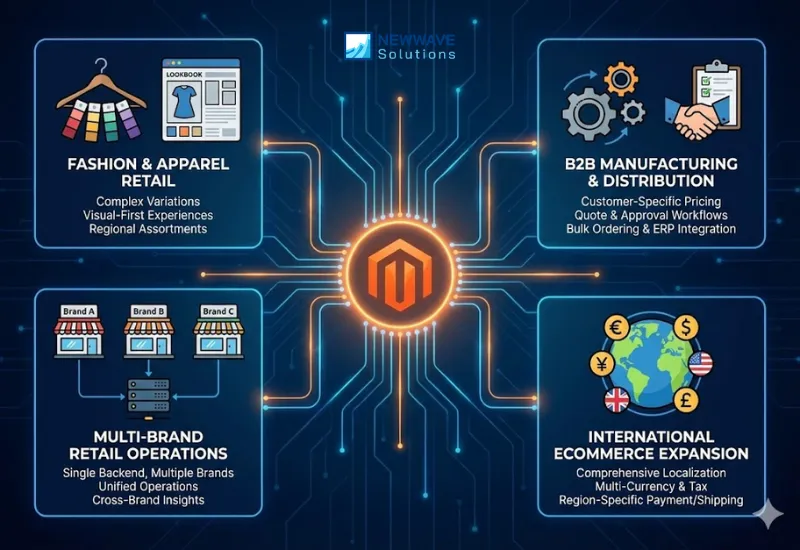
Fashion and Apparel Retail
Fashion retailers gravitate toward Magento because their business model demands flexibility that simpler platforms cannot deliver. A mid-sized apparel brand needs capabilities that go beyond basic product listings:
- Display products in multiple colors and sizes with complex variations
- Manage stock across warehouse locations with real-time synchronization
- Implement brand-specific size guides and fit recommendations
- Handle region-specific return policies and seasonal inventory transitions
- Create visual-first experiences with high-quality imagery and lookbook layouts
One fashion retailer using Magento development services implemented a sophisticated system where customers see recommended sizes based on previous purchases and returns, reducing return rates by 23%. Their multi-store setup presents different product assortments by region—winter coats prominent in Nordic countries while beachwear dominates Mediterranean stores—all managed from a single backend.
Magento’s flexible product page templates let them create lookbook-style layouts for featured collections and grid views for sale items, maintaining brand consistency while optimizing conversion for each context.
B2B Manufacturing and Distribution
Industrial suppliers represent perhaps Magento’s strongest use case, requiring capabilities consumer-focused platforms rarely provide. These businesses need sophisticated functionality that goes beyond standard retail:
- Customer-specific pricing based on negotiated contracts and volume tiers
- Quote-based purchasing with approval workflows for large orders
- Purchase order support and credit limit enforcement
- Account-based ordering where multiple users operate under organizational accounts
- Bulk ordering capabilities via CSV upload for hundreds of SKUs
- Integration with ERP systems for real-time inventory and automatic invoicing
A building materials distributor migrated to Magento to handle their pricing complexity—different customers receiving pricing based on negotiated contracts, purchase volumes, and payment terms. Their Magento website now automatically applies appropriate pricing, generates quotes for custom orders, and integrates with their ERP system for real-time inventory.
Such deep backend integration and process automation is a hallmark of effective ERP Development Solutions, creating a seamless operational flow from quote to cash.
Multi-Brand Retail Operations
Corporate entities managing multiple brands leverage Magento’s multi-store architecture to operate all brands from a single installation. Each brand maintains its own domain, distinct design, and separate product catalog while sharing backend infrastructure. This consolidation delivers significant operational advantages:
- Customer service accesses all orders across brands from one unified interface
- Inventory management consolidates stock for efficient fulfillment and allocation
- Marketing teams analyze cross-brand customer behavior for targeted campaigns
- Finance tracks portfolio performance through unified reporting and analytics
- Cross-selling opportunities emerge from understanding multi-brand purchasing patterns
One such company discovered 18% of customers purchased from multiple brands in their portfolio—insight impossible with fragmented systems that informed cross-brand promotional strategies and product development decisions based on customer preferences across their entire catalog.
International eCommerce Expansion
A specialty foods company used Magento’s international capabilities to launch operations in 12 countries simultaneously. Each country operates as a separate store with comprehensive localization:
- Native language content and culturally adapted messaging
- Appropriate currencies with dynamic conversion and local pricing strategies
- Country-specific payment gateways (iDEAL, Klarna, local credit cards)
- Region-appropriate shipping carriers with accurate delivery estimates
- Proper tax calculations applying VAT, GST, or sales tax by jurisdiction
- Compliance features including GDPR cookie consent and data privacy requirements
Rather than launching sequentially with separate platforms—a process requiring years—they deployed across Europe in six months. Centralized management meant updating product information once it appeared correctly across all localized stores, dramatically reducing operational overhead.
Magento vs. Wix: Which Should You Choose?
The choice between Magento and a platform like Wix is fundamentally a choice between ultimate flexibility and ultimate simplicity. It’s not about which platform is “better,” but which is the right tool for your specific business context and goals. The following table breaks down the key differences.
| Feature | Magento (Open Source) | Wix Ecommerce |
| Control & Customization | Full access to source code. Unlimited customization of frontend and backend. | Limited to pre-built templates and apps. No backend code access. |
| Scalability | Highly scalable with proper hosting and development. Handles large catalogs and high traffic. | Good for small to medium stores. You can hit performance and feature limits as you grow. |
| Ease of Use | Steeper learning curve. Requires technical knowledge for set-up and management. | Extremely user-friendly. Drag-and-drop builder, ideal for non-technical users. |
| Total Cost | Higher TCO (development, hosting, extensions, maintenance). | Lower upfront cost. Simple monthly subscription fee. |
| SEO Capabilities | Powerful, native Magento SEO features fine-grained control. | Good basic SEO but limited advanced control and customization. |
| Ideal For | Growing businesses, complex models, B2B, marketplaces, brands need a unique digital presence. | Small businesses, solopreneurs, simple product lines, those who prioritize ease-of-use over customization. |
Your decision hinges on your ambition and resources. If you need a simple, beautiful online presence quickly and have a straightforward business model, Wix is an excellent choice. However, if you view your Magento website development as a strategic, long-term investment and require a platform that can be molded to your unique business processes and scale with your success, then Magento is the clear path forward.
FAQs
Is Magento good for a small business?
It can be, but it depends on the business’s trajectory. If you are a small business with a simple product catalog, limited technical resources, and no immediate plans for complex customizations, a simpler platform like Shopify or Wix might be more cost-effective. However, if you anticipate rapid growth, have a complex model, or require deep customization from the start, starting with Magento can prevent a costly platform migration later.
Can I migrate my existing store to Magento?
Yes, migrating from another platform (like Shopify, WooCommerce, or BigCommerce) to Magento is a common process. Data such as products, customers, and orders can be transferred using manual methods, custom scripts, or specialized migration tools and extensions. It’s highly recommended to work with a Magento agency to ensure a smooth and complete migration.
What is the typical timeline for Magento web development?
The timeline for Magento website development varies dramatically based on complexity, customization, and design requirements. A relatively simple, customized store might take 2-4 months. A highly complex, enterprise-level project with deep customizations and integrations can take 6 months to a year or more.
Final Words
Understanding what Magento is ultimately highlights a strategic truth: your commerce platform should fuel growth, not restrict it. Magento embodies this philosophy. It gives businesses the freedom to design experiences, workflows, and architectures that reflect their ambitions instead of forcing them into one size fits all patterns. For brands operating in competitive markets or planning large scale expansion, this flexibility becomes a long term advantage — one that template driven platforms cannot match.
Choosing Magento is not merely a software decision. It is a decision to build a digital commerce foundation capable of evolving with your business. And to unlock its full potential, you need a partner who understands both the technical depth of the platform and the business strategy behind a modern e commerce operation.
Newwave Solutions delivers that partnership. Based in Vietnam with a team of experienced engineers, we provide end to end e commerce web development, Magento customization, custom web development services, and scalable digital commerce solutions tailored to global businesses. We help you build faster, optimize smarter, and launch stores engineered for performance, security, and long term growth.
If you are ready to elevate your commerce ecosystem and create a digital experience that truly represents your brand, let’s explore how Newwave Solutions can bring your Magento vision — and your broader e commerce strategy — to life.
To Quang Duy is the CEO of Newwave Solutions, a leading Vietnamese software company. He is recognized as a standout technology consultant. Connect with him on LinkedIn and Twitter.



Read More Guides
Get stories in your inbox twice a month.
Let’s Connect
Let us know what you need, and out professionals will collaborate with you to find a solution that enables growth.
Leave a Reply