


What Is Sails.js? The Complete Guide to Node.js MVC Framework
As many tech businesses continue to adopt cloud-based systems and data-driven operations, the need for scalable and real-time backend frameworks has never been greater. Sails.js emerges as a powerful Node.js framework built on the MVC architecture, enabling developers to build modern web applications and APIs with speed and flexibility. By learning what is Sails.js and exploring its core features in this Newwave Solutions blog, you’ll uncover how this framework empowers enterprises to simplify real-time data handling, improve backend efficiency, and accelerate digital transformation across web and cloud-based systems.
What Is Sails.js?
Sails.js is an open-source, full-featured Node.js framework built on the MVC (Model–View–Controller) architecture that simplifies the creation of scalable, data-driven web applications and APIs. It provides a structured yet flexible approach to backend development, allowing developers to easily handle RESTful APIs, real-time communication, and complex business logic within one environment.
Designed with enterprise-grade scalability in mind, Sails.js integrates smoothly with multiple database systems and supports modern JavaScript standards for rapid development.
Salis js example:
Companies like Postman and Paystack have used Sails.js for its robust real-time data handling and fast API development capabilities, significantly reducing backend setup time while maintaining code scalability across growing projects.
How Does Sails.js Work?
Sails.js operates as a full-stack backend framework that extends Node.js with opinionated conventions for faster, cleaner coding. It follows an MVC design pattern, integrates with modern databases, and provides built-in tools for routing, sockets, and security. Developers can easily connect with multiple databases and automate endpoint generation using Sails.js documentation and configuration best practices available through its open-source community.
- MVC Architecture: Separates data, logic, and presentation layers to ensure cleaner code organization and maintainability.
- ORM (Waterline): Abstracts complex database operations and provides a unified API for Sails.js database connections, including MySQL, MongoDB, and PostgreSQL.
- Socket.io Integration: Enables real-time communication, allowing instant data synchronization between servers and clients.
- Blueprint API: Auto-generates RESTful endpoints for models and controllers to accelerate development.
- Hooks & Policies: Allow developers to inject middleware, authentication, and custom logic into the application lifecycle.
7 Main Features of Sails.js
Modern development teams value frameworks that balance simplicity and scalability, and Sails.js achieves that by combining Node.js flexibility with pre-built enterprise-ready tools. Since Sails.js shares many similarities with other Node.js-based frameworks, below are its most essential and differentiating features that developers and businesses should understand.
- Auto-Generated REST APIs: Automatically creates CRUD endpoints for every model, reducing the manual effort required for backend API setup.
- Waterline ORM: Provides a single data access layer that works seamlessly across SQL and NoSQL databases, simplifying data modeling and queries.
- Socket.io Support: Enables the creation of live chat systems, dashboards, and multiplayer applications by integrating real-time communication directly into the backend.
- Blueprints: Simplify development by auto-generating controllers and routes, accelerating prototyping and MVP deployment.
- Hook System: Allows custom integrations and feature extensions without modifying the core framework.
- Cross-Platform Compatibility: Works effectively with popular frontend frameworks like React, Vue, and Angular, allowing consistent development across stacks.
- Error Handling & Policies: Offers structured middleware and security policies for better access control, API validation, and exception management.
Pros & Cons of Using Sails.js
Sails.js remains one of the most efficient Node.js frameworks for building robust, real-time APIs, but it also comes with a few trade-offs developers and businesses should consider. Explore the following pros and cons to determine whether it fits your project requirements.
| Pros | Cons |
| Rapid API Development: Built-in Blueprints and auto-generated routes drastically reduce backend setup time, enabling quicker delivery. | Performance Limitations in Heavy Apps: For highly concurrent applications, native Node.js implementations may outperform Sails.js due to its additional abstractions. |
| Comprehensive Documentation: Detailed Sails.js documentation supports both new and advanced developers, minimizing learning friction. | Limited Community Compared to Express.js: While active, its community size is smaller than other mainstream Node.js frameworks. |
| Integrated ORM Support: The Waterline ORM simplifies database interaction, making it ideal for multi-database and enterprise-grade projects. | Debugging Complexity: Abstracted conventions can make error tracing more challenging in deeply customized builds. |
| Real-Time Communication: Socket.io integration provides real-time data exchange without needing external setup. | Memory Usage Overhead: Applications with large data models may consume more memory due to ORM operations. |
| Cross-Platform and Scalable: Works across front-end frameworks, allowing flexible stack integration. | Limited Third-Party Plugin Ecosystem: Some advanced tools may require custom implementation rather than plug-and-play options. |
| Enterprise-Focused Security: Policies, validations, and middleware make it suitable for enterprise compliance and API protection. | Version Compatibility Issues: Major updates occasionally require refactoring due to framework evolution. |
4 Common Industry Applications of Sails.js
Let’s explore some of the real industry applications of the Sails js framework and see how it can be applied and involved in different tasks:
1. Fintech and Banking
In the finance sector, Sails.js enables the development of secure, real-time dashboards, APIs for transaction tracking, and fraud detection tools. The framework’s Waterline ORM ensures smooth integration with multiple databases for handling complex data structures and compliance-driven workflows.
Example: Paystack adopted Node.js-based frameworks like Sails.js to power its payment API system, helping the company scale across Africa while maintaining strong security and fast processing for millions of transactions daily.
2. Logistics & Transportation
Logistics platforms benefit from Sails.js through real-time tracking systems and WebSocket-powered communication between drivers and dispatch centers. Its ability to manage dynamic APIs and route optimization supports large-scale fleet coordination.
Example: Uber’s backend prototypes leveraged real-time Node.js frameworks like Sails.js to manage driver tracking, route matching, and automated dispatching in milliseconds.
3. E-commerce Platforms
E-commerce companies use Sails.js to unify backend logic, manage product inventory, and streamline order management with real-time API responses across web platforms and e-commerce mobile app development. The framework also enables rapid integration with payment gateways and customer analytics systems, ensuring a consistent and scalable experience on both web and mobile applications.
Example: Zalando Labs implemented Node.js-based frameworks similar to Sails.js to create scalable backends that ensure faster page loads and efficient synchronization between catalogs and front-end user interfaces.
4. Education Tech
Sails.js supports collaborative learning platforms, student dashboards, and course management systems with WebSocket driven interactions, making it a strong foundation for edtech software development solutions. It enables educational startups to deliver interactive experiences such as real time quizzes and chat enabled classrooms at scale.
Example: Coursera integrated backend components inspired by Sails.js to handle real-time class sessions and peer-to-peer interactions for its global online learning platform.
Sails.js vs Other Node.js Frameworks
Although Sails.js is a highly capable Node.js MVC framework, it is not the only option available for backend development. Many Sails.js alternatives, such as Express, NestJS, and Meteor, also serve various purposes, from minimalist microservices to large-scale enterprise APIs. The comparison below highlights where each framework excels and when to use them.
| Criteria | Sails.js | Express.js | NestJS | Meteor.js | Verdict |
| Architecture Design | Follows MVC with conventions for structured development. | Minimalist and flexible without enforced structure. | Uses modular, Angular-like architecture for scalability. | Full-stack with integrated frontend support. | Winner: Sails.js for developers who prefer convention over configuration. |
| Real-Time Features | Native WebSocket (Socket.io) support. | Requires manual WebSocket setup. | Supports real-time with adapters. | Built-in real-time sync. | Winner: Sails.js for native WebSocket integration. |
| Database Support | Built-in Waterline ORM for SQL and NoSQL databases. | Database handled via middleware or ORM plugins. | Supports TypeORM and Prisma natively. | Primarily MongoDB. | Winner: Sails.js for multi-database abstraction. |
| Ease of Setup | Moderate setup; CLI tools automate boilerplates. | Very lightweight and manual setup. | Requires TypeScript knowledge. | Heavier due to full-stack nature. | Winner: Express.js for simple microservices, Sails.js for structured apps. |
| Enterprise Readiness | Designed for scalable API-driven systems. | Better for lightweight services. | Excellent for modular enterprise applications. | Suitable for rapid MVPs. | Winner: Sails.js and NestJS for large-scale systems. |
| Community and Maintenance | Active open-source community with growing plugin support. | Largest Node.js community overall. | Rapidly growing and enterprise-backed. | Declining but still active for niche apps. | Winner: Express.js for ecosystem size. |
| Performance and Scalability | Excellent for real-time and API workloads. | Highest raw performance. | Good scalability via modularity. | Moderate, not ideal for complex APIs. | Winner: Express.js for speed, Sails.js for feature balance. |
Verdict:
Sails.js offers the most balanced mix of structure, scalability, and real-time capability. Express remains best for small services, NestJS for enterprise modularity, and Meteor for rapid prototyping and full-stack development.
How to set up Sails.js?
Many developers face challenges when adopting Sails.js due to its extensive features and structured conventions. To help streamline adoption, this Sails.js tutorial provides a clear, step-by-step guide that simplifies both the installation and initial setup process. Whether you are learning how to set up Sails JS or exploring how to use Sails JS for business apps, this process will get your project running quickly.
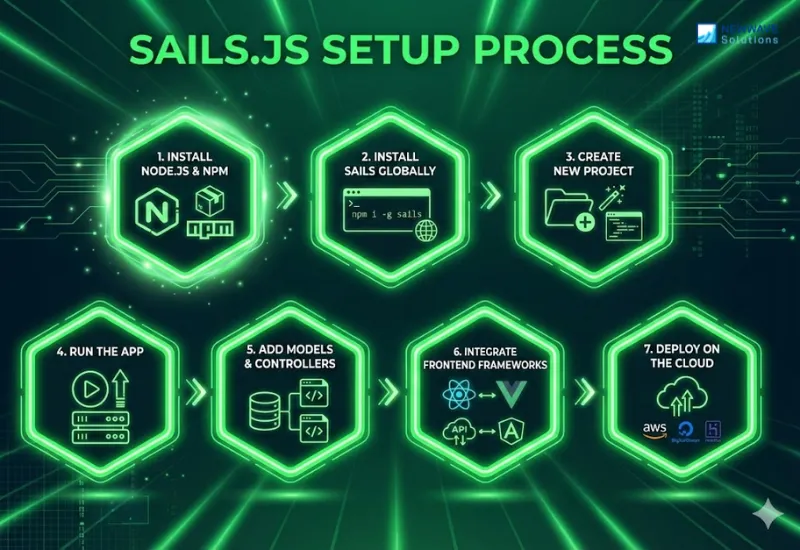
Step 1: Install Node.js and npm
Before you begin, ensure Node.js and npm are installed since Sails.js relies on npm for managing dependencies and plugins.
Step 2: Install Sails.js globally
Run npm install sails -g in your terminal to install Sails.js globally, enabling access to CLI commands anywhere on your machine.
Step 3: Create a new project
Use the command sails new projectname to generate a boilerplate structure containing models, controllers, and views.
Step 4: Run the app
Navigate into the project directory and execute sails lift to start the local development server. This command verifies that all dependencies are working correctly.
Step 5: Add Models & Controllers
Create custom data models and REST APIs for handling your business logic efficiently.
Step 6: Integrate with Frontend Frameworks
Connect your app to React, Vue, or Angular frontends using REST or WebSocket APIs for a complete full-stack experience.
Step 7: Deploy on the Cloud
Once stable, deploy your app on AWS, DigitalOcean, or Heroku to ensure scalability and continuous availability in production environments.
Best Practices for Enterprises Using Sails JS
Following best practices ensures that Sails.js applications remain performant, scalable, and easy to maintain as your business grows.
- Modularize Code Structure: Maintain a clear separation between controllers, services, and policies to ensure scalability and maintainability.
- Use Policies for Security: Implement access rules and authentication layers at the policy level to safeguard APIs.
- Enable Real-Time Monitoring: Integrate monitoring tools like PM2, New Relic, or Datadog for performance insights and error tracking.
- Automate Testing: Use Mocha, Chai, or Jest to automate backend tests and ensure consistent code reliability.
- Optimize Database Queries: Leverage the Waterline ORM efficiently to manage relationships and reduce latency across large datasets.
The Future of Sails JS in Enterprise Development
Sails.js continues to hold its relevance in the Node.js ecosystem, especially for organizations focused on enterprise application development that require real time data handling and well structured backend systems. While newer frameworks such as NestJS or Fastify have entered the market, Sails.js retains strong community support, a mature plugin ecosystem, and consistent updates.
Many enterprises still choose to hire experienced Sails.js developers for enterprise application development projects that demand rapid API generation, efficient WebSocket communication, and scalable system architecture. As the framework continues to evolve, Sails.js will remain a dependable option for building data driven enterprise platforms, hybrid applications, and microservices based systems.
FAQs
Is Sails JS free to use?
Yes. Sails JS is fully open source and released under the MIT license. This means it can be used freely for commercial products, internal enterprise systems, and large scale applications without licensing costs. Enterprises can also customize the framework to fit internal standards without legal restrictions.
What programming language does Sails JS use?
Sails JS is built entirely with JavaScript and runs on Node.js for backend development. This allows teams to use a single language across both frontend and backend, improving development speed, code consistency, and collaboration between product and engineering teams.
Can Sails JS handle real time data?
Yes. Sails JS includes native WebSocket support through Socket.io, enabling real time data synchronization without complex setup. This makes it well suited for live dashboards, notifications, chat systems, collaborative tools, and applications that require instant data updates.
How is Sails JS different from Express?
Express is a lightweight and flexible framework that provides core routing and middleware, while Sails JS builds on top of Express with a full MVC architecture. Sails adds features such as automatic REST API generation, built in ORM, WebSocket integration, and convention based project structure, making it more suitable for large and structured applications.
Is Sails JS suitable for enterprise apps?
Yes. Sails JS is well suited for enterprise applications due to its modular architecture, ORM support for multiple databases, built in security features, and scalability. It helps enterprises build maintainable, data driven systems such as internal platforms, SaaS products, and microservices while supporting long term growth and system complexity.
Conclusion
Understanding what Sails.js is reveals why it continues to be a strong choice for building scalable, data driven, and real time web applications. Designed on top of Node.js, Sails.js enables rapid API development solutions, structured application architecture, and seamless handling of real time communication — making it well suited for enterprise systems, SaaS platforms, and complex backend services. When used correctly, it provides the flexibility and stability needed to support long term product growth.
However, maximizing the value of Sails.js requires more than technical familiarity. It demands thoughtful system design, experienced development practices, and the ability to align technology choices with business goals. This is where the right development partner becomes critical.
Newwave Solutions delivers end to end software development services and offshore development solutions with a skilled engineering team based in Vietnam. We help businesses plan, build, and scale Sails.js and Node.js applications — from architecture design and API development to deployment, optimization, and long term support. By combining technical expertise with cost efficient offshore delivery, we enable global clients to accelerate development while maintaining quality and control.
If you are considering Sails.js for your next project or need expert support to bring your application to life, Newwave Solutions is ready to help you build a robust, scalable backend tailored to your business needs.
To Quang Duy is the CEO of Newwave Solutions, a leading Vietnamese software company. He is recognized as a standout technology consultant. Connect with him on LinkedIn and Twitter.



Read More Guides
Get stories in your inbox twice a month.
Let’s Connect
Let us know what you need, and out professionals will collaborate with you to find a solution that enables growth.
Leave a Reply