


What is SaSS? The Ultimate Guide to Streamlined CSS
As projects grow, stylesheets become bulky, repetitive, and difficult to manage. If you’ve ever struggled with this, you’re not alone. This is where powerful tools like Sass come into play, revolutionizing how developers write and organize their styles. But what is Sass, and why has it become a non-negotiable skill for modern front-end developers and a cornerstone for teams building sophisticated web app development solutions? This comprehensive guide will demystify Sass, exploring its history, its inner workings, and its profound impact on how we style the web.
What is Sass?
In the simplest terms, Sass is a CSS preprocessor. Think of it as a powerful upgrade to your standard CSS. It’s a tool that lets you write styles using features that don’t exist in vanilla CSS—like variables, nesting, and reusable mixins—and then compiles that code into clean, standard CSS that any web browser can understand.
A common point of confusion is the difference between Sass and SCSS. SCSS, which stands for Sassy CSS, is one of the two syntaxes for Sass. It looks almost identical to regular CSS, using the same curly braces and semicolons, which makes it incredibly easy for developers to learn and adopt. When people talk about using Sass in their projects today, they are most often referring to the SCSS syntax.
The history of Sass is a story of solving a real developer pain point. It was first conceived in 2006, a time when web projects were growing increasingly complex. Developers were drowning in repetitive, hard-to-manage CSS code. Sass introduced programming-like concepts to the world of design, allowing for more structured, efficient, and maintainable stylesheets. Its impact has been so profound that it has directly influenced the evolution of CSS itself, pushing the web standards community to adopt similar features natively.
The Impact of Sass on the World of Web Development
The impact of Sass on web development cannot be overstated. Before its advent, CSS was largely static and repetitive. Developers relied on copy-pasting code, leading to massive, unmaintainable stylesheets. Sass introduced a paradigm shift towards abstraction and programmability. It paved the way for:
- Systematic Design: By allowing the definition of variables for colors, fonts, and spacing, Sass enabled the creation of formal design systems, long before they became a mainstream concept.
- Architectural Best Practices: It encouraged developers to think about the structure and architecture of their stylesheets through features like partials and modules.
- Community and Tooling: The success of Sass inspired a wave of innovation, including other preprocessors like Less CSS, and ultimately pressured the W3C to begin incorporating its most popular features (like variables, now called CSS Custom Properties) directly into the native CSS specification.
It’s also important to distinguish this tool from a Sass company in the business context. While you might hear about a disruptive SaaS (Software as a Service) startup, in our world, Sass is the foundational technology that helps developers build the interfaces for those very services. For any business looking to hire developers for software development services, understanding that a candidate is proficient in Sass is a strong indicator of their modern skill set and understanding of maintainable code.
Why Choose SaSS?
Choosing a technology is about understanding the tangible benefits it provides over the status quo. While plain CSS is perfectly capable for small projects, Sass provides a critical advantage as projects grow in scale and complexity. The decision to use Sass is a decision to invest in the long-term health, scalability, and efficiency of your codebase.
Here are the detailed reasons why Sass remains a top choice for professional developers and agencies providing custom web development services:
Unparalleled Maintainability and Organization
As stylesheets grow, finding and updating specific rules becomes a time-consuming task. Sass solves this with features that promote clean code architecture. You can break your styles into smaller, logical files called “partials” (e.g., _variables.scss, _header.scss, _components.scss) and use the @use rule to assemble them into a single, cohesive stylesheet. This modular approach means you can quickly locate the code for a specific component without wading through unrelated styles. For large-scale web app development solutions, this organization is not a luxury; it’s a necessity.
The Power of Variables and Design Systems
Before Sass, if your brand’s primary blue color was used in 100 different places, changing it required 100 separate find-and-replace operations—a error-prone process. Sass variables allow you to store values like colors, font stacks, or spacing units in one place. By defining $primary-color: #3498db; at the top of your project, you can then use $primary-color throughout your stylesheets. A change to the variable’s value automatically propagates everywhere it’s used, ensuring visual consistency and making global updates effortless. This is the bedrock of creating a scalable design system.
Writing DRY Code with Mixins and Functions
The DRY (Don’t Repeat Yourself) principle is a cornerstone of good programming. Sass brings this to CSS with mixins and functions. A mixin is a block of reusable code. A classic example is handling CSS vendor prefixes for a complex property like a flexbox. Instead of writing out the same set of rules multiple times, you define a mixin once. And then you simply include it wherever needed with @include flex-center;. This eliminates redundancy, reduces the file size of your final CSS, and makes updates far simpler.
Logical and Readable Nesting
In standard CSS, styling a navigation menu often leads to long, repetitive selector chains like .nav ul { }, .nav ul li { }, .nav ul li a { }. Sass allows you to nest selectors within one another, creating a visual hierarchy that mirrors your HTML structure. This makes the relationships between elements immediately clear and the code significantly more readable.
So when you need to choose SaSS?
- Your CSS feels unmanageable and you’re spending more time searching than coding.
- You’re working on a team project and need a structured approach to avoid conflicts.
- You are building a design system or need to enforce brand consistency across a large site or application.
- Your project involves complex, reusable components that require a lot of repetitive CSS.
You are building a complex application and need the architectural benefits that Sass provides for long-term maintainability.
How Does It Work?
The magic of Sass lies in a process called compilation. It’s a straightforward but powerful system that bridges the gap between the powerful features you write and what the browser can understand.
You, the developer, work in a file with a .scss extension. In this file, you use all the advanced features Sass offers—variables, mixins, nesting, and more. This file, however, is not something a web browser can read. This is where the Sass compiler comes in. The compiler is a piece of software that acts as a translator. It reads your .scss file, processes all the special Sass instructions, and converts them into a completely standard .css file.
Think of it like writing a document with a powerful word processor. You use tools like a table of contents generator, style templates, and cross-references. When you’re done, you “compile” that document by exporting it to a standard PDF. Anyone can read the PDF, even if they don’t have your advanced word processor. The Sass compiler does the same thing: it takes your enhanced source code and exports it into a universal format—plain CSS—that every browser on the internet can interpret perfectly. This makes Sass a development-side tool that dramatically improves your workflow without any performance cost for the end-user.
What is it Used For?
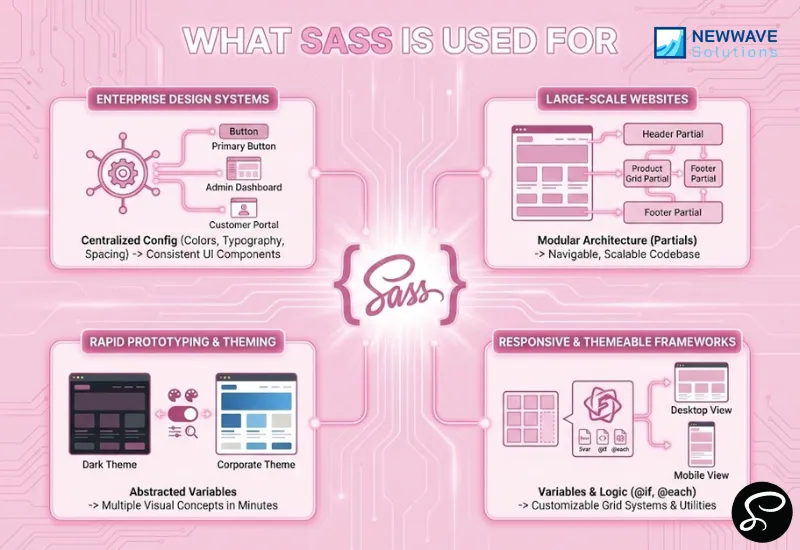
Sass is not an academic exercise; it’s a practical tool that solves real-world problems across the industry. Its applications are foundational to modern front-end development.
Building Enterprise-Level Design Systems
For large corporations and product companies, visual consistency is paramount. Sass is the engine behind countless internal and public design systems. Teams define a core _config.scss file that holds all the “source of truth” values—brand colors, typography scales, spacing units, and breakpoints. Every component in the system then pulls from these central variables. This ensures that a “Primary Button” looks and behaves identically across a marketing site, a customer portal, and an internal admin dashboard, which is crucial for complex web app development solutions.
Structuring Large-Scale Website Projects
When building a large corporate website, the CSS for the header, footer, product grids, and blog posts can be immense. Sass’s modular architecture via partials allows teams to split the code into logical units. This makes the codebase navigable for large teams and simplifies onboarding for new developers, a key consideration when you plan to hire developers or work with an external agency.
Creating Responsive and Themeable Frameworks
Sass is the backbone of powerful front-end frameworks like Bootstrap (which used it extensively from version 4 onwards). The framework’s grid system, components, and utilities are all built with Sass variables and mixins. This allows developers to deeply customize the framework by overriding default variables before compilation, generating a tailored version of Bootstrap without ever touching the core CSS. Furthermore, the logic provided by Sass control directives (like @if and @each) makes it exceptionally good for building complex, responsive grid systems and utility classes.
Rapid Prototyping and Theming
For agencies that need to present multiple visual concepts to a client, Sass is invaluable. By abstracting colors, fonts, and spacing into variables, a developer can create multiple theme files (e.g., _theme-dark.scss, _theme-corporate.scss). Swapping out which theme file is imported and recompiling can generate a completely different visual design in minutes, without rewriting any of the core component styles. This dramatically speeds up the prototyping and client review process in custom web development services.
Advantages and Disadvantages
Besides its powerful feature set, including variables, mixins, and functions, SaSS provides capabilities that go beyond what native CSS currently offers, SaSS also has some disadvantages that worth considering. First, we begin with its advantages:
Advantages
- Powerful Features: It provides variables, nesting, mixins, functions, and control directives that native CSS is still catching up with.
- Mature and Stable: With over 15 years of development, Sass is a battle-tested tool with a massive community and extensive documentation.
- Improved Developer Experience: It makes writing CSS faster, less repetitive, and more enjoyable, leading to higher productivity.
- Strong Community and Ecosystem: It is integrated into all major build tools and frameworks, making it a standard part of the modern front-end workflow.
Disadvantages
- Requires a Build Process: You cannot use a .scss file directly in the browser; it must be compiled, which adds complexity to the development setup.
- Potential for Over-Nesting: Inexperienced developers can create overly specific and complex CSS selectors by nesting too deeply, which can harm performance and maintainability.
- The CSS Gap is Closing: With the advent of native CSS features like Custom Properties (variables) and @import, the unique value proposition of Sass has diminished slightly, though its full feature set remains more powerful.
Conclusion
Sass is far more than a simple tool; it is a paradigm shift that taught developers how to write scalable, maintainable, and architecturally sound CSS. It brought the power of programming principles to the world of design, empowering teams to build the sophisticated and consistent user interfaces that users now expect. From the most straightforward marketing site to the most complex data-driven application, the methodologies championed by Sass are indispensable. While native CSS continues to evolve, the comprehensive workflow, proven stability, and sheer power of Sass ensure it remains a vital part of the modern web development toolkit.
Are you ready to build a digital product with a front-end that is as robust and maintainable as it is beautiful? Leveraging the right technology is crucial, but it’s only half the equation. You need a team that has mastered these tools. By choosing to hire dedicated developers service from Newwave Solutions, you gain a partner with deep expertise in Sass and other cutting-edge technologies. We don’t just write code; we engineer scalable, high-performance digital experiences designed to propel your business forward. Contact us today and let’s build something amazing together.
To Quang Duy is the CEO of Newwave Solutions, a leading Vietnamese software company. He is recognized as a standout technology consultant. Connect with him on LinkedIn and Twitter.



Read More Guides
Get stories in your inbox twice a month.
Let’s Connect
Let us know what you need, and out professionals will collaborate with you to find a solution that enables growth.
Leave a Reply