


What is TYPO3 CMS? The Enterprise-Grade Platform for Powerful Websites
In the world of content management systems (CMS), WordPress often steals the spotlight. But what if your project demands managing multiple websites, serving content in dozens of languages, or handling complex enterprise-level workflows? This is where TYPO3 enters the stage. Understanding what is TYPO3 CMS is crucial for businesses and organizations that have outgrown simpler platforms. This guide will demystify TYPO3 for both technical and non-technical readers, exploring its powerful features, how it works, and why it might be the perfect solution for your next ambitious project.
What is TYPO3 CMS?
TYPO3 is a free, open-source enterprise content management system (CMS) designed for building and managing complex, large-scale, and multilingual websites. Think of it less as a simple website builder and more as a digital experience platform for major organizations. First released in 1998 by Kasper Skårhøj, it stands as one of the oldest and most mature open-source CMS platforms available. Built on PHP and supporting databases like MySQL and PostgreSQL, TYPO3 is engineered for flexibility, security, and scalability right out of the box.
Its evolution has always focused on enterprises and institutions that demand full control over their digital presence. So, what is TYPO3 development? It’s the process of leveraging this robust framework to create custom digital solutions—similar in some ways to Drupal development, but tailored for organizations seeking advanced enterprise-grade functionality. For non-technical users, this means managing content across regional or multilingual sites through its sophisticated backend. For developers, it opens opportunities for deep customization using its extension API and Fluid templating engine. Much like Drupal, TYPO3 is a professional toolset built to solve complex web challenges, from third-party software integration to designing tailored editorial workflows for large teams.
Why Choose TYPO3?
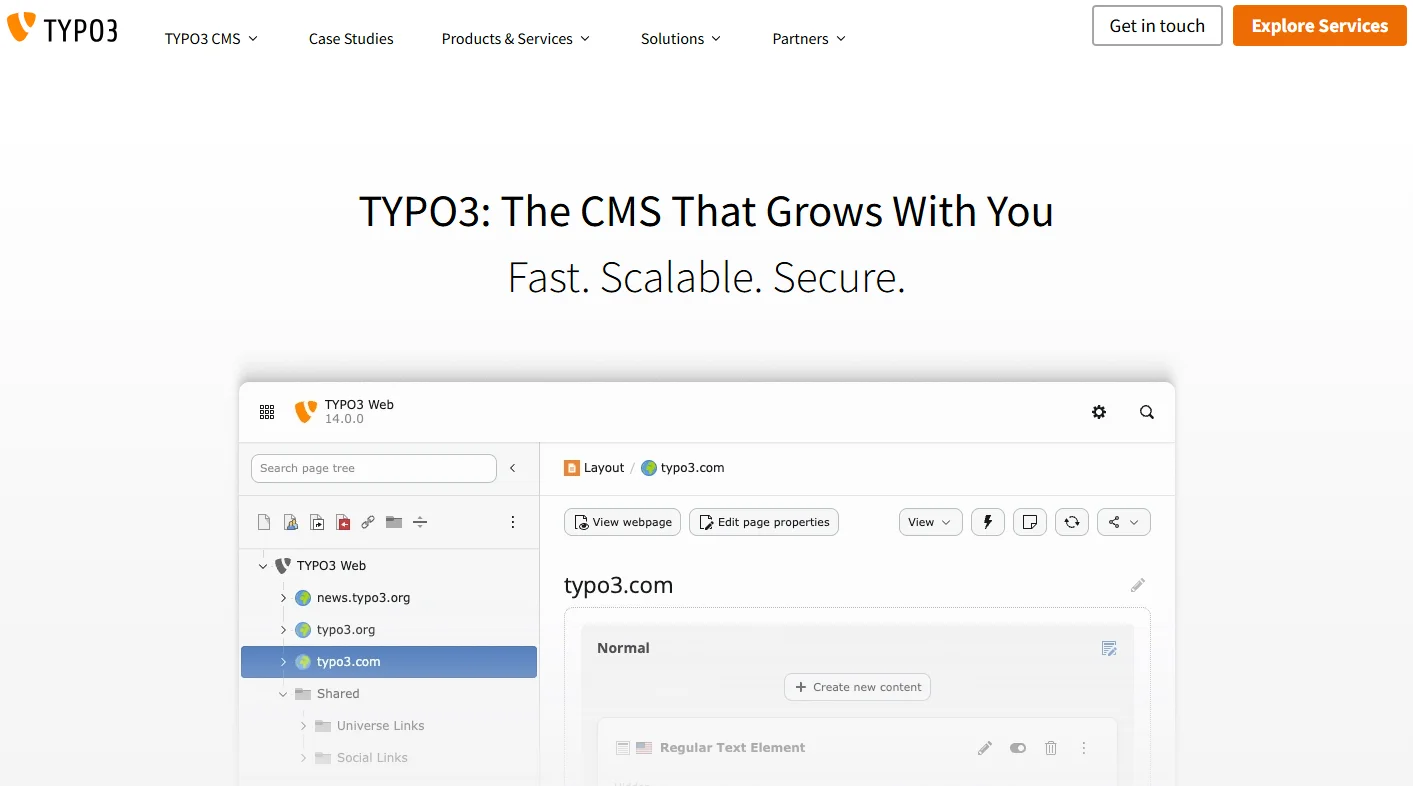
You should choose TYPO3 if you need an enterprise-grade solution that offers unparalleled scalability, built-in multilingual support, and absolute content management flexibility for large, complex projects. It is not designed for a simple blog; it’s built to power the digital infrastructure of major organizations. Its strengths become apparent when project requirements extend beyond the ordinary.
1. Unmatched Scalability
TYPO3 is built to grow with you. It can effortlessly manage websites with thousands of pages and hundreds of thousands of visitors without breaking a sweat. Its architecture is optimized for performance under heavy load, making it a reliable choice for large corporations and high-traffic institutions.
2. Enterprise-Grade Multilingual Support
While other CMSs need plugins for multiple languages, TYPO3 has this functionality deeply integrated into its core. You can manage a single website in over 50 languages from one installation, with advanced tools for translation workflows and maintaining consistency across all versions.
3. Powerful Content Management Flexibility
TYPO3 offers exceptional flexibility in how content is structured and presented. Its backend allows for highly granular content element management, enabling editors to create complex page layouts without touching code. This is ideal for large sites with diverse content needs.
4. Robust Security and Stability
Security is a top priority for the TYPO3 Association. The platform is known for its rigorous security practices, regular long-term support (LTS) releases, and a dedicated security team. This makes it a trusted choice for government entities, financial institutions, and large enterprises where data security is non-negotiable.
5. Digital Sovereignty
As a free and open-source platform, TYPO3 guarantees complete digital sovereignty. You own your data and have full control over your website’s code and infrastructure, with no vendor lock-in or recurring licensing fees.
6. Granular User and Access Management
TYPO3 allows administrators to define very precise user permissions. You can create custom user roles and restrict access to specific pages, content types, or even functions within the backend. This is essential for large teams with multiple content editors, reviewers, and administrators.
Which Type of Enterprise Uses TYPO3?
TYPO3 is used by large organizations, governments, educational institutions, and corporations that require a secure, scalable, and multilingual content management platform. It is the platform of choice for projects where complexity, security, and compliance are critical deciding factors. Its user base consists of entities that need more than just a basic web presence.
- Governments and Public Sector: Federal, state, and municipal government portals that require high security, accessibility, and multilingual support.
- Large Corporations: Global enterprises that need to manage complex brand sites, intranets, or multisite installations.
- Educational Institutions: Universities and research institutions with multiple faculties, departments, and language requirements.
- Non-Profit Organizations: Large NGOs and international bodies that operate across different countries and languages.
- Publishing and Media Houses: Organizations that manage a high volume of content with sophisticated editorial workflows.
>>> In short:
- For enterprises, it’s a scalable and secure foundation for their digital ecosystem.
- For governments, it’s a compliant and trustworthy platform for citizen services.
- For developers, it’s a powerful and extensible framework for building custom solutions.
- For organizations with complex needs, it’s the solution that won’t hold them back.
What is TYPO3 Used For?
TYPO3 is used for creating and managing sophisticated digital experiences that require advanced functionality, such as multisite management, complex workflows, and deep integration with other business systems. It excels in environments where a standard CMS would quickly become a bottleneck. Here are its most common and powerful applications.
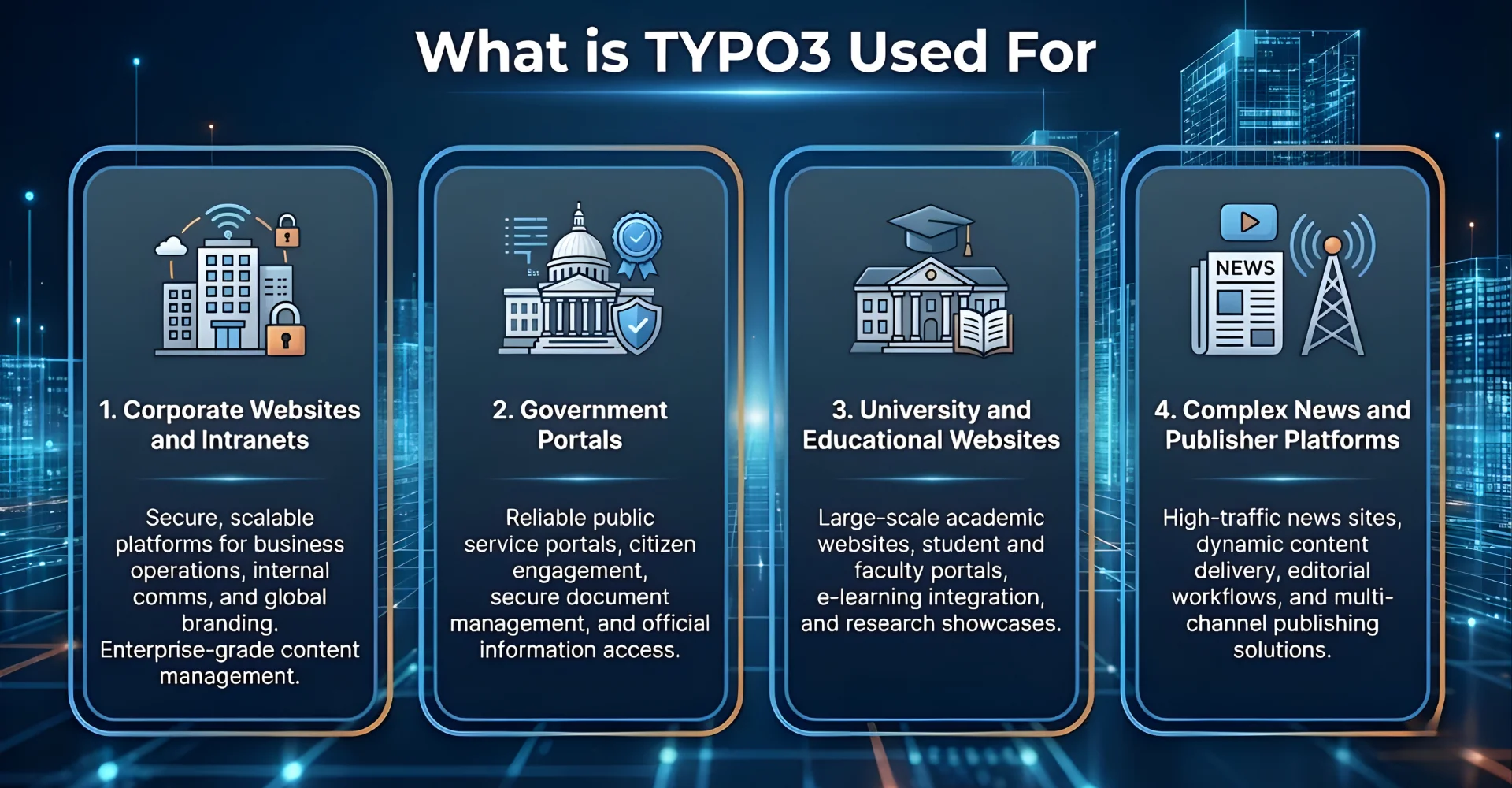
1. Corporate Websites and Intranets
In addition, TYPO3 can be seamlessly integrated with custom software development services to extend functionality, automate workflows, and tailor digital solutions to specific business needs. This makes it a powerful choice for enterprises looking to unify their online presence while enhancing internal efficiency.
Core Benefit:
- Centralized Multi-Site Management: Run dozens of websites from one installation, ensuring brand consistency and reducing admin work.
- Granular Access Control: Create secure intranets with detailed permissions for different departments and teams.
- Enterprise Content Workflows: Implement multi-stage review and approval processes for content before publication.
Example: Airbus uses TYPO3 for parts of its corporate web presence, leveraging its ability to handle complex content structures and multiple languages.
2. Government Portals
Government entities at all levels trust TYPO3 for its robust security, adherence to accessibility standards (WCAG), and ability to serve content in multiple official languages. The platform’s transparency as open-source software aligns with the principles of open government.
Core Benefit:
- Uncompromising Security: A dedicated security team and rigorous patching meet strict government IT standards.
- Built-In Accessibility: Core features adhere to WCAG guidelines, making sites inclusive and legally compliant.
- Digital Sovereignty: As open-source software, it avoids vendor lock-in and ensures long-term control of public data.
Example: Numerous German federal and state government portals, such as the site for the State of Saxony-Anhalt, are built with TYPO3.
3. University and Educational Websites
Universities with numerous departments, research centers, and international programs benefit greatly from TYPO3’s multisite and multilingual capabilities. Combined with Educational Software Development solutions, different faculties can manage their own sub-sites while maintaining a consistent university brand.
Core Benefit:
- Decentralized Content Management: Allow departments to control their own content while enforcing university-wide branding and navigation.
- Built for Scale: Easily handles thousands of course pages, faculty profiles, and news articles.
- Multilingual by Design: Perfect for international student recruitment and research institutions with a global focus.
Example: The University of Vienna uses TYPO3 to manage its extensive web presence, providing information for tens of thousands of students and staff.
4. Complex News and Publisher Platforms
While WordPress is common for blogging, TYPO3 is chosen by publishers who need advanced workflow management, detailed user roles (e.g., editor, publisher, chief editor), and the ability to handle a vast archive of content.
Core Benefit:
- Advanced Editorial Workflows: Define custom roles (writer, editor, publisher) and multi-step approval processes.
- Content Versioning & Comparison: Track every change and easily compare versions to manage content effectively.
- Flexible Content Modeling: Structure and relate content in custom ways beyond simple “posts” and “pages.”
Example: Major media houses and industry publishers use TYPO3 to manage their online news platforms.
How Does TYPO3 Work?
TYPO3 operates on a modular, enterprise-oriented architecture designed for flexibility and performance. Understanding how does TYPO3 work involves looking at its core components:
- The Core & The Database: The TYPO3 software (PHP-based) and your database (e.g., MySQL) work together. The database stores all content, relationships, and configuration settings.
- The Request Cycle: When a user visits a page, TYPO3’s engine determines what content to display based on the URL. It then queries the database, processes the content, and merges it with the template.
- Templating with Fluid: Instead of mixing PHP and HTML, TYPO3 primarily uses the Fluid templating engine. This separates the logic from the presentation, making themes easier to build, maintain, and secure.
- Extensions for Functionality: Almost every feature beyond the core is added via extensions. Thousands are available in the TYPO3 Extension Repository (TER) to add anything from forms and news systems to full e-commerce capabilities.
- Backend Administration: Editors and administrators work in a powerful backend interface (accessed at yoursite.com/typo3) to manage the page tree, create content elements, and configure the site. This is where you truly learn how to use TYPO3 as a content manager.
The magic for editors is that they work in a structured interface to manage content, while TYPO3 handles the complex task of assembling everything into a webpage dynamically for each visitor.
Pros and Cons
TYPO3 offers unparalleled power and flexibility for large-scale projects, but this comes with a steeper learning curve and higher initial complexity than mainstream CMSs.
Pros
The pros of using TYPO3 are what make it an industry leader for enterprise solutions.
- Enterprise-Grade Features: Built-in multisite, multilingual, and advanced workflow management out of the box.
- Exceptional Scalability: Proven to handle sites with hundreds of thousands of pages and high traffic loads.
- Rock-Solid Security: A dedicated security team and a strong track record make it trusted by governments and Fortune 500 companies.
- Total Flexibility and Control: The architecture allows for deep customization and integration with any third-party system.
- Digital Sovereignty: You own your platform and data completely, with no vendor lock-in.
Cons
The cons are typically the flip side of its powerful features.
- Steep Learning Curve: TYPO3 is significantly more complex to install, configure, and manage than platforms like WordPress. It is not built for beginners.
- Higher Resource Requirements: It demands more robust server infrastructure and skilled developers, leading to a higher total cost of ownership for small projects.
- Smaller Community: While dedicated, its community and pool of available developers are smaller than those of WordPress, making it harder to find resources and talent.
- Development Overhead: For small sites, the time and cost required for development can be disproportionate to the project’s needs.
How to Develop a TYPO3 Site?
Developing a TYPO3 site is a professional process that requires careful planning and technical expertise. Here is a guide to TYPO3 development for a large-scale project:
- Planning and Architecture: Define the site structure, content types, multilingual requirements, and integration needs. This is the most critical phase for a TYPO3 project.
- Server Provisioning: Secure a robust hosting environment that meets TYPO3’s server requirements (e.g., specific PHP versions, database).
- Download and Install TYPO3: How to download TYPO3? You can get the latest version from the official website, get.typo3.org. For how to install TYPO3, the process involves uploading files to your server and running the installation wizard, which sets up the database connection.
- Extension Installation: Browse the TYPO3 Extension Repository (TER) and install essential extensions for your functionality (e.g., news, form framework).
- Template Development: Develop the site’s frontend using the Fluid templating engine to create a custom theme or adapt a pre-built “sitepackage”.
- Content Structure and Configuration: Build the page tree in the backend, configure languages, and set up user roles and permissions.
- Content Migration and Populating: Import existing content or begin creating content using TYPO3’s content elements.
- Testing and Launch: Rigorously test all functionalities, performance, and security before going live.
For any project of significant size or complexity, navigating the intricacies of TYPO3 alone can be a formidable challenge. This is where the strategic decision to find the IT outsourcing services from a professional TYPO3 development agency becomes critical to the project’s success. An agency brings more than just coding skills; it provides a foundation of proven expertise, established best practices, and a structured methodology that mitigates risk and ensures a robust, scalable, and secure implementation.
Partnering with specialists means you gain access to a team that has already encountered and solved the complex challenges you might face, from intricate multisite configurations and custom extension development to seamless third-party system integration. They ensure your project is built on a solid architectural foundation from the outset, avoiding costly refactoring down the line. Ultimately, to hire developers is to invest in peace of mind, ensuring your enterprise-grade platform is implemented correctly, performs optimally, and is maintained to the highest security standards, allowing you to focus on your core business objectives.
Why Choose a Professional TYPO3 Development Agency?
Given TYPO3’s complexity, embarking on a project without expert guidance is risky. Partnering with a professional agency is not a luxury; it’s a necessity for ensuring project success, performance, and security. They provide the expertise to navigate the platform’s steep learning curve and unlock its full potential.
- Expertise and Best Practices: Agencies bring deep knowledge of TYPO3’s architecture, ensuring your site is built on a solid, secure, and scalable foundation from day one.
- Efficiency and Speed: They can avoid common pitfalls and implement solutions much faster than an in-house team learning the platform, reducing time-to-market.
- Custom Integration: They can develop custom extensions and seamlessly integrate TYPO3 with your existing enterprise software (ERP, CRM, etc.).
- Long-Term Support and Maintenance: They provide critical ongoing services: applying security patches, performing updates, and ensuring optimal performance.
At Newwave Solutions, we specialize in transforming complex business requirements into powerful digital solutions. Our team of certified TYPO3 developers possesses the deep expertise needed to harness the full power of this enterprise CMS. We don’t just build websites; we build secure, scalable, and efficient digital ecosystems that drive organizational growth. From initial strategy and custom web development services with Typo3 to ongoing maintenance and support, we are your dedicated partner.
Typo 3 CMS is the undisputed champion for enterprise-level web projects. It’s the powerful, secure, and flexible platform that steps in when other CMSs fall short. Understanding what TYPO3 is used for complex, multilingual, and scalable websites is key to identifying if it’s the right tool for your organization’s ambitious goals. While its complexity means it’s not for everyone, for those who need its powerful feature set, there is no substitute.
Whether you decide to partner with experts like Newwave Solutions or build an in-house team, TYPO3 provides the robust foundation needed to support your largest digital ambitions.
To Quang Duy is the CEO of Newwave Solutions, a leading Vietnamese software company. He is recognized as a standout technology consultant. Connect with him on LinkedIn and Twitter.



Read More Guides

Get stories in your inbox twice a month.
Let’s Connect
Let us know what you need, and out professionals will collaborate with you to find a solution that enables growth.
Leave a Reply