


Zend Framework Tutorial: From Beginner Basics to Enterprise Solutions

In PHP circles, Laravel grabs headlines, but when seasoned engineers need performance, modularity, and fine-grained control for complex systems, they often look to Zend Framework (now continued as Laminas). If you’re exploring what is Zend Framework, how Zend Framework works, and why to use Zend Framework for serious projects—from rapid MVP builds to long-lived platforms that demand rigorous SDLC discipline, this guide distills everything a beginner needs. We’ll walk through the big picture of the Zend Framework Tutorial.
What is Zend Framework?
Zend Framework is an open-source, object-oriented PHP framework designed specifically for building enterprise-grade web applications and services, following the Model-View-Controller (MVC) architectural pattern. First introduced in 2006 by Zend Technologies (the creators of PHP itself), it quickly earned a reputation as an enterprise-ready MVC framework. Its modular architecture allows developers to use it either as a full-stack framework or as a collection of standalone components, a flexibility that sets it apart from other PHP frameworks.
Now known as the Laminas Project, it represents a collection of professional PHP packages that can be used independently or together as a full-stack framework. The framework’s “use-at-will” architecture allows developers to use individual components as needed, making it incredibly flexible for various software development services requirements.
So, what is a Zend Framework application? It’s a web application built using Zend’s component-based architecture, where each piece of functionality is encapsulated in reusable, testable components. This approach is particularly valuable for web portal development that requires modular, maintainable codebases. The framework emphasizes best practices, enterprise patterns, and interoperability through its adherence to the PHP Framework Interop Group standards.
Key Characteristics of Zend Framework:
- Component-Based Architecture: Use only the components you need
- Enterprise-Focused: Designed for large-scale, complex applications
- Standards-Compliant: Adheres to PHP-FIG PSR standards
- Professional Grade: Built with extensibility and testing in mind
Why Use Zend Framework?
You should use Zend Framework if you’re developing enterprise-level applications that require maximum flexibility, strict adherence to standards, and long-term maintainability. Its design philosophy makes it ideal for professional software development services where quality and scalability are paramount.
1. Enterprise-Grade Flexibility
Zend Framework’s “use-at-will” architecture provides unparalleled flexibility compared to more opinionated frameworks. You can use individual components independently or combine them into a full-stack solution. This approach is perfect for web app development service projects that need to integrate with existing systems or require specific architectural patterns that other frameworks might not support easily.
2. Strict Standards Compliance
The framework strictly adheres to PHP-FIG PSR standards, ensuring interoperability with other PHP components and frameworks. This standards-based approach reduces vendor lock-in and makes your codebase more maintainable over time. For teams offering software maintenance services, this standards compliance significantly reduces long-term maintenance complexity.
3. Robust Security Features
Zend Framework includes comprehensive security components for input validation, encryption, and authentication. These built-in security features help developers create secure applications by default, which is crucial for ecommerce web development services and applications handling sensitive data. The framework’s security architecture is designed with enterprise security requirements in mind.
4. Professional Development Workflow
The framework encourages professional development practices, including comprehensive testing, documentation, and modular architecture. This makes it ideal for teams practicing rigorous SDLC methodologies and for organizations that need to hire dedicated development engineer services for long-term project maintenance and enhancement.
5. Long-Term Maintainability
Zend Framework’s emphasis on clean architecture, dependency injection, and interface-based programming results in code that’s easier to maintain and extend over time. This is particularly valuable for enterprise applications that typically have long lifecycles and evolving requirements.
Who Uses Zend Framework?
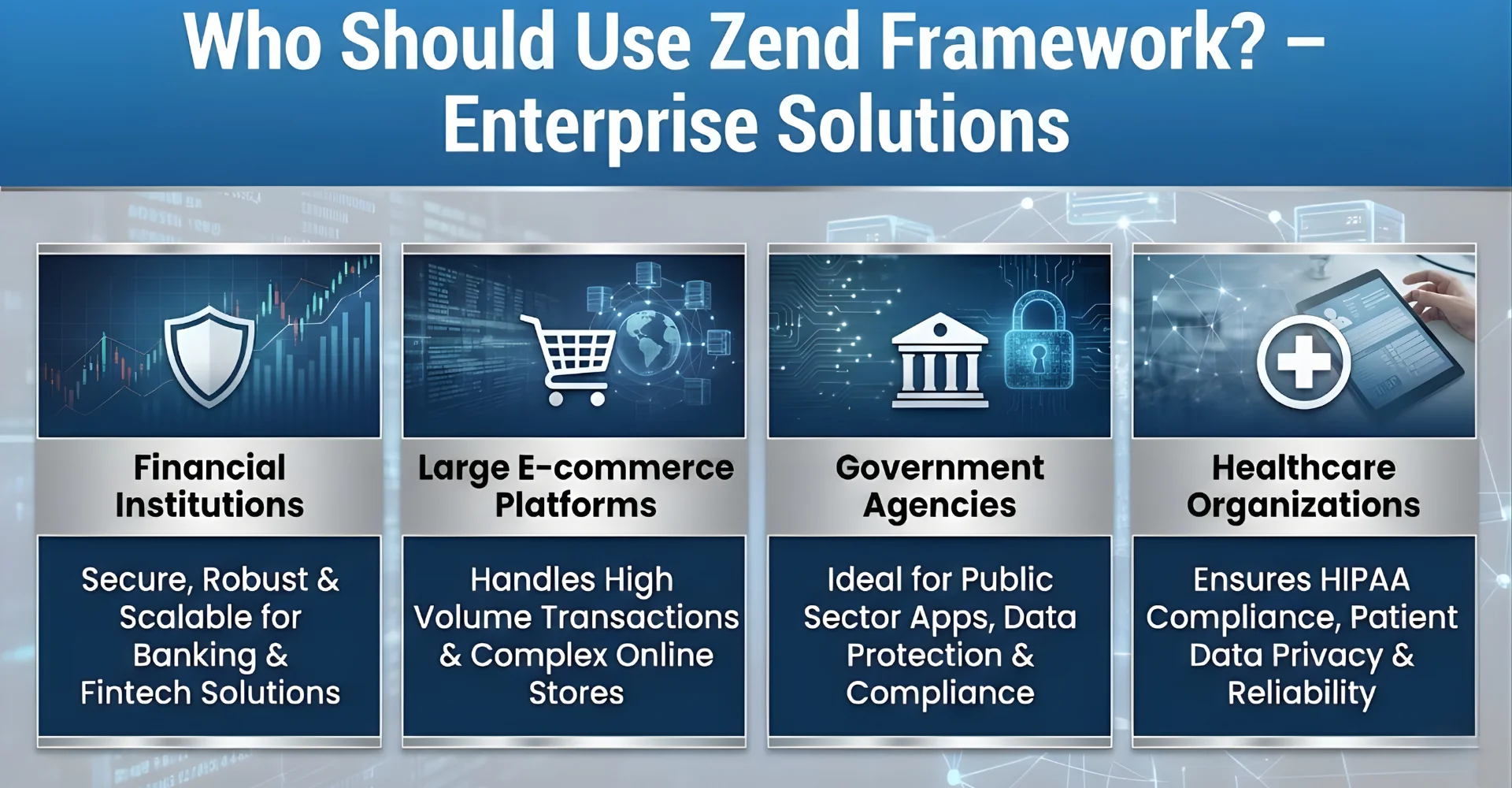
Zend Framework is used primarily by large enterprises, financial institutions, and organizations building complex, mission-critical web applications that require high levels of customization, security, and scalability. Enterprise Users Include:
- Financial Institutions: Banks and financial services companies needing secure, compliant applications
- Large E-commerce Platforms: Companies like Magento (which uses Zend components) for robust online stores
- Government Agencies: Organizations requiring secure, maintainable web applications
- Healthcare Organizations: Systems handling sensitive patient data with strict compliance requirements
In summary:
- For enterprises, it’s a scalable solution for complex business logic
- For development teams, it provides a professional, standards-based workflow
- For long-term projects, it offers excellent maintainability and extensibility
- For specialized applications, it provides the flexibility needed for custom solutions
What is Zend Framework Used For?
Zend Framework is used for building enterprise-level web applications, APIs, and complex business systems where flexibility, security, and maintainability are critical requirements. Some common use cases include:
1. Enterprise Web Applications
Large organizations use Zend Framework to build complex internal systems, customer portals, and business applications. The framework’s modular architecture makes it ideal for web portal development solutions that need to scale with organizational growth while maintaining performance and security standards.
2. E-commerce Platforms
The framework’s robustness and security features make it well-suited for ecommerce web development services. Platforms like Magento demonstrate how Zend components can power high-volume online stores with complex product catalogs, customer management, and order processing requirements.
3. API Development and Microservices
Zend Framework’s component-based architecture is perfect for API development services and microservices implementations. The framework’s HTTP layer and middleware capabilities make it excellent for building RESTful APIs that serve web applications, mobile apps, and third-party integrations.
4. Content Management Systems
Large-scale content management systems benefit from Zend’s flexible architecture. The framework allows developers to create customized CMS solutions that exactly match specific content workflow requirements, unlike off-the-shelf solutions that may impose limitations.
How Zend Framework Works?
Understanding how Zend Framework works is essential for effectively utilizing its power in your projects. The framework follows a component-based architecture with MVC pattern implementation.
Component-Based Architecture
Unlike monolithic frameworks, Zend is built as a collection of independent components. Each component solves a specific problem and can be used alone or in combination with others. This architecture allows developers to create tailored solutions for specific web app development service needs without carrying unnecessary baggage.
MVC Implementation
The framework implements the Model-View-Controller pattern with a focus on separation of concerns:
- Models handle business logic and data operations
- Views manage presentation and the user interface
- Controllers process requests and coordinate between models and views
This separation makes applications easier to test, maintain, and scale – crucial considerations for enterprise software development services.
Request Lifecycle
When a request arrives at a Zend Framework application:
- The request is routed to the appropriate controller
- The controller processes the request and interacts with models
- Models handle business logic and data operations
- The controller selects a view to render the response
- The view generates the final output sent to the client
This structured approach ensures consistent application behavior and makes complex applications more manageable.
How to Install Zend Framework
Installing Zend Framework involves using Composer, PHP’s dependency manager, to create a new project structure and install the necessary components. Installation Steps:
1. System Requirements Check
- Ensure you have PHP 7.3 or higher installed
- Verify Composer is available on your system
- Check that necessary PHP extensions are enabled
2. Project Creation
- Use Composer to create a new project skeleton
- The skeleton provides the basic directory structure
- Includes essential configuration files and dependencies
3. Configuration Setup
- Configure your web server to point to the public directory
- Set up environment-specific configuration files
- Configure database connections and other services
4. Verification
- Access the application through your web browser
- Verify that the basic installation is working correctly
- Check that all required services are properly configured
The installation process emphasizes flexibility, allowing you to start with a minimal setup and add components as needed for your specific web app development service requirements. From here, you’re ready to build modules, connect models to your database, and expand features. Think of it as setting the foundation for your next MVP or enterprise-ready system.
Zend Framework Tutorial – Building an Enterprise Application
This comprehensive PHP Zend framework tutorial will guide you through the complete process of building a robust enterprise application from initial concept to final implementation. Unlike simple web applications, enterprise systems require careful planning, scalable architecture, and maintainable code structure – all areas where Zend Framework excels.
1. Defining Business Objectives
Defining Business Objectives
Before writing a single line of code, successful enterprise application development begins with thorough planning. Start by identifying the core business problems your application needs to solve. For an enterprise system, this typically involves:
- Stakeholder Interviews: Conduct detailed discussions with end-users, managers, and technical teams to understand everyone’s requirements and expectations
- Use Case Development: Create detailed scenarios of how different users will interact with the system, covering both normal operations and edge cases
- Regulatory Compliance: Identify any industry-specific regulations (GDPR, HIPAA, PCI-DSS) that will impact your application’s design and security requirements
Technical Architecture Planning
Enterprise applications demand robust technical planning that considers both current needs and future growth:
- Database Design: Plan your database schema with normalization principles, considering relationships, indexes, and future scalability requirements
- Component Strategy: Map out which Zend Framework components you’ll need – Authentication for user management, DB for data access, MVC for application structure
- Integration Planning: Identify external systems your application needs to connect with (payment gateways, CRM systems, legacy databases) and plan the integration approach
2. Development Environment Setup
Professional Development Workflow
Setting up a proper development environment is crucial for enterprise projects where multiple developers collaborate:
- Version Control Strategy: Implement Git with a branching strategy that supports parallel development, code reviews, and controlled releases
- Environment Configuration: Set up separate development, testing, staging, and production environments with appropriate configuration management
- Development Tools: Establish coding standards, automated testing frameworks, and continuous integration pipelines to maintain code quality
Team Collaboration Setup
For teams providing software development services, efficient collaboration tools are essential:
- Documentation Systems: Implement systems for technical documentation, API documentation, and project wikis
- Project Management: Set up agile development practices with proper sprint planning, task tracking, and progress monitoring
- Code Quality Tools: Configure static analysis, code formatting, and automated testing to maintain consistent code quality across the team
3. Core Business Logic Implementation
Domain-Driven Design Approach
Enterprise applications benefit greatly from a domain-driven design methodology:
- Entity Modeling: Create rich domain models that encapsulate business rules and validation logic, rather than simple data containers
- Service Layer Development: Build service classes that coordinate complex business operations across multiple entities and systems
- Repository Pattern: Implement data access layers that separate business logic from persistence concerns, making your application more testable and maintainable
Business Rule Implementation
Complex enterprise applications require sophisticated business rule management:
- Validation Strategies: Implement comprehensive input validation at multiple levels – form validation, business rule validation, and database constraint validation
- Workflow Management: Design and implement business process workflows that guide users through complex multi-step operations
- Audit Logging: Build comprehensive audit trails that track important business events for compliance and troubleshooting purposes
4. User Interface Development
Enterprise-Grade UI Architecture
Building user interfaces for enterprise applications requires special considerations:
- Template System Setup: Configure Zend Framework’s view layer with reusable templates, layouts, and partial views to maintain consistency across the application
- Component-Based UI Development: Create reusable UI components that can be shared across different parts of the application, reducing duplication and maintenance overhead
- Accessibility Compliance: Ensure your user interface meets WCAG accessibility standards to accommodate all users and meet legal requirements
Responsive Design Implementation
Modern enterprise applications must work seamlessly across different devices:
- Mobile-First Approach: Design interfaces that work well on mobile devices while providing enhanced experiences on desktop platforms
- Progressive Enhancement: Build core functionality that works in all browsers while providing enhanced features in modern browsers
- Performance Optimization: Implement techniques like lazy loading, asset compression, and caching to ensure fast load times even with complex enterprise interfaces
5. Security Implementation
Comprehensive Security Strategy
Enterprise applications demand robust security measures at multiple levels:
- Authentication System: Implement secure authentication with features like password policies, account lockouts, and session management
- Authorization Framework: Build role-based access control that manages what different users can see and do within the application
- Data Protection: Implement encryption for sensitive data at rest and in transit, following industry best practices for key management
Security Testing and Validation
Continuous security validation is essential for enterprise applications:
- Vulnerability Assessment: Regularly scan your application for common security vulnerabilities like SQL injection, XSS, and CSRF
- Penetration Testing: Conduct simulated attacks to identify and fix security weaknesses before they can be exploited
- Security Monitoring: Implement logging and monitoring systems that detect and alert on suspicious activities in real-time
6. Integration and API Development
Third-Party System Integration
Enterprise applications rarely exist in isolation and often need to integrate with other systems:
- API Design: Create well-designed RESTful APIs that follow consistent patterns and provide comprehensive documentation
- Integration Patterns: Implement reliable integration patterns like message queues, webhooks, and batch processing for system-to-system communication
- Error Handling: Build robust error handling and retry mechanisms for external system integrations to ensure reliability
Microservices Architecture
For large enterprise applications, consider a microservices approach:
- Service Decomposition: Identify bounded contexts within your application that can be developed and deployed as independent services
- Communication Protocols: Implement efficient communication between services using appropriate protocols (HTTP/REST, message queues, gRPC)
- Data Consistency: Design strategies for maintaining data consistency across distributed services while ensuring performance and reliability
7. Testing Strategy Implementation
Comprehensive Test Coverage
Enterprise applications require thorough testing at multiple levels:
- Unit Testing: Test individual components and classes in isolation to ensure they work correctly
- Integration Testing: Verify that different parts of the application work together as expected
- System Testing: Test the complete application from end to end to validate overall functionality
Automated Testing Pipeline
Implement continuous testing to maintain quality throughout the development process:
- Test Automation: Automate regression testing to quickly identify when new changes break existing functionality
- Performance Testing: Regularly test application performance under load to identify and fix bottlenecks before they impact users
- User Acceptance Testing: Work with business stakeholders to validate that the application meets their requirements and expectations
8. Deployment and Maintenance
Production Deployment Strategy
Enterprise applications require careful deployment planning:
- Deployment Automation: Implement automated deployment pipelines that reduce human error and ensure consistent deployments
- Database Migration: Plan and execute database schema changes without disrupting service to existing users
- Rollback Planning: Prepare rollback strategies in case deployment introduces unexpected issues
Ongoing Maintenance Planning
Plan for the long-term maintenance of your enterprise application:
- Monitoring Setup: Implement comprehensive monitoring for application performance, errors, and business metrics
- Maintenance Procedures: Establish regular maintenance procedures for tasks like database optimization, log rotation, and security updates
- Evolution Planning: Plan for how the application will evolve over time to meet changing business needs and technology trends
This structured approach to building an enterprise application with Zend Framework ensures that you create a robust, maintainable, and scalable solution that can grow with your business needs. Each phase builds upon the previous one, creating a solid foundation for long-term success.
Advantages and Disadvantages
Zend Framework offers enterprise-grade flexibility and standards compliance, but requires significant expertise and may be overkill for simpler projects.
Advantages
- Maximum Flexibility: Component-based architecture allows tailored solutions
- Enterprise Ready: Designed for large-scale, complex applications
- Standards Compliance: Adherence to PSR standards ensures interoperability
- Professional Quality: Emphasizes testing, documentation, and best practices
- Long-Term Viability: Stable, well-maintained codebase suitable for enterprise use
Disadvantages
- Steep Learning Curve: Requires a deep understanding of enterprise patterns
- Development Overhead: More setup and configuration required than simpler frameworks
- Performance Considerations: May require optimization for high-traffic scenarios
- Smaller Community: Less third-party resources compared to more popular frameworks
Why Partner with a Professional Zend Framework Development Agency?
Building enterprise applications with Zend Framework requires specialized expertise that goes beyond basic PHP development. Partnering with a professional agency ensures your project benefits from enterprise best practices and architectural excellence.
Strategic Benefits of Choosing a Professional Partnership:
- Architectural Excellence: Experts design scalable application structures that grow with your business needs
- Security Implementation: Professional setup of enterprise-grade security measures beyond basic protections
- Performance Optimization: Database optimization, caching strategies, and code-level performance tuning
- Ongoing Maintenance: Comprehensive software maintenance services, including updates, security patches, and feature enhancements
At Newwave Solutions, we bring all these capabilities together with a dedicated team of certified engineers who understand how to turn Zend’s flexibility into real business impact. Whether you need to launch a high-performance MVP, streamline your SDLC, or scale enterprise web portals and ecommerce platforms, we deliver tailored software development services that align with your goals. Ready to elevate your Zend Framework project?
Partner with Newwave Solutions today and transform your vision into a secure, scalable reality.
To Quang Duy is the CEO of Newwave Solutions, a leading Vietnamese software company. He is recognized as a standout technology consultant. Connect with him on LinkedIn and Twitter.



Read More Guides

Get stories in your inbox twice a month.
Let’s Connect
Let us know what you need, and out professionals will collaborate with you to find a solution that enables growth.
Leave a Reply