


What Is Google Cloud Platform? Benefits, Costs & Use Cases
In today’s digital economy, enterprises of all sizes need cloud services to store data, run applications, and scale their operations with flexibility. Among the leading options, Google Cloud Platform stands out for its convenience, powerful infrastructure, and wide range of services. In this Newwave Solutions article, we will explore what is Google Cloud Platform, along with its features, benefits, costs, and use cases, to help you decide if GCP can support your business operations effectively.
What is Google Cloud Platform?
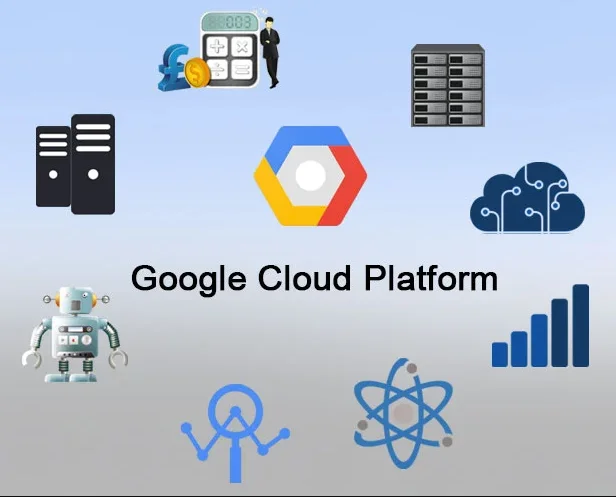
What is a Google Cloud Platform? Google Cloud Platform (GCP) is a suite of cloud computing services offered by Google, providing infrastructure, storage, networking, artificial intelligence, and analytics tools on the same reliable systems that power Google Search, YouTube, and Gmail. It enables businesses to build, deploy, and scale applications globally while ensuring security, flexibility, and cost efficiency.
Example: Spotify migrated much of its data infrastructure to GCP to handle billions of daily music streams. This move improved scalability, enhanced user experience with faster load times, and reduced operational costs by leveraging Google’s advanced data analytics capabilities.
How Google Cloud Platform works
When exploring how does Google Cloud Platform work, you can see that GCP works by hosting applications and data on Google’s global infrastructure, accessible via the internet instead of relying on local servers.
- Compute services let you run applications on virtual machines or containers.
- Storage and databases securely house your data and allow real-time queries.
- Networking and security ensure reliable global access and protection of information.
- AI and analytics tools help organizations gain insights and automate processes.
Pros & Cons of Google Cloud Platform
| Pros |
Cons |
| Scalability and performance – GCP lets businesses quickly scale resources up or down while maintaining high-speed performance worldwide. | Smaller market share – Compared to AWS and Azure, GCP holds a smaller share of the cloud market, which can affect enterprise adoption. |
| Advanced AI/ML capabilities – Built-in AI tools like Vertex AI and TensorFlow give enterprises powerful options for automation and analytics. | Fewer data centers in some regions – Limited local availability in certain countries may lead to latency or compliance issues. |
| Cost flexibility – Pay-as-you-go pricing and sustained-use discounts make GCP cost-effective for both startups and large enterprises. | Steeper learning curve – Some services require technical expertise, which may challenge teams new to Google Cloud. |
| Strong security standards – End-to-end encryption and global compliance certifications protect sensitive enterprise data. | Complex pricing structure – Understanding and forecasting cloud costs can be difficult without proper monitoring tools. |
| Global infrastructure – GCP offers reliable uptime and access across a vast global network of servers. | Integration challenges – Migrating from legacy systems may require additional planning and resources. |
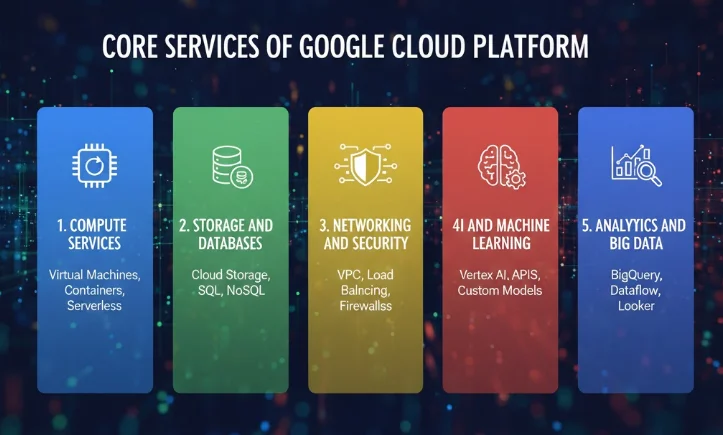
5 Core Services of Google Cloud Platform
From my experience working with cloud adoption projects, I’ve seen how Google Cloud Platform (GCP) provides a wide range of services that help enterprises, startups, and developers solve critical challenges in scalability, data management, and innovation. Below are the 5 main services that define GCP and the types of users who can gain the most value from them.
1. Compute Services
GCP offers compute services such as Google Compute Engine (virtual machines), Google Kubernetes Engine (container orchestration), and Cloud Run (serverless deployment). These tools allow businesses to run applications efficiently, scale on demand, and support modern architectures like microservices.
>>> Who is best suited for this service: They are best for enterprises needing flexible workloads, startups building scalable web apps, and developers adopting containerized environments.
2. Storage and Databases
Google Cloud provides reliable storage options like Cloud Storage for unstructured data, Cloud SQL and Cloud Spanner for relational databases, and Bigtable for high-volume NoSQL workloads. These services handle everything from backups to real-time data queries, helping organizations manage data securely and efficiently.
>>> Who is best suited for this service: As a result, these services are ideal for businesses managing big data pipelines, ecommerce platforms, and financial firms requiring reliable databases.
3. Networking and Security
Networking tools such as Virtual Private Cloud (VPC), Cloud CDN, and Cloud Armor ensure fast, secure, and global data delivery. Combined with identity and access management (IAM), GCP enables enterprises to safeguard data and meet compliance standards.
>>> Who is best suited for this service: This service is most valuable for global enterprises, fintechs, and industries handling sensitive customer information that require robust security and low-latency performance.
4. AI and Machine Learning
With platforms like Vertex AI, AutoML, and integrated TensorFlow, GCP empowers businesses to develop advanced machine learning models and AI applications. Companies can use these services for predictive analytics, personalization, and natural language processing.
>>> Who is best suited for this service: This service line is best suited for retail companies wanting to forecast demand, healthcare firms analyzing patient data, and any enterprise leveraging AI for innovation.
5. Analytics and Big Data
BigQuery, Dataflow, and Pub/Sub are among GCP’s big data analytics tools that process large datasets in real time. These services allow organizations to transform raw data into actionable insights for decision-making and optimization.
>>> Who is best suited for this service: They are particularly useful for digital businesses, marketing agencies, and enterprises that rely heavily on real-time analytics and customer insights.
6 Common Use Cases of Google Cloud Platform
When exploring what is Google Cloud Platform, it’s important to also understand how it applies in real-world business scenarios. GCP can be adapted to multiple industries and business functions, helping organizations modernize IT, improve efficiency, and gain valuable insights. Below are some of the most common use cases where GCP proves its value.
1. Enterprise IT Modernization
Companies use GCP’s Compute Engine and Google Kubernetes Engine to migrate workloads from legacy systems into a flexible, cloud-native environment. This reduces infrastructure costs, increases agility, and ensures systems scale seamlessly with business growth. Enterprises that adopt GCP often report faster time-to-market and improved resilience in IT operations.
Example: PayPal migrated parts of its infrastructure to Google Cloud Compute Engine to gain flexibility and reduce reliance on on-premises systems. This shift improved agility, helped handle millions of daily transactions, and enhanced fraud detection with GCP’s advanced tools.
2. Data Analytics and Business Intelligence
With BigQuery, businesses can analyze massive datasets in seconds and generate insights that drive decision-making. This helps industries like retail, finance, and marketing better understand customer behavior and market trends. Companies using BigQuery often achieve significant gains in operational efficiency and revenue optimization.
Example: HSBC uses BigQuery to analyze billions of financial transactions and customer interactions in real time. With GCP, the bank has improved fraud detection, compliance monitoring, and customer insights, all while reducing reporting times from days to minutes.
3. Artificial Intelligence and Machine Learning
GCP’s Vertex AI and AutoML allow businesses to build custom machine learning models for tasks such as customer recommendation systems, fraud detection, and predictive analytics. Enterprises in healthcare, ecommerce, and fintech use these tools to improve personalization, reduce risks, and enhance customer engagement.
Example: Spotify leverages GCP’s AI and machine learning tools (TensorFlow and Vertex AI) to personalize music recommendations for its 500+ million users. The system analyzes listening patterns to deliver tailored playlists, improving engagement and user satisfaction.
4. Healthcare and Life Sciences
Healthcare organizations leverage GCP’s Cloud Healthcare API and BigQuery to securely store, manage, and analyze patient records while ensuring compliance with HIPAA and other regulations. This improves care delivery, enables advanced research, and fosters secure data sharing across providers.
Example: Mayo Clinic partnered with Google Cloud to store and analyze massive volumes of patient data securely using BigQuery and Cloud Healthcare API. The collaboration accelerates medical research, improves diagnosis accuracy, and ensures HIPAA-compliant record management.
5. Retail and E-commerce
Retailers utilize Cloud Spanner for managing global transactions and BigQuery for customer analytics. GCP helps them deliver personalized shopping experiences, optimize supply chains, and scale digital platforms during high-demand periods like Black Friday. The result is improved customer satisfaction and higher sales conversions in the Healthcare software development field.
Example: Target uses BigQuery and Cloud Spanner to process millions of daily transactions and optimize supply chain operations. By adopting GCP, the retailer delivers better personalized promotions and ensures seamless shopping experiences during seasonal demand spikes.
6. Media and Entertainment
Streaming platforms rely on GCP’s Cloud CDN and Cloud Storage to deliver content quickly and reliably to millions of users worldwide. This ensures low latency, high-quality video streaming, and better user experiences. Media companies using GCP can scale content delivery while minimizing downtime and buffering issues.
Example: YouTube relies heavily on Cloud CDN and Cloud Storage within Google Cloud to deliver billions of videos daily worldwide. This infrastructure enables smooth, low-latency streaming for users while ensuring massive scalability and data redundancy.
How to use Google Cloud Platform
If you are completely new to cloud computing, getting started can feel overwhelming. However, by following a simple step-by-step guide, you can quickly learn how to access Google Cloud Platform and understand its essential features for your business or personal projects.
- Step 1: Create a Google Cloud Account – Go to the Google Cloud Console and sign up with your Google account. New users typically receive free credits to explore services without immediate costs.
- Step 2: Set Up a Project – Every task in GCP runs under a project, so you must create one before using services. Remember to organize projects by department or use case for easier management.
- Step 3: Explore the Google Cloud Console – The console is your main dashboard to manage resources, billing, and permissions. Beginners may find the interface complex, so start with the navigation menu to locate core services.
- Step 4: Enable APIs and Services – Most GCP features require you to enable specific APIs. Take note that enabling too many at once can create billing confusion, so activate only the ones you need.
- Step 5: Choose and Launch a Service – For example, deploy a virtual machine using Compute Engine or store files in Cloud Storage. Each service comes with tutorials and configuration options tailored to your use case.
- Step 6: Manage Billing and Budgets – Use the billing dashboard to track expenses and set up alerts to avoid unexpected costs. Many beginners underestimate this step, but proper monitoring ensures cost efficiency.
- Step 7: Learn and Scale – Start small by testing basic services, then scale into advanced offerings like BigQuery or Vertex AI as you grow more confident. Google’s documentation and community forums are valuable resources for troubleshooting.
How much does Google Cloud Platform cost?
One of the most common questions businesses ask is how much is Google Cloud Platform costs, and the answer depends on usage and services. GCP follows a pay-as-you-go model, meaning you only pay for the resources you consume, such as compute time, storage, or database queries.
To help businesses optimize expenses, Google also offers sustained-use discounts, committed-use contracts, and a Free Tier that includes popular services like Compute Engine (1 f1-micro VM per month) and BigQuery (1 TB of queries per month).
Furthermore, GCP provides several cost management tools, including the Billing Console, Budgets & Alerts, and the Pricing Calculator, which allows users to estimate monthly costs before deploying services. For example, a basic Compute Engine VM instance (e2-medium) costs about $25–$30 per month when run continuously, while storing 1 TB in Cloud Storage costs around $20 per month.
>>> Sample GCP pricing:
|
Service |
Free Tier / Entry Cost |
Estimated Cost (Standard Use) |
| Compute Engine (VM) | 1 f1-micro VM free per month | ~$25–$30 per month for e2-medium instance |
| Cloud Storage | 5 GB free per month | ~$20 per TB per month |
| BigQuery | 1 TB queries free per month | ~$5 per TB processed |
| Cloud SQL | None free | ~$30–$50 per month for small instances |
| Vertex AI | Limited free tier | ~$20–$25 per 1M predictions |
Google Cloud vs Other Cloud Providers (AWS, Azure)
While Google Cloud Platform (GCP) offers powerful and innovative cloud solutions, it operates in a competitive market dominated by Amazon Web Services (AWS) and Microsoft Azure. To help businesses choose the best option, the following table compares the three providers across key factors, highlighting where each excels.
|
Factor |
Google Cloud Platform (GCP) | Amazon Web Services (AWS) | Microsoft Azure |
Best Option & Why |
| Market Share | ~11% global share (Statista 2024) | ~31% global share (leader) | ~23% global share | AWS – Widest adoption and market dominance. |
| AI & Machine Learning | Vertex AI, TensorFlow integration, strong innovation | SageMaker for ML is versatile but less user-friendly | Azure ML, good enterprise AI tools | GCP – Strongest AI/ML ecosystem with Google research backing. |
| Data Analytics | BigQuery for real-time analytics, highly scalable | Redshift is strong but less intuitive | Azure Synapse for integrated analytics | GCP – BigQuery outperforms in speed, ease of use, and cost-efficiency. |
| Global Infrastructure | 35+ regions, expanding but with a smaller footprint | 30+ regions, the widest server presence globally | 60+ regions, largest geographical spread | Azure – Broadest reach and compliance coverage. |
| Ease of Use | Clean interface, simple learning curve for developers | Steeper learning curve, complex navigation | Integrated with the Microsoft ecosystem, easy for Windows users | GCP – Easiest UI and developer-friendly tools. |
| Pricing | Flexible pay-as-you-go, sustained-use discounts | Generally higher, with complex billing | Competitive but varies by service | GCP – Transparent pricing and free tier benefits. |
| Enterprise Integration | Strong in data and AI-driven enterprises | Best for startups to large-scale enterprises | Best for enterprises using Microsoft tools (Office 365, Dynamics) | Azure – Seamless fit for Microsoft-heavy organizations. |
FAQs
1. What is Google Cloud Platform used for?
Google Cloud Platform is used to run applications, store data, build AI models, and analyze information on Google’s global infrastructure. Businesses use it for scalability, cost efficiency, and advanced tools like BigQuery and Vertex AI.
2. Is GCP better than AWS or Azure?
It depends on business needs. AWS leads in market share, and Azure integrates best with Microsoft tools, while GCP is considered stronger in AI, machine learning, and data analytics.
3. How secure is Google Cloud Platform?
GCP is highly secure, offering encryption by default, identity and access controls, and compliance with global standards such as ISO, HIPAA, and GDPR. Security is managed at Google scale, which protects billions of users daily.
4. Does GCP offer a free trial?
Yes, Google Cloud provides a Free Tier with popular services like BigQuery and Compute Engine, plus $300 in free credits for new users to test services. This makes it risk-free to get started.
5. Can startups use GCP effectively?
Absolutely. Startups benefit from GCP’s free credits, cost-efficient pricing, and easy-to-scale services. Many high-growth startups use GCP to launch quickly without heavy upfront infrastructure costs.
Conclusion
After exploring what is Google Cloud Platform, along with its related services, you can see that its scalability, security, and cost-effective pricing models make it a strong choice for enterprises looking to modernize IT systems, startups seeking agility, and industries that depend on data-driven insights. Whether you are a growing business or a large organization, GCP provides the cloud foundation you need to innovate and compete successfully.
Contact Newwave Solutions today if you are in need of hiring professional developers or experts to help you apply GCP and related software effectively to your IT project.
To Quang Duy is the CEO of Newwave Solutions, a leading Vietnamese software company. He is recognized as a standout technology consultant. Connect with him on LinkedIn and Twitter.



Read More Guides
Get stories in your inbox twice a month.
Let’s Build Something Extraordinary
Sign up for a 30 min no-obligation strategic session with us. Transform your Ideas into scalable reality.
Leave a Reply