


What is Liferay? The Enterprise-Grade Digital Experience Platform
In the realm of enterprise digital solutions, where complexity, scale, and integration are paramount, platforms like WordPress often reach their limits. This is where Liferay shines. But what is Liferay? And why do major organizations like Lenovo, AT&T, and Carrefour trust it with their most critical digital assets? This guide will demystify Liferay for both technical and non-technical readers, exploring its core capabilities, how it works, and why it might be the ultimate solution for your enterprise’s digital transformation journey.
What is Liferay?
Liferay is a free, open-source enterprise Digital Experience Platform (DXP) and portal software used to build highly customizable corporate intranets, extranets, self-service portals, and complex web applications. Think of it as an all-in-one operating system for your enterprise’s digital ecosystem. It is Java-based and provides a comprehensive toolset designed for large organizations across various industries, marketing itself as “One Platform – Endless Solutions” with a focus on B2B (business-to-business) and B2E (business-to-employee) environments.
First developed over two decades ago, Liferay has evolved into a mature and robust platform. It is available in two main editions:
- Liferay Community Edition (CE): A free, open-source edition licensed under the LGPL public license, ideal for experimentation and smaller deployments.
- Liferay Digital Experience Platform (DXP): An enterprise edition available via subscription, which includes additional support, updates, security fix packs, and access to cloud services.
So, what is Liferay development? It’s the process of leveraging this powerful, Java-based framework to create tailored digital solutions. For a business user, this might mean using its low-code tools to design a customer portal. For a developer, it involves deep customization using its API-first architecture, headless capabilities, and modular components like portlets and fragments. It’s a professional discipline focused on solving complex enterprise challenges, such as unifying disparate legacy systems or creating sophisticated multi-site, multi-language digital experiences. For such complex tasks, many firms choose to hire offshore developer services with specific Liferay expertise.
Why Use Liferay?
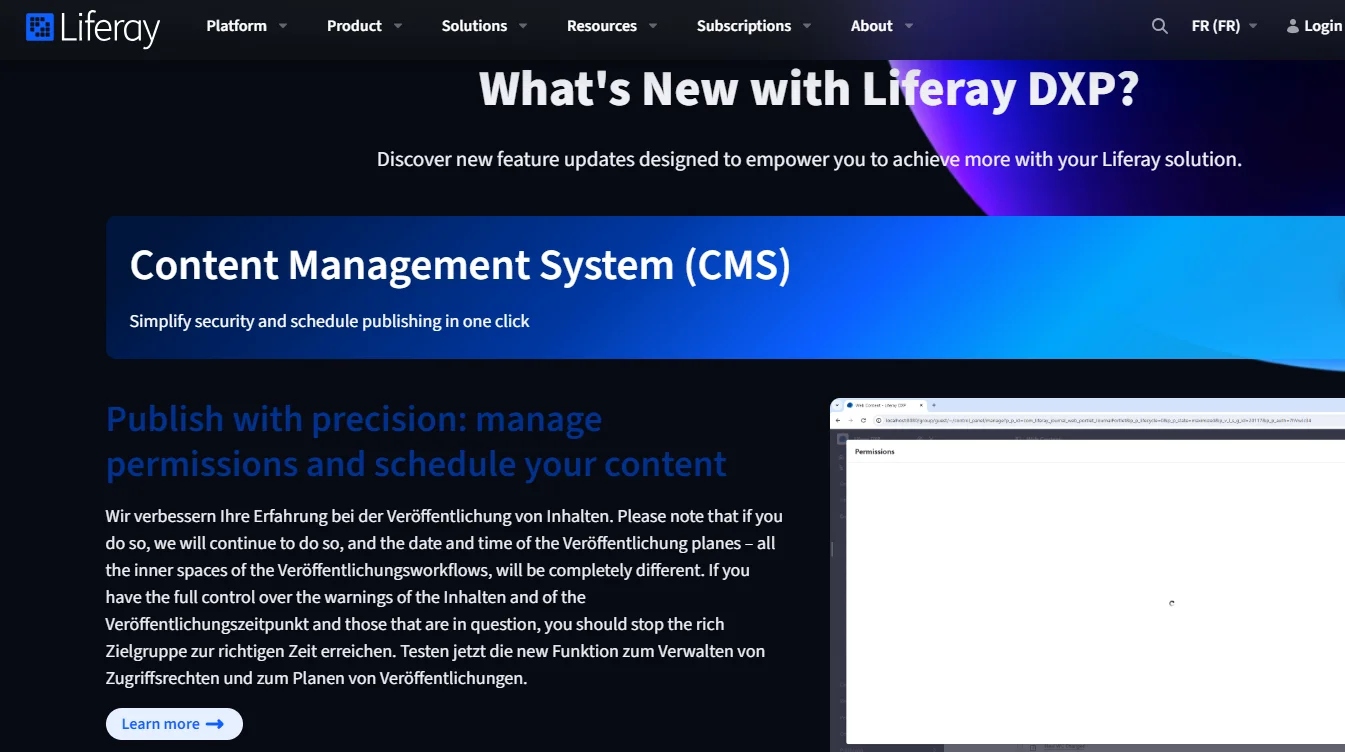
You should choose Liferay if you need an all-in-one enterprise DXP that offers unparalleled integration capabilities, robust personalization, and the flexibility to build complex, secure digital solutions that scale with your business. Its strengths become apparent when project requirements extend far beyond a standard website or CMS. Here’s a breakdown of the key reasons it’s trusted by global enterprises.
1. An All-in-One Platform
Liferay DXP integrates a wide range of capabilities—including CMS, Digital Asset Management (DAM), forms, document management, workflow automation, search, personalization, and collaboration tools—into a single, reliable platform. This reduces the need for multiple disparate technologies, simplifying your tech stack and creating synergy between different solutions. This is a core value proposition of modern software development services aimed at consolidation.
2. Native Headless & Omnichannel Capabilities
Liferay provides out-of-the-box headless APIs (supporting the OpenAPI specification), giving front-end developers the freedom to build consistent, immersive experiences across web, mobile, wearable, kiosk, and other IoT devices using the frameworks they already know, like React or Vue.
3. Powerful and Intelligent Integration
One of Liferay’s biggest advantages is its robust integration capability. It unifies existing systems and data using frameworks, APIs (SOAP, REST, GraphQL), and messaging services, making it easier to connect third-party software and legacy technologies without modifying the platform’s core. This is essential for comprehensive ecommerce web development services that need to connect to inventory and payment systems.
4. Contextualized and Personalized Experiences
Liferay allows you to leverage enhanced segmentation and AI-powered tools to define user groups and deliver dynamic, personalized experiences. You can tailor page layouts, content, messages, and product recommendations to different segments based on their behavior and demographics.
5. Low-Code Tools
The platform includes native low-code capabilities that allow business users to build applications, automate processes, and create mobile apps with minimal to no coding, streamlining the creation of reports, forms, and issue-tracking systems.
6. Enterprise-Grade Security
Liferay is a trusted vendor in security-conscious industries like government and finance. It holds certifications such as ISO 27001, SOC 2 Type 2, and HIPAA, ensuring that security and compliance are at the core of its product and operations.
Who Uses Liferay?
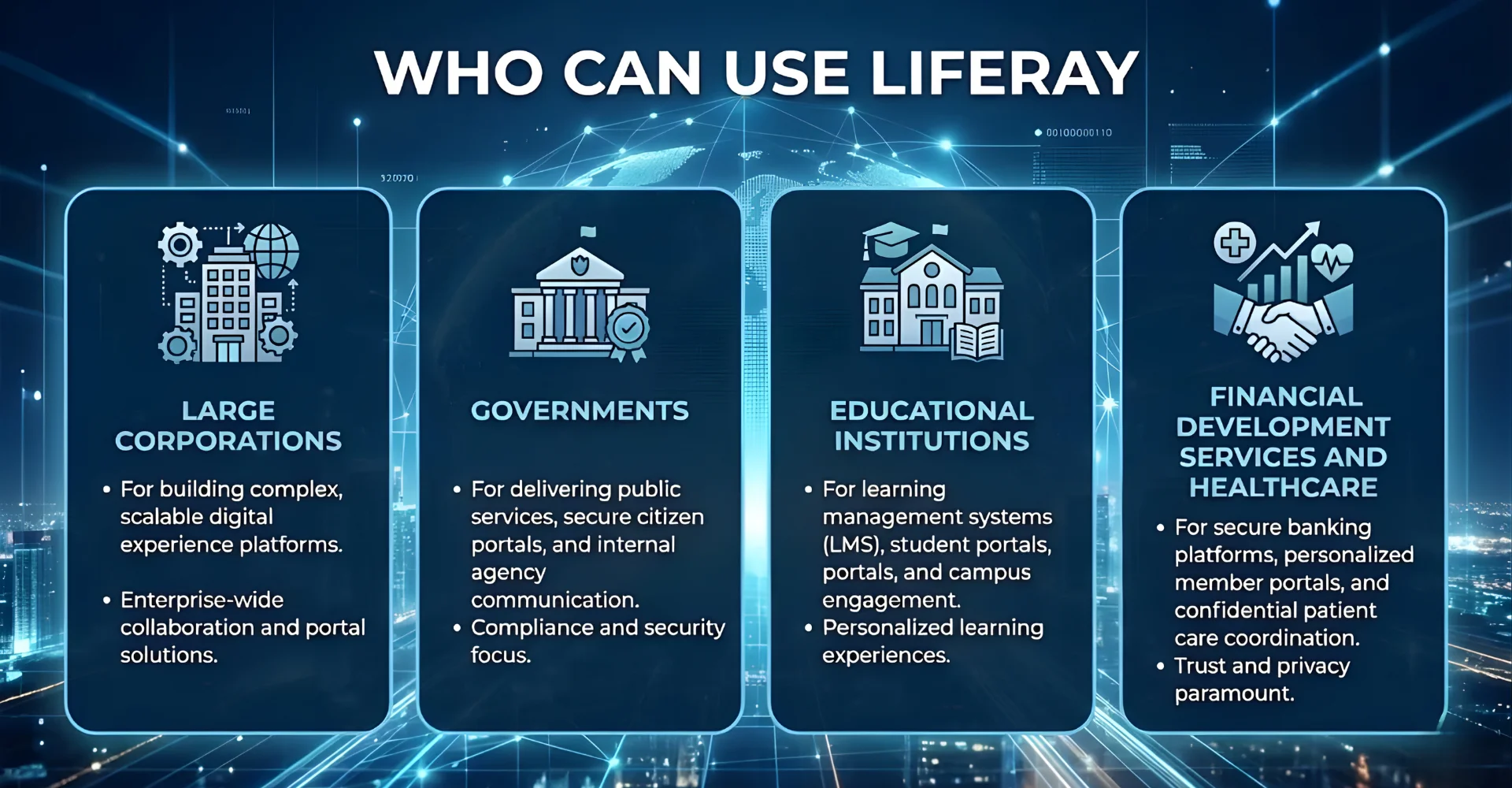
Liferay is used by large enterprises, governments, financial institutions, and educational organizations that require a secure, scalable, and highly integrable platform for their mission-critical digital experiences. Its user base consists of entities that need to compose complex digital solutions from many different parts.
- Large Corporations: Global companies like Lenovo, AT&T, and Airbus use it for customer portals, supplier extranets, and complex intranets.
- Governments: Public sector organizations trust it for secure citizen service portals due to its compliance and robust security features.
- Educational Institutions: Universities use it to build student and faculty portals that unify information from disparate systems.
- Financial Development Services and Healthcare: Highly regulated industries leverage its security and ability to build compliant onboarding and patient portals.
What is Liferay Used For?
Liferay is used for creating and managing sophisticated digital experiences that require deep integration, personalization, and complex workflows, such as enterprise portals, commerce sites, and unified intranets. It excels in environments where a standard CMS would be a bottleneck. Here are its most powerful applications:
1. Customer & Supplier Portals
Liferay is ideal for building secure, self-service portals that provide customers or suppliers with personalized access to order histories, support tickets, inventory data, and collaborative tools. Its robust integration features allow it to act as a central hub, pulling data from various backend systems like ERP and CRM into a single, cohesive user experience.
Core benefits:
- Unified Gateway: Provides a single, personalized point of access for all B2B interactions, eliminating the need to log into multiple disparate systems.
- Deep Backend Integration: Powerful tools and APIs seamlessly pull real-time data from ERP, CRM, and other legacy systems, presenting it in a cohesive user interface.
- Enhanced Efficiency & Loyalty: Reduces support calls and streamlines processes by enabling self-service for common tasks, leading to higher customer satisfaction.
Example: Putzmeister, a global construction leader, uses Liferay for self-service portals for their customers and dealers, enabling them to access critical information and services seamlessly.
2. Corporate Intranets & Digital Workplaces
Large organizations use Liferay to power their internal intranets, creating a central digital workplace that boosts employee productivity, collaboration, and access to resources. Its granular permission systems ensure the right people have access to the right information.
Core Benefit:
- Centralized Resource Hub: A single source of truth for all employee resources, documents, announcements, and communications, reducing information silos.
- Granular Permissions & Security: Ensures sensitive HR, financial, and project data is only accessible to authorized personnel through detailed role-based access control.
- Streamlined Process Automation: Built-in workflows automate internal processes like leave requests, onboarding checklists, and IT support tickets, boosting operational efficiency.
Example: Many Fortune 500 companies use Liferay to connect their employees with HR systems, project management tools, and internal communications platforms.
3. Complex Commerce Sites
Liferay’s native digital commerce capabilities enable businesses to run full-fledged B2B and B2C commerce websites on the same platform. It simplifies complex purchasing processes and allows for the seamless blending of content and commerce.
Core Benefit:
- Unified Content & Commerce: Manages marketing content and product data in a single system, ensuring a consistent and personalized buyer journey from discovery to purchase.
- Advanced Personalization: Leverages user data and segmentation to deliver tailored product recommendations, content, and pricing, dramatically increasing conversion rates.
- Complex Order Management: Natively supports sophisticated B2B requirements like bulk ordering, custom quote generation, multi-tiered approval workflows, and contract-based pricing.
Example: Companies use Liferay to manage complex catalogues, bulk ordering, and custom pricing models for their B2B clients.
4. Public Sector & Government Websites
Government entities choose Liferay for its proven security, compliance, and ability to serve citizens in multiple languages. Its commitment to accessibility standards makes it ideal for public-facing services.
Core Benefit:
- Certified Security & Compliance: Meets the strictest governmental IT standards and holds certifications like ISO 27001 and SOC 2, which are often mandatory for public sector projects.
- Built-In Accessibility: The platform is developed with WCAG guidelines in mind, ensuring digital citizen services are inclusive and available to all people, fulfilling legal requirements.
- Digital Sovereignty & Transparency: As open-source software, it avoids vendor lock-in, ensures long-term control of public data, and allows for code transparency, aligning with open government principles.
Example: Various government portals use Liferay to provide citizens with secure access to forms, information, and services .
How does Liferay work?
Liferay operates on a modular, Java-based architecture designed for maximum flexibility and integration. Understanding how Liferay works involves looking at its core components.
- Modular Architecture: At its heart, Liferay is built on OSGi, a modular system that allows developers to extend functionality without touching the core code. This ensures maintainability and easier upgrades, a principle upheld by quality software maintenance services.
- Portlets and Fragments: Portlets are small, pluggable components that provide specific functionality. Liferay Fragments are more modern, modular UI blocks (HTML+CSS+JS) that can be assembled visually, allowing for dynamic page creation without deep coding.
- Headless APIs: Liferay exposes all its content and data through a comprehensive set of headless REST APIs. This allows developers to use any front-end technology (React, Vue, Angular) to build the user interface while Liferay acts as the powerful backend.
- Client Extensions: This modern feature allows for building UI and integration code outside of Liferay and connecting it seamlessly. This means developers can use their preferred tools and frameworks and deploy updates independently of the main Liferay platform.
- Low-Code/Object Framework: Liferay Objects provide a low-code way to create custom data models and applications directly within the platform, complete with automatic REST API generation and workflow integration, speeding up development significantly.
The process is simple for editors: they work in a user-friendly backend to manage content and pages. Behind the scenes, Liferay handles the complex tasks of pulling data from integrated systems, applying personalization rules, and rendering the experience consistently across all channels.
Advantages and Disadvantages
Liferay offers unparalleled power and integration capabilities for large-scale enterprise projects, but this power comes with inherent complexity and a higher cost of entry compared to simpler platforms.
Advantages
The pros of using Liferay are what make it a leader in the enterprise DXP space.
- All-in-One Platform: Integrates CMS, DAM, commerce, and collaboration into a single solution, reducing vendor management.
- Unmatched Integration: Robust tools and APIs make it the ideal platform for unifying disparate legacy systems and data sources.
- Enterprise-Grade Security: Holds major certifications (ISO, SOC 2, HIPAA), making it trusted for highly regulated industries.
- Flexibility and Scalability: Its modular architecture and cloud options allow it to scale to meet the demands of the largest global enterprises.
- Personalization: Advanced segmentation and AI tools enable deep personalization of user experiences.
Disadvantages
The cons are typically the flip side of its powerful enterprise features.
- High Complexity: Liferay has a very steep learning curve for both developers and administrators. It is not designed for simple projects.
- Resource Intensive: Requires significant server resources and expert software development knowledge, leading to a higher total cost of ownership.
- Cost of Enterprise Edition: While the Community Edition is free, the enterprise-grade DXP version requires a subscription, and how much does Liferay cost can be significant, though it offers instance-based pricing.
- Development Overhead: Customizing and maintaining a Liferay implementation often requires a dedicated team or partnering with a specialized agency, making ongoing software maintenance services a key consideration.
Why Partner with Newwave Solutions for Your Liferay Project?
Implementing Liferay successfully requires specialized expertise that goes beyond basic coding. Its enterprise-grade complexity demands a strategic partner who can ensure your investment delivers maximum ROI. Partnering with a specialized agency like Newwave Solutions is the most effective way to de-risk your implementation, accelerate time-to-market, and leverage the platform’s full potential.
What can you expect when being our partner?:
- Expertise from Day One: Our team of certified Liferay developers brings years of experience, allowing us to navigate complex challenges in multisite configuration, third-party integration, and custom extension development efficiently.
- End-to-End Services: We provide comprehensive support, from initial strategy and custom web portal development services to ongoing software maintenance services, ensuring your platform remains secure and optimized.
- Reduced Total Cost of Ownership: We build on a solid architectural foundation from the start, preventing costly reworks and ensuring optimal performance, which lowers your long-term expenses.
- Focus on Your Business: By handling the technical complexity, we free your internal team to concentrate on core business objectives and strategy.
We are more than just developers; we are strategic partners in your digital transformation. Our certified experts deliver tailored solutions, including LMS development services and ecommerce web development services, built on Liferay’s powerful framework. We are committed to building secure, scalable digital ecosystems that drive growth and provide a clear competitive advantage.
Ready to build a large-scale, integrated digital experience on a powerful and secure foundation? Contact us today for a detailed consultation and let’s discuss your Liferay project!
To Quang Duy is the CEO of Newwave Solutions, a leading Vietnamese software company. He is recognized as a standout technology consultant. Connect with him on LinkedIn and Twitter.



Read More Guides


Get stories in your inbox twice a month.
Let’s Build Something Extraordinary
Sign up for a 30 min no-obligation strategic session with us. Transform your Ideas into scalable reality.
Leave a Reply