


Zero Knowledge Proofs Explained: How ZKPs Enable Privacy
Zero-knowledge proofs are becoming a key building block in modern digital systems where verification and privacy must coexist. They enable validation of data or actions without revealing sensitive underlying information. This is especially important in blockchain networks, financial applications, and identity systems.
This article explains what a zero knowledge proof is, how it works, why it matters for privacy and blockchain scalability, and its real-world applications.
Key Takeaways
|
What is Zero-Knowledge Proof?
A zero-knowledge proof (also known as a ZK proof or ZKP) is a protocol in which one party – the prover, convinces another party – the verifier, that a statement is true without revealing any information beyond the fact that the statement is valid.
Zero knowledge proofs were introduced in 1985 by cryptographers Shafi Goldwasser, Silvio Micali, and Charles Rackoff. Their research demonstrated that one party could prove knowledge of a secret without revealing the secret itself.
This concept created a new approach to digital verification by removing the need to expose private data. Since then, zero knowledge proofs have evolved from cryptographic theory into practical technology used in modern blockchain and privacy-focused systems.
How do Zero-Knowledge Proofs Work?
A zero-knowledge proof works by allowing a prover to demonstrate that a statement is true to a verifier without revealing the secret information behind it. The protocol uses cryptographic algorithms to evaluate the proof and return a valid or invalid result.
For the process to be reliable, a zero-knowledge protocol must meet three conditions:
- Completeness: If the statement is true and both parties follow the protocol correctly, the verifier will accept the proof.
- Soundness: If the statement is false, a dishonest prover cannot convince the verifier that it is true, except with an extremely small probability.
- Zero knowledge: The verifier learns only whether the statement is valid and receives no additional information about the underlying data.
Zero-Knowledge Proof Example
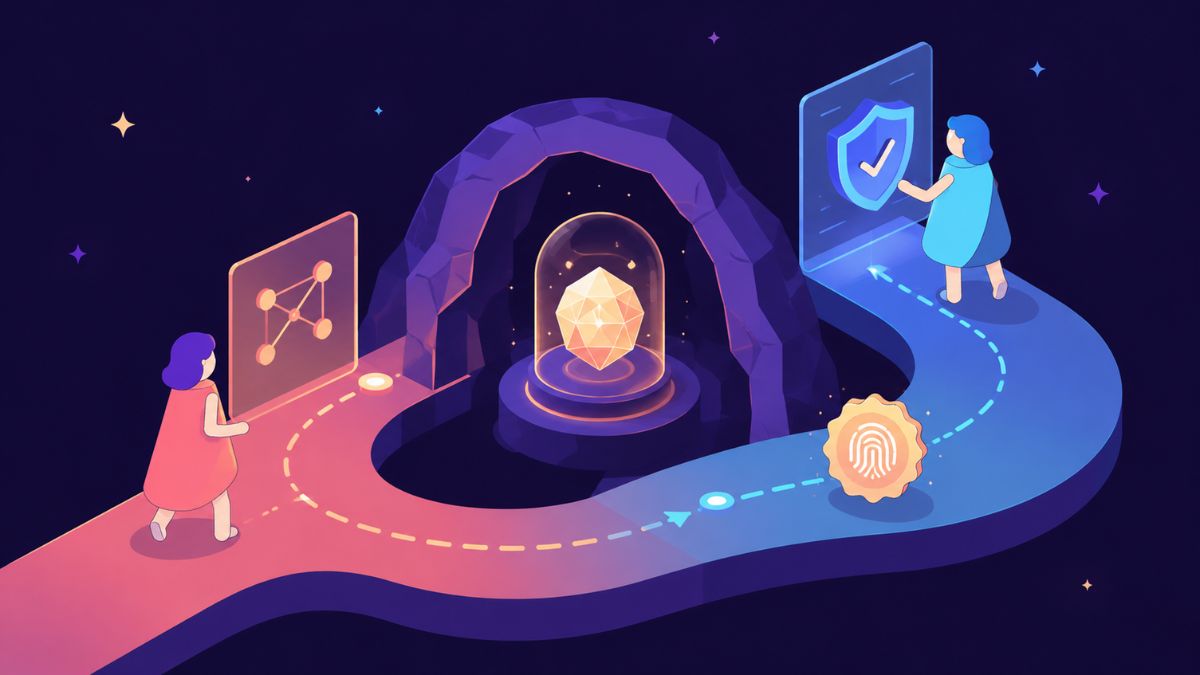
A simple way to understand zero-knowledge proofs is through the classic “cave example,” where one person proves they know secret information without revealing the secret itself. This example demonstrates the core principle behind ZKPs: proving knowledge of data while keeping the actual data private.
- The setup: Alice wants to prove to Bob that she knows the secret passphrase to open a locked door inside a cave. The cave has two paths (Path A and Path B) that connect to the same locked door, but Bob cannot see which path Alice takes.
- The goal: Alice needs to convince Bob that she knows the passphrase without directly telling him what the passphrase is. The challenge is to prove knowledge while keeping the secret information hidden.
- The test: Alice enters the cave using either Path A or Path B. Bob then randomly asks her to return using one of the two paths. If Alice does not know the passphrase, she can only succeed when Bob chooses the same path she originally took. If she knows the passphrase, she can unlock the door and return through either path.
- The result: By repeating this challenge multiple times, Bob becomes highly confident that Alice knows the passphrase without ever learning it.
Although the cave is only a conceptual example, zero-knowledge proofs apply the same logic through cryptographic circuits that take a private input, process it according to defined rules, and generate a verifiable output.
The circuit functions like the path through the cave: if the prover can repeatedly produce the correct result for different challenges, the verifier gains strong confidence that the prover possesses the required secret. Because the probability of guessing correctly decreases with each round, knowledge can be verified without revealing the private input, making this approach especially valuable for blockchain privacy, secure transactions, and data verification.
Why Are Zero Knowledge Proofs Important?
Zero knowledge proofs enhance blockchain systems by enabling secure verification of data without exposing the underlying information. This improves both user privacy and network efficiency, making blockchain applications more practical for real-world use.
Better privacy
Public blockchains are transparent, meaning transaction data can be viewed and verified by network participants. Zero knowledge proofs add a privacy layer by allowing users and businesses to validate transactions or execute smart contracts without revealing sensitive information such as identities, financial records, or proprietary business data.
This makes public blockchain networks more suitable for banks, healthcare providers, supply chain companies, and other regulated organizations. They can benefit from blockchain security and accessibility while protecting confidential data and supporting compliance with privacy requirements such as GDPR and HIPAA.
Improved blockchain scalability
Blockchain networks can become slower and more expensive as transaction volume increases because many nodes must process and verify the same data. Zero knowledge proofs reduce this burden by combining multiple transactions into a compact cryptographic proof.
Instead of checking every transaction individually, the blockchain verifies a single proof that confirms all transactions are valid. This lowers the amount of data processed and stored on-chain, helping increase transaction throughput, reduce fees, and improve network performance.
Common Types of ZKP
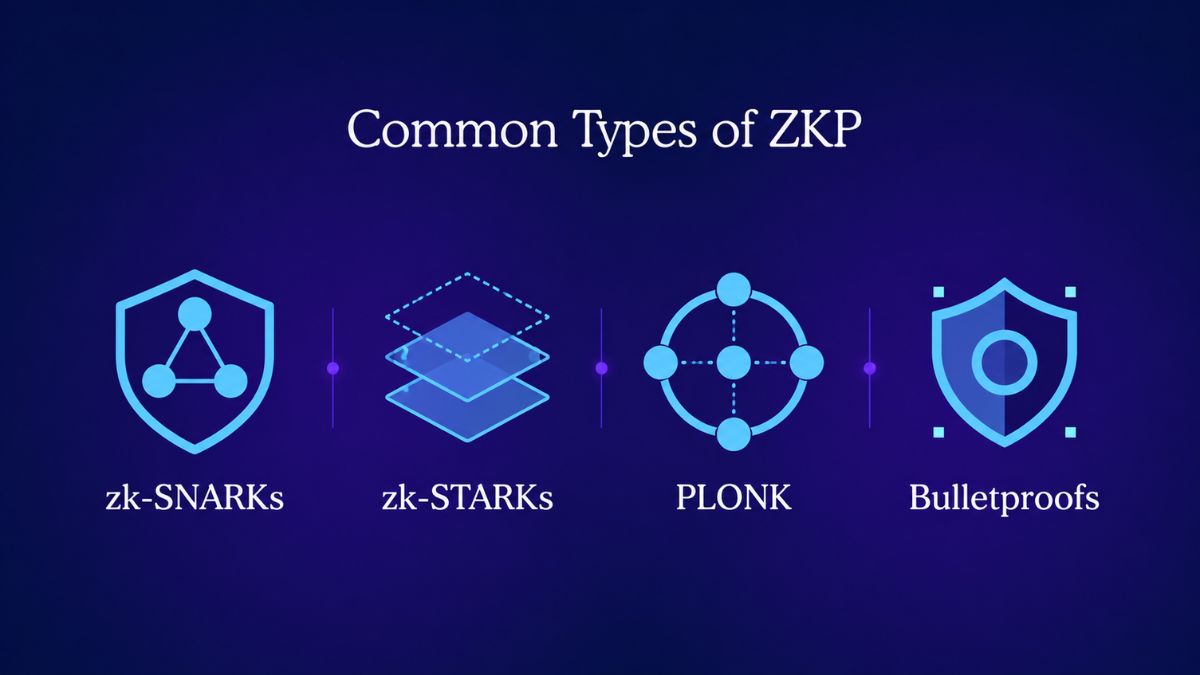
Different types of zero-knowledge proofs (ZKPs) are designed with different trade-offs in proof size, generation speed, verification efficiency, scalability, and setup requirements. The most common implementations include zk-SNARKs, zk-STARKs, PLONK, and Bulletproofs, each serving different privacy and blockchain use cases.
zk-SNARKs
zk-SNARKs (Zero-Knowledge Succinct Non-Interactive Arguments of Knowledge) are compact proofs that allow users to verify information without revealing the underlying data. They are lightweight and require minimal verification time, making them suitable for privacy-focused blockchain applications. However, many zk-SNARK implementations rely on a trusted setup process.
zk-STARKs
zk-STARKs (Zero-Knowledge Scalable Transparent Arguments of Knowledge) provide scalable and transparent zero-knowledge proofs without requiring a trusted setup. They use advanced cryptographic techniques to generate proofs that can be verified efficiently, making them suitable for large-scale blockchain applications. Compared with zk-SNARKs, zk-STARKs generally offer stronger scalability but may produce larger proof sizes.
PLONK
PLONK (Permutations over Lagrange-bases for Oecumenical Non-interactive Arguments of Knowledge) is a universal zero-knowledge proof system that uses a reusable trusted setup. Unlike some traditional ZKP methods, PLONK can support different programs and circuits without requiring a new setup for each application. This flexibility makes it attractive for developers building complex blockchain solutions.
Bulletproofs
Bulletproofs are short, non-interactive zero-knowledge proofs that do not require a trusted setup. They are commonly used for privacy-preserving cryptocurrency transactions, allowing users to prove transaction validity while hiding sensitive information. While they provide strong privacy features, they typically require more computation time compared with some newer ZKP approaches.
Zero Knowledge vs. Zero Trust: What is the Difference?
“Zero knowledge” and “zero trust” are related to security and privacy but serve different purposes. Zero knowledge refers to a cryptographic technique, specifically zero-knowledge proofs (ZKPs), that allows one party to prove the validity of information without revealing the actual data. In contrast, zero trust is a cybersecurity framework designed to protect systems by assuming that no user, device, or network connection should be automatically trusted.
The zero-trust security model treats every access request as potentially risky, whether it comes from inside or outside an organization. Users and devices must be authenticated, authorized, and continuously verified before gaining access to sensitive resources. This approach helps reduce security risks caused by unauthorized access, compromised accounts, or internal threats.
Zero-knowledge proofs can complement zero-trust architectures by improving privacy during authentication and verification processes. For example, zero-knowledge authentication allows employees to prove they have valid credentials without exposing sensitive personal information, enabling secure access while protecting user privacy.
What Are Popular Use Cases of Zero Knowledge Proofs?
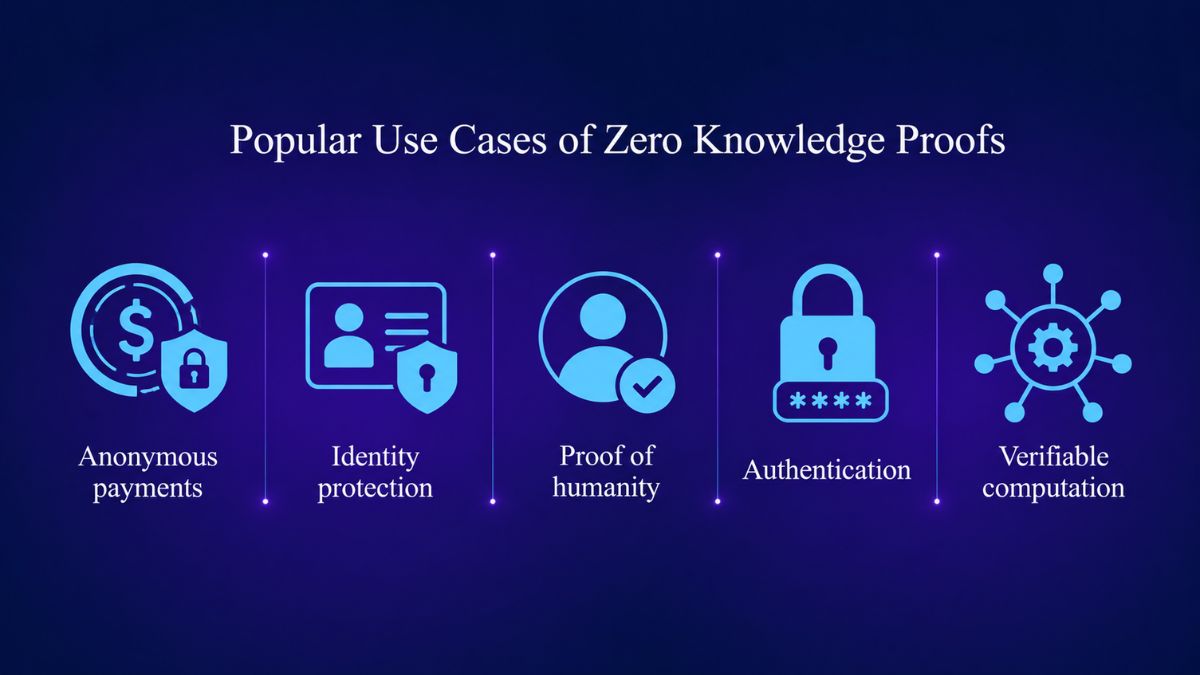
Zero-knowledge proofs (ZKPs) are transforming how blockchain systems handle privacy, security, and verification. By allowing users to prove the validity of information without revealing the underlying data, ZKPs enable a wide range of applications across finance, identity, authentication, and decentralized technologies.
Anonymous payments
Zero-knowledge proofs enable private blockchain transactions by allowing networks to verify transaction validity without revealing sensitive details such as sender, receiver, amount, or transaction history. This helps address the transparency limitations of public blockchains while preserving user privacy.
Privacy-focused cryptocurrencies such as Zcash use zero-knowledge technology to support confidential transactions. ZKPs are also being explored to introduce privacy features into public blockchain networks while balancing security, usability, and regulatory requirements.
Identity protection
Zero-knowledge proofs provide a privacy-preserving approach to digital identity management by allowing users to prove specific information without exposing unnecessary personal data. For example, users can verify their age, citizenship, or eligibility without sharing documents such as passports or identification numbers.
This technology supports decentralized identity (DID) systems, where individuals maintain control over their personal information. Real-world applications, such as Bhutan’s National Digital ID system, use ZKPs to verify identity claims while keeping sensitive data private.
Proof of humanity
Zero-knowledge proofs can help users prove they are unique individuals without revealing their personal identity. This is increasingly important in the AI era, where verifying human participation while protecting privacy has become a growing challenge.
Protocols such as World ID use zero-knowledge technology to confirm that a user is a verified human without exposing biometric information or personal details. This enables privacy-preserving access to services such as online platforms, voting systems, and digital communities.
Authentication
Zero-knowledge proofs improve authentication by allowing users to prove they have valid credentials without revealing passwords or sensitive personal information. Instead of storing large amounts of user data, platforms can verify access rights through cryptographic proofs.
This approach enhances both security and user experience by reducing risks from data breaches, password theft, and unauthorized access. ZKP-based authentication can be applied to financial services, enterprise systems, and Web3 applications.
Verifiable computation
Zero-knowledge proofs enable verifiable computation, allowing users to outsource complex calculations while still confirming that the results are accurate. The external party performs the computation and provides a proof that the process was executed correctly.
This capability is valuable for blockchain scalability, where heavy computations can be processed off-chain while maintaining trust and security. ZK-based solutions support applications such as Layer 2 scaling, decentralized computing, and privacy-preserving data processing.
Challenges and Limitations of Zero-knowledge Proofs
While zero-knowledge proofs offer powerful privacy and security benefits, their adoption still faces several technical and practical challenges. Factors such as computational requirements, implementation costs, trust assumptions, and future security risks can affect the scalability and accessibility of ZKP-based solutions.
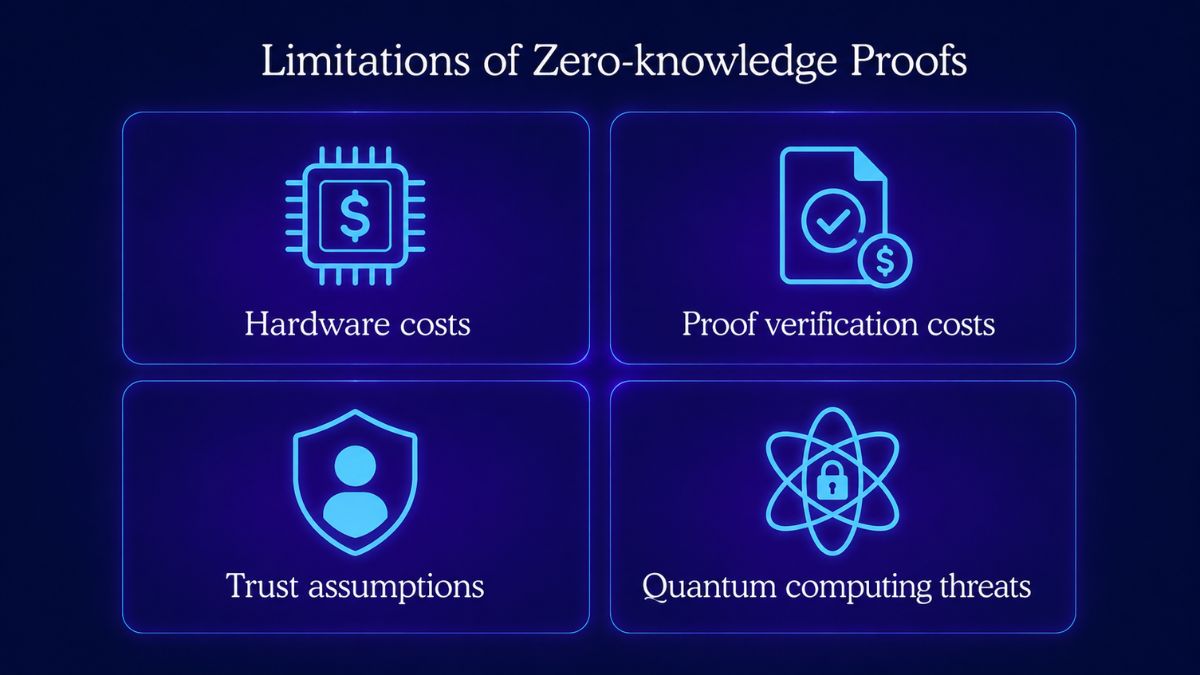
Hardware costs
Generating zero-knowledge proofs requires complex cryptographic computations that often rely on specialized hardware. These machines can be expensive, creating barriers for individuals and increasing infrastructure costs for applications implementing ZKP technology.
Proof verification costs
Although verifying zero-knowledge proofs is more efficient than revealing and processing full datasets, it still requires significant computational resources. For blockchain applications such as ZK-rollups, proof verification can consume substantial network fees, affecting scalability and user costs.
Trust assumptions
Some zero-knowledge proof systems, particularly zk-SNARKs, require a trusted setup process to generate public parameters. If participants in this setup are compromised or act dishonestly, the security of the system may be affected. Newer approaches, such as zk-STARKs, reduce this risk by removing the need for trusted assumptions.
Quantum computing threats
Certain ZKP systems, including zk-SNARKs, rely on cryptographic techniques that could potentially be vulnerable to future quantum computing advancements. While zk-STARKs provide stronger resistance by relying on hash-based cryptography, ongoing research continues to improve the long-term security of zero-knowledge technologies.
The Future of Zero-knowledge Proofs
The future of zero knowledge proofs will be shaped by improvements in performance, easier development tools, stronger regulatory demand, and wider adoption across digital systems. As the technology matures, ZKPs are expected to become a key component of secure, private, and scalable infrastructure.
More efficient and scalable ZKP algorithms
Ongoing advances in cryptography will make zero knowledge proofs faster, smaller, and less computationally expensive. These improvements will support higher transaction volumes and make ZKP-based systems more practical for blockchain networks, enterprise platforms, and applications that require real-time verification.
Integration with emerging technologies
Zero knowledge proofs will increasingly be combined with blockchain, artificial intelligence, and cloud computing. These integrations can enable secure data processing, privacy-preserving AI models, confidential cloud services, and scalable decentralized applications without exposing sensitive information.
Growing regulatory adoption
Stricter privacy and financial regulations will encourage organizations to use cryptographic verification methods. ZKPs can help businesses prove regulatory compliance, eligibility, or adherence to specific rules without revealing confidential customer, financial, or operational data.
Expansion across regulated industries
Adoption is expected to grow across banking, healthcare, government, and other data-sensitive industries. These sectors can use zero knowledge proofs to verify identities, transactions, records, and regulatory requirements while maintaining confidentiality.
FAQs
1. What is an example of zero-knowledge proof?
A common example is proving that you are old enough to access a service without revealing your exact birth date. The system verifies that the age requirement is met while keeping the underlying personal information private.
2. Is zero-knowledge proof legit?
Yes, zero-knowledge proof is a legitimate cryptographic technology supported by decades of academic research and practical development. It is now used in blockchain networks, identity verification, privacy systems, and secure data-sharing applications.
3. Which crypto uses zero-knowledge proof?
Zcash is one of the best-known cryptocurrencies using zero-knowledge proofs to enable private transactions. ZKP technology is also used by blockchain networks and scaling solutions such as Polygon zkEVM and Starknet.
4. What are the disadvantages of using ZKP?
Zero-knowledge proofs can require significant computing resources and specialized cryptographic expertise to develop and implement. Some systems may also involve complex setup procedures, longer proof-generation times, and security risks if the underlying code or protocol is poorly designed.
5. Does Ethereum use zero-knowledge proofs?
Yes, the Ethereum ecosystem uses zero-knowledge proofs primarily through Layer 2 solutions known as ZK-rollups. These systems process transactions outside Ethereum Mainnet and submit compact proofs on-chain, helping improve scalability and reduce transaction costs.
Conclusion
Zero knowledge proofs are becoming a core building block for privacy-focused and scalable digital systems. They enable data verification without revealing sensitive information, allowing ZKPs to support secure authentication, private transactions, decentralized identity, and more efficient blockchain networks.
To apply these capabilities effectively, businesses need the right blockchain architecture and implementation expertise. Newwave Solutions delivers end-to-end blockchain services, including dApps, smart contracts, DeFi platforms, crypto wallets, and solutions integrated with zero knowledge proof technology.
Contact us to explore how ZKPs can strengthen privacy, scalability, and trust in your platform.
To Quang Duy is the CEO of Newwave Solutions, a leading Vietnamese software company. He is recognized as a standout technology consultant. Connect with him on LinkedIn and Twitter.



Read More Guides
Get stories in your inbox twice a month.
Let’s Build Something Extraordinary
Sign up for a 30 min no-obligation strategic session with us. Transform your Ideas into scalable reality.
Leave a Reply