


Chainlink vs Pyth: A Comparative Guide Between Two Oracle Kings
In decentralized systems, smart contracts are only as reliable as the data they consume. This is where blockchain oracles play a critical role. Among all oracle solutions, two names dominate current discussions: Chainlink vs Pyth Network. At first glance, Chainlink vs Pyth looks like a battle between two competing oracle protocols. In reality, they represent two fundamentally different philosophies about how external data should enter blockchain systems. One prioritizes decentralized aggregation and composability. The other prioritizes speed, precision, and institutional-grade market data. Understanding these differences is essential for teams building modern blockchain technology, especially when designing financial, trading, or consumer-scale applications.
Chainlink – The DeFi-Native Oracle
Chainlink is the most widely adopted decentralized oracle network in the blockchain ecosystem. Founded in 2017 by Sergey Nazarov and Steve Ellis, Chainlink was created to solve a core limitation of early smart contracts: their inability to securely access off-chain data.
The Chainlink Network acts as a middleware layer between blockchains and real-world data sources. Instead of relying on a single data provider, Chainlink aggregates information from multiple independent oracle nodes, creating a decentralized and fault-tolerant data pipeline. This approach made Chainlink the default oracle standard for Ethereum and EVM-compatible chains, especially across DeFi.
Pros
Chainlink’s core strength lies in its ability to deliver trust-minimized data to smart contracts at scale. Rather than optimizing for raw speed, Chainlink prioritizes reliability, decentralization, and composability. This design choice makes it particularly suitable for financial protocols where incorrect data can lead to systemic loss.
By aggregating data from multiple independent oracle nodes and applying consensus mechanisms, Chainlink reduces the risk of manipulation, single points of failure, and data outages. Over time, this approach has earned Chainlink a reputation as the most battle-tested oracle infrastructure in decentralized finance.
From a practical implementation standpoint, Chainlink offers:
- Highly decentralized data aggregation through independent node operators, reducing reliance on any single data provider
- A proven security model that has been tested across multiple market cycles and extreme volatility events
- Broad multi-chain support, including Ethereum, Layer 2 networks, and the wider EVM ecosystem
- A diversified oracle product suite beyond price feeds, including randomness, automation, and cross-chain messaging
- Mature developer tooling, documentation, and ecosystem integrations that reduce integration risk
Cons
Chainlink’s emphasis on decentralization and security introduces tradeoffs that may not suit every application type. Its architecture is intentionally conservative, which can limit performance in scenarios where ultra-low latency is a hard requirement.
These limitations become more apparent in applications that operate closer to real-time trading or market-making environments.
Key constraints include:
- Slower price update frequency compared to high-performance oracle models optimized for millisecond execution
- Data update costs that must be paid by DApps, with fees influenced by Layer 1 gas conditions
- Latency that may be insufficient for high-frequency trading or perpetual derivatives platforms
- Dependence on third-party APIs as primary data inputs, introducing indirect trust assumptions
- More complex integration patterns for applications requiring continuous data streams rather than periodic updates
Use Cases
Chainlink is best suited for applications where data correctness and resilience matter more than speed. Its architecture aligns with protocols that secure large pools of capital and cannot tolerate frequent or aggressive oracle updates.
In production environments, Chainlink is commonly used for:
- Lending and borrowing protocols that require highly reliable price references for collateral management
- Stablecoins and collateralized assets where safety and predictability outweigh execution speed
- Randomness generation for gaming mechanics and NFT minting workflows
- Automation of smart contract execution based on predefined conditions
- Cross-chain messaging and interoperability between different blockchain environments
Chainlink’s roadmap extends far beyond price oracles. With initiatives such as Cross-Chain Interoperability Protocol (CCIP), enhanced staking and slashing mechanisms, and expanded data services, Chainlink is positioning itself as a universal data and messaging layer for decentralized systems. Its long-term potential lies in becoming foundational infrastructure for trust-minimized applications across multiple blockchains.
Pyth – The Institution-Native Oracle
Pyth Network approaches oracle design from a fundamentally different angle. Launched in 2021 with early backing from Jump Trading and other institutional partners, Pyth was built to deliver high-fidelity financial data with minimal latency.
Rather than aggregating prices from public APIs, Pyth sources first-party data directly from trading firms, exchanges, and market makers. These participants publish live market prices on-chain, creating a continuous data feed that mirrors professional trading environments.
Pros
Pyth’s architecture is optimized for performance, precision, and economic incentives rather than maximal decentralization. This makes it especially effective in markets where outdated or imprecise prices can be exploited within seconds.
Its primary advantages include:
- Extremely fast price updates with sub-second latency, suitable for real-time trading logic
- First-party data sourced directly from active market participants, reducing abstraction layers
- Minimal integration cost for DApps consuming price feeds, as updates are subsidized at the network level
- Strong adoption across high-performance chains optimized for throughput and low fees
- A natural fit for derivatives, perpetual futures, and order-book-based trading systems
Cons
Pyth’s specialization also narrows its scope. While it excels in financial data delivery, it is not designed to serve as a general-purpose oracle framework.
Notable limitations include:
- A narrow focus on market price data, with limited support for non-financial data types
- Lack of broader oracle services such as randomness or automation
- A more centralized data source layer due to reliance on institutional publishers
- A smaller overall ecosystem compared to long-established oracle networks
- Limited applicability for non-financial or consumer-focused decentralized applications
Use Cases
Pyth is purpose-built for environments where speed and precision directly affect protocol safety and profitability. It is especially relevant in applications exposed to arbitrage and liquidation risks.
Typical production use cases include:
- Perpetual futures and derivatives exchanges requiring real-time price feeds
- High-frequency decentralized trading platforms competing with centralized exchanges
- On-chain order books that depend on continuous price updates
- Margin and liquidation systems where delayed prices create systemic risk
- Financial applications where stale oracle data can be economically exploited
As decentralized finance increasingly converges with traditional financial markets, demand for institutional-grade, low-latency data continues to rise. Pyth’s ongoing expansion across multiple chains positions it as a critical infrastructure layer for next-generation financial DApps, particularly those aiming to deliver professional trading experiences on-chain.
Chainlink vs Pyth Network: Which Is the Core Difference?
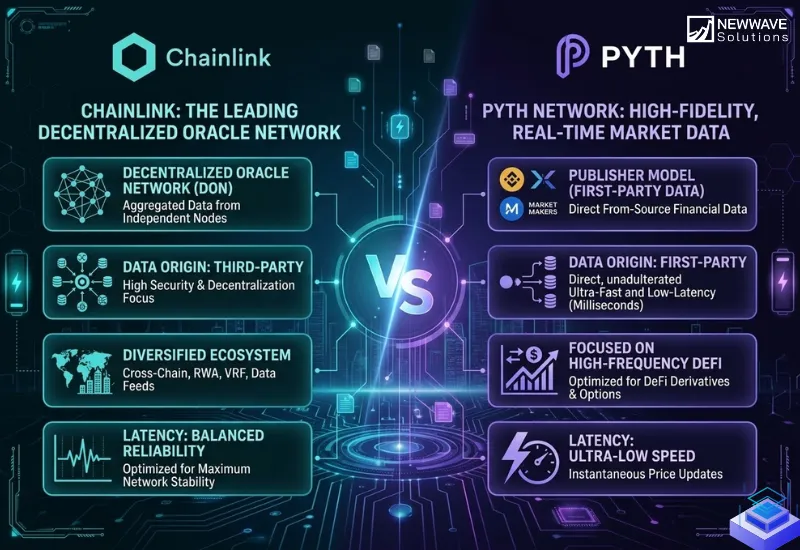
At a fundamental level, the difference between Chainlink and Pyth Network is not about which oracle is “more advanced”, but where trust is placed and how risk is managed. Both aim to deliver accurate off-chain data on-chain, yet they approach this goal from two almost opposite design philosophies.
Chainlink distributes trust across a decentralized network of independent oracle operators. Pyth concentrates trust in the economic incentives and reputational risk of institutional data providers. This distinction shapes everything from performance and cost to ecosystem alignment.
Core Differences Table
| Aspect | Chainlink | Pyth Network |
| Data source | Third-party APIs via independent nodes | First-party institutional publishers |
| Update model | Pull-based, on-demand | Push-based, continuous |
| Latency | Seconds to minutes | Milliseconds |
| Cost model | Paid by DApps | Subsidized by the network |
| Best for | General DeFi and infrastructure | High-speed trading and derivatives |
Data Source Philosophy
Chainlink is built on the principle that no single data source should be trusted by default. Instead, it aggregates information from multiple independent oracle nodes, each sourcing data from different APIs. By comparing and consolidating these inputs, Chainlink minimizes the impact of faulty, delayed, or manipulated data from any single source.
Pyth Network takes a different stance. It assumes that the most accurate prices come directly from the entities that actively trade the assets. These first-party publishers, such as market makers and exchanges, provide data they already rely on for their own operations. Trust is enforced economically: inaccurate data harms the publisher’s financial position and reputation.
In short:
- Chainlink reduces risk through redundancy and decentralization
- Pyth reduces risk through economic alignment and data provenance
Update and Performance Model
Chainlink operates on a pull-based update model. Price feeds are updated when predefined thresholds are met or when a DApp explicitly requests new data. This approach balances cost efficiency with sufficient freshness for most financial applications, such as lending or collateral valuation.
Pyth uses a push-based model, continuously publishing price updates on-chain. Prices change as the market changes, creating a near real-time data stream. This model is essential for applications where even small delays can be exploited, such as perpetual futures or high-frequency trading.
As a result:
- Chainlink prioritizes stability and predictable updates
- Pyth prioritizes speed and real-time responsiveness
Security and Incentives
Chainlink secures data accuracy through a combination of staking, reputation, and decentralization. Oracle nodes stake LINK tokens and build long-term reputational value by consistently providing accurate data. Misbehavior can result in slashing and loss of future business.
Pyth enforces accuracy primarily through direct economic penalties. Data publishers stake PYTH tokens, and incorrect or misleading data can lead to slashing. Because publishers are often active traders, incorrect prices can also expose them to immediate market losses, reinforcing honest behavior.
This leads to two distinct security models:
- Chainlink emphasizes distributed trust and historical reliability
- Pyth emphasizes economic accountability and real-time correctness
Ecosystem Alignment
Chainlink is deeply embedded across Ethereum, Layer 2 networks, and the broader EVM ecosystem. It has become the default oracle choice for many foundational DeFi protocols, particularly those managing large amounts of locked value where security and composability are critical.
Pyth is tightly aligned with Solana and other high-performance chains. Its architecture fits environments optimized for throughput and low latency, making it the preferred oracle for trading-focused protocols that aim to compete with centralized exchanges.
In practice:
- Chainlink dominates general-purpose DeFi infrastructure
- Pyth dominates performance-critical trading environments
How to Choose Which One?
Choose Chainlink if your application values decentralization, composability, and support for diverse data types beyond price feeds. It is better suited for protocols where correctness and resilience outweigh execution speed.
Choose Pyth Network if your application depends on real-time financial data with minimal latency. It is the stronger choice for derivatives, perpetual trading, and systems where stale prices introduce immediate economic risk.
This decision often frames comparisons such as pyth vs chainlink, pyth network vs chainlink, and chainlink vs pyth network. In practice, the right choice depends less on which oracle is “better” and more on which risk model aligns with your application’s design and user expectations.
It’s Not “Or”, It’s “And”
In mature decentralized finance architectures, Chainlink and Pyth are rarely treated as mutually exclusive options. Instead, they are often deployed together, each serving a distinct role within the same protocol stack. This layered oracle strategy reflects a growing understanding that different components of a DeFi system carry different risk profiles.
Chainlink is typically used where price accuracy, decentralization, and resistance to manipulation are paramount. These include lending protocols, stablecoins, and governance mechanisms where incorrect pricing can cause systemic damage but where millisecond-level latency is not essential.
Pyth, by contrast, is commonly used in execution-critical paths such as trading engines and liquidation logic. In these contexts, stale prices can be exploited within seconds, making ultra-low latency a necessity rather than an optimization.
This approach mirrors traditional financial systems, which often combine multiple data vendors depending on the function. Just as Bitcoin and Ethereum play different foundational roles in the broader ecosystem, oracle diversity increases resilience. Performance-sensitive components benefit from Pyth’s real-time data streams, while security-sensitive components rely on Chainlink’s decentralized aggregation.
Designing an Oracle Strategy – Practical Risk Considerations
Choosing an oracle is not simply an implementation detail. It is a core risk management decision that directly affects protocol safety, user trust, and long-term sustainability. Oracle failures have historically been a root cause of cascading losses in decentralized systems.
A well-designed oracle strategy aligns data freshness, trust assumptions, and economic incentives with the specific function being served.
Key considerations include:
- Match oracle latency to the actual risk tolerance of each application component rather than defaulting to the fastest option
- Avoid relying on a single oracle provider for all critical functions, especially in capital-intensive protocols
- Separate pricing logic used for execution, settlement, and governance to reduce systemic coupling
- Continuously monitor oracle behavior during periods of extreme volatility and low liquidity
- Design fallback and circuit-breaker mechanisms to handle oracle outages or abnormal price movements
Protocols that treat oracle selection as a first-class design decision tend to be more robust under real-world market stress.
FAQs
Is Pyth Network Better Than Chainlink?
Whether Is Pyth network better than Chainlink depends entirely on the application context. Pyth is better suited for use cases that require real-time financial data with minimal latency, such as derivatives trading and liquidation engines. Chainlink is better suited for applications that prioritize decentralization, composability, and long-term reliability across diverse data types.
Neither oracle is universally superior. Each is optimized for a different risk and performance profile.
Is Python Better Than Chainlink?
This question often arises from misunderstandings. Is Python better than Chainlink? compares two unrelated concepts. Python is a general-purpose programming language, while Chainlink is a decentralized oracle network. Pyth Network is not connected to Python as a blockchain programming language, despite the similarity in name.
In practice, developers may use Python off-chain for data processing, but oracle selection is a separate architectural decision.
Who Is Chainlink’s Biggest Competitor?
Chainlink’s biggest competitor depends on the specific oracle function being evaluated. In the domain of high-frequency and low-latency market data, Pyth is a leading challenger. In broader oracle services such as randomness, automation, and cross-chain messaging, Chainlink currently has fewer direct competitors, though new cross-chain oracle solutions continue to emerge.
Rather than a single rival, Chainlink faces competition across specialized verticals as the oracle landscape becomes more segmented and application-driven.
Wrap Up
The comparison between Chainlink and Pyth highlights a broader trend in blockchain infrastructure: specialization. No single oracle can optimally serve every application.
Chainlink offers a decentralized, battle-tested oracle framework trusted across DeFi. Pyth delivers institutional-grade market data at speeds previously unavailable on-chain. Together, they enable applications that rival centralized systems in both trust and performance.
At Newwave Solutions, we help teams design oracle strategies as part of broader dApp development solutions. Our work spans smart contracts, protocol architecture, token creation, and even fully self-hosted blockchain networks at the foundational layer. We build across ecosystems using the right blockchain programming language for each use case, and support product teams launching trading platforms, financial protocols, and NFT development services.
With delivery teams based in Vietnam and experience across global markets, Newwave Solutions helps organizations navigate complex choices like oracle architecture, chain selection, and system scalability with confidence.
If you’re evaluating how oracle design fits into your product roadmap, our team can help translate technical tradeoffs into systems that perform reliably in real-world conditions.
To Quang Duy is the CEO of Newwave Solutions, a leading Vietnamese software company. He is recognized as a standout technology consultant. Connect with him on LinkedIn and Twitter.



Read More Guides

Get stories in your inbox twice a month.
Let’s Build Something Extraordinary
Sign up for a 30 min no-obligation strategic session with us. Transform your Ideas into scalable reality.
Leave a Reply