


VB6 vs VB.NET: What’s the Difference and Which One Is Better?

The comparison between VB6 and VB.NET remains relevant as many enterprises continue to maintain long-running systems built on VB6 while working within increasingly modern IT environments. Understanding the differences between the two platforms helps organizations evaluate how they differ in architecture, scalability, maintainability, and integration capability. This article provides a clear VB6 vs VB.NET comparison to highlight the strengths, limitations, and practical role of each technology in enterprise systems.
What Are VB6 and VB.NET?
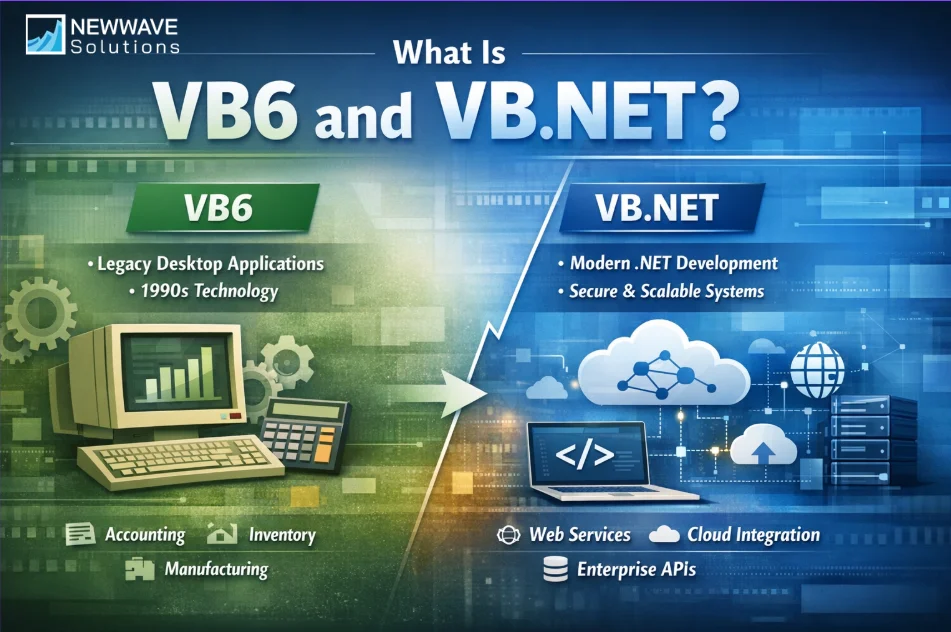
VB6 is a legacy programming language developed by Microsoft in the late 1990s, mainly for rapid Windows desktop application development. Even today, some enterprises still use VB6 to maintain long-running internal systems such as accounting, inventory, and manufacturing applications that have supported stable operations for years.
Example: SiS, an Austrian IT services provider, operates a 950,000-line VB6-based ERP system across 33 applications supporting core business processes worldwide, according to an InfoQ case study.
VB.NET, by contrast, is a modern programming language built on the .NET platform. It was introduced as the successor to VB6, but it uses a fundamentally different architecture. Enterprises often use VB.NET for systems that require stronger security, better scalability, easier maintenance, and integration with modern technologies such as web services, cloud environments, and enterprise APIs.
VB6 vs VB.NET: Core Differences
Before moving into a more detailed comparison, the table below provides a quick overview of the main differences between VB6 and VB.NET in modern enterprise environments.
| Aspect | VB6 | VB.NET |
|---|---|---|
| Security and Stability | No regular security support | Regular Microsoft security updates |
| Performance and Scalability | Limited by its legacy runtime model | Runs on the optimized .NET managed runtime |
| Maintainability and Code Quality | Primarily procedural and often tightly coupled | Full object-oriented architecture |
| Integration and Modernization | Limited support for modern APIs and web technologies | Stronger support for APIs, web technologies, and cloud integration |
| Developer Ecosystem | Shrinking talent pool | Large and active .NET developer community |
| Platform Compatibility | Best suited to legacy Windows environments | Better suited to modern Windows and 64-bit environments |
| Future Readiness | Limited long-term viability | Better aligned with long-term enterprise modernization |
1. Security and Stability
VB6 relies on a legacy runtime that no longer receives regular security or platform updates from Microsoft. As a result, systems built on VB6 may face growing security and stability risks, especially when operating in modern Windows environments.
VB.NET benefits from ongoing Microsoft support, including regular security updates and a managed runtime that improves error handling and overall system stability. This makes VB.NET a more secure and reliable option for enterprise environments, particularly those handling sensitive data.
>>>Verdict: VB.NET is the clear choice due to ongoing security support and higher operational stability.
2. Performance and Scalability
VB6 applications were originally built for older hardware environments and often face limitations when scaling in modern systems. Options for performance tuning are also relatively limited, especially as applications become more complex or need to support higher user loads.
VB.NET uses the .NET runtime to manage memory more efficiently and make better use of modern hardware capabilities. As a result, it is better positioned to deliver stronger performance and improved scalability for enterprise workloads.
>>>Verdict: VB.NET has a clear advantage in this area, offering better performance and scalability for modern enterprise applications.
3. Maintainability and Code Quality
VB6 is primarily based on procedural programming and offers limited support for modern design patterns. This often results in tightly coupled codebases that are harder to maintain over time. As systems grow, the structure can lead to higher technical debt and greater maintenance effort.
VB.NET supports full object-oriented programming, which allows for cleaner code organization, better reuse, and easier refactoring. As a result, long-term maintenance becomes more structured, predictable, and cost-effective.
>>>Verdict: VB.NET offers a stronger foundation for building maintainable, higher-quality code.
4. Integration and Modernization
VB6 offers limited built-in support for integrating with modern APIs, web services, and cloud platforms. Adding these capabilities often requires custom workarounds, which can increase both complexity and risk.
VB.NET is designed for easier integration with REST APIs, web services, databases, and cloud infrastructure. This allows enterprises to modernize more gradually without requiring full system replacement.
>>>Verdict: VB.NET has a clear advantage when integration and modernization are priorities.
5. Developer Ecosystem
VB6 depends on a shrinking pool of developers with legacy expertise, making hiring and long-term support more difficult over time. Documentation and community resources are also relatively limited.
VB.NET benefits from the broader .NET ecosystem, which provides extensive documentation, active community support, and a broader talent pool. This helps reduce long-term dependency risk for enterprises.
>>>Verdict: VB.NET offers a broader and more sustainable developer ecosystem.
6. Platform Compatibility
VB6 applications often face compatibility limitations in modern Windows versions and 64-bit environments. These limitations increase operational risk as infrastructure evolves.
VB.NET is better suited to modern Windows systems and supports 64-bit architectures more effectively. This makes it easier to operate and maintain applications as infrastructure standards continue to advance.
>>>Verdict: VB.NET is better aligned with modern platform requirements.
7. Future Readiness
VB6 is officially end-of-life and does not align well with modern software development strategies. Continued reliance on VB6 can limit an organization’s ability to adopt new technologies and respond to evolving business needs.
VB.NET is actively maintained and better aligned with future enterprise requirements, including cloud adoption, service-based architectures, and ongoing modernization efforts. This makes it better suited to long-term modernization planning.
>>>Verdict: VB.NET is the more future-ready option for enterprises planning long-term growth.
For most modern enterprise requirements, VB.NET is the stronger platform. It offers better maintainability, broader integration capabilities, stronger compatibility with modern environments, and a more sustainable path for long-term development.
However, that does not mean every VB6 system should be replaced immediately. If a legacy application remains stable, operates in an isolated environment, and faces minimal change pressure, organizations may choose to retain VB6 temporarily while planning modernization in stages.
Should You Keep VB6 or Upgrade to VB.NET?
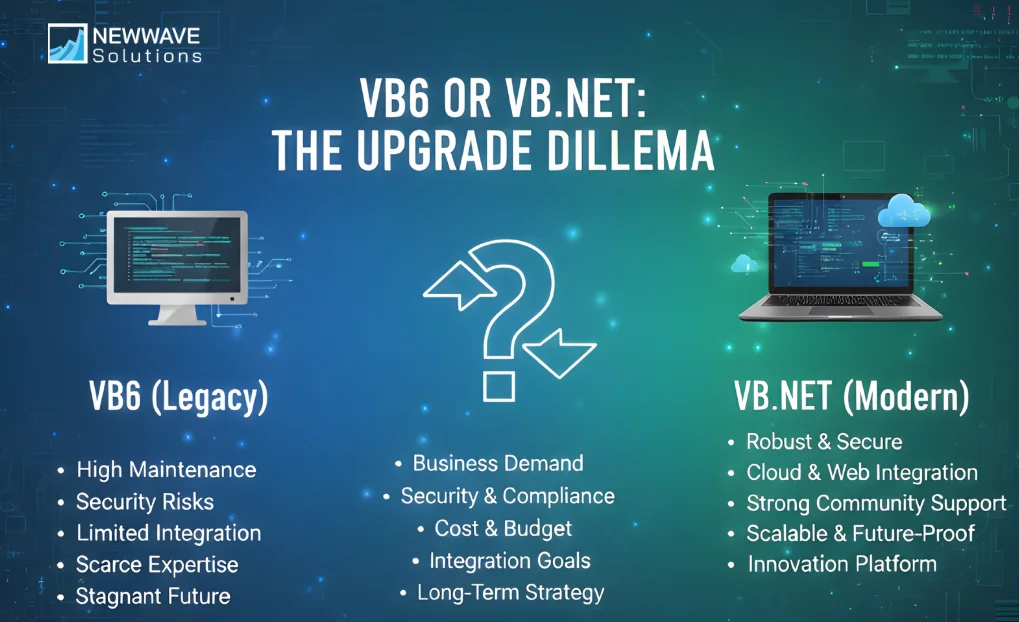
The right decision depends on the role the system plays in your business.
Keeping VB6 may still be reasonable if the application is stable, isolated, and requires only limited maintenance. This is more common in internal applications that face minimal change requests, limited compliance pressure, and low integration demand.
Upgrading to VB.NET becomes the stronger option when the application is business-critical, requires ongoing enhancement, must integrate with modern platforms, or creates growing maintenance and staffing risk. Although migration requires upfront investment, it often provides a more sustainable foundation for long-term operations and modernization.
A practical decision should take into account business reliance, security expectations, available technical resources, and the long-term role of the system in the organization’s technology roadmap.
How to Migrate from VB6 to VB.NET More Effectively?
Once an organization decides that VB.NET is the better long-term direction, the next challenge is not only conversion itself, but how well the migration is executed. Migrating from VB6 to VB.NET often involves undocumented business logic, legacy dependencies, compile-time issues, and the need for careful validation throughout the process.
This is why many enterprises look beyond basic conversion utilities and evaluate migration approaches based on accuracy, control, security, and post-conversion stabilization effort.
For organizations that decide to modernize, CodeShift VB is designed to make the migration process more controlled and practical for enterprise environments. It combines structured conversion logic, AI-assisted error handling, and offline deployment support to help teams reduce manual effort while maintaining greater visibility throughout modernization.
Key benefits include:
- Support for complex legacy code conversion
- Assistance with compile-error stabilization
- Stronger source-code security through offline deployment
- Documentation support for better post-migration maintainability
This makes CodeShift VB particularly relevant for enterprises that need more than a basic code conversion tool. If your team is planning a VB6 to VB.NET migration and needs a more controlled approach, explore how CodeShift VB supports secure, enterprise-ready modernization.
Conclusion
A side-by-side comparison of VB6 and VB.NET shows that, while VB6 may still remain workable in some legacy environments, VB.NET is better aligned with the security, scalability, maintainability, and integration needs of modern enterprises. For that reason, organizations should evaluate their current system condition, internal resources, long-term cost considerations, and strategic direction before deciding whether to retain VB6 or move toward VB.NET.
If modernization is the next step, the migration approach matters just as much as the decision itself. For organizations looking for a more structured path forward, CodeShift VB can be considered as part of a more controlled VB6 to VB.NET modernization strategy.
To Quang Duy is the CEO of Newwave Solutions, a leading Vietnamese software company. He is recognized as a standout technology consultant. Connect with him on LinkedIn and Twitter.



Read More Guides


Get stories in your inbox twice a month.
Let’s Build Something Extraordinary
Sign up for a 30 min no-obligation strategic session with us. Transform your Ideas into scalable reality.
Leave a Reply