


Unlocking the Key Advantages of VB.NET Today

Many enterprise applications built on VB6 are now reaching the limits of what legacy technology can reliably support in today’s digital environment. As a result, VB.NET has emerged as one of the most practical and future-ready upgrade options, offering not only improved syntax but also a fundamentally modern architecture designed for long-term enterprise use. Therefore, for organizations considering VB.NET as a strategic replacement for aging VB6 systems, understanding the advantages of VB.NET is an essential first step to evaluate whether this transition aligns with their modernization objectives and operational needs.
What Is VB.NET
VB.NET is a programming language developed by Microsoft on top of the .NET Framework and modern .NET platform, first introduced in 2001 as the successor to VB6 with a more advanced programming paradigm. Unlike VB6, VB.NET is a fully object-oriented language that supports classes, inheritance, exception handling, and multithreading. By running on the managed .NET runtime, VB.NET benefits from a rich ecosystem that includes strong standard libraries, built-in security, web services, and cross-platform support through .NET Core and .NET 5+.
The key characteristics of VB.NET include:
- VB.NET is actively supported and continuously updated by Microsoft.
- VB.NET is fully compatible with modern Windows environments and 64-bit architectures.
- VB.NET integrates easily with modern databases, web APIs, and cloud platforms.
- VB.NET runs on managed code with improved memory and error handling.
- VB.NET leverages the broader .NET ecosystem for security, tooling, and scalability.
- VB.NET is designed to support long-term digital transformation strategies.
Key Advantages of VB.NET
Before deciding whether to upgrade from VB6, enterprises should carefully examine the advantages of VB.NET and how this platform supports modern software requirements, operational stability, and long-term growth.
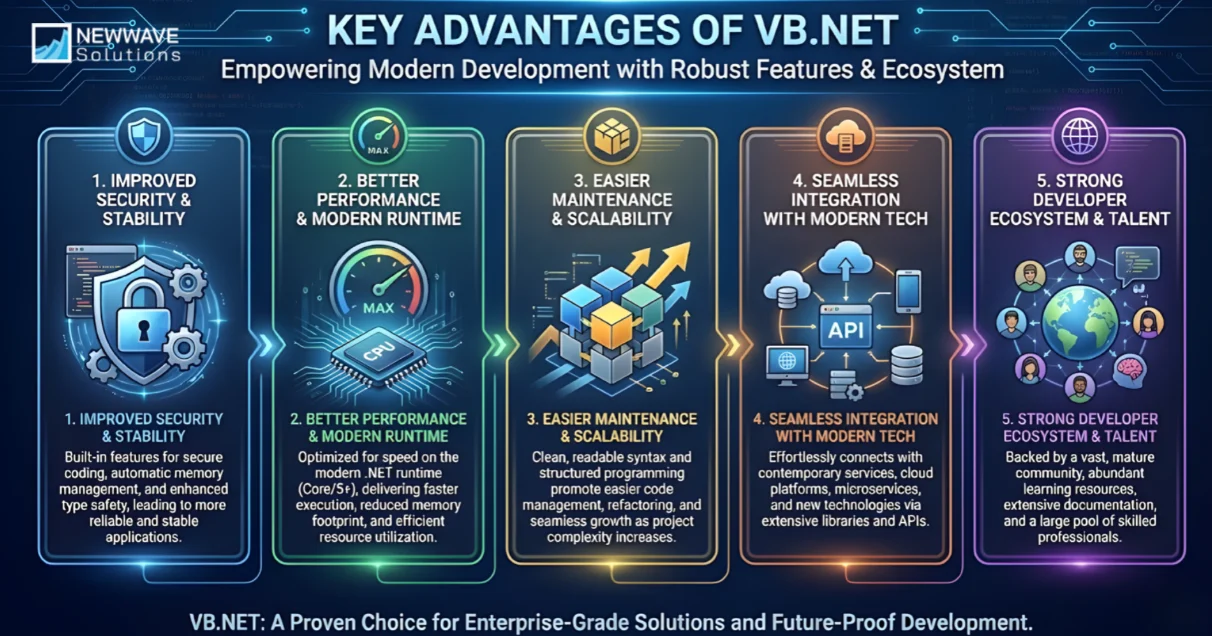
1. Improved Security and Stability
VB.NET benefits from regular security updates and patches provided by Microsoft, which significantly reduce exposure to known vulnerabilities. In addition, the managed runtime environment improves application stability by handling memory management and runtime exceptions more safely.
2. Better Performance and Modern Runtime
VB.NET applications run on a modern managed runtime that optimizes memory usage and execution efficiency. As a result, systems can better utilize modern hardware and perform more reliably under higher workloads.
3. Easier Maintenance and Scalability
VB.NET introduces a cleaner and more structured codebase through full object-oriented programming support. Consequently, applications become easier to maintain, refactor, and extend as business requirements evolve.
4. Seamless Integration with Modern Technologies
VB.NET is designed to integrate natively with web services, RESTful APIs, cloud platforms, and modern enterprise systems. Therefore, organizations can modernize incrementally without replacing their entire application ecosystem.
5. Strong Developer Ecosystem and Talent Availability
VB.NET is supported by a large developer community, extensive documentation, and mature tooling within the .NET ecosystem. Compared to VB6, organizations can recruit developers more easily and reduce dependency on scarce legacy expertise.
Why VB.NET Is the Right Upgrade Path for VB6 Systems
After reviewing the core advantages of VB.NET, it becomes clear how this platform enables enterprises to modernize legacy systems while remaining aligned with current technology trends and operational demands. When compared to continuing on outdated VB6 platforms, upgrading to VB.NET represents a bold yet necessary step for long-term system sustainability.
- Modern Platform Stability: VB6 operates on an outdated runtime that is no longer supported by Microsoft, which increases long-term operational risk. In contrast, VB.NET runs on the modern .NET platform, offering improved stability and compatibility with current operating systems.
- Enterprise-Grade Security: VB6 does not receive security updates and lacks built-in protection against modern threats. VB.NET benefits from regular Microsoft security patches and managed runtime safeguards that significantly reduce vulnerability exposure.
- Full Object-Oriented Architecture: VB6 provides limited support for object-oriented principles, which restricts long-term maintainability. VB.NET introduces full object-oriented programming, enabling cleaner design, better code reuse, and easier system evolution.
- Improved Performance and Resource Management: VB6 relies on older memory handling mechanisms that are less efficient on modern hardware. VB.NET leverages the .NET runtime to optimize memory management and better utilize contemporary system resources.
- Seamless Integration Capabilities: VB6 struggles to integrate with modern APIs, web services, and cloud platforms. VB.NET is designed to connect easily with REST services, enterprise systems, and cloud technologies, supporting gradual modernization.
- Future-Proof Development Ecosystem: VB6 has a shrinking developer community and limited tooling support. VB.NET is backed by a large ecosystem, active community, and modern development tools, ensuring long-term maintainability and talent availability.
Common Concerns When Upgrading to VB.NET and How to Address Them
Upgrading to VB.NET can introduce technical risks and operational challenges, especially for organizations with limited migration experience or resources. The issues below highlight common concerns and practical solutions to help your migration proceed smoothly and with greater control.
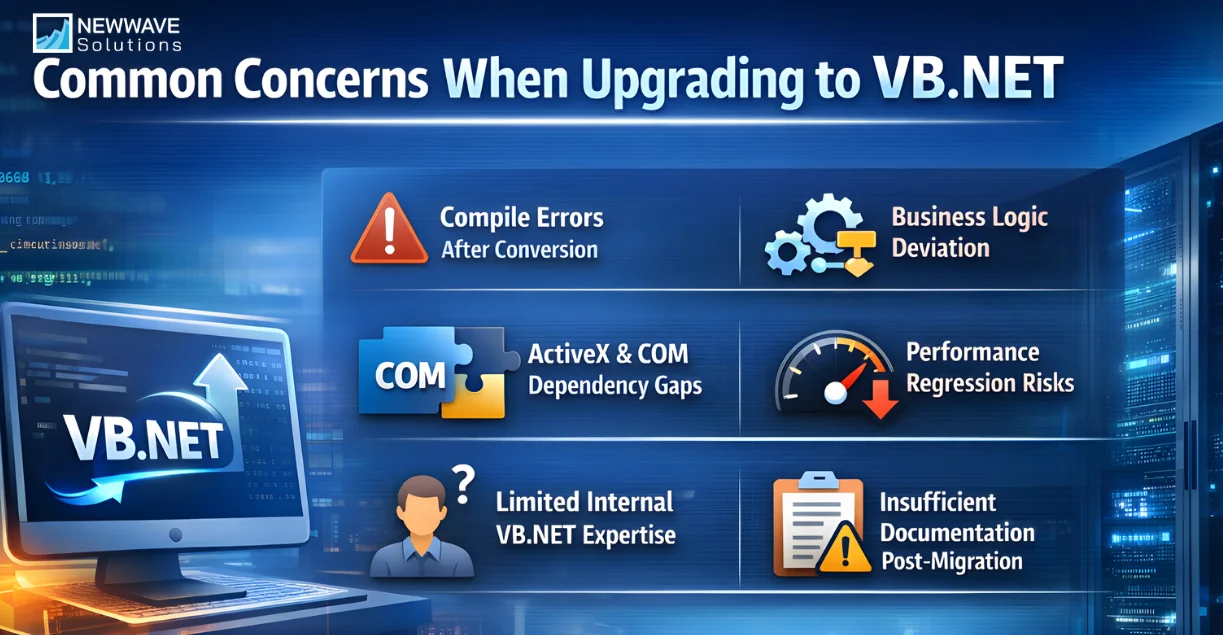
- Compile Errors After Conversion: Automated or manual upgrades can introduce compile-time errors due to deprecated syntax or unsupported components. A structured remediation phase with automated fixing tools and targeted refactoring helps stabilize builds faster.
- Business Logic Deviation: Legacy rules embedded across forms and modules may change unintentionally during upgrade. Comprehensive regression testing and logic validation ensure functional parity before release.
- ActiveX and COM Dependency Gaps: VB6 applications often rely on components that are not natively supported in VB.NET. Replacing or wrapping these dependencies with. NET-compatible alternatives reduce runtime risk.
- Performance Regression Risks: Upgraded applications may behave differently under load if performance is not validated. Performance benchmarking and tuning during pre-production testing mitigate this risk.
- Limited Internal VB.NET Expertise: Teams without VB.NET experience may struggle to maintain momentum after the upgrade. Leveraging automated migration tools and expert guidance shortens the learning curve and improves outcomes.
- Insufficient Documentation Post-Migration: Many upgrades fail to produce usable technical documentation for the new system. Generating documentation in parallel with migration improves maintainability and onboarding.
When Should Businesses Move from VB6 to VB.NET
- When legacy VB6 systems support business-critical operations and require long-term stability.
- When security, compliance, or OS compatibility risks begin to impact operations.
- When VB6 expertise becomes difficult or costly to maintain internally.
- When integration with web services, APIs, or cloud platforms is required.
- When the organization plans gradual modernization rather than a full system rewrite.
- When development teams need a maintainable and scalable foundation for future growth.
Conclusion
Overall, VB.NET delivers a wide range of advantages for enterprises that aim to modernize their legacy systems and remain compatible with today’s technology landscape. With improved security, stability, performance, and integration capabilities, VB.NET provides a sustainable foundation for long-term system evolution. Deciding to migrate VB6 to VB.NET a necessary step for businesses that want to keep pace with changing customer demands and operational requirements.
However, many organizations face practical challenges when migrating VB6 to VB.NET due to limited internal resources or a lack of hands-on migration experience. In such cases, CodeShift VB offers a practical and reliable solution by automating VB6 modernization through pattern-based conversion and intelligent AI-driven error handling, helping optimize migration time, cost, and risk.
To explore how CodeShift VB can support your specific upgrade needs, we encourage you to contact Newwave Solutions for tailored guidance on modernizing your VB6 systems into a robust VB.NET platform.
To Quang Duy is the CEO of Newwave Solutions, a leading Vietnamese software company. He is recognized as a standout technology consultant. Connect with him on LinkedIn and Twitter.



Read More Guides




Get stories in your inbox twice a month.
Let’s Build Something Extraordinary
Sign up for a 30 min no-obligation strategic session with us. Transform your Ideas into scalable reality.
Leave a Reply