


Top 12 Cloud Migration Companies for Businesses in 2026
Cloud migration companies can make the difference between a smooth cloud transition and a costly project filled with delays, downtime, and unexpected technical issues. As legacy infrastructure becomes harder to scale, selecting a provider with the right migration experience and cloud expertise becomes an important business decision.
A strong partner should help simplify the move while improving security, performance, and cost visibility over time. This guide reviews 10 leading cloud migration providers and the most important criteria for comparing their capabilities, approaches, and fit for your migration goals.
How We Built This List
Our evaluation of best cloud migration companies focuses on providers with evidence of hands-on delivery, especially in complex or compliance-sensitive environments, rather than companies that treat migration as a secondary service.
- Pre-migration assessment: We looked at how thoroughly each provider examines architecture, system dependencies, and data flows before defining a migration plan.
- Multi-cloud expertise: Providers were assessed on demonstrated capabilities across AWS, Azure, and GCP, rather than strong expertise in one platform with limited support for the others.
- Cutover risk management: We considered how companies approach staged cutovers, rollback planning, and incident ownership during the most sensitive phase of migration.
- Post-migration visibility: The evaluation considered whether clients receive meaningful performance and cost data after migration, rather than confirmation that the move is complete.
- Regulated workload experience: We prioritized experience with compliance-sensitive environments, including workloads subject to HIPAA and PCI DSS requirements.
- Independent validation: We cross-checked project experience of each company against Gartner Peer Insights and verified reviews on Clutch and G2.
Top Cloud Migration Providers at a Glance
The cloud migration companies below differ in platform focus, delivery model, and the types of migration programs they support. This comparison highlights the key distinctions across providers, ranging from enterprise-scale transformations and managed services to application modernization and support for regulated workloads.
|
Company |
Core services | Key strengths | Target audience |
Pricing & engagement |
|
Deloitte |
Cloud assessment, migration, application modernization, hybrid and multicloud transformation, Cloud FinOps | Structured Assess, Migrate, Modernize framework; strong financial governance; AWS, Google Cloud, IBM, and VMware ecosystem expertise | Mid sized to large enterprises, especially regulated organizations with complex legacy environments | Custom enterprise pricing |
|
IBM Consulting |
Legacy and mainframe modernization, SAP and Oracle migration, multicloud migration, data center consolidation, post migration optimization | Strong IBM Z and Power Systems expertise; AI assisted discovery and code analysis; specialized ERP and database migration capabilities | Large enterprises with extensive legacy infrastructure, mainframes, SAP, Oracle, or complex hybrid environments | Enterprise-focused engagements; high administrative oversight expected |
|
Wipro |
Data center migration, VMware migration, application migration, data platform migration, cloud modernization | Automation first approach; Cloud Migration Studio and other proprietary tools; ability to leverage hyperscaler migration funding | Enterprises undertaking large data center exits, VMware migrations, or high volume workload transitions | Custom enterprise pricing. Engagements favor large scale projects where automation can justify the heavier governance model. |
|
HCLTech |
Application and infrastructure migration, VMware migration, SAP S/4HANA migration, Kubernetes and data platform migration | CloudFactory delivery model; automation at scale; specialized SAP and container migration platforms | Large enterprises with extensive application portfolios and complex AWS or Azure environments | Custom quote, enterprise focus. |
|
Accenture |
Cloud strategy, TCO planning, migration execution, application modernization, managed cloud services | Industrialized migration factory model; global delivery scale; strong experience with regulated and brownfield environments | Large multinational enterprises, particularly healthcare, finance, utilities, and public sector organizations | Premium custom pricing, governance-heavy engagements |
|
Rackspace Technology |
Cloud adoption and migration, cloud advisory, hybrid and multicloud management, FinOps, ongoing cloud operations | Strong managed cloud focus; support across major cloud platforms; combines migration with optimization and ongoing operations | Organizations that want continued support after migration, particularly those operating hybrid or multicloud environments | Custom scoped pricing |
|
Cognizant |
Automated cloud assessment, migration wave planning, application modernization, multicloud migration, FinOps | Skygrade platform; AI augmented FinOps; cost modeling before migration; strong AWS, Azure, and Google Cloud coverage | Mid market and large enterprises with complex application portfolios and concerns about cloud cost predictability | Custom enterprise pricing, platform-led approach |
|
Simform |
Cloud readiness assessment, application and data migration, application modernization, infrastructure engineering, DevSecOps | Combines migration with full stack engineering; cloud native modernization; proprietary accelerators; strong Azure capabilities | Businesses that need to modernize applications, infrastructure, data, and delivery processes as part of migration | $25–$49/hr |
|
ELEKS |
Cloud migration, application reengineering, cloud architecture, software engineering and modernization | Ability to combine cloud work with broader application engineering and legacy transformation | Enterprises and technology companies that need migration alongside custom software or application modernization | $50–$99/hr |
|
Intellias |
Cloud assessment, infrastructure and application migration, rehosting, replatforming, refactoring, cloud foundation and managed services | Structured migration roadmap; AWS, Azure, and Google Cloud coverage; combines migration with DevOps, governance, and modernization | Businesses moving applications, databases, or infrastructure to public, hybrid, or multicloud environments | $50–$99/hr |
|
Trigent Software |
Cloud consulting, application migration, multitenant architecture, legacy application modernization | Experience combining migration with application redevelopment and architecture changes | Software companies and organizations that need cloud migration together with legacy application modernization | $25–$49/hr |
|
EPAM Systems |
Cloud readiness assessment, migration strategy, application and infrastructure migration, cloud native modernization, ongoing support | Strong software engineering capabilities; migration connected with application modernization; extensive hyperscaler expertise | Enterprises with complex applications that require engineering or architectural modernization during cloud migration | $150 – $199 / hr |
12 Best Cloud Migration Companies to Consider
The at-a-glance comparison helps narrow the field, but choosing among cloud migration companies also requires a closer look at migration scope, platform expertise, delivery model, and commercial fit. Below, we reveal each company at a deeper level to help you choose the best fit.
Deloitte
- Location: Global, founded in London
- Established: 1845
- Employees: 450,000+ globally
- Certifications and partnerships: AWS Cloud Operations Competency in Cloud Financial Management; alliances across major cloud ecosystems (AWS, Google Cloud)
- Pricing: Custom enterprise engagements.
- Industry focus: Government and public sector, life sciences and healthcare, finance, automotive, retail, and consumer goods
Deloitte approaches cloud migration as more than moving existing workloads to a new environment. Its strategy combines migration with application modernization, helping enterprises update legacy systems while strengthening security, cost control, and long term cloud governance.
Its cloud migration services follow an automated Assess, Migrate, Modernize framework and place strong emphasis on Cloud FinOps. With alliances across AWS, Google Cloud, IBM, and VMware, Deloitte can also support complex hybrid cloud environments that combine public cloud infrastructure with private data centers.
Core services and strengths
- Assess, Migrate, Modernize framework: Uses a structured process to assess legacy environments, execute migration, and identify modernization opportunities.
- Cloud FinOps: Integrates cloud financial governance and cost optimization into the operating model.
- Hybrid and multicloud capabilities: Supports architectures spanning public cloud platforms and on premises environments.
- Application modernization: Connects migration with application refactoring and broader modernization programs.
Pros
- Strong fit for complex enterprise environments.
- Integrates migration planning with financial governance.
- Supports hybrid and multicloud strategies.
Cons
- Designed primarily for mid-sized and large enterprise budgets.
- Extensive governance can result in longer project timelines.
- Requires substantial participation from the client’s internal stakeholders.
Best for: Deloitte is suited to mid sized and large enterprises that need to combine cloud migration with legacy modernization, FinOps, security, and hybrid cloud governance.
IBM Consulting
- Location: Global
- Established: 1911
- Employees: 300,000+
- Certifications and partnerships: Extensive AWS, Azure, Google Cloud, Oracle, and enterprise technology ecosystem capabilities
- Pricing: Custom enterprise pricing
- Industry focus: Financial services, healthcare and life sciences, government, retail, and manufacturing
IBM Consulting focuses on cloud migrations for organizations with complex legacy environments, including mainframes, Power Systems, SAP, and Oracle workloads. Its approach combines migration with application modernization, multicloud planning, data center consolidation, and automation to reduce the complexity of moving business critical systems.
A key part of IBM’s model is the use of AI across the migration lifecycle, including application discovery, dependency mapping, and code remediation. Its experience with SAP and Oracle environments also makes IBM particularly relevant for enterprises that need to modernize core ERP workloads while maintaining operational continuity.
Core services and strengths
- Legacy and mainframe modernization: Supports assessment and migration of IBM Z, Power Systems, and traditional enterprise workloads.
- AI assisted migration: Uses automation and AI in discovery, analysis, and parts of application modernization.
- ERP and database expertise: Supports SAP and Oracle migration across major cloud environments.
- Hybrid cloud optimization: Extends migration into ongoing performance and cost management.
Pros
- Strong experience with complex legacy estates.
- Suitable for SAP, Oracle, mainframe, and hybrid environments.
- Combines migration with longer term modernization.
Cons
- The enterprise grade methodology can be excessive for straightforward migrations.
- Governance requirements may add complexity.
- Engagements are oriented toward larger transformation programs.
Best for: IBM Consulting fits enterprises with substantial legacy infrastructure that need cloud migration to be coordinated with mainframe, ERP, database, or hybrid cloud modernization.
Wipro
- Location: Headquarters in Bangalore, India, with operations worldwide
- Established: More than 80 years in operation
- Employees: 240,000+
- Certifications and partnerships: Works across major hyperscaler ecosystems
- Pricing: Custom enterprise engagements
- Industry focus: Banking and financial services, healthcare and life sciences, manufacturing, retail, and energy and utilities
Wipro’s FullStride Cloud practice focuses on large scale migrations where speed and automation are key priorities, including data center exits, VMware environments, and legacy data platforms. Its approach uses proprietary migration tools to standardize assessment, planning, and execution while reducing the amount of manual work required.
A major strength is Wipro’s automation first model, supported by platforms such as Cloud Migration Studio and the Application Migration Toolkit. The company also supports VMware migration through Google Cloud VMware Engine, including funding based migration programs designed to help eligible businesses reduce transition costs.
Core services and strengths
- Automation led migration: Uses migration tooling to support discovery, assessment, planning, and execution.
- Large data center migrations: Supports organizations moving substantial infrastructure estates.
- VMware migration: Provides structured migration paths for large VMware environments.
- Hyperscaler collaboration: Can use cloud provider programs and funding structures within eligible migration engagements.
Pros
- Suitable for migration programs involving large volumes of workloads.
- Strong automation focus.
- Global delivery capability.
Cons
- Standardized frameworks may require adaptation for highly customized environments.
- Governance may feel heavyweight for smaller organizations.
- Larger engagements benefit from an experienced client side project lead.
Best for: Wipro is suitable for enterprises undertaking large data center exits, VMware transitions, or broad migration programs where automation and global delivery capacity are important.
HCLTech
- Location: Global, operating across 60 countries
- Established: 1991
- Employees: 223,000
- Certifications and partnerships: Major cloud provider partnerships, including Microsoft and AWS
- Pricing: Enterprise focused custom engagements
- Industry focus: Financial services, manufacturing, healthcare, technology, telecom, retail, mobility, and public services
HCLTech supports large enterprises with complex application portfolios through a structured, factory based cloud migration model. Its approach relies heavily on automation and proprietary tooling to standardize assessment, planning, and execution across large scale AWS and Azure migration programs.
The company also offers specialized migration solutions for complex workloads. Examples include its AI enabled SAP S/4HANA Migration+ offering developed with Microsoft and its Kubernetes Migration Platform for moving applications from legacy container environments to more modern cloud native architectures.
Core services and strengths
- CloudFactory delivery model: Uses standardized automation to support discovery, assessment, and migration.
- SAP migration: Provides dedicated approaches for SAP S/4HANA migration, including Microsoft aligned solutions.
- Container migration: Supports transitions involving Kubernetes and older container platforms.
- Application modernization: Can update legacy applications as part of a wider cloud transition.
Pros
- Experienced in large scale enterprise migrations.
- Broad global delivery network.
- Industry specific approaches for complex sectors.
Cons
- Primarily designed for organizations with significant IT budgets.
- The tool driven model may create an onboarding learning curve.
- May be unnecessarily complex for small migration programs.
Best for: HCLTech fits multinational enterprises with extensive application portfolios, SAP workloads, or infrastructure estates that benefit from standardized migration processes and automation.
Accenture
- Location: Operations in more than 200 cities across 52 countries
- Established: 1989
- Employees: Approximately 799,000
- Certifications and partnerships: AWS, Microsoft Azure, Google Cloud, and broader enterprise technology ecosystem
- Pricing: Premium enterprise engagements
- Industry focus: Financial services & banking, retail & consumer goods, healthcare & public services, telecommunications & high tech, industrial & manufacturing, travel, hospitality, & sports
Accenture’s Cloud First division supports large multinational enterprises managing complex cloud transformation programs, particularly in regulated sectors such as healthcare, finance, and government. Its approach covers the full migration lifecycle, from strategy and TCO planning to execution and post migration managed services.
Accenture’s factory based delivery model standardized frameworks and toolsets to accelerate large scale migrations. This approach is especially relevant for brownfield environments with complex legacy systems, strict compliance requirements, and sensitive workloads.
Core services and strengths
- End to end cloud programs: Supports strategy, migration planning, implementation, and ongoing cloud operations.
- Migration factories: Uses repeatable processes and tools for high volume enterprise migrations.
- Multicloud support: Works across AWS, Azure, and Google Cloud.
- Industry specific migration: Provides accelerators for complex enterprise platforms and regulated workloads.
Pros
- Capacity for multinational and multiregion transformations.
- Broad industry and cloud platform coverage.
- Structured frameworks for complex legacy environments.
Cons
- Premium pricing may not suit smaller migration projects.
- Governance and program management can be extensive.
- Requires strong client side coordination.
Best for: Accenture is suited to large multinational enterprises that require coordinated cloud migration across multiple regions, business units, applications, and cloud platforms.
Rackspace Technology
- Location: Global
- Established: 1998
- Certifications: 11,000+ technical certifications across AWS, Microsoft, Google Cloud, VMware, and other technologies
- Pricing: Custom quotation
- Industry focus: Finance, healthcare, public sector, automotive & manufacturing, retail
Rackspace Technology combines cloud migration with the operational work that follows the move. Its migration approach is built around customized planning designed to reduce disruption, downtime, and business risk, while supporting public, private, hybrid, and multicloud environments.
What differentiates its model is the close connection between migration execution and ongoing managed operations. This means Rackspace can remain involved after cutover through monitoring, incident response, optimization, and cloud management.
Core services and strengths
- Cloud assessment and strategy: Reviews existing environments before determining suitable migration paths.
- Multicloud migration: Supports AWS, Azure, Google Cloud, private cloud, and hybrid environments.
- Workload migration: Covers lift and shift as well as cloud native refactoring approaches.
- Managed cloud services: Provides ongoing management and optimization after migration.
Pros
- Broad multicloud capabilities.
- Extensive cloud certifications.
- Supports migration as well as post migration operations.
Cons
- Entech notes that its service model is primarily oriented toward enterprise organizations.
- Support arrangements can vary by service tier and region.
- Complex engagements may still require internal expertise to coordinate delivery.
Best for: Rackspace Technology is suited to organizations operating complex hybrid or multicloud environments that want one provider to support migration, management, and ongoing cloud operations.
Cognizant
- Location: Headquartered in Teaneck, New Jersey, with global operations
- Established: 1994
- Employees: Approximately 357,600
- Certifications and partnerships: AWS, Azure, and Google Cloud ecosystem capabilities
- Pricing: Custom enterprise engagements
- Industry focus: Healthcare, financial services, communications, media, and technology
Cognizant takes a structured approach to cloud migration with a strong focus on cost visibility and financial governance from the planning stage. Its methodology uses the Skygrade platform to automate application discovery, dependency mapping, workload assessment, and migration planning.
They integrate AI supported FinOps into the migration process. By modeling cloud costs and identifying optimization opportunities before workloads are moved, Cognizant can help organizations plan migrations with greater financial predictability, particularly across complex application portfolios and hybrid environments.
Core services and strengths
- Automated assessment: Uses Skygrade to analyze applications and migration dependencies.
- Migration wave planning: Groups workloads according to technical dependencies and business priorities.
- Cloud FinOps: Integrates cost forecasting and optimization into migration planning.
- Multicloud capabilities: Supports AWS, Azure, and Google Cloud environments.
Pros
- Strong combination of migration planning and FinOps.
- Suitable for complex application portfolios.
- Broad hyperscaler support.
Cons
- Structured processes may introduce unnecessary overhead for simple migrations.
- Clients need to adapt to a platform led migration methodology.
- Better aligned with mid sized and large organizations than small teams.
Best for: Cognizant fits mid sized and large businesses that want migration planning, application modernization, and cloud cost governance managed through a structured platform based approach.
Simform
- Location: Florida, USA
- Established: 2010
- Employees: 1,200+
- Certifications: Microsoft Solutions Partner, Azure Expert MSP, Advanced Consulting Partner status with Amazon Web Services (AWS)
- Pricing: $25–$49/hr
- Industry focus: Financial services, healthcare and life sciences, retail and ecommerce, supply chain and logistics, high tech, and digital native businesses
Simform combines cloud migration with modernization to improve the architecture around applications, data, infrastructure, and delivery pipelines. Their approach includes assessing current workloads and dependencies before defining the target architecture and migration path.
The company also emphasizes cloud-native engineering practices such as Infrastructure-as-Code, DevOps, and modernization of legacy applications, which can help organizations address technical debt alongside the migration itself.
Core services and strengths
- Application migration and modernization: Supports replatforming, refactoring, and adoption of cloud managed services.
- Infrastructure migration: Covers server and infrastructure transitions.
- Database and data migration: Supports modernization of databases and analytics environments.
- DevOps integration: Connects migration with CI/CD, SRE, observability, and infrastructure automation.
Pros
- Combines cloud migration with application engineering.
- More than 1,200 engineers across cloud, application, data, and platform disciplines.
- Strong current Microsoft Azure partnership credentials.
Cons
- Public pricing is unavailable.
- The reviewed materials provide more detail about Azure capabilities than comparable migration programs on other cloud platforms.
Best for: Simform is suitable for businesses that need to modernize applications, infrastructure, data, and DevOps practices during migration rather than perform a basic infrastructure transfer.
ELEKS
- Location: Global presence across 20 countries
- Established: 1991
- Employees: 2,100+ specialists reported in its 2024 sustainability materials
- Certifications: Certified partner with major cloud providers like Microsoft Azure, Amazon Web Services (AWS), and Google Cloud, holding advanced competencies like AWS Advanced Tier Services Partner and Microsoft Solutions Partner
- Pricing: $50–$99/hr
- Industry focus: Finance, healthcare, insurance, retail, government, manufacturing
ELEKS provides full-cycle cloud migration with a strong engineering and modernization orientation. Its process begins with an analysis of the existing IT ecosystem and uses those findings to shape a migration strategy and target cloud architecture.
ELEKS also works across AWS, Microsoft Azure, and Google Cloud, giving it flexibility for organizations considering different cloud platforms or hybrid configurations rather than committing to a single-provider migration model.
Core services and strengths
- Cloud migration: Included within ELEKS’ broader engineering capabilities.
- Application reengineering: Can support applications that require modification alongside migration.
- Cloud architecture expertise: Technical roles indicate experience across AWS, Azure, and Google Cloud.
- Security governance: ELEKS materials reference ISO 27001 and SOC 2 Type II controls.
Pros
- Combines migration with software engineering and application modernization.
- Supports the three major public cloud ecosystems.
- Security and quality credentials are documented.
Cons
- Current public materials provide less detail about a standardized cloud migration methodology than some larger system integrators.
- Public pricing is unavailable.
Best for: ELEKS can fit organizations that want cloud migration to be delivered alongside custom software engineering, application reengineering, or broader technology consulting.
Intellias
- Location: Offices and operations across 17 countries
- Established: 2002
- Employees: 3,000+
- Certifications and partnerships: AWS Advanced Consulting Partner, Microsoft partner, Google Cloud partner
- Pricing: $50–$99/hr
- Industry focus: Automotive, financial services, telecom, healthcare, retail, hospitality
Intellias frames cloud migration around business objectives, infrastructure readiness, and the long-term operating model rather than the cutover alone. They provide cloud foundation, migration, application modernization, managed services, and industry cloud capabilities.
Their migration approach is organized around assessment, migration, operations, and ongoing optimization. Intellias also supports hybrid and multicloud environments involving AWS, Microsoft Azure, and Google Cloud.
Core services and strengths
- Cloud foundation and migration: Establishes cloud structures, landing zones, and migration plans.
- Application modernization: Uses rearchitecture and containerization to prepare legacy applications for cloud environments.
- Multicloud infrastructure: Supports AWS, Azure, Google Cloud, hybrid cloud, and multicloud environments.
- Managed cloud operations: Provides infrastructure governance, monitoring, and ongoing operational support.
Pros
- Covers migration from assessment through post migration operations.
- Supports major public cloud platforms.
- Combines infrastructure work with application modernization.
Cons
- Public pricing is unavailable.
- The provided and reviewed sources do not contain enough information to verify standardized engagement costs or minimum project sizes.
Best for: Intellias is suited to organizations that need cloud migration combined with application modernization, infrastructure management, or long-term cloud operations.
Trigent Software
- Location: Massachusetts, USA
- Established: 1995
- Employees: 1,000-5,000
- Certifications and partnerships: AWS Advanced Tier Services Partner and a Microsoft Gold Certified Partner with over 40 AWS certifications
- Pricing: $25–$49/hr
- Industry focus: Healthcare, BFSI, insurance, manufacturing, retail
Trigent Software takes an application- and workload-specific approach to cloud migration. Their teams assess existing applications, dependencies, business objectives, and cloud readiness before determining whether individual workloads should be rehosted, re-platformed, refactored, retained, or otherwise modernized.
The company also connects migration with legacy application re-architecture, cloud security, DevOps, and ongoing management. This approach can be useful for organizations with mixed legacy estates where some applications can move quickly while others require deeper architectural changes before they are suitable for cloud deployment.
Core services and strengths
- Cloud consulting: Cloud consulting is identified as part of the documented engagement.
- Multitenant architecture: Demonstrated experience designing environments supporting multiple tenants and infrastructure configurations.
- Application modernization: Has rebuilt existing software into web based architectures.
Pros
- Documented experience with long term modernization engagements.
- Can combine architecture work with application redevelopment.
Cons
- The reviewed sources do not provide enough current information to verify its cloud certifications, total migration practice size, or standardized methodology.
- Public pricing is not available.
Best for: Trigent suits software organizations that need cloud migration to be combined with application architecture or legacy application modernization.
EPAM Systems
- Location: Global headquarters in Newtown, Pennsylvania, with operations in 55+ countries and regions
- Established: 1993
- Employees: 10,000+
- Certifications and partnerships: AWS Premier Tier Services Partner and extensive AWS, Google Cloud, and Microsoft Azure certifications
- Pricing: $150 – $199 / hr
- Industry focus: Business services, consumer products & services, financial services, retail, medical
EPAM Systems approaches cloud migration as an engineering-led modernization program, with particular depth in complex application and data environments. EPAM also uses automation and proprietary tooling such as migVisor to support assessment and planning, particularly for database and data-platform migrations.
Through its AWS migration practice and broader multicloud consulting capabilities, EPAM is positioned for organizations that need to combine migration with substantial application, data, or architecture modernization.
Core services and strengths
- Cloud readiness assessment: Evaluates cloud adoption maturity, TCO, assets, risks, dependencies, and constraints.
- Migration strategy: Prioritizes applications and defines the target state before execution.
- Application and infrastructure migration: Supports workload migration as cloud foundations are established and expanded.
- Large certified cloud workforce: EPAM reports 6,000+ AWS certified engineers and significant certified practices across other hyperscalers.
Pros
- Strong combination of software engineering and cloud migration.
- Large certified cloud engineering workforce.
- Supports cloud transformation across many enterprise industries.
Cons
- Public project pricing is not available.
- Its extensive engineering and transformation capabilities may exceed what is necessary for a basic lift and shift project.
Best for: EPAM Systems is suited to enterprises that need cloud migration closely connected with application engineering, cloud native modernization, data platforms, or longer term digital transformation.
How to Choose the Right Cloud Migration Service Provider
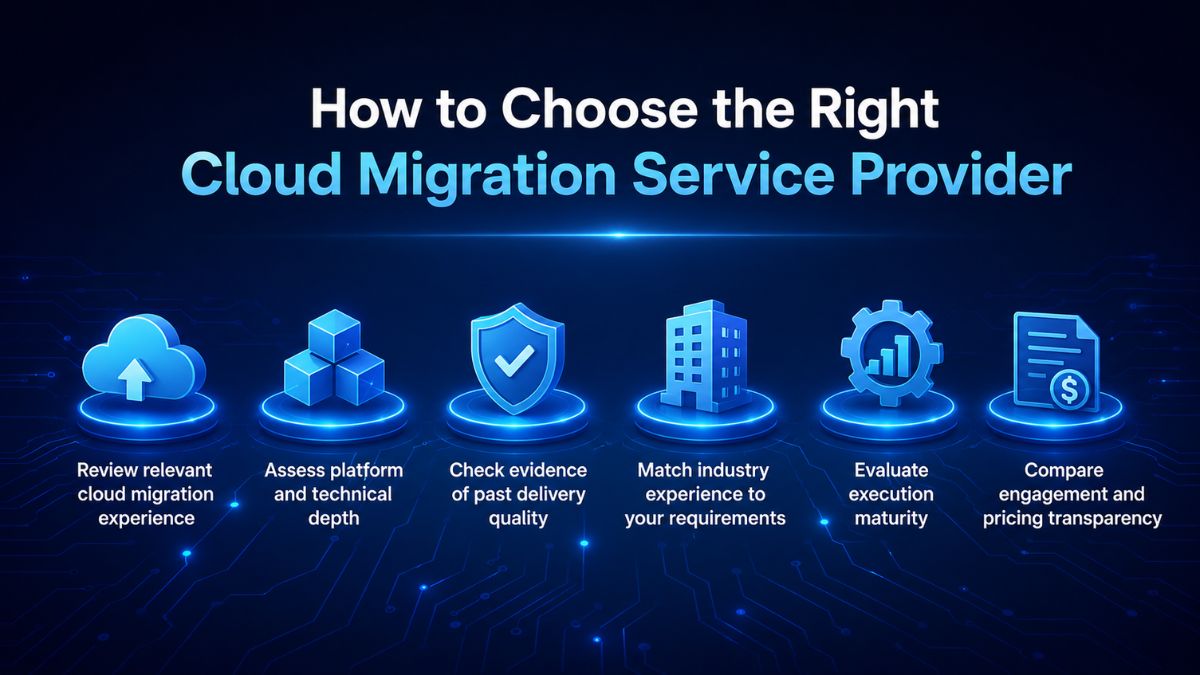
Choosing between cloud migration companies requires more than comparing service menus or cloud certifications. Here are 6 areas you should focus on when evaluating potential partners:
1. Review relevant cloud migration experience
Look for proven work across application, data, and infrastructure migrations, including public, private, and hybrid environments. Verifiable case studies can help determine whether a provider has handled migration challenges comparable to yours.
2. Assess platform and technical depth
Evaluate practical capabilities across AWS, Azure, and Google Cloud where relevant to your architecture. This should include workload assessment and migration techniques such as refactoring and re-platforming, as well as security hardening and post-migration optimization.
3. Check evidence of past delivery quality
Client ratings and feedback on platforms such as G2, Gartner, and Clutch can provide additional signals about delivery quality, communication, and longer-term engagements. These indicators are most useful when considered alongside technical evidence rather than in isolation.
4. Match industry experience to your requirements
Industry specialization becomes particularly important when workloads involve strict compliance or performance constraints. Relevant experience in financial services, healthcare, SaaS, retail, or manufacturing can therefore be an important comparison factor.
5. Evaluate execution maturity
Look for a clear migration roadmap and a predictable delivery model. The provider should also demonstrate how it manages scope, timelines, and risk across multi-phase migration programs rather than focusing only on the technical cutover.
6. Compare engagement and pricing transparency
Review any available information on engagement models, hourly rates, or minimum project thresholds. Greater visibility into these commercial factors makes it easier to compare providers and reduce uncertainty before contracting.
What to Expect from a Successful Cloud Migration
A successful cloud migration should do more than move workloads to a new environment. It should align technical execution with broader operational goals while reducing disruption and creating a cloud foundation that teams can manage, scale, and improve over time.
Controlled migration with minimal disruption
A well-planned migration uses structured methodologies, automated discovery, and Infrastructure as Code to improve consistency and reduce execution risk. The objective is to move workloads without creating unnecessary disruption to ongoing operations.
Security and compliance built in from the start
Security should be incorporated into migration planning and execution rather than added after workloads have moved. This helps ensure that security and compliance requirements remain part of the target cloud environment from the outset.
Cost governance established early
Cloud spending should be considered during migration planning, not only after deployment. Integrating cost governance and FinOps practices early provides a clearer framework for managing cloud consumption and avoiding uncontrolled spend.
Greater use of automation and AI-assisted planning
Modern migration approaches increasingly use automation and AI-driven insights to support discovery, planning, and operational decisions. These capabilities can improve planning accuracy and make migration processes more efficient.
A cloud environment built for ongoing operations
Migration is not complete simply because workloads have been transferred. The end state should be an environment that internal teams can operate confidently, scale efficiently, and continuously optimize as requirements evolve.
How Much Does Cloud Migration Cost?
Cloud migration costs vary significantly with business size and technical complexity. A simple migration may start around $40,000, while large enterprise programs involving regulated data, full refactoring, or global-scale environments can exceed $600,000. Ongoing annual costs also rise with complexity, so budgeting should account for both the initial migration and the cloud-related costs that follow.
|
Complexity |
One-time migration cost |
Ongoing annual cost |
| Simple applications (few services and minimal legacy complexity |
~$40,000–$100,000 |
$10,000–$30,000 |
| Mixed legacy systems and custom applications |
~$100,000–$300,000 |
$40,000–$100,000 |
| Cloud migration with regulated data, full refactoring, or global-scale environments |
$300,000–$600,000+ |
$100,000–$200,000+ |
Why Partner with Newwave Solutions for Cloud Migration
With 15+ years of experience in software engineering, Newwave Solutions helps organizations move from legacy systems, private cloud, and hybrid environments to AWS, Azure, and Google Cloud. Our cloud migration services focus on building environments that improve scalability, strengthen security, and support better cost efficiency over the long term.
Each engagement begins with a comprehensive cloud readiness assessment and architecture review to determine the right migration strategy. From there, projects move through phased execution, modernization, security hardening, and structured post-migration support to create a cloud environment that teams can operate and continuously optimize.
Why choose Newwave Solutions for cloud migration?
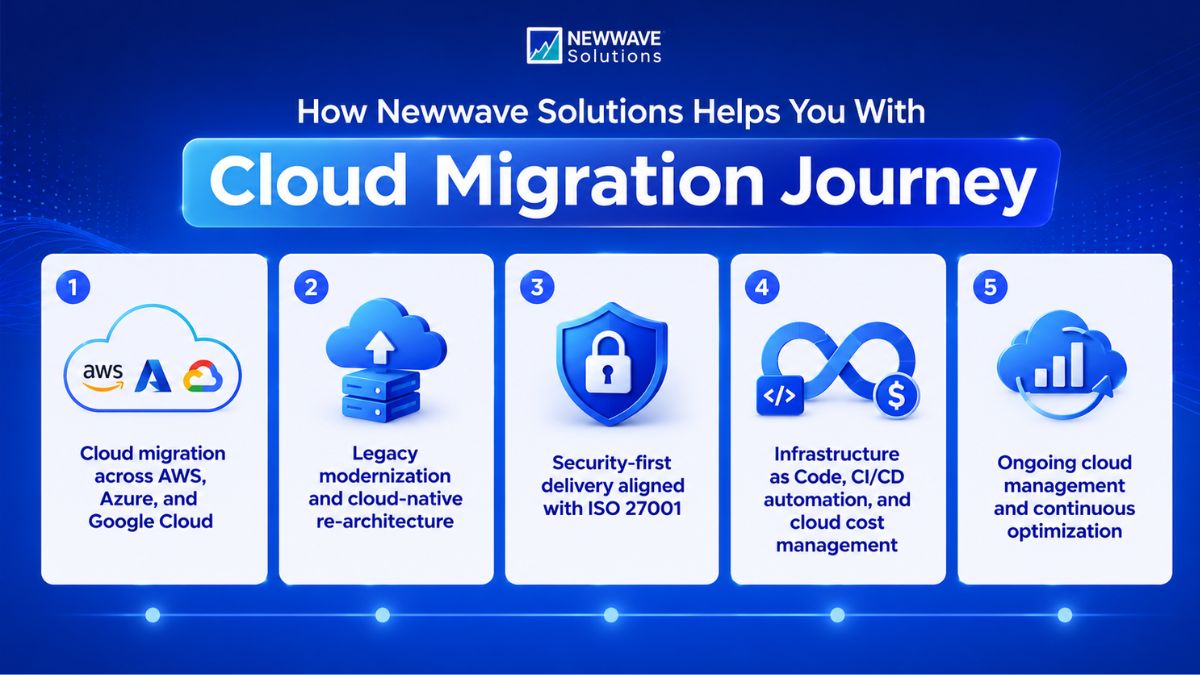
- Cloud migration across AWS, Azure, and Google Cloud to support different infrastructure and platform requirements.
- Legacy modernization and cloud-native re-architecture for organizations moving beyond lift-and-shift migration.
- Security-first delivery aligned with ISO 27001 to keep security considerations embedded throughout the migration lifecycle.
- Infrastructure as Code, CI/CD automation, and cloud cost management to improve consistency, deployment efficiency, and cost visibility.
- Ongoing cloud management and continuous optimization to support performance and operational improvements after migration.
Discuss your goals with our experts to identify the right strategy, architecture, and execution approach for your environment
Final Thought
The best cloud migration partner is the one that fits your technical environment, risk profile, and long-term operating needs. When comparing cloud migration companies, focus on relevant delivery experience, cloud platform expertise, security capabilities, and the provider’s ability to support modernization and ongoing optimization. Cost should be evaluated in context rather than as a standalone selection factor.
Migration is most valuable when it improves how the cloud environment performs after cutover, not simply when workloads reach their destination. Newwave Solutions helps organizations plan and execute migrations across AWS, Azure, and Google Cloud with assessment, modernization, and post-migration support built into the process. Contact our team to explore the right migration strategy for your current environment.
FAQs
1. What services do cloud migration companies provide?
Cloud migration companies typically support the full migration lifecycle, from cloud readiness assessment and architecture planning to workload migration, modernization, security configuration, and post-migration optimization. Depending on the provider, services may cover applications, data, infrastructure, and hybrid or multi-cloud environments across platforms such as AWS, Azure, and Google Cloud.
2. Do cloud migration companies support modernization?
Yes. Many cloud migration companies combine migration with legacy system modernization, application refactoring, re-platforming, and cloud-native re-architecture. This allows organizations to improve scalability, maintainability, and operational efficiency instead of simply moving existing workloads to new infrastructure.
3. How do cloud migration companies handle security and compliance?
Security and compliance should be integrated from the beginning of the migration process. Providers may assess security requirements, harden cloud configurations, apply access controls, and align the target environment with relevant compliance requirements. Experience in regulated industries can be especially important when workloads involve sensitive data or strict governance standards.
4. How long does a cloud migration usually take?
Cloud migration timelines vary by size and complexity. A small business with only a few applications may complete migration in 2 to 6 weeks, while a mid-sized organization may need around 2 to 4 months. For complex enterprise environments with extensive legacy systems, migration can take 6 to 18 months or longer, especially when the project involves multiple workloads, dependencies, and phased execution.
5. How do I know whether my IT provider is ready for cloud migration?
Check whether they have handled migrations similar to yours and whether they use a clear process for assessment, risk reduction, and downtime planning. Also confirm that they provide post migration support so your team has help managing and optimizing the new cloud environment.
To Quang Duy is the CEO of Newwave Solutions, a leading Vietnamese software company. He is recognized as a standout technology consultant. Connect with him on LinkedIn and Twitter.



Read More Guides
Get stories in your inbox twice a month.
Let’s Build Something Extraordinary
Sign up for a 30 min no-obligation strategic session with us. Transform your Ideas into scalable reality.
Leave a Reply