


Top 10 Generative AI Development Companies in 2026
Generative AI adoption is widespread, but business returns remain concentrated among a small group of companies. McKinsey’s 2025 State of AI survey found that while many organizations are already using AI, only about 6% are seeing significant financial impact. That gap often comes down to how well AI is designed, integrated, and scaled beyond the pilot stage.
For companies looking to close that gap, choosing the right generative AI development partner is a high-stakes decision. Technical expertise alone is not enough; delivery experience, integration capability, cost control, and production readiness all matter. This guide compares top 10 leading generative AI development companies and compares their capabilities, along with criteria to evaluate them and common red flags.
How We Evaluate Generative AI Development Companies
We evaluate generative AI development companies using 5 criteria that reflect both technical capability and production readiness. The assessment focuses on whether a provider can build reliable AI systems, deliver them in real projects, meet security requirements, and scale beyond an initial proof of concept.
- Technical depth: We review capabilities in LLM fine-tuning, RAG architecture, agentic workflow design, and the methods used to test model outputs before deployment.
- Delivery track record: We look at completed production deployments rather than pilots, along with the industries served and whether project timelines were consistently met.
- Client feedback: We assess verified Clutch reviews, with particular attention to repeat client relationships and satisfaction after launch instead of relying only on company-selected testimonials.
- Compliance and security: We examine readiness for SOC 2, HIPAA, and GDPR, as well as data handling practices and how clearly intellectual property ownership is defined in contracts.
- Production scale readiness: We assess whether the company has a documented path for moving generative AI solutions from proof of concept to full deployment without requiring costly re-architecture.
Quick Comparison of Top Generative AI Development Companies
Below is the comparison of the 10 generative AI development companies covered above. The table focuses on how each company delivers GenAI work, its pricing profile, and the type of project or buyer it is best suited for.
|
Company |
AI delivery strength | Hourly Rate | Best fit |
Key differentiator |
| Newwave Solutions | End-to-end GenAI delivery with RAG, AI agents, enterprise integration, and multidisciplinary software, data, cloud, and system engineering | Contact us | Businesses that need GenAI integrated with existing workflows, enterprise data, and business systems | 15+ years of delivery experience, 800+ projects, 200+ active clients, and ISO 9001/27001-aligned AI development. |
| Leanware | Hands-on AI engineering focused on custom GenAI products, AI agents, LLM applications, and LLMOps | $30–$49/hour | Startups and mid-market companies building custom GenAI products with a closely involved engineering team | Lean engineering model with close founder involvement and strong post-launch ownership. |
| Itransition | Enterprise-scale GenAI delivery covering RAG, fine-tuning, AI agents, copilots, integration, and production optimization | $25–$49/hour | Mid-sized and enterprise organizations that need end-to-end GenAI development and enterprise integration | GenAI delivery backed by experience across 20+ industries and ISO 27001-certified security management. |
| DianApps | Production-focused AI engineering with LLMs, RAG, intelligent agents, multi-agent systems, MLOps, and monitoring | $30–$49/hour | Startups and SMEs building production-ready GenAI applications or multi-agent systems | 150+ engineers, 450+ delivered products, and full-cycle ownership across AI, product engineering, backend, and deployment. |
| Vention | Flexible GenAI delivery from discovery and PoC to full AI product engineering, model optimization, and enterprise integration | $50–$99/hour | SMBs and enterprises that need support across PoC, MVP, AI integration, or full-scale product development | 150+ completed AI projects, 100+ AI professionals, 3,000+ engineers, and ISO 27001 certification. |
| Phaedra Solutions | Strong in multimodal GenAI, content generation, AI agents, workflow automation, model fine-tuning, and system integration | $25–$49/hour | Startups and growing companies building content-focused, multimodal, or workflow-oriented GenAI applications | 300+ AI/ML projects delivered and recognized with the 2025 ASOCIO AI Service Provider Award. |
| Marvik | Domain-tuned GenAI built around proprietary data, with RAG, multimodal AI, conversational systems, and production monitoring | $100–$149/hour | Mid-market and enterprise companies that need custom GenAI systems using private data or advanced multimodal AI | 300+ projects delivered, handling billions of records with production AI used by thousands of users daily. |
| Appricotsoft | Product-focused GenAI integration with LLMs, custom AI agents, workflow automation, and end-to-end implementation | $30–$49/hour | Startups and growing companies adding GenAI to existing products or automating workflows with AI agents | 50+ projects and 8 years of experience, with an AI approach built around feasibility checks, human review, and production readiness. |
| Dualboot Partners | Structured GenAI delivery covering model customization, AI agents, workflow automation, integration, and deployment | $50–$99/hour | Startups and mid-market companies embedding GenAI into products, workflows, and existing business systems | Its DB90 AI-first framework can bring projects from concept to deployment in 90 days and has shown 25% faster delivery with 33% fewer resources. |
| Lexogrine | Custom LLM engineering with RAG, fine-tuning, API orchestration, multi-model integration, and AI workflow development | $50–$99/hour | Companies building custom LLM applications, RAG systems, or GenAI features for existing web and mobile products | Custom LLM and RAG delivery with functional GenAI PoCs or MVPs achievable in as little as 4–8 weeks. |
Top 10 Generative AI Development Companies in 2026
The companies below represent a range of generative AI development partners, from boutique specialists to large engineering firms. Each brings a different mix of GenAI expertise, project focus, delivery model, and client fit, helping you narrow the shortlist based on your specific needs.
Newwave Solutions
Newwave Solutions helps businesses turn generative AI into practical applications that fit existing workflows, data, and technology environments. Our teams can integrate generative AI into current platforms, build RAG-based systems grounded in enterprise knowledge, and develop AI agents that support more complex tasks and interactions.
We support the full delivery cycle of AI development, from identifying viable use cases and assessing data readiness to architecture design, development, integration, deployment, and ongoing optimization. By combining AI expertise with software engineering, data, cloud, and system integration capabilities, we focus on building solutions that can move from initial validation into day-to-day business use.
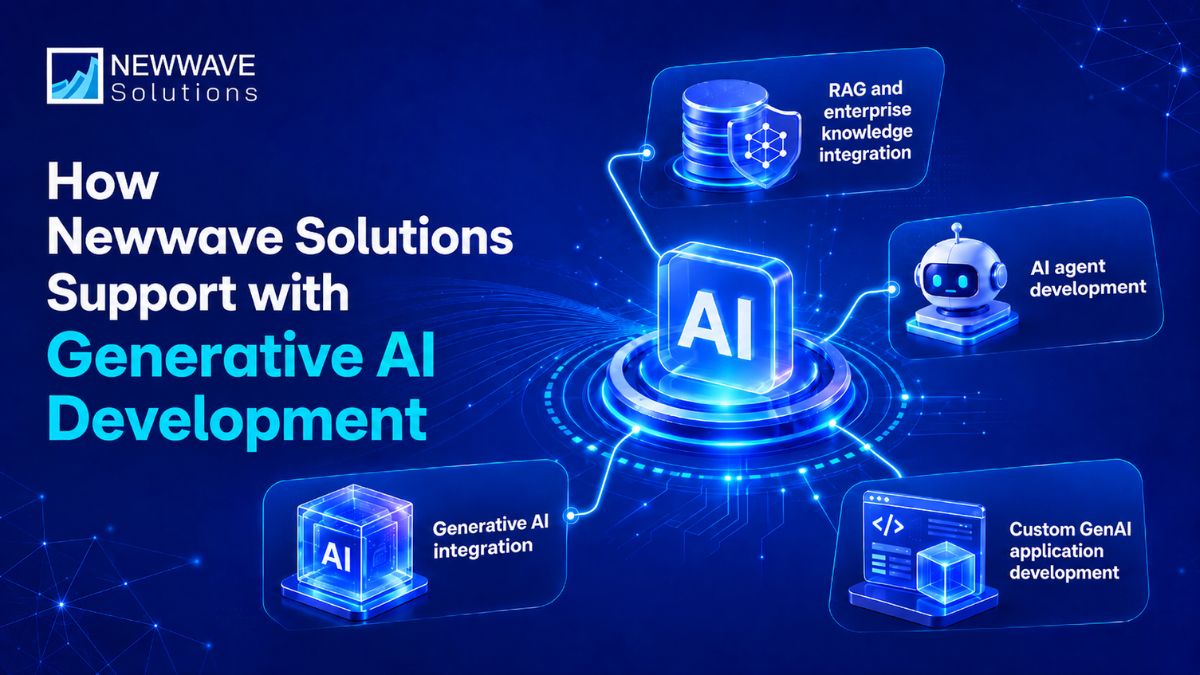
Our generative AI capabilities focus on building systems that can work with enterprise data, existing applications, and real business processes.
- RAG and enterprise knowledge integration: Connect LLMs with internal data sources to generate more grounded and context-aware responses.
- AI agent development: Build agents that can interact with business tools and handle multi-step workflows.
- Generative AI integration: Add GenAI capabilities to existing applications, platforms, databases, APIs, and enterprise systems.
- Custom GenAI application development: Design solutions around specific workflows, user needs, and operational goals.
Beyond AI capabilities, Newwave Solutions brings the engineering, delivery, and governance needed to move GenAI projects from early validation into production use.
- End-to-end delivery: Support projects from discovery and solution design through development, deployment, and ongoing optimization.
- Multidisciplinary engineering: Combine AI expertise with software, data, cloud, and system integration capabilities.
- Security-focused delivery: Apply ISO 27001-aligned practices and NDA protection across data handling, access, integration, and deployment.
- Quality management: Use ISO 9001-aligned processes and continuous testing throughout the development lifecycle.
- Industry experience: Adapt GenAI solutions to business contexts across e-commerce, education, manufacturing, healthcare, finance, and real estate.
Ready to turn generative AI into a practical solution for your business? Talk to our AI experts to discuss your use case, technical requirements, and the right development approach.
Leanware
Key facts
- Founded: 2019
- Company size: 10–49 employees
- Location: Bogotá, Colombia; Miami, United States
- Minimum project size: $25,000+
- Hourly rate: $30–$49/hour
- Rating: 5.0/5 on Techreviewer
Leanware focuses on building production-ready AI agents for workflow-heavy business processes. Rather than stopping at basic chatbots or prompt-based assistants, its agents can retain context, reason across multiple steps, use external tools, and take actions inside business systems.
The company also works with RAG and multi-agent orchestration when a workflow requires access to company knowledge or coordination between specialized agents.
Core services
- Custom AI agent development
- Generative AI integration
- Generative AI model development
- LLM Deployment and LLMOps
Key strengths
- Direct senior engineer access: Clients collaborate directly with the engineers building the product.
- AI-first engineering: Leanware combines generative AI capabilities with full-cycle software engineering.
- Startup-friendly delivery: Its engagement model suits startups and mid-sized companies that need flexible technical support.
- Broad technical capability: Its team works across AI, backend, mobile, web, cloud, and data engineering.
Best for: Startups and mid-market companies building custom GenAI products, AI agents, or LLM-powered applications with a hands-on engineering partner.
Itransition
Key facts
- Founded: 1998
- Company size: 3,000+ specialists
- Location: United States, with 10+ development centers serving clients globally
- Minimum project size: $25,000+
- Hourly rate: $25–$49
- Rating: 4.9/5 on Clutch
Itransition builds domain-specific systems that can work with enterprise knowledge and automate more involved tasks. Its solutions use techniques such as RAG and model tuning to improve response accuracy and ground outputs in company data. The company also applies guardrails and continuous testing to reduce hallucinations before deployment
Its stronger technical depth appears in agentic GenAI, where agents can reason across multiple steps, use external tools, and interact with other systems with limited human input.
Core services
- Generative AI development
- Generative AI consulting
- AI chatbot development
- AI agent and copilot development
- GenAI integration
- GenAI support and optimization
- RAG and model fine-tuning
Key strengths
- End-to-end GenAI delivery: Itransition covers strategy, architecture, development, integration, deployment, and ongoing optimization.
- Enterprise-scale experience: The company serves clients across 40+ countries and has delivered projects in more than 20 industries.
- Broad GenAI capability: Its team works with RAG, prompt engineering, model fine-tuning, AI agents, chatbots, and knowledge assistants.
- Security and compliance: Its GenAI delivery is backed by an ISO 27001-certified security management system and supports requirements including GDPR, HIPAA, and PCI DSS.
Best for: Mid-sized and enterprise organizations that need end-to-end GenAI development, enterprise integration, industry-specific solutions, and support from proof of concept through production deployment.
DianApps
Key facts
- Founded: 2017
- Company size: 50-99
- Location: St. Petersburg, United States, with teams across the US, India, Australia, and the UK
- Minimum project size: $10,000+
- Hourly rate: $30–$49/hour
- Rating: 5.0/5 on Techreviewer
DianApps is an AI-native engineering, with 150+ engineers and more than 450 digital products delivered across D2C, fintech, healthtech, edtech, and supply chain projects.
They build GenAI systems around LLMs, RAG, conversational AI, and agentic workflows. One of its stronger AI case studies is Orby, an enterprise automation platform powered by a Large Action Model. DianApps helped build the platform architecture and integrate the model into enterprise workflows, allowing users to train AI agents and automate more involved business tasks with less manual intervention.
Core services
- AI strategy and discovery
- AI proof of concept
- Production AI deployment
- Multi-agent system development
- Custom RAG implementation
- LLM integration
- MLOps and observability
- AI monitoring and support
Key strengths
- Production-focused AI engineering: DianApps builds AI systems intended for deployment and scaling rather than stopping at proof of concept.
- Strong LLM and RAG capability: Its AI work includes LLM integrations, custom RAG systems, intelligent agents, and multi-agent platforms.
- Full AI lifecycle coverage: The team handles discovery, prototyping, deployment, observability, monitoring, and post-launch support.
- Cross-functional delivery: Projects are supported by engineers, designers, and product specialists working across AI-powered web and mobile products
Best for: Startups and SMEs developing production-ready GenAI applications using LLMs, RAG, AI agents, or multi-agent architectures.
Vention
Key facts
- Founded: 2002
- Company size: 1,000+ employees
- Location: New York, United States, with offices in London, San Francisco, Vienna, Berlin
- Minimum project size: $50,000+
- Hourly rate: $50–$99/hour
- Rating: 5.0/5 on Techreviewer
Vention has strong GenAI capabilities in agentic systems and RAG-based applications. Vention also has experience combining different LLMs within one architecture to balance retrieval, routing, and content generation.
One example is its agentic RAG system built with Claude and AWS Bedrock. The solution connected scattered marketing data and routed requests between Claude Haiku and Sonnet, reducing information retrieval time by 40%. Vention also built an internal RAG platform for their legal team that reached about 88% response accuracy.
Core services
- Generative AI development
- AI agent development
- LLM development and fine-tuning
- AI integration
- AI product development
- Enterprise AI development
- GenAI PoC and MVP development
Key strengths
- Large engineering capacity: Vention has more than 3,000 developers and experience serving companies across 30+ industries.
- Flexible AI entry points: Clients can begin with discovery, a PoC, an MVP, AI integration, or full product development depending on project maturity.
- Enterprise AI capability: The company works across data preparation, model selection, training, optimization, and integration with business systems.
- Production-focused delivery: Vention supports AI projects beyond initial development through monitoring, maintenance, and further product evolution.
Best for: SMBs and enterprises that need flexible GenAI support, from PoC and MVP development to AI integration and full-scale product engineering.
Phaedra Solutions
Key facts
- Founded: 2013
- Company size: 50–249
- Location: Dubai, United Arab Emirates, with listed addresses in the US and UK
- Minimum project size: $10,000+
- Hourly rate: $25–$49/hour
- Rating: 4.9/5 on Clutch
Phaedra Solutions’ generative AI offering stands out for its emphasis on content-intensive and multimodal applications. Their business-ready systems can generate, retrieve, and act on information within real workflows.
A notable case is its AI-powered retail video automation system for retail and eCommerce teams. The platform automated the creation of shoppable social videos, helping the client increase weekly content output while cutting production time.
Core services
- Custom generative AI application development
- Generative AI integration
- Multimodal GenAI development
- Generative AI model training and fine-tuning
- AI agents and workflow development
- Generative AI maintenance
- AI image and video generation
- Conversational AI and chat UX
Key strengths
- Content-focused GenAI expertise: Phaedra Solutions builds systems for generating text, images, video, and other media within business workflows.
- Multimodal capability: Its team develops systems that work across text, image, audio, and video formats.
- Existing-system integration: GenAI applications can be connected to CRMs, CMSs, internal tools, and other business software.
- Model customization: The company fine-tunes models using client data and tests outputs for accuracy, relevance, tone, and consistency.
- From prototype to production: Its process covers use-case discovery, architecture, model development, testing, integration, monitoring, and further scaling.
Best for: Startups and growing companies that need GenAI for content generation, workflow automation, multimodal applications, or AI features connected to existing software.
Marvik
Key facts
- Founded: 2017
- Company size: 50–249 employees
- Location: Montevideo, Uruguay; Austin, Texas
- Minimum project size: $25,000+
- Hourly rate: $100–$149/hour
- Rating: 4.8/5 on Clutch
Marvik differs from many general software outsourcing companies because they describe themselves as AI-native from its foundation. GenAI work goes deeper than standard chatbot development.
Marvik builds generative AI solutions with controls for privacy, hallucination monitoring, bias, and human review. Its published GenAI cases include an internal knowledge assistant that turns hundreds of pages into searchable answers and an eCommerce solution that automates image enhancement across product catalogs
Core services
- Custom generative AI development
- RAG and domain-tuned AI systems
- Multimodal AI development
- Conversational AI and assistants
- Synthetic media generation
- Intelligent automation
- Generative AI deployment and monitoring
Key strengths
- Domain-tuned AI: Marvik builds RAG systems that connect models with private company data for more context-specific responses.
- Multimodal expertise: Its team works across text, image, audio, video, LLMs, diffusion models, and GAN-based systems.
- Production experience: Marvik reports more than 300 delivered projects and production AI systems used by thousands of users daily.
- Responsible AI controls: Its approach includes bias testing, human review, performance monitoring, privacy controls, and hallucination tracking.
Best for: Mid-market and enterprise companies that need custom GenAI systems built around proprietary data, advanced multimodal applications, or AI solutions designed for production use.
Appricotsoft
Key facts
- Founded: 2017.
- Company size: 10–49 employees.
- Location: Kraków, Poland.
- Minimum project size: Less than $5,000.
- Hourly rate: $30–$49/hour.
- Rating: 5.0/5 on Techreviewer
Appricotsoft’s GenAI capabilities are geared toward embedding AI into digital products and business workflows, especially where teams need a practical layer of automation rather than a standalone AI tool. The company also emphasizes product fit and data readiness when applying GenAI. This makes Appricotsoft a suitable option for companies that want to add GenAI gradually while keeping the product experience under control.
Core services
- Generative AI integration
- Custom AI agent development
- AI strategy and discovery
- LLM integration
- AI workflow automation
- AI product implementation and monitoring
Key strengths
- Product-focused GenAI integration: Appricotsoft embeds generative AI into existing web and mobile products rather than treating it as a separate tool.
- Custom AI agent development: Their team builds agents for customer support, financial analysis, reporting, and repetitive business processes.
- Validation before implementation: Projects can start with process analysis, hypothesis validation, model selection, and architecture planning.
- End-to-end AI delivery: The company covers discovery, design, development, secure integration, launch, monitoring, and infrastructure optimization.
Best for: Startups and growing companies that want to integrate generative AI into existing products or build custom AI agents for workflow automation.
Dualboot Partners
Key facts
- Founded: 2018
- Company size: 250–999 employees
- Location: Charlotte, United States
- Minimum project size: $50,000+
- Hourly rate: $50–$99/hour
- Rating: 4.9/5 on Clutch
Dualboot Partners positions AI as part of broader product and business execution rather than a standalone technical experiment. Their teams work with companies that want to embed generative AI into existing products, automate workflows, or validate new AI-driven ideas before scaling them further.
One example is its work for WG Henschen, where Dualboot built a GenAI application on Amazon Bedrock to interpret complex aerospace standards. The system converted standards PDFs into structured part-number rules and reduced processing time from around 30 hours to 30 minutes, while keeping a senior engineer responsible for final validation.
Core services
- Generative AI application development
- AI and ML consulting
- AI model customization and training
- AI agent development
- Intelligent workflow automation
- Generative AI integration
- MLOps and AI deployment
Key strengths
- Structured AI delivery: Its DB90 framework covers discovery, solution design, implementation, deployment, and continuous optimization.
- Generative AI integration: Dualboot builds scalable applications that incorporate generative AI models into existing or new products.
- Model customization: Its team can train and fine-tune models around client data, industry context, and specific use cases.
- Security-focused approach: AI projects include safeguards, bias testing, and attention to relevant security and regulatory requirements.
Best for: Startups and mid-market companies that need GenAI application development, model customization, AI agents, and workflow automation integrated into existing products.
Lexogrine
Key facts
- Founded: 2019
- Company size: 10–49 employees
- Location: Kraków, Poland
- Minimum project size: $10,000+
- Hourly rate: $50–$99/hour
- Rating: 5.0/5 on Clutch
Lexogrine sits at the intersection of AI engineering and end-to-end digital product development. Generative AI is a core part of Lexogrine’s current offering. The company builds LLM-powered applications that can work with proprietary data, automate workflows, and add AI capabilities to existing software.
Lexogrine also has visible GenAI product experience. One of their case studies features Mysti AI, which uses advanced generative AI to work with health testing information, while its agent offering extends into customer service, task automation, data analysis, and multi-agent orchestration.
Core services
- Generative AI application development
- LLM integration and API orchestration
- Custom LLM development and fine-tuning
- RAG system development
- AI assistant and workflow automation development
Key strengths
- Custom LLM capability: Lexogrine can fine-tune open-source models or build tailored LLM solutions around industry and company data.
- Strong RAG expertise: Its team connects LLMs with proprietary data sources to produce more grounded and current responses.
- Existing-system integration: Lexogrine can add AI features to current applications without requiring a full software rebuild.
- Multi-model flexibility: The company works with OpenAI, Gemini, Claude, Llama, Mistral, Qwen, and other commercial and open-source models.
Best for: Companies looking to build custom LLM applications, RAG-based systems, or add generative AI features to existing web and mobile products.
How to Choose the Right Generative AI Development Company?
Choosing the right generative AI development company comes down to evidence, not presentation. A strong partner should be able to show that it has moved AI beyond demos into production and can explain how it handles the technical, integration, and cost issues that appear after launch.
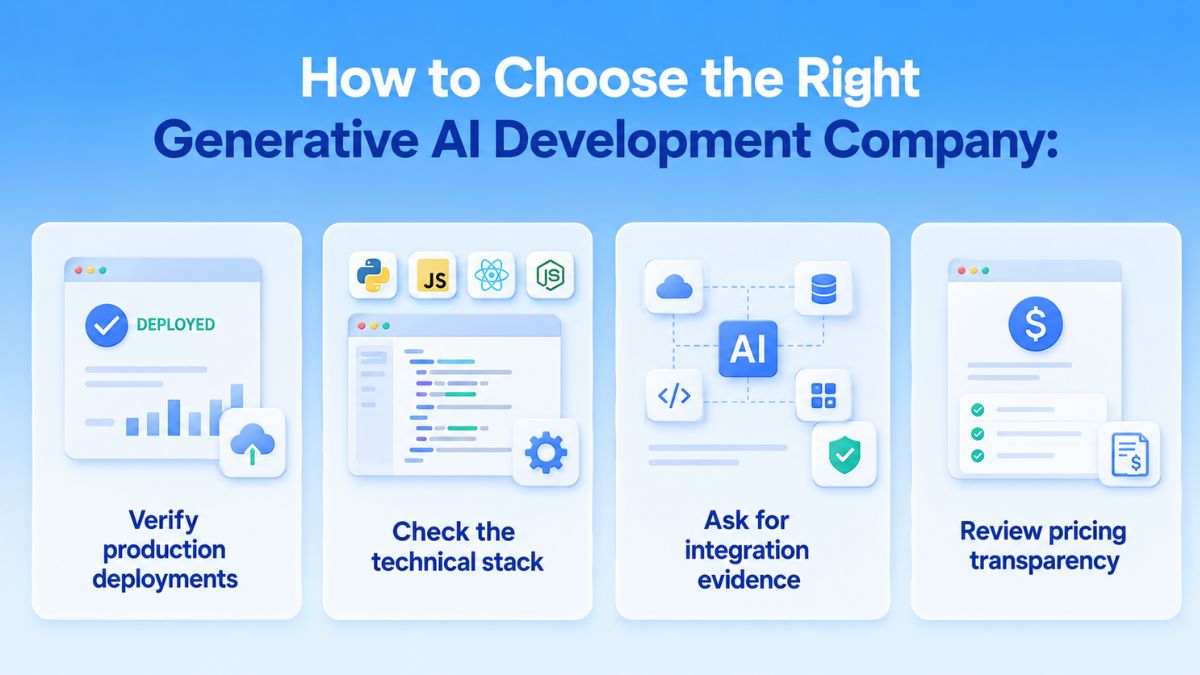
1. Verify production deployments
Ask the company to show a generative AI system that is already running with real users and company data. Then go beyond the feature set and ask how failures are detected, how poor outputs are handled, and what happens when the system needs to be rolled back.
A provider with production experience should be able to explain these operational details clearly. If the discussion stays at the level of demos, feature lists, or future plans, that may indicate limited experience beyond pilot projects.
Pro tip: Consider a paid two-week discovery sprint using a real internal problem before committing to a larger engagement. This gives you a practical way to evaluate how the team works before signing a full contract.
2. Check the technical stack
A capable GenAI partner should be specific about the tools it uses. Look for concrete experience with orchestration frameworks such as LangChain or LlamaIndex, retrieval technologies such as Pinecone, Weaviate, or pgvector, and evaluation tools such as Ragas or DeepEval.
For projects that require model customization, ask how the team approaches fine-tuning and which platforms it uses, including tools such as Hugging Face or Modal. A vague answer that stops at “we use ChatGPT” does not provide enough evidence of technical depth.
3. Ask for integration evidence
Generative AI rarely operates as a standalone system. Ask whether the company has connected AI agents or copilots with enterprise platforms, data warehouses, or other business systems similar to your environment.
Evidence from integrations with systems such as Salesforce, SAP, or Epic can help you understand whether the team has handled the technical work around the model itself. A reference call with a client using a similar technology environment can provide further validation.
4. Review pricing transparency
Look for a provider that explains pricing ranges and what is included in the estimate. The discussion should also cover costs that may increase after deployment, including LLM token usage, monitoring infrastructure, and repeated prompt-tuning work.
A single flat quote without this breakdown can make it difficult to understand the actual cost of operating and improving the system after launch.
Red Flags to Look Out for When Choosing a Generative AI Development Firm
Even a strong-looking proposal can hide risks that only become visible after development starts. Before choosing a generative AI partner, look closely at ownership terms, data handling, pricing, post-launch support, and whether the company can prove its past work.
- Proprietary lock-in: Be cautious if the solution depends on closed frameworks that only the original provider can maintain, especially if moving the codebase elsewhere would require a rebuild.
- Unclear IP ownership: The contract should state who owns the model, training data, and code after the engagement ends; vague wording can create disputes later.
- Pricing that expands mid-project: Fixed quotes can become much more expensive once integration work begins, so change-order terms should be agreed before development starts.
- Unclear data handling: Ask where your data is processed during training or fine-tuning, whether third-party model providers receive it, and whether it may be reused to improve other products.
- No post-launch plan: A provider should explain how monitoring, retraining, and ongoing support will be handled once the system is in production.
- Unverifiable references: Treat anonymous case studies or testimonials with caution when they cannot be connected to a real company or verified review platform such as Clutch or G2.
- Unrealistic integration timelines: Be wary of aggressive estimates for connecting generative AI with legacy ERP, CRM, or other complex systems, as rushed planning may lead to problems later.
Conclusion
There is no single provider that fits every GenAI project. The better decision is to compare generative AI development companies against your actual use case, data environment, integration needs, budget, and production goals. Strong technical capability matters, but so do transparent pricing, ownership terms, and a realistic plan for what happens after launch.
Newwave Solutions can support that next step with GenAI development across RAG, AI agents, enterprise integration, and end-to-end delivery. If you are evaluating a project now, talk to our AI experts to assess your use case, technical requirements, and the most suitable delivery approach.
FAQs
1. What services do generative AI development companies provide?
Generative AI development companies typically provide GenAI consulting, custom application development, LLM integration, RAG systems, AI agents, model fine-tuning, and workflow automation. Many also support deployment, monitoring, optimization, and integration with existing enterprise systems.
2. How long does it take to develop a generative AI solution?
The timeline depends on the project scope, data readiness, integration requirements, and whether the solution is a PoC, MVP, or production system. A focused prototype may take weeks, while more complex enterprise GenAI solutions can require several months.
3. How do generative AI companies protect my data?
Providers may use access controls, secure data handling practices, private or controlled model environments, and compliance frameworks such as GDPR, HIPAA, or ISO 27001 where relevant. You should also confirm where data is processed, whether third-party model providers can access it, and how IP and training data ownership are defined.
4. What ongoing costs should I plan for after deployment?
Post-launch costs can include LLM token usage, cloud infrastructure, monitoring, maintenance, model or prompt tuning, and ongoing support. These expenses vary with usage volume, model choice, system complexity, and how often the solution needs updates.
5. Should we use a large firm or a boutique AI studio for generative AI development?
Large firms may be a better fit for complex enterprise programs that require broader engineering capacity, integration, and governance, while boutique studios can offer closer collaboration and specialized expertise. The right choice depends on your project scale, technical environment, budget, and how much hands-on involvement you need from the development team.
To Quang Duy is the CEO of Newwave Solutions, a leading Vietnamese software company. He is recognized as a standout technology consultant. Connect with him on LinkedIn and Twitter.



Read More Guides
Get stories in your inbox twice a month.
Let’s Build Something Extraordinary
Sign up for a 30 min no-obligation strategic session with us. Transform your Ideas into scalable reality.
Leave a Reply