


Let's discuss your business needs and identify practical technology solutions.
Talk to Our Experts
A fixed budget sounds safer. A flexible contract sounds easier to manage when requirements change. But the choice between time and material vs fixed price is more nuanced because each model handles uncertainty differently. One locks scope and price earlier, while the other lets effort and priorities evolve during delivery.
This article compares how both models work, where each performs best, and what safeguards can keep spending under control.
Key Takeaways
|
What is the Time and Material Model?
The Time and Material (T&M) model is a contract and pricing model where the client pays for the actual time spent and resources used on a project. Before work begins, both parties agree on billing rates for the people involved, while the amount paid over the course of the project depends on the work performed.

How the T&M model works
A T&M project usually begins with an agreement on team composition, billing rates, and working terms. The client and the project team then decide which tasks should be handled first and organize the work into short cycles or sprints.
As work progresses, priorities can be revised from one cycle to the next. The team records the actual hours spent by each person, and invoices are calculated from those records and the agreed rates.
This setup gives the client room to revise requirements and reorder the backlog during the project. It also requires regular participation in planning, reviews, priority decisions, and budget checks.
For work that needs longer-term access to software specialists, companies may also use an extended team model to add dedicated members to their internal team.
Pros and cons of the T&M model
Pros of the T&M model
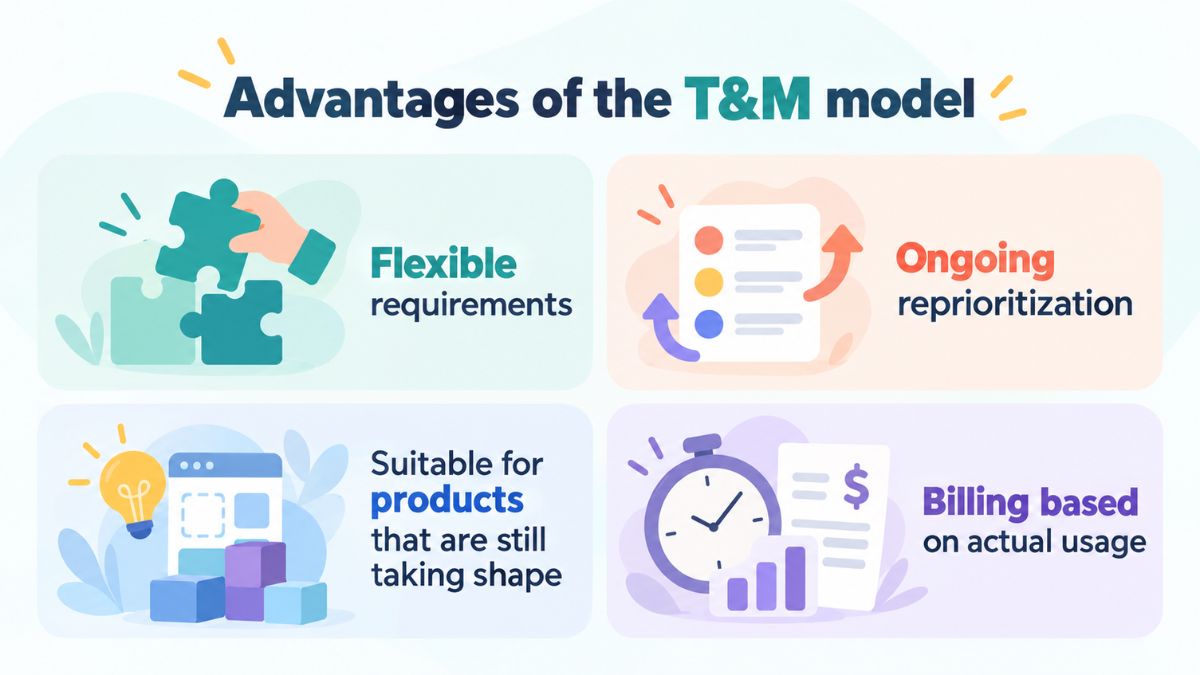
T&M works well when a project needs room for requirements and priorities to move during delivery.
- Flexible requirements: Features or specifications can be revised as the team learns more about the product or receives new business input.
- Ongoing reprioritization: Work can be reordered between sprints, allowing the team to spend upcoming effort on the most relevant tasks.
- Greater effort and cost visibility: Recorded hours and agreed rates show how project time and budget are being used.
- Billing based on actual usage: Clients pay for the time and resources recorded during the agreed billing period.
Cons of Time and Materials
The same flexibility also means the client needs closer oversight of both delivery and spending.
- Risk of scope and budget growth: New requirements can keep adding work when priorities and scope boundaries are not reviewed regularly.
- No exact final cost at the start: The total project cost depends on the actual effort used, so the final spend cannot be fixed in advance.
- More client involvement: The client needs to review progress, priorities, upcoming work, and budget use throughout the project.
- Greater need to monitor efficiency: Because billing is tied to time spent, clients need clear productivity checks to ensure the effort billed is being used effectively.
What is the Fixed Price Model?
A fixed price model is a project pricing approach that sets one agreed cost for a defined body of work. The price is calculated from the requirements, expected deliverables, resources, and schedule identified during project planning. It is most suitable when the work can be specified with enough detail for the vendor to estimate the required effort before execution starts.

How the fixed price model works
A fixed price project starts with detailed requirement definition. The agreed requirements are translated into deliverables, acceptance criteria, milestones, and deadlines. The vendor then estimates the effort and resources needed to complete that scope and proposes a total project price.
Once the contract is signed, the team works toward the agreed milestones. The client reviews each deliverable against the acceptance criteria, and payments are released according to the milestone terms in the contract. If new requirements fall outside the original scope, both sides may need to review their effect on cost and schedule before adding them to the project.
Pros and cons of fixed price model
Pros of the fixed price model
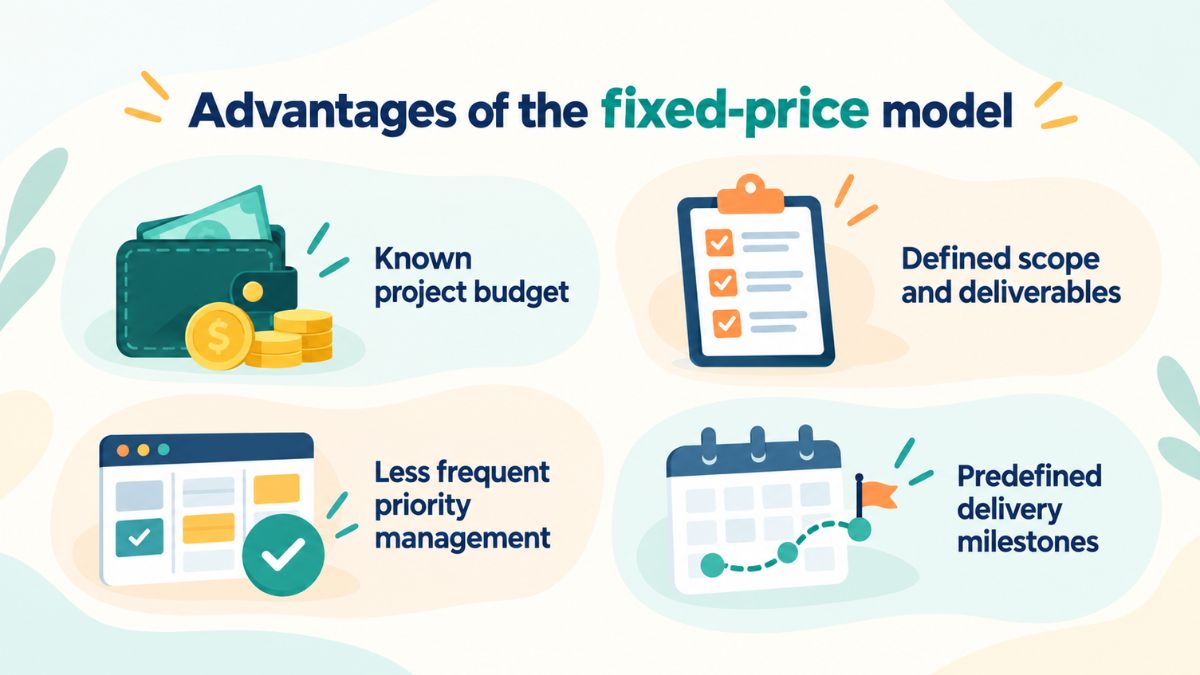
Fixed pricing gives both sides a defined commercial baseline before the project starts, which can make budgeting and delivery planning easier.
- Known project budget: The total price is agreed before development, giving the client a clear figure to plan against.
- Defined scope and deliverables: Requirements, expected outputs, and acceptance criteria are documented upfront, reducing ambiguity about what the project includes.
- Less frequent priority management: Once the scope is approved, the vendor can carry out the agreed work without requiring the client to reprioritize tasks throughout every iteration.
- Predefined delivery milestones: Milestones and deadlines can be included in the contract, giving the client clear points for review, approval, and payment.
Cons of the fixed price model
The model depends heavily on early planning and scope accuracy. That can become restrictive when the product or requirements need to move during delivery.
- Limited room for requirement changes: New needs or user feedback may not fit the agreed scope and can require additional review before implementation.
- Extra scope may trigger change requests: Features or tasks added after contract approval can affect both price and timeline.
- More planning is required before development: Requirements, dependencies, deliverables, and acceptance conditions need to be defined in enough detail for the vendor to estimate the work.
- Uncertainty affects the estimate: When effort is difficult to predict, the vendor may account for that uncertainty when setting the fixed project price.
Fixed vs time and material pricing is only one part of structuring an external software engagement. If you are also deciding how the delivery team should be organized, see our comparison of staff augmentation vs outsourcing.
Time and Material vs Fixed Price: Key Differences
Comparing time and material vs fixed price means looking beyond the billing method. The main differences lie in budget certainty, scope flexibility, client involvement, and how project risk is shared.
| Category | Fixed Price | Time & Material |
|---|---|---|
| Pricing | One agreed project price | Billing based on actual time and resources used |
| Budget certainty | Total cost is set at the start | Final spend depends on actual effort |
| Scope | Defined in detail before delivery | Can be adjusted during delivery |
| Change handling | New work may require a change request or contract update | Priorities can be revised during the project |
| Client involvement | Higher during early requirement definition, lower during day-to-day delivery | Ongoing involvement is needed for reviews and prioritization |
| Risk allocation | Vendor carries more cost risk if effort exceeds the estimate within the agreed scope | Client carries more exposure because additional effort increases spend |
| Delivery control | Driven by predefined milestones and acceptance criteria | Managed through continuous prioritization and review |
| Vendor incentives | Strong pressure to deliver within the agreed cost and schedule | More room to spend additional effort on refinement when the client approves it |
Pricing and budget certainty
A fixed price project starts with one total amount agreed for the defined scope. This gives the client a clear budget figure before the work begins and makes financial planning easier when the requirements are stable.
Under T&M, the client knows the agreed rates for the people or resources involved, but the final project cost depends on how much effort is actually used. If the project grows or runs longer, spending rises with it. This gives T&M less upfront cost certainty and makes regular budget tracking more important.

Scope and change flexibility
Fixed price depends on having a baseline scope that can be estimated before delivery. The vendor prices the work around those requirements, deliverables, and assumptions. For example, if a new payment method is added later, it may require a change request, revised estimate, or contract adjustment.
T&M allows requirements to move more easily during the project. Teams can revise priorities between delivery cycles and direct upcoming effort toward newer business needs. That makes the model more practical when the product is still taking shape, but it also means scope needs active control to prevent unnecessary expansion.
Client involvement and project control
Fixed price places more work at the front of the project. The client needs to provide enough detail for the vendor to define the scope, estimate the work, and set acceptance criteria. Once delivery starts, involvement may be concentrated around milestone reviews and approvals.
T&M spreads that involvement across the project. The client is expected to review progress, adjust priorities, and decide what the team should work on next. This gives the client more direct control over the backlog, but it also requires more time and attention throughout delivery.

Risk allocation
In a fixed price contract, the vendor takes on more financial risk when the agreed scope requires more effort than originally estimated. Since the total price has already been set, extra work within that scope can reduce the vendor’s margin.
With T&M, the client is more exposed to cost growth because actual effort drives billing. Technical issues, added work, or longer delivery can increase the total spend. The model gives the client more room to change direction, but that flexibility comes with greater responsibility for monitoring both scope and budget.
Vendor incentives and delivery quality
Neither model is neutral about vendor incentives. Under T&M, payment is tied to the effort used, so the client needs clear checks on productivity and cost efficiency. Regular reviews, time records, and delivery checkpoints help confirm that billed effort is producing the expected progress. This makes governance important throughout the engagement.
Under fixed price, the vendor has more incentive to complete the agreed scope within the planned budget and schedule. If the estimate is tight, that pressure can reduce the time available for refinement beyond the contract requirements. T&M gives more room for additional testing and adjustment when the client approves the extra effort, but continued refinement can also increase cost and extend delivery.

Time and Material vs Fixed Price: How to Choose
Choosing between fixed price vs time & material depends mainly on how much is known before the project starts. Scope clarity, project size, prior delivery experience, and the likelihood of future changes all affect which model fits better.
When to choose fixed price
Fixed Price is a stronger fit when the work can be estimated with reasonable confidence before delivery begins. Before choosing this model, consider the following questions:
- The scope is clearly defined: Requirements, deliverables, and boundaries are known early enough to price the work.
- The project is relatively limited in size: A smaller, contained scope is easier to estimate and control under one agreed price. Examples may include a proof of concept, code audit, security testing, or a clearly specified feature.
- The technical approach is already understood: Major integrations, workflows, and dependencies have been identified, reducing estimation uncertainty.
- The scope is unlikely to shift significantly: The project does not depend heavily on ongoing discovery, frequent user feedback, or changing priorities.
When to choose T&M
T&M is more suitable when the project contains more uncertainty and the work cannot be mapped in full at the start.
- Requirements are still being worked out: Some features, workflows, or priorities may only become clear during delivery.
- The project needs ongoing iteration: Product development, reengineering, or continuous improvement may require repeated adjustments across multiple delivery cycles.
- Technical dependencies are not fully known: Legacy systems, third-party integrations, or unfamiliar architectures can make effort difficult to estimate upfront.
- Priorities are likely to change during delivery: New business needs, user feedback, or technical findings may require the team to redirect upcoming work.
A quick decision guide by project type
There is no single pricing model for every software project. The table below shows how Fixed Price, T&M, and Hybrid can fit different types of work based on how the project is expected to be delivered.
| Project type | More likely fit | Reason |
|---|---|---|
| Proof of concept or feasibility study | Fixed Price | The work can be framed around a specific technical question, prototype, or validation output. |
| Code audit or architecture assessment | Fixed Price | The engagement can be tied to a defined review scope and a specific set of findings or recommendations. |
| One-time security testing | Fixed Price | Testing can be limited to agreed systems, environments, and test coverage. |
| Development of a clearly specified feature | Fixed Price | Interfaces, workflows, and acceptance criteria can be defined before implementation. |
| Cloud migration with a defined application scope | Fixed Price | The systems, workloads, and migration targets are already identified before execution. |
| Iterative product development | T&M | Product behavior may change as features are built, tested, and reviewed. |
| Legacy system reengineering | T&M | Hidden dependencies and undocumented logic may only become visible during technical analysis. |
| Continuous bug fixing and product maintenance | T&M | The volume and complexity of issues cannot be fully predicted in advance. |
| New product with features still being validated | Hybrid | T&M can cover early discovery and experimentation, then Fixed Price can be used for components that become clearly defined. |
The pricing model is only one part of planning an outsourced project. Team structure, delivery location, communication, and vendor management also affect how the engagement runs. For a broader view, see our guide to offshore software development.
Hybrid Pricing: When Fixed Price and T&M Can Work Together
A hybrid pricing model combines T&M and Fixed Price at different stages of the same project. The main idea is to match the contract type to how much uncertainty exists at each stage. Early work can stay flexible while requirements are still being tested, then move to a fixed price structure once the scope becomes clear enough to estimate with more confidence.
For example, a project may use T&M during discovery and MVP work, where priorities are still being refined. Once the core features and delivery scope are defined, the next phase can move to fixed price. After launch, the project may return to T&M for new features, product adjustments, or later-stage expansion.
A hybrid setup may make sense when:
- The project starts with unclear requirements but is expected to become more defined later. T&M gives the team room to test ideas early, while Fixed Price can be introduced once the scope is stable.
- Different project stages have different levels of uncertainty. Discovery, validation, and post-launch work may need more flexibility than a clearly specified delivery phase.
- The business wants flexibility without keeping the entire engagement open-ended. A fixed price phase can create firmer cost boundaries once the work is understood well enough to estimate.
- The product will continue to change after launch. T&M can be used again for later improvements when priorities depend on user feedback or new business needs.
Common Misconceptions About Time & Materials vs Fixed Price
The difference between time and material vs fixed price is often oversimplified into a few assumptions about cost, control, and risk. In practice, both models depend heavily on how the project is planned, monitored, and adjusted during delivery.
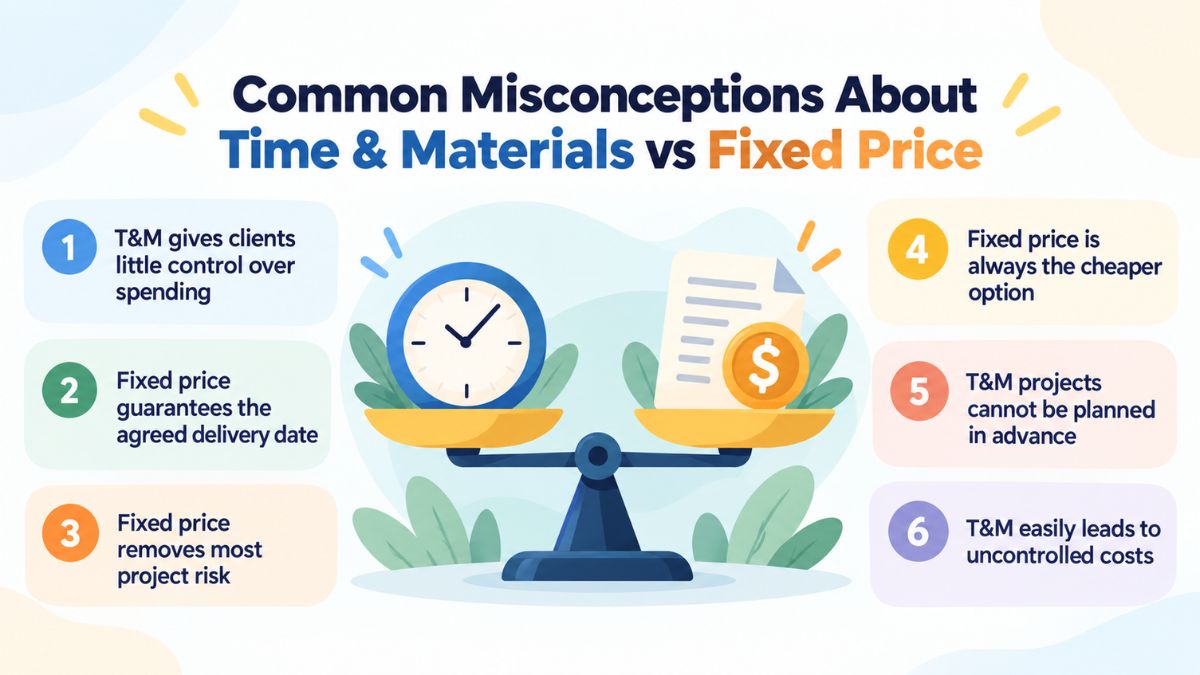
T&M gives clients little control over spending
T&M can give clients regular visibility into how effort and budget are being used. Time records, progress reviews, and budget checks show what has been completed, how much time it required, and how much has been spent.
That visibility also gives the client more control over upcoming work. Priorities can be revised when certain tasks consume more effort than expected, keeping future spending focused on the critical work.
Fixed price guarantees the agreed delivery date
A contract can define a target date, but that does not remove delivery uncertainty. Technical problems, incorrect assumptions, or gaps in the original requirements can still affect the schedule even when the price and timeline are agreed upfront.
Fixed price removes most project risk
Fixing the budget mainly addresses one part of project risk: cost exposure within the agreed scope. Problems can still arise if requirements were misunderstood, business needs move during delivery, or the completed product no longer matches what users need.
Fixed price is always the cheaper option
Knowing the total price in advance does not mean the project will cost less. Vendors may add a buffer for uncertainty, which can raise the quoted price.
The buyer is therefore paying for predictability as well as the expected work. When uncertainty is priced into the contract, a fixed total can be easier to budget without necessarily being the lowest-cost option.
T&M projects cannot be planned in advance
A flexible scope does not prevent structured planning. Teams can work with estimates, sprint plans, budget ranges, and short delivery cycles, then update upcoming work as requirements become clearer.
The difference is that planning happens at multiple levels. The project can still have a broader budget, delivery direction, and near-term priorities, while detailed scope is refined from one iteration to the next. This gives teams a planning structure without forcing every requirement to be finalized before work starts.
T&M easily leads to uncontrolled costs
T&M spending can grow when new work is added without clear priorities or regular budget review. Milestones, cost tracking, and progress checks allow the client to reassess scope and redirect effort before spending moves too far beyond plan.
How to Protect Your Budget Under Either Model
Budget control works best when financial safeguards are built into the contract before delivery starts and reviewed throughout the project. The exact controls can differ by pricing model, but both should define how spending is approved, how progress is verified, and what happens when the engagement needs to change.
Before you sign:
Before delivery starts, both sides should agree on the financial and contractual controls that will govern spending:
- Set a budget cap for T&M work: Define the maximum authorized spend and add early-warning thresholds below it. The contract should also state what happens when the cap is reached, such as pausing work until additional budget is approved.
- Define milestone acceptance criteria: For fixed-price work, connect payments to outcomes that can be verified. For example, a milestone could require a reporting dashboard to display agreed data correctly in the test environment before payment is released.
- Agree on pause and termination terms: For T&M engagements, define when the client can stop work and what must be handed over at that point. This reduces the risk of continued spending when priorities change.

During delivery
During delivery, budget control depends on checking whether spending continues to match completed work and current priorities:
- Review working software regularly: Use demos to compare delivered functionality with the current scope. This helps identify gaps before more effort is committed.
- Review T&M invoices at sprint checkpoints: Compare reported hours with completed work before approving each billing period. If effort is higher than expected, adjust the next sprint before additional spending continues.
- Use technical reviews for higher-risk work: An independent review can identify design limitations, testing gaps, or security weaknesses while there is still time to address them.
At exit
The contract should specify how completed code, documentation, credentials, and other paid deliverables are transferred when the engagement ends. Clear handover terms help the client retain control of work already completed and avoid unnecessary lock-in.
Conclusion
Choosing between time and material vs fixed price comes down to how much certainty the project has at the start. Fixed Price suits work with clear scope, stable requirements, and predictable effort, while T&M fits projects that need more room to adjust priorities and scope during delivery.
Newwave Solutions provides software development services across different engagement models. Our team can review your scope, priorities, and delivery requirements, then help you identify the model that best fits how the project needs to run. Contact us to discuss the right engagement model for your next software project.
FAQs
1. What is the difference between Time and Material and fixed price?
The main difference between Time & Material vs fixed price is how cost and scope are managed. Fixed Price sets a total project fee for an agreed scope, while T&M charges based on the actual time and resources used during delivery.
2. Is Time and Materials a fixed price contract?
No. In a T&M contract, the billing rates may be agreed upfront, but the total project cost depends on the actual effort and resources used. A spending cap can be added, but that does not make the contract Fixed Price.
3. Is unit price the same as T&M?
No. Unit pricing charges a set amount for each defined unit of work or output, while T&M charges for actual labor time and materials or resources used. The two models can both vary in total cost, but they calculate that cost differently.
4. How does T&M pricing work?
The client and vendor first agree on rates for the people or resources involved. The team records the actual effort used, and invoices are calculated from those records over each billing period.
5. What are the disadvantages of fixed price contracts?
Fixed price contracts offer less flexibility once the scope is agreed. New requirements may require change requests, detailed planning is needed upfront, and vendors may include extra margin to cover estimation risk.
Read More Guides






Let’s Build Something Extraordinary
Sign up for a 30 min no-obligation strategic session with us. Transform your Ideas into scalable reality.
Leave a Reply