


Agile Approach to Software Development: The Modern Approach
The business world is witnessing a growing shift toward the Agile approach to Software Development as companies strive to deliver high-value solutions in shorter cycles. Many enterprises now adopt this approach with outsourcing partners and internal teams to respond to changing market demands and accelerate their digital transformation. In doing so, they benefit from enhanced collaboration, flexibility and continuous improvement rather than relying purely on traditional waterfall methods.
In this article, we will explore the definition of the agile approach, its core values and principles, leading frameworks, pros & cons, and how your business can choose the right agile outsourcing partner.
What is the Agile Approach to Software Development?
The agile approach to software development describes a flexible and iterative method in which teams deliver software in short cycles, respond quickly to feedback, and continuously refine the product based on real-world input. Unlike traditional sequential models, this mindset emphasises collaboration, adaptability, and incremental value delivery rather than rigid upfront planning.
In enterprise contexts—including large-scale and outsourced software projects—the agile approach enables organisations to manage complexity, accommodate change, and accelerate innovation effectively.

Example of Agile Software Development:
Spotify restructured its engineering organisation into autonomous squads and tribes, adopting an agile approach to software development that reduced cycle time and improved responsiveness.
Agile Software Development Cycle
The following outlines the primary cycle that governs how an agile software development project progresses, providing enterprises with a clear, iterative path to delivery.
- Concept / Ideation: This step begins when stakeholders and product owners define the vision, objectives, and business value of the software endeavour, thereby ensuring alignment with enterprise strategy.
- Inception / Planning: At this stage, the team assigns roles, establishes the initial backlog, identifies technical architecture, and prepares resources required for the first iterations, setting the groundwork for delivery.
- Iteration / Development: During this phase, a cross-functional team works in short cycles (sprints) to build functional increments of the product, allowing rapid feedback and continuous refinement of features.
- Testing / Quality Assurance: This step ensures that each increment meets quality standards, integrates correctly, and addresses identified defects, which reduces risk before production release.
- Release / Deployment: Once iterations deliver a shippable increment, the software is deployed to production or made available to users, thereby creating real business value and enabling user feedback.
- Maintenance & Continuous Improvement: After initial release, the team supports the product in live use, gathers user feedback, monitors performance, and iteratively enhances functionality to keep pace with market change.
- Retirement / Evolution: Eventually, the product may be decommissioned or significantly re-architected, at which point the cycle ends or transitions into a new generation of development.

Core Values and Principles of Agile Approach to Software Development
The agile approach to software development relies on a set of core values and guiding principles that shape how the model operates and delivers value in dynamic business environments. These values and principles provide the mindset and structure by which teams plan, execute, and evolve software solutions in an adaptive way.
Below are the key principles that underpin this approach and explain why they matter for enterprise-scale software projects.
4 Agile Values
- Individuals and interactions over processes and tools: This value emphasises that a motivated team with strong collaboration delivers better outcomes than reliance on rigid processes or the latest tools.
- Working software over comprehensive documentation: This principle holds that delivering functional, valuable software early and often is preferable to spending extensive time on documentation, which may become outdated.
- Customer collaboration over contract negotiation: This value highlights the importance of ongoing partnership and dialogue with stakeholders rather than relying solely on fixed contracts that may inhibit responsiveness.
- Responding to change over following a plan: This emphasises that change is inevitable and embracing it enables organisations to stay competitive, whereas rigid adherence to a predefined plan may lead to obsolescence.
12 Agile Principles
- Early and continuous delivery of valuable software: Enterprises prioritise customer satisfaction by delivering working software regularly and early, which allows them to adapt to feedback while adding business value continuously.
- Welcoming changing requirements, even late in development: Organisations embrace change as a competitive advantage rather than a disruption, enabling agile teams to adjust scope or priorities when new business needs emerge.
- Frequent delivery of working software: Development teams plan short cycles and release usable increments often, which supports rapid feedback and reduces the risk of delivering obsolete solutions.
- Close, daily collaboration between business stakeholders and developers: Business people and technical teams work together every day, resulting in shared understanding and accelerating decision-making.
- Building projects around motivated individuals: Agile teams rely on empowered, trusted teams with the right environment and support, which enhances productivity and innovation.
- Face-to-face communication is the most efficient and effective method: In complex software contexts, direct interaction among team members and stakeholders improves clarity, alignment, and speed of delivery.
- Working software is the primary measure of progress: Rather than tracking activities or documentation, agile projects evaluate success based on value delivered to users, which aligns closely with business goals.
- Sustainable development pace: Teams maintain a constant tempo indefinitely, avoiding burnout and ensuring long-term productivity and quality rather than heroic one-off sprints.
- Continuous attention to technical excellence and good design: Quality, maintainability, and sound architecture are built in from the start, preventing technical debt and enabling scalability of enterprise solutions.
- Simplicity – the art of maximising the amount of work not done: Agile teams focus on minimal viable features and eliminate waste, which drives efficiency and keeps the product aligned with core business value.
- Self-organising teams produce the best architectures, requirements, and designs: Agile organisations trust teams closest to the work to determine how best to deliver, which fosters ownership and innovation.
- Regularly, the team reflects on how to become more effective, then adapts its behaviour accordingly: Continuous improvement is built into the process, ensuring that agile projects evolve their methods, tools, and collaboration patterns for better outcomes.

>>>Read more: Traditional vs Agile Software Development: Which Method Suits Your Business?
Key Practices & Frameworks under Agile
Agile development frameworks provide concrete practices that bring the agile mindset to life within software teams and projects. Below you will find an overview of the most widely used frameworks that embody the agile approach and drive value in enterprise settings.
1. Scrum Framework
Scrum is an agile framework that organises work into fixed-length iterations known as sprints, typically lasting two to four weeks, and emphasises self-organising teams collaborating around a product backlog. It assigns defined roles — for example, a Product Owner, Scrum Master, and Development Team — to ensure accountability and efficient delivery. Many enterprises adopt Agile software development with Scrum to enhance visibility, responsiveness, and stakeholder engagement throughout the software development lifecycle.

2. Kanban Framework
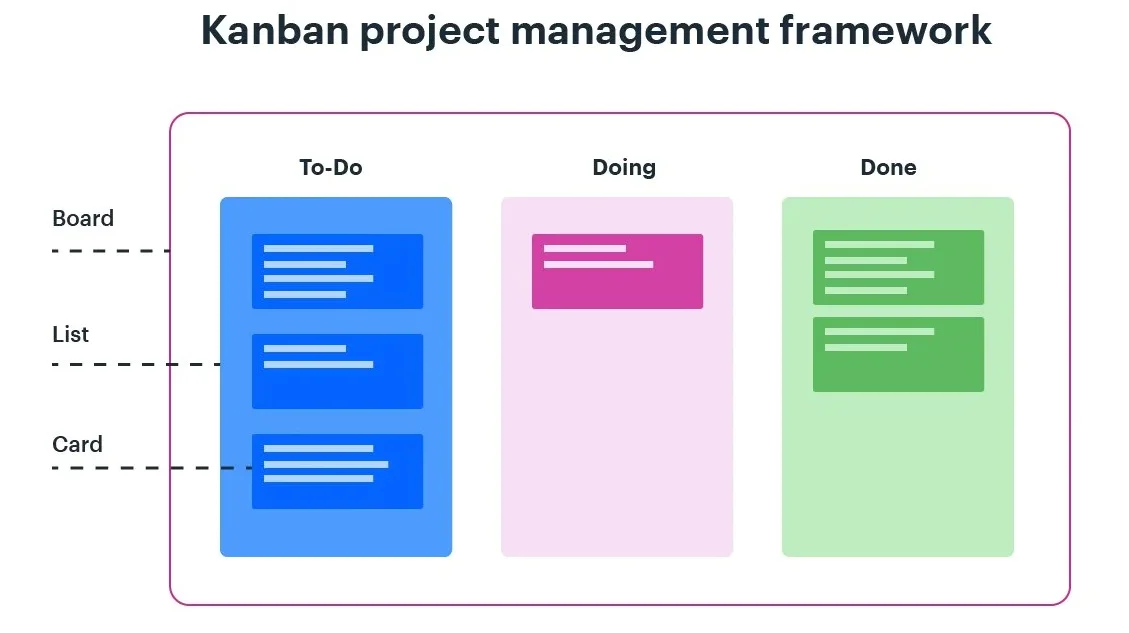
Kanban is an agile framework that uses a visual workflow board and limits work-in-progress (WIP) so that teams focus on completing tasks rather than starting many simultaneously, thereby improving throughput and reducing bottlenecks. It emphasises continuous flow rather than fixed iterations, which makes it particularly suitable for support, maintenance, and continuous delivery environments. Enterprises use Kanban to increase transparency across distributed teams and to handle unpredictable incoming work while maintaining steady delivery.
3. XP & Other Agile Variants
Extreme Programming (XP) and other agile variants like Lean and SAFe (Scaled Agile Framework) extend the agile approach by introducing additional technical practices, scaling mechanisms, and value streams for larger organisations. XP emphasises pair programming, test-driven development, and continuous integration, which suits projects with high technical risk or requirement volatility. Enterprises often adopt these variants when they require faster feedback loops, greater code quality discipline, or must scale agile across multiple teams and geographies.
Pros & Cons of Agile Approach to Software Development
Pros
- Increased customer collaboration: Agile places stakeholders and users at the centre of development, which ensures the final product aligns closely with business needs and adapts based on feedback.
- Rapid delivery of working software: Agile teams deliver functional increments frequently rather than waiting until the end, which allows early value realisation and reduces the risk of outdated requirements.
- Flexibility and adaptability: Agile supports changing requirements even late in the process by focusing on iterative development and continuous refinement, which increases responsiveness to market or business shifts.
- Empowered, cross-functional teams: Agile encourages self-organising teams composed of diverse skills, which fosters innovation, accountability, and faster decision-making.
- Continuous improvement and quality focus: Agile embeds feedback loops, frequent testing, and reflection ceremonies, which help maintain high code quality and evolve system design over time.
Cons
- Lack of predictability: Agile’s emphasis on change and iterative delivery means it can be difficult to forecast final costs, timeline, or scope early in the project, which can pose challenges for rigid budget environments.
- Less documentation and design upfront: Many agile teams prioritise working software over comprehensive documentation and architecture, which can lead to technical debt or maintenance challenges in large-scale systems.
- Dependency on stakeholder availability: Agile requires frequent collaboration, user feedback, and engaged product owners; when stakeholder participation is low or irregular, the project can lose direction or slow down.
- Team expertise and cultural readiness required: Successful agile adoption demands experienced teams, strong communication, and organisational culture change; organisations without these may struggle to realise the benefits.
- Risk of scope creep and resource overload: Because agile emphasises responsiveness and ongoing change, without strong governance, the project may suffer scope expansion, fatigue, or team burnout over time.
How to Choose the Right Agile Outsourcing Partner
Adopting an agile software development approach within your organisation is not straightforward due to factors such as changing requirements, distributed teams, and legacy technical environments. For that reason, engaging a specialised outsourcing partner becomes a strategic necessity. If your company is evaluating a reliable agile software development services provider, the following criteria will help guide your evaluation process:
- Agile maturity: Assess whether the partner has a demonstrated history of agile projects, mature agile processes, and an organisational culture that supports continuous delivery and feedback loops.
- Proven track record with agile engagements: Request case studies or references showing successful agile outcomes—such as frequent releases, stakeholder engagement, and measurable business impact.
- Continuous delivery capability: Check that the provider utilises automation (CI/CD), frequent iteration, quality assurance, and deployment practices that support ongoing releases rather than one-off deliveries.
- Cross-functional teams: Ensure the outsourcing firm assembles teams combining business analysis, UX/UI, development, testing, and DevOps—thus enabling end-to-end delivery with minimal hand-offs.
- Governance and communication model: Verify that the partner offers transparent governance structures, clear roles, reporting cadence, and effective tools for collaboration across time zones and organisational boundaries.
- Cultural fit and mindset alignment: Evaluate whether the provider aligns with your company’s values, work style, communication norms, and business objectives—because culture and mindset often determine agile success more than tools.

Choose Newwave Solutions for Quality Software Development Services
Having reviewed the key criteria for selecting an agile outsourcing partner, you now understand how to identify a capable provider of agile software development services. If you still seek a partner with proven expertise, robust delivery, and enterprise-grade capability, Newwave Solutions is an option worthy of your consideration. With more than 14 years of experience in software development and outsourcing, we have supported hundreds of global enterprises in delivering technology solutions and products to users.
Software Development Services by Newwave Solutions
- IT Outsourcing Services
- Offshore Software Development
- Software Outsourcing
- MVP Development Services
- Salesforce Development
- Web & Mobile Application Development
- Software Product Development & Maintenance

Why Choose Us?
- Staff Augmentation: We provide skilled, multidisciplinary professionals who integrate with your team, filling gaps quickly and scaling to your demands.
- Fixed-Price Model: For well-defined scopes, we offer upfront pricing that gives your business budget predictability and financial certainty.
- Time & Materials (T&M) Model: If your requirements may evolve, our flexible T&M model allows you to pay only for resources used while maintaining high quality and transparent billing.
- Dedicated Development Teams: We offer dedicated teams aligned with your strategic objectives and embedded in your governance framework, ensuring ownership and continuity.
- Enterprise-Grade Processes & Quality Assurance: With ISO-certified practices and agile workflows, our delivery emphasises reliability, security, and maintainable architecture across the software lifecycle.
Final Thoughts
After understanding the concept of Agile software development, we recommend that you start the Agile approach to Software Development practices with well-defined business objectives, a set of optimal tools, and, most importantly, a team of experts. Make sure you apply the appropriate frameworks and follow the principles strictly to ensure the efficiency of your project.
Choose a quality Agile outsourcing partner like Newwave Solutions, and we can help you in your software development process. With a highly expert team of an average of 14 years of experience, we are confident that we can help you achieve your project and business objectives. Contact us today to approach high-quality software development services to assist your business effectively.
Contact Information:
- Head Office (Hanoi): 1F, 4F, 10F, Mitec Building, Cau Giay Ward, Hanoi City, Vietnam
Branch Office (Tokyo): 1chōme118 Yushima, Bunkyo City, Tokyo 1130034, Japan - Hotline: +84 985310203
- Website: https://newwavesolution.com
- Email: [email protected]
To Quang Duy is the CEO of Newwave Solutions, a leading Vietnamese software company. He is recognized as a standout technology consultant. Connect with him on LinkedIn and Twitter.



Read More Guides
Get stories in your inbox twice a month.
Let’s Connect
Let us know what you need, and out professionals will collaborate with you to find a solution that enables growth.
Leave a Reply