


Top 10 Best Blockchain Programming Languages for Modern Development
As businesses continue exploring blockchain platforms for innovation, security, cost optimization, and new digital business models, choosing the right blockchain programming languages becomes one of the most important decisions in the Software Development Life Cycle of any blockchain initiative. This guide presents a detailed analysis of the top programming languages for blockchain, including why they are used, real technical strengths, and the types of blockchain projects they suit best. Whether you are building an enterprise-grade ledger, a DeFi protocol, an NFT marketplace, or MVP development for a new Web3 concept, the right language can significantly influence scalability, performance, and blockchain cost.
What is Blockchain Programming Language?
A blockchain programming language is any programming language used to build blockchain systems, decentralized applications, smart contracts, cryptographic protocols, or blockchain infrastructure components such as nodes and consensus engines.
Unlike conventional applications, blockchain development solutions must handle distributed consensus, immutable data, cryptography, and peer-to-peer networking. This means the underlying programming language must support:
- Deterministic execution
- High security and memory safety
- Efficient resource usage
- Strong concurrency models
- Predictable performance
- Compatibility with blockchain virtual machines
Choosing the right blockchain programming language is critical for several reasons:
- Different blockchain architectures: Each platform uses its own architecture, VM, consensus model, and runtime, so a language suitable for Ethereum may not work for Solana, NEAR, or Hyperledger Fabric.
- Security-driven development: Blockchain apps handle high-value assets, and even small bugs can cause irreversible losses. Choosing the right language reduces vulnerability risks.
- Varying performance needs: High-throughput chains require fast, low-level languages, while other projects may prioritize readability or rapid development instead of raw speed.
- Ecosystem and tooling impact: Strong language ecosystems provide better frameworks, testing tools, debugging, and deployment support.
- Maintainability and scalability: Using the wrong language leads to complexity and refactoring later, increasing long-term blockchain cost and slowing system growth.
In short, choosing the best programming language for blockchain is not about popularity. It is about alignment with your technical goals, project requirements, and target blockchain platforms.
Top 10 Best Blockchain Programming Languages
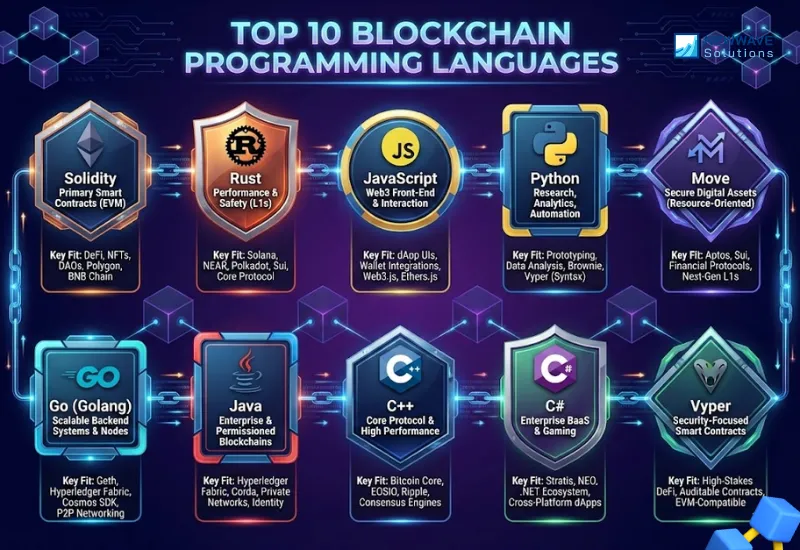
This section outlines the top languages shaping modern blockchain development. Before exploring each language in detail, it is important to recognize that different languages serve different blockchain layers:
- Smart contract development
- Blockchain node or protocol development
- Enterprise blockchain systems
- dApp integration and front-end
- Data analysis and blockchain tooling
Understanding this diversity helps teams select the right technology stack from the start.
1. Solidity
Solidity is the primary smart contract language for Ethereum and all EVM-compatible blockchains. It was designed from the ground up for decentralized applications, enabling secure execution within the Ethereum Virtual Machine.
Solidity uses a JavaScript-like syntax, making it accessible to millions of developers transitioning into Web3. It includes native primitives for addresses, tokens, events, and gas management. Its modular structure and library system make it essential for DeFi protocols, NFT marketplaces, DAOs, staking platforms, and the broader Web3 ecosystem.
Key Blockchain Fit
Solidity compiles to EVM bytecode, enabling deterministic smart contract execution. Its tight integration with Ethereum’s tooling (Hardhat, Truffle, Foundry) accelerates development cycles and improves audit readiness.
Suitable for
- DeFi protocols
- NFT and GameFi projects
- DAO governance systems
- EVM-compatible chains such as Ethereum, Polygon, BNB Chain, Avalanche C-Chain
Pros and Cons
| Pros | Cons |
|---|---|
| Familiar JS-like syntax | Requires strict auditing to avoid vulnerabilities |
| Largest Web3 developer ecosystem | Gas-efficient design requires experience |
| Rich tooling and frameworks | Not suitable for non-EVM blockchains |
| Wide documentation and libraries | Performance limited by EVM |
2. Rust
Rust is known for performance, safety, concurrency, and memory control. Its unique ownership model eliminates entire classes of bugs at compile-time, making it ideal for mission-critical blockchain systems. Rust is the backbone of high-performance Layer 1 blockchains like Solana, NEAR, Polkadot, and Sui. Its capabilities extend from core protocol development to high-throughput smart contracts.
Rust’s core value proposition is “performance without compromising safety.” Its ownership model and strict compile-time checks eliminate entire classes of bugs like null pointer dereferences, buffer overflows, and data races. This is a game-changer for blockchain, where a single bug can lead to the loss of hundreds of millions of dollars.
Key Blockchain Fit
For new Layer 1 blockchains aiming for high throughput (like Solana), Rust’s speed and efficient resource management are non-negotiable. It allows developers to build fast, secure, and concurrent systems at the protocol level, making it ideal for core development, not just smart contracts.
Suitable for
- High-performance blockchains
- Parallel transaction engines (Solana)
- Core blockchain protocol development
- Secure financial protocols
Pros and Cons
| Pros | Cons |
|---|---|
| High-performance and memory safety | Steeper learning curve |
| Eliminates common security vulnerabilities | More complex toolchain |
| Excellent concurrency support | Smaller ecosystem than JS or Python |
| Suitable for both L1 and smart contracts | Longer development time |
3. JavaScript
JavaScript powers most front-end web applications, and its natural role extends to decentralized applications. While not used for smart contracts directly, JavaScript is essential for interacting with nodes and integrating blockchain features into Web interfaces.
Since most decentralized applications (dApps) are accessed through web browsers, JS (and its ecosystem) is the undisputed king for building the front-end that users interact with.
Key Blockchain Fit
Libraries like Web3.js and Ethers.js are the bridge that allows a web page to communicate with a blockchain node. They translate JavaScript function calls into JSON-RPC requests that nodes can understand, enabling actions like sending transactions, reading smart contract state, and listening to on-chain events.
Suitable for
- dApp front-ends
- Wallet integrations
- API interaction with blockchain nodes
- Light scripting for Web3 applications
Pros and Cons
| Pros | Cons |
|---|---|
| Largest developer community | Less secure if not written carefully |
| Highly flexible | Slower than compiled languages |
| Excellent libraries (Web3.js, Ethers.js) | Not for core blockchain logic |
| Works across browsers and mobile | Requires constant updates and patches |
4. Python
Python is widely used for blockchain research, prototyping, testing, and automation. It offers readability, strong libraries, and rapid development capabilities.
Python is essential for blockchain analytics, AI-driven system components, backend services, and proof-of-concept blockchain models. Tools like Brownie support Python-based Ethereum development, while Vyper uses a Python-like syntax for secure smart contracts.
Key Blockchain Fit
Beyond scripting and automation, Python is used for:
- Prototyping: Quickly testing a consensus algorithm or economic model.
- Data Analysis: Querying and analyzing on-chain data.
- Frameworks: Brownie is a popular Python-based framework for smart contract testing and deployment.
- Vyper: The security-focused language Vyper uses a Pythonic syntax, leveraging its readability for safer contract code.
Suitable for
- Smart contract testing
- Blockchain data analysis
- Prototyping and research
- Backend services for dApps
Pros and Cons
| Pros | Cons |
|---|---|
| Clean and readable | Not suitable for high-performance blockchain layers |
| Rich scientific libraries | Limited concurrency performance |
| Great for prototyping | GIL restricts parallelism |
| Strong community | Smaller blockchain-specific ecosystem |
5. Move
Move was built from the ground up by Facebook (now Meta) for the Diem blockchain with a singular focus: secure digital asset management. Its core innovation is the “resource” type, which has semantics inspired by linear logic: resources cannot be copied or accidentally destroyed, only moved.
Blockchains such as Aptos and Sui adopted Move due to its safety guarantees and performance-oriented design, making it a strong candidate for financial protocols and next-gen Layer 1 chains.
Key Blockchain Fit
This “resource-oriented” model is a perfect fit for blockchains that treat digital assets as first-class citizens (like Aptos and Sui). It makes it impossible to write code that duplicates a token or loses track of it, fundamentally preventing many of the hacks that have plagued Solidity contracts.
Suitable for
- High-security financial protocols
- Next-generation L1 ecosystems
- Digital asset management
- Transactional systems requiring determinism
Pros and Cons
| Pros | Cons |
|---|---|
| Resource-oriented security | Smaller ecosystem |
| Designed for performance | Steep learning curve |
| Built for safe asset management | Limited tooling compared to Solidity |
| Reduces common smart contract vulnerabilities | Fewer developers available |
6. Go (Golang)
Go was designed by Google for building modern, scalable, and efficient backend systems and distributed networks. This aligns perfectly with the needs of a blockchain node, which is fundamentally a peer-to-peer distributed system. It powers major blockchain frameworks such as Hyperledger Fabric, Ethereum’s Geth client, and Cosmos SDK.
Key Blockchain Fit
Go’s simplicity, fast compilation, excellent standard library, and built-in concurrency primitives (goroutines and channels) make it ideal for implementing the complex networking, consensus, and concurrent transaction processing required by blockchain nodes. This is why it’s the language for Go-Ethereum (Geth), Hyperledger Fabric, and Cosmos SDK.
Suitable for
- Blockchain protocol development
- Node implementation
- P2P networking
- Enterprise blockchain infrastructure
Pros and Cons
| Pros | Cons |
|---|---|
| Great for distributed systems | Basic standard library |
| Fast compilation and strong concurrency | Less expressive generics (until recent updates) |
| Stable and easy to maintain | Not ideal for complex smart contracts |
| Widely used in enterprise-grade blockchains | Smaller Web3-specific ecosystem |
7. Java
Java remains dominant in enterprise application development and is widely used in private and permissioned blockchains. Its scalability, security features, and large ecosystem make it suitable for complex business workflows.
Frameworks such as Hyperledger Fabric and Corda rely heavily on Java due to its reliability and broad developer base.
Key Blockchain Fit
Enterprise blockchains like Hyperledger Fabric and Corda prioritize privacy, interoperability with existing systems, and a permissioned model. Java’s robustness and the vast availability of enterprise-grade libraries and developers make it a natural fit for building the complex business logic required in these environments.
Suitable for
- Enterprise dApps
- Private blockchain networks
- Identity and compliance systems
- Financial and supply chain solutions
Pros and Cons
| Pros | Cons |
|---|---|
| Strong enterprise ecosystem | Verbose syntax |
| Write once, run anywhere | Higher memory overhead |
| Mature security frameworks | Slower than Rust or C++ |
| Great documentation and libraries | More complex for small dApps |
8. C++
C++ offers full control over memory, CPU, and performance. It is used for blockchain core components requiring maximum efficiency, such as consensus mechanisms and virtual machine design.
It provides fine-grained control over memory and system resources, which is essential when building the foundational layer of a blockchain. Bitcoin Core, EOSIO, Ripple, and Litecoin were built using C++.
Key Blockchain Fit
Bitcoin’s core is written in C++ because Satoshi Nakamoto needed absolute control over performance and resource management. This legacy continues with other L1s like EOS and Litecoin. C++ is used where every CPU cycle and byte of memory counts, such as in consensus engines and cryptographic operations.
Suitable for
- Core protocol development
- High-performance blockchain nodes
- Cryptographic engines
- Custom virtual machines
Pros and Cons
| Pros | Cons |
|---|---|
| Maximum performance | Steep learning curve |
| Complete memory control | Error-prone without experience |
| Suitable for protocol-level systems | Longer development cycles |
| Widely used in major L1s | Manual memory management |
9. C#
C# is modern, object-oriented, and supported by the powerful .NET ecosystem. It is often used in Blockchain-as-a-Service (BaaS) platforms and gaming-oriented blockchain systems. Blockchains like Stratis and NEO are deeply integrated with the C# ecosystem.
Key Blockchain Fit
Suitable for
- Enterprise-grade BaaS
- Blockchain gaming ecosystems
- Cross-platform dApps
- Token economy solutions
Pros and Cons
| Pros | Cons |
|---|---|
| Clean, modern syntax | Smaller blockchain ecosystem |
| Strong tooling in .NET | Historically tied to Microsoft |
| Good performance | Fewer blockchain libraries |
| Easy for enterprise adoption | Less suitable for core protocols |
10. Vyper
Vyper was created to address the security limitations of Solidity. With a Python-like syntax, it prioritizes simplicity and auditability over expressiveness. It is used for high-value financial applications where clarity and predictability matter more than flexibility.
Key Blockchain Fit
Its design philosophy is “maximal human readability.” By being more Python-like and less JavaScript-like, it aims to be understood even by those not deeply familiar with the language. It’s a specialist tool for developers who prioritize security and simplicity over expressive power, especially in high-value DeFi contracts where the cost of a bug is astronomical.
Suitable for
- High-stakes DeFi
- Security-focused smart contracts
- EVM-compatible chains
- Auditable financial operations
Pros and Cons
| Pros | Cons |
|---|---|
| Highly readable syntax | Fewer features than Solidity |
| Built for security | Small developer community |
| Excellent for audits | Limited tooling |
| Avoids complexity | Slower development progress |
In summary, the diversity of programming languages in blockchain isn’t random. Each was chosen—or created—to solve specific problems, from enabling global shared computation (Solidity) to building unbreakable financial primitives (Rust, Move) and scalable enterprise systems (Java, Go).
How to Choose the Right Language for Your Blockchain Project
Choosing the most suitable programming language for blockchain development solutions begins with understanding your project’s purpose, performance needs, and the ecosystem you plan to build on. Different blockchain platforms operate with different architectures, throughput goals, security requirements, and integration expectations. Because of this, the ideal language is the one that aligns naturally with your technical objectives, long-term scalability strategy, and the capabilities of your development team. Below is a practical guide to help you map the right language to the right type of blockchain project.
Best Language Choices by Project Type:
- Ethereum and EVM-Compatible dApps: Solidity is the default choice for smart contracts on Ethereum, Polygon, BNB Chain, and other EVM-based platforms. It offers the largest ecosystem, the richest tooling, and the most established standards for DeFi, NFTs, and DAOs.
- High-Performance or Next-Generation Layer 1 Blockchains: Rust or Move is suitable for projects built on Solana, NEAR, Aptos, or Sui. These languages deliver exceptional speed, safety guarantees, and memory control, making them ideal for advanced L1 architectures and high-frequency applications.
- Blockchain Core Infrastructure and Protocol Development: Go or C++ should be used when building node implementations, consensus algorithms, and peer-to-peer networking layers. They provide the low-level performance and efficient concurrency required for reliable blockchain infrastructure.
- Enterprise-Grade or Private Blockchain Solutions: Java or enterprise frameworks like Hyperledger Fabric are ideal for permissioned blockchains. They support enterprise integration, structured workflows, identity management, and large-scale business processes.
- Prototyping, Research, and Data-Driven Blockchain Tools: Python is best for rapid experimentation, blockchain analytics, and simulations. Its simplicity and strong libraries make it excellent for early-stage modeling, testing, and scripting tasks.
Wrap Up
Selecting the right blockchain programming language lays the foundation for secure architecture, long-term scalability, predictable blockchain cost, and successful deployment across modern blockchain platforms. Each language in this list brings its own strengths, whether for building decentralized applications, developing new Layer 1 blockchains, creating enterprise-ledger systems, or shaping MVP development in the early phases of innovation.
If your goal is to build a secure, scalable, and production-ready blockchain solution, choosing the right technology stack at the beginning will dramatically influence your Software Development Life Cycle, total ownership cost, development speed, and security posture.
At Newwave Solutions, we help global businesses navigate this complexity with end-to-end blockchain development services. Our engineers in Vietnam specialize in multiple programming languages for blockchain development, including Java, Python, C++ and more. Whether you need architectural consulting, smart contract engineering, enterprise blockchain integration, or guidance on selecting the best programming language for blockchain projects, we provide the technical clarity and development capability needed to turn your ideas into robust blockchain technology.
From initial strategy to full-cycle implementation, Newwave Solutions supports startups, SMEs, and enterprises worldwide with advanced emerging technology development solutions designed to scale.
If you are looking for blockchain development companies that can turn complex ideas into secure, high-performing solutions — we are ready to help.
To Quang Duy is the CEO of Newwave Solutions, a leading Vietnamese software company. He is recognized as a standout technology consultant. Connect with him on LinkedIn and Twitter.




Get stories in your inbox twice a month.
Let’s Connect
Let us know what you need, and out professionals will collaborate with you to find a solution that enables growth.
Leave a Reply