


Batch vs Real Time Processing: A Strategic Guide for Enterprise Data Architecture
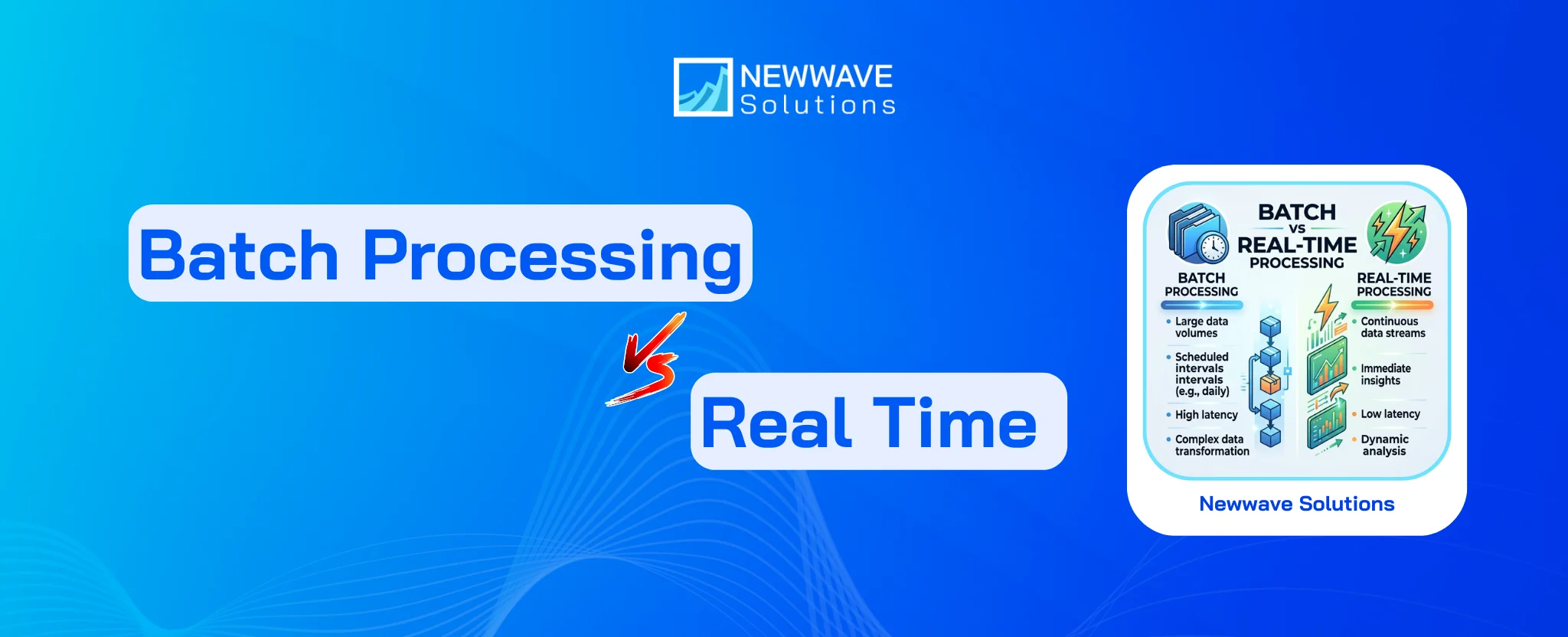
Every modern enterprise eventually reaches a point where its Data Architecture and Data Processing Pipelines begin to determine how fast decisions can be made and how accurately performance can be measured. At that moment, the comparison of batch vs real time processing shifts from a technical debate to a mission-critical choice that directly affects operational efficiency and system responsiveness. The following analysis will guide you through the essential differences and architectural criteria for making the right decision on which model can best optimize both cost structure and performance across your data architecture.
What Is Batch Processing?
Batch processing refers to a data processing model in which large volumes of data are collected over a defined period and then processed together as a single unit. Instead of handling each transaction instantly, the system waits until a scheduled trigger initiates execution, which makes it highly efficient for structured and repetitive workloads. As a result, organizations that prioritize stability, cost control, and predictable execution often rely on batch processing to manage core operational data pipelines.
Example: A global cloud service provider such as Amazon Web Services applies batch processing to aggregate and analyze usage logs across millions of customer accounts at scheduled intervals. This approach enables accurate billing reconciliation and infrastructure reporting while maintaining cost efficiency at scale.
Common Use Cases
- Data conversion: Enterprises use batch processing to migrate or transform legacy datasets into new formats, allowing large data volumes to be converted systematically without interrupting daily operations.
- Supply chain fulfillment: Retail and logistics companies process accumulated order data in scheduled batches to optimize shipment planning, warehouse coordination, and delivery routing efficiency.
- Report generation: Organizations generate daily, weekly, or monthly performance reports through batch workflows that consolidate transactional data into structured analytics outputs for leadership review.
- Billing and payroll: Financial systems execute batch jobs to calculate salaries, invoices, and tax deductions in bulk, ensuring consistency and compliance across thousands of transactions.
- Inventory processing: Enterprises update stock levels and reconcile warehouse records in periodic batches, which helps maintain data integrity without constant real-time synchronization overhead.
- Maintaining subscription cycles: SaaS platforms schedule recurring subscription renewals, usage calculations, and invoice generation through batch routines that ensure predictable revenue tracking and system stability.
Pros & Cons
Pros
- Lower infrastructure cost optimization
- High efficiency for large data volumes
- Predictable scheduled execution
- Strong data reconciliation control
- Simplified pipeline architecture
- Stable performance under heavy workloads
- Scalable compute allocation during off-peak hours
- Suitable for historical analytics and reporting
Cons
- High processing latency
- Delayed business insights
- Limited real-time responsiveness
- Potential backlog accumulation risk
- Less suitable for event-driven applications
What Is Real Time Processing?
Real-time processing is a data processing model that ingests, analyzes, and responds to data immediately as it is generated. Instead of waiting for scheduled execution, the system processes each event continuously, enabling instant decision-making and system feedback. Consequently, enterprises that require immediate responsiveness, low-latency performance, and dynamic user experiences adopt real-time processing as a core architectural component.
Example: A multinational digital payment company, such as Visa, utilizes real-time processing to analyze transaction streams within milliseconds to detect suspicious activity. This capability allows the organization to prevent fraud instantly while maintaining seamless customer payment experiences.
Common Use Cases
- Fraud detection systems: Financial institutions apply real-time processing to evaluate transaction patterns instantly, enabling immediate risk scoring and fraud prevention before a transaction is completed.
- Online transaction processing systems: Banking platforms and ATM networks rely on real-time processing to verify account balances and authorize withdrawals without delay.
- Real-time monitoring systems: Defense and aviation industries utilize streaming architectures to analyze radar and sensor data continuously, ensuring rapid response to anomalies.
- IoT applications: Industrial environments process temperature, pressure, and equipment sensor data in real time to trigger automated alerts and prevent operational failures.
Pros & Cons
Pros
- Immediate data availability
- Low-latency decision-making
- Enhanced customer experience responsiveness
- Continuous event-driven architecture
- Proactive anomaly and fraud detection
- Improved operational visibility
- Better support for IoT and streaming workloads
- Dynamic system adaptability
Cons
- Higher infrastructure and operational cost
- Increased architectural complexity
- Greater monitoring and maintenance demand
- Scalability challenges under peak traffic
- Higher risk of real-time failure propagation
Real Time vs Batch Processing: Key Differences
After understanding the fundamentals of both real-time processing and batch processing, the next logical step is to examine how they differ across critical architectural dimensions. A structured comparison allows enterprises to evaluate which model aligns more closely with operational priorities, infrastructure constraints, and performance expectations.
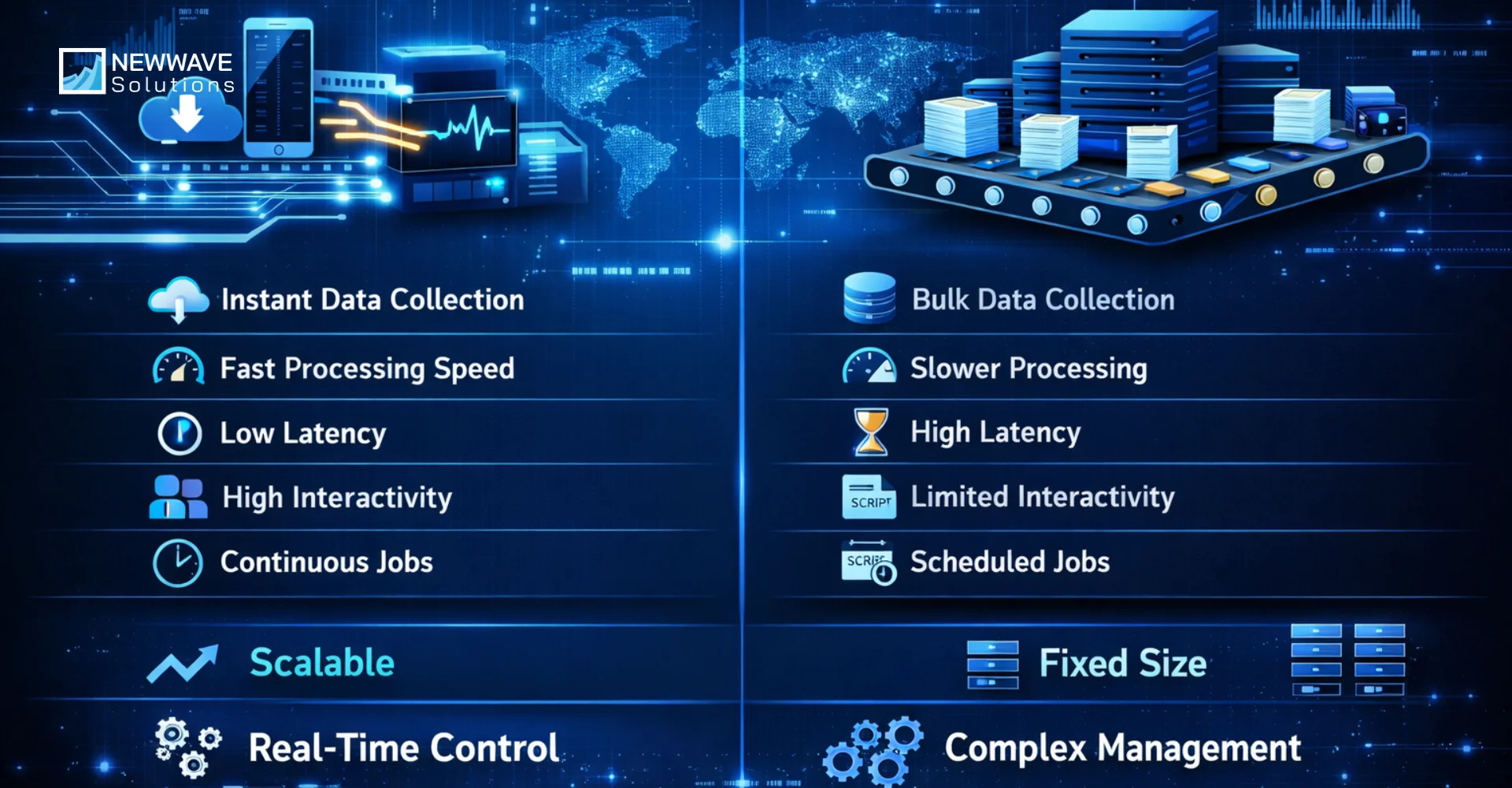
| Criteria | Batch Processing | Real Time Processing |
| Data Collection | Accumulates data over time | Continuous data ingestion |
| Processing Speed | Scheduled execution | Immediate execution |
| Latency | High latency | Low latency |
| Scalability | Scales for bulk workloads | Scales for streaming workloads |
| Job Frequency | Periodic | Continuous |
| Interactivity | Limited user interaction | High interactivity |
| Job Control | Centralized scheduling | Event-driven orchestration |
| Complexity | Moderate architectural complexity | High architectural complexity |
| Data Sources | Structured internal systems | Dynamic multi-source streams |
1. Data Collection
Batch processing collects and stores data over a defined period before initiating execution. This accumulation model ensures organized data consolidation but delays immediate analysis.
Real-time processing ingests data continuously from event streams as soon as it is generated. This model enables instant visibility but requires persistent system readiness.
Verdict: Real-time processing is superior when immediate insight is required because continuous ingestion supports faster business reaction.
2. Processing Speed
Batch processing executes workloads according to predefined schedules, which optimizes system throughput for large datasets. However, execution only begins once the trigger condition is met.
Real-time processing handles each data event instantly, enabling rapid system feedback and dynamic updates. The architecture prioritizes responsiveness over grouped efficiency.
Verdict: Real-time processing offers better speed for time-sensitive applications because execution occurs immediately.
3. Latency
Batch processing introduces inherent latency since results are only available after the batch job completes. This delay is acceptable for reporting or reconciliation tasks.
Real-time processing minimizes latency by processing events as they occur. The system is designed to reduce milliseconds of delay in critical environments.
Verdict: Real-time processing is optimal where latency directly impacts user experience or risk mitigation.
4. Scalability
Batch systems scale effectively by allocating compute resources temporarily during heavy processing windows. This elasticity supports large volume data consolidation.
Real-time systems scale horizontally to handle continuous event streams, but require persistent infrastructure capacity. Scaling must account for unpredictable traffic spikes.
Verdict: Batch processing is more cost-efficient for predictable bulk scaling, while real-time processing is better for fluctuating event-driven demand.
5. Job Frequency
Batch jobs operate on daily, weekly, or monthly cycles depending on business requirements. This periodic execution ensures operational stability and structured workflow management.
Real-time processing runs continuously without scheduled interruption. Events trigger execution automatically based on incoming data signals.
Verdict: Real-time processing provides superior operational continuity due to its uninterrupted execution model.
6. Interactivity
Batch processing provides limited interactivity because results are generated after scheduled execution. Users must wait until processing completes before accessing insights.
Real-time processing enables dynamic user interaction by delivering immediate system responses. This capability enhances digital experiences in customer-facing platforms.
Verdict: Real-time processing is more suitable for interactive systems where user engagement depends on immediate feedback.
7. Job Control
Batch systems rely on centralized schedulers that define when and how jobs execute. Control is predictable and administratively structured.
Real-time systems use event-driven orchestration mechanisms to respond to streaming triggers. Control is distributed and requires continuous monitoring.
Verdict: Batch processing provides simpler governance, while real-time processing demands advanced orchestration for optimal control.
8. Complexity
Batch processing architectures are generally less complex because execution occurs in controlled intervals. The reduced need for constant monitoring simplifies maintenance.
Real-time architectures require messaging systems, streaming frameworks, and failover mechanisms. The continuous nature of execution increases engineering complexity.
Verdict: Batch processing is more straightforward to implement, whereas real-time processing introduces higher technical complexity.
9. Data Sources
Batch processing primarily integrates structured data from internal enterprise systems such as ERP, CRM, or financial databases. Data flows follow predictable pipelines.
Real-time processing aggregates data from multiple dynamic sources, including APIs, IoT sensors, user interactions, and transactional systems. The model supports diverse and rapidly changing streams.
Verdict: Real-time processing is better suited for multi-source, event-driven environments requiring immediate aggregation.
Real Time Processing vs Batch Processing: Which is Better?
From an architectural and operational perspective, real-time processing currently holds a stronger advantage in environments where speed, responsiveness, and user experience directly impact business performance. Enterprises that rely on digital transactions, interactive platforms, or risk-sensitive systems increasingly prioritize immediacy over periodic consolidation.
Key reasons supporting this position include:
- Immediate decision support capability
- Reduced latency for customer-facing applications
- Enhanced fraud detection and anomaly prevention
- Continuous operational visibility
- Improved responsiveness in event-driven systems
However, batch processing remains strategically valuable for structured reporting, cost-sensitive workloads, and reconciliation processes.
Emerging Trends in Data Processing Architecture
Data processing architecture is evolving toward hybrid environments where batch and real-time models coexist within unified platforms. Industry research from Gartner and IDC indicates that enterprises increasingly adopt combined architectures to balance cost efficiency with performance responsiveness.
Key emerging directions include:
- Edge Computing and Event Driven Systems: Growth of decentralized data processing near data sources to reduce latency and support mission-critical IoT applications.
- AI Driven Stream Optimization: Machine learning models embedded within streaming pipelines to dynamically prioritize events and optimize throughput.
- Real Time Analytics for Predictive Decision Making: Expansion of continuous analytics in finance, healthcare, and manufacturing to support proactive rather than reactive decisions.
Industries most affected by these developments include financial services, e-commerce, telecommunications, healthcare, and industrial automation, where architectural choices directly influence competitive advantage and operational resilience.
As data processing architectures grow more distributed and cloud-dependent, the infrastructure decisions underneath them matter just as much as the patterns on top. Keeping up with how cloud migration strategies are evolving gives architects and engineering leads a clearer picture of where modern data pipelines are heading.
Why Real-time Processing is the Gold Standard for Offshore Success?
The choice between batch and real-time processing is fundamentally linked to the strategic success of offshore software development activities. Consequently, businesses implementing offshore models must meticulously evaluate which data processing method aligns best with their goals to optimize operational costs and overall efficiency. Moreover, selecting the right framework is crucial for ensuring robust data security and seamless project integration across borders.
Currently, real-time processing has emerged as the superior solution for offshore software development, becoming the preferred choice for forward-thinking enterprises. This approach significantly enhances project quality and safety by providing continuous updates and high-level security protocols that traditional methods may lack. Therefore, prioritizing real-time capabilities ensures that your offshore venture remains competitive and highly responsive in a fast-paced digital landscape.
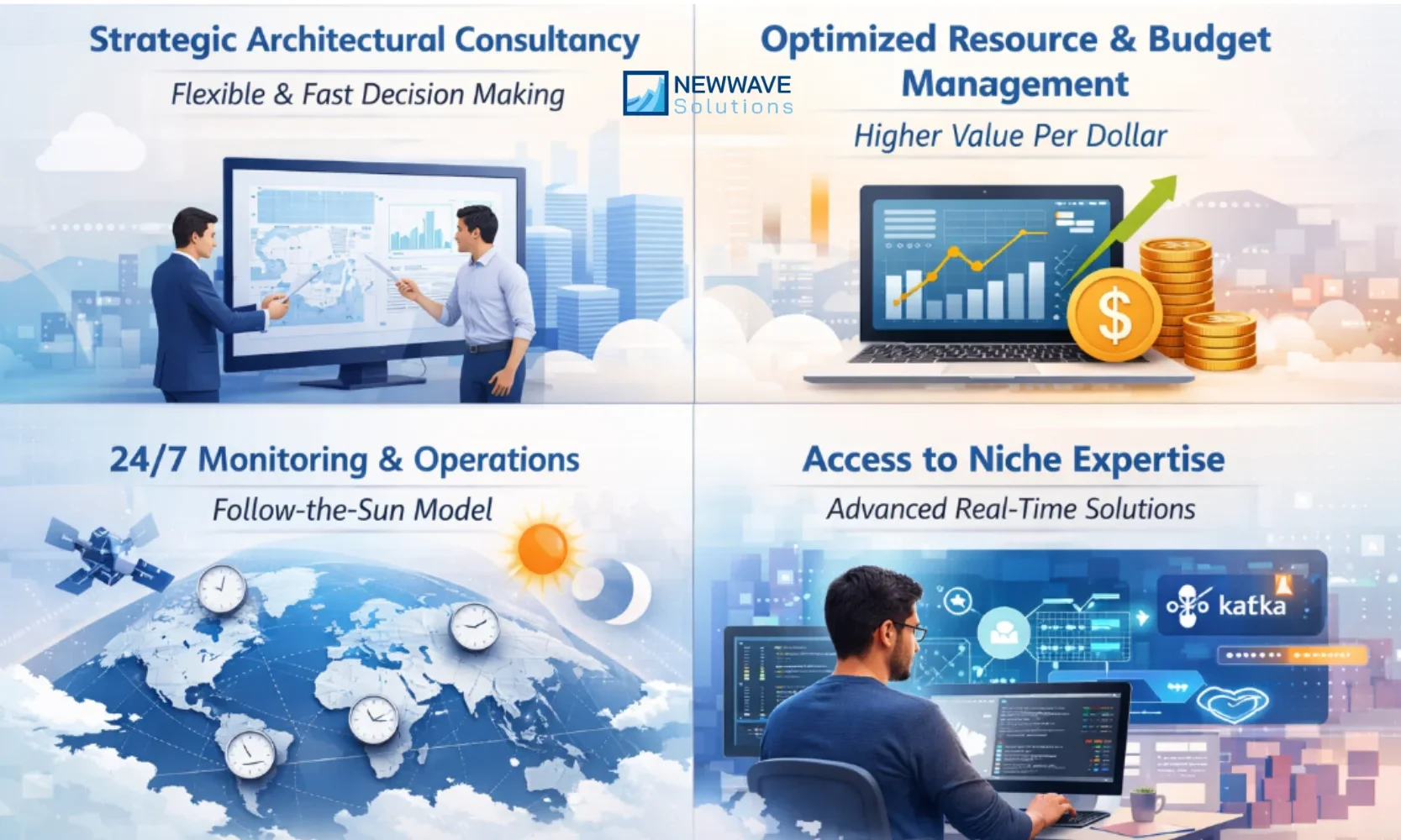
Why Real-time Processing Outperforms in an Offshore Environment:
- Strategic Architectural Consultancy: While batch processing might seem simpler for initial architectural setups, a professional offshore team acts as strategic consultants who favor real-time processing to solve complex, modern business problems. Although batch can lower immediate cloud costs in certain scenarios, real-time architecture offers superior long-term flexibility and faster decision-making insights.
- Optimized Resource & Budget Management: Even though batch processing is traditionally recognized for being budget-friendly and easier to maintain, real-time processing provides a much higher “value per dollar” for dynamic projects. By investing in real-time systems, offshore teams eliminate the hidden costs associated with data latency, ensuring a more efficient and profitable software product.
- Seamless 24/7 Operations (Follow-the-Sun): Real-time processing requires constant monitoring, which can be a burden for local teams; however, the offshore model perfectly offsets this by utilizing time zone differences. Your offshore partner ensures that real-time data streams are monitored 24/7, turning a potential high-maintenance requirement into a significant operational advantage.
- Access to Specialized Niche Skills: Building sophisticated real-time systems (using tools like Kafka or Spark Streaming) requires elite technical expertise that is often scarce. Businesses seek offshore partners specifically to access these specialized talents, as real-time processing allows these experts to deliver high-end, high-performance solutions that far exceed the capabilities of standard batch systems.
Based on global industry practices and the expert perspective of Newwave Solutions—a premier provider of professional offshore software development services—real-time processing is generally a more optimized and comprehensive choice than batch processing. However, we recommend that your enterprise carefully consider specific factors such as budget constraints and internal resources to decide the most appropriate solution for your unique offshore software journey.
Conclusion
Ultimately, the evaluation of batch vs real time processing depends on how your business prioritizes data velocity, risk tolerance, and budget allocation. A well-defined architectural roadmap reduces uncertainty and strengthens the foundation for continuous digital growth.
An experienced offshore software development partner can help you design a balanced environment where batch and streaming workloads coexist efficiently. Don’t worry if you can’t find a suitable partner yet, since Newwave Solutions stands ready to assist you in implementing high-performance batch and real-time processing solutions tailored to your enterprise objectives. Contact us and discuss the way to balance the efficiency and budget of your offshore software development project.
To Quang Duy is the CEO of Newwave Solutions, a leading Vietnamese software company. He is recognized as a standout technology consultant. Connect with him on LinkedIn and Twitter.



Read More Guides



Get stories in your inbox twice a month.
Let’s Connect
Let us know what you need, and out professionals will collaborate with you to find a solution that enables growth.
Leave a Reply