


Blockchain as a Service (BaaS): How It Works, Benefits & Use Cases
While blockchain technology has expanded rapidly, deploying and maintaining the underlying infrastructure remains a complex and technically demanding task for many organizations. This challenge has fueled the rise of Blockchain as a Service (BaaS), which is projected to reach USD 4.58 billion by 2031, driven largely by enterprise demand for secure and transparent digital infrastructure.
This article provides CTOs and tech managers with an in-depth look at benefits of BaaS, common use cases, and future market shifts, ensuring you have the insights needed to integrate blockchain technology successfully.
Key Takeaways
|
What is Blockchain as a Service (BaaS)?
Blockchain as a Service (BaaS) is a cloud-based service model in which third-party providers build, host, and manage blockchain networks for businesses. It allows organizations to develop blockchain applications without setting up servers, maintaining nodes, or managing the underlying infrastructure themselves.
By reducing technical and operational barriers, BaaS supports blockchain adoption across industries such as finance, logistics, and healthcare. Major technology providers, including Microsoft, Amazon, and IBM, have introduced BaaS solutions to help enterprises integrate blockchain into their business processes.

How Does Blockchain as a Service Work?
Blockchain as a Service helps organizations deploy and manage blockchain networks through a cloud-based, pre-configured environment. After subscribing to a BaaS platform, businesses gain access to the infrastructure, tools, and services required to build, test, and launch blockchain applications without maintaining the underlying network themselves.
The BaaS provider handles technical responsibilities such as setting up nodes, validating and storing transactions, monitoring network health, applying updates, and maintaining availability across distributed data centers. Meanwhile, users can focus on developing decentralized applications and smart contracts.
Organizations can also customize their networks by selecting consensus mechanisms, defining access permissions, and configuring data storage. Built-in scalability and performance tools allow the network to adapt to changing transaction volumes and business requirements.
Key Characteristics of Blockchain as a Service
Blockchain as a Service combines core blockchain technologies with managed cloud infrastructure, allowing businesses to build and operate blockchain applications more efficiently. Its key features include:
- Distributed ledger technology: BaaS platforms provide a shared and tamper-resistant ledger that records and synchronizes data across authorized network participants.
- Cryptographic security: Hashing, encryption, and digital signatures help protect transaction data, verify user identities, and maintain data integrity.
- Consensus mechanisms: Built-in protocols enable network nodes to validate transactions and agree on the ledger’s current state without relying on a central authority.
- Managed blockchain nodes: Providers host, configure, monitor, and maintain the nodes responsible for storing ledger copies and validating transactions.
How Businesses can Benefit from Blockchain as a Service
Blockchain as a Service enables organizations to adopt blockchain technology without building and maintaining complex infrastructure internally. By combining managed cloud services with blockchain capabilities, it can improve efficiency, security, scalability, and cost control.
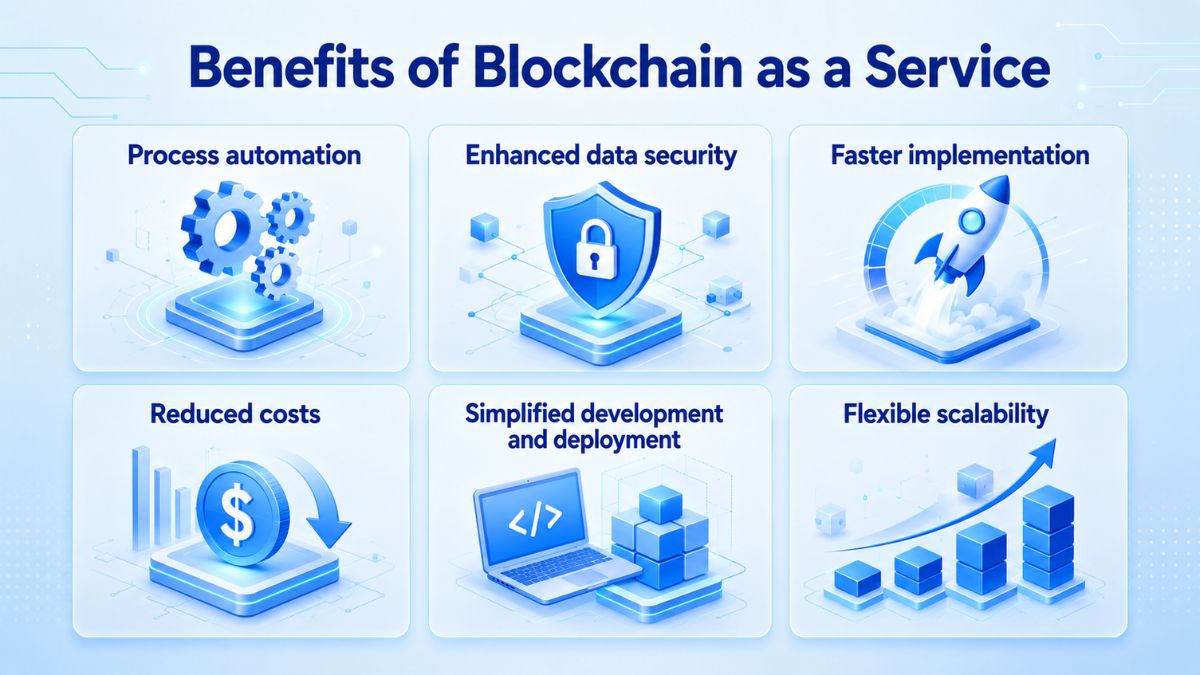
Process automation
BaaS supports automated business processes through smart contracts that execute transactions once predefined conditions are met. This reduces manual intervention, accelerates workflows, and improves operational consistency across different systems and participants.
Enhanced data security
BaaS platforms use encryption, digital signatures, access controls, and distributed ledger technology to protect business data. These security mechanisms help prevent unauthorized changes while strengthening data integrity, accountability, and transaction transparency.
Faster implementation
Building a private blockchain from scratch requires infrastructure, specialized talent, testing, and employee training. BaaS provides pre-configured environments and development tools, allowing businesses to deploy blockchain applications faster and shorten the initial ramp-up period.
Reduced costs
BaaS reduces the need to invest heavily in servers, blockchain specialists, maintenance, and network administration. Blockchain-based processes can also lower operational costs by reducing reliance on intermediaries and simplifying multi-party transactions.
Simplified development and deployment
Blockchain systems require extensive configuration, testing, and monitoring before launch. BaaS providers offer pre-tested frameworks, managed infrastructure, and technical support, helping organizations streamline development and reduce the risks associated with complex deployments.
Flexible scalability
BaaS platforms allow organizations to scale blockchain resources according to transaction volumes and changing business requirements. Businesses can increase or reduce network capacity without rebuilding the underlying infrastructure, helping maintain stable performance as demand changes.
Blockchain as a Service vs. Self-Managed Blockchain
Choosing between Blockchain as a Service and a self-managed blockchain depends on an organization’s technical capabilities, budget, customization needs, and long-term strategy. BaaS reduces infrastructure and operational burdens, while an in-house model provides greater control and ownership.
|
Factor |
BaaS |
Self-Managed Blockchain |
|
Cost |
Lower upfront cost with subscription-based pricing. | Higher investment in infrastructure, staff, and maintenance. |
|
Management |
The provider manages nodes, security, updates, and availability. | The organization manages the entire blockchain environment. |
|
Deployment speed |
Faster through pre-configured cloud infrastructure. | Slower due to internal setup, testing, and configuration. |
|
Control |
Flexible but limited by the provider’s platform. | Full control over protocols, architecture, and governance. |
|
Best for |
Businesses prioritizing speed, flexibility, and lower complexity. | Organizations requiring deep customization and infrastructure ownership. |
Common Use Cases of Blockchain as a Service
BaaS helps organizations apply blockchain to business processes that require secure data sharing, transaction transparency, traceability, and automation. Here are the most common use cases of BaaS in different industries:
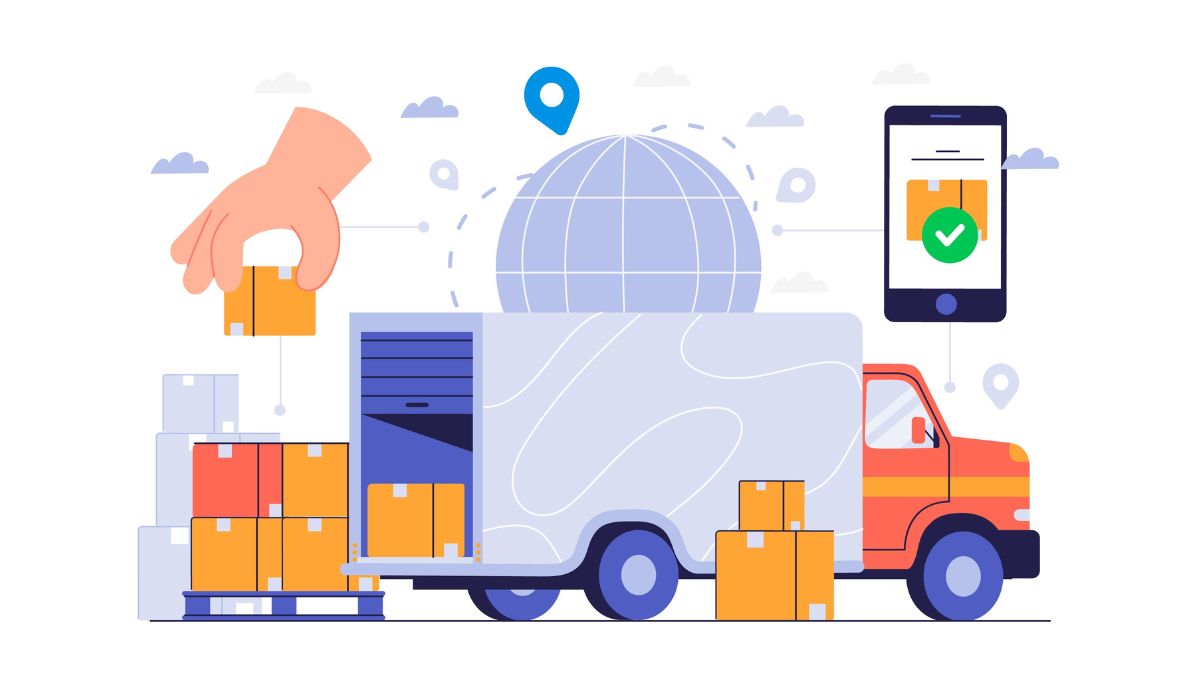
Supply chain management
BaaS enables stakeholders to record and verify product origin, shipment status, and delivery data on a shared ledger. It is especially useful for improving traceability and confirming authenticity in food, pharmaceutical, and luxury goods supply chains.
Financial services
Financial institutions can use BaaS for cross-border payments, remittances, trade finance, and digital asset management. It also supports the issuance and transfer of cryptocurrencies, tokenized securities, and other blockchain-based assets.
Healthcare
BaaS can improve the secure exchange and management of electronic health records. Patients can control access to their data, while healthcare providers can retrieve authorized information without compromising privacy or integrity.

Real estate
BaaS supports real estate tokenization by representing property ownership through blockchain-based tokens. These tokens can be divided, transferred, and traded more easily, helping make real estate investment more accessible.
Gaming and entertainment
BaaS enables verifiable ownership and trading of in-game items, collectibles, and other virtual assets. It can also support NFT platforms, decentralized content distribution, royalty automation, and digital rights management.

Challenges and Limitations of Blockchain as a Service
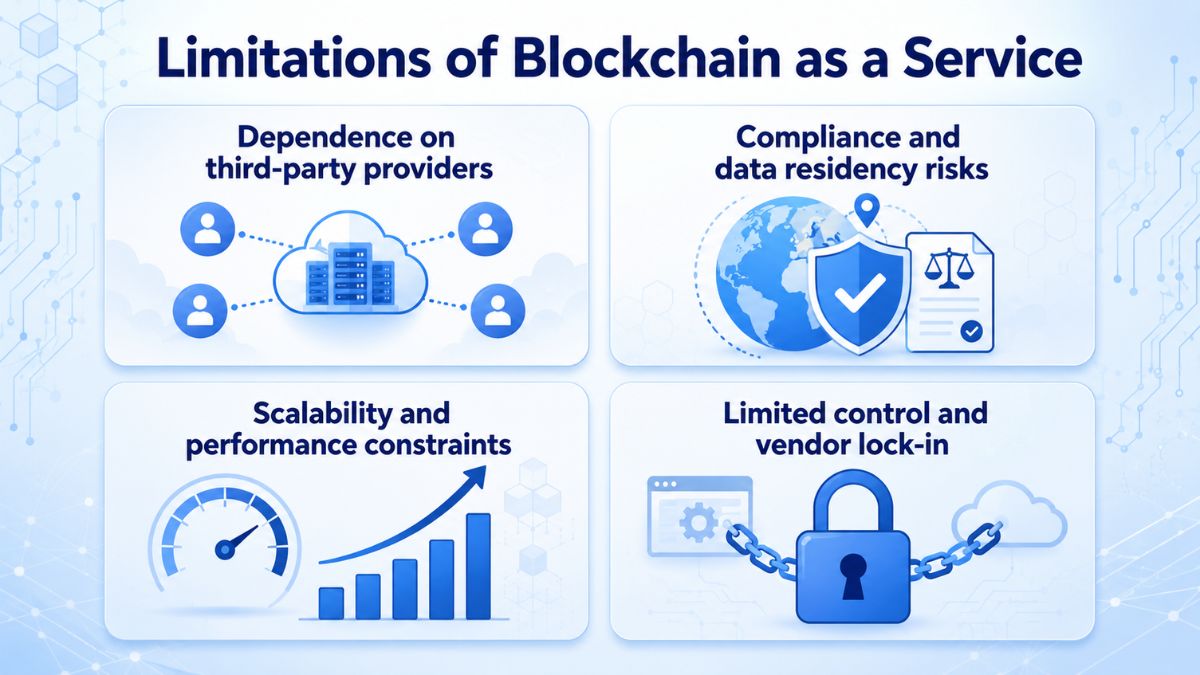
Although BaaS simplifies blockchain adoption, organizations must still evaluate several operational, regulatory, and technical risks before relying on a managed platform.
Dependence on third-party providers
BaaS shifts infrastructure management to an external vendor, making service quality, availability, and support critical. Delays, miscommunication, or limited understanding of business requirements can affect implementation and ongoing operations.
Compliance and data residency risks
Blockchain networks may distribute data across multiple regions, creating challenges around cross-border data transfers and local regulations. As a result, organizations must ensure that the selected BaaS platform supports their compliance, privacy, and data residency requirements.
Scalability and performance constraints
As transaction volumes increase, network congestion or shared infrastructure may reduce performance. Businesses need to assess throughput, latency, and scaling options to ensure the platform can support future workloads.
Limited control and vendor lock-in
BaaS platforms may restrict protocol-level customization, infrastructure choices, or migration options. Moving applications and data to another provider can also be complex, increasing the risk of long-term vendor dependency.
Is BaaS Right for Your Business?
Before adopting BaaS, businesses should assess whether the model aligns with their operational needs, technical environment, and regulatory obligations. The following factors can help determine whether BaaS is a suitable choice.
Determine whether your use case fits blockchain needs
BaaS works best for scenarios involving multiple stakeholders, shared information, traceability, or automated smart contracts. Typical applications include supply chain monitoring, asset authentication, international payments, and contract automation.
Assess industry suitability and data sensitivity
Sectors like finance, healthcare, logistics, and legal services can gain from improved transparency and auditability. However, businesses dealing with sensitive or regulated data must carefully evaluate compliance, privacy protections, and data residency rules.
Review infrastructure readiness and scalability needs
BaaS is ideal for organizations already operating in cloud environments and looking for quicker blockchain deployment. Companies relying on on-premises systems or complex legacy infrastructure should first ensure smooth integration and consider whether BaaS can scale with their long-term needs.
Blockchain as a Service: Future Trends and Innovations
The future of BaaS will be shaped by more sustainable infrastructure, flexible blockchain frameworks, and stronger smart contract capabilities. As enterprise adoption expands, providers are expected to focus on improving performance, security, interoperability, and regulatory readiness.
More efficient consensus mechanisms
BaaS platforms will increasingly support alternatives to traditional Proof of Work, including Proof of Stake, Proof of Authority, and other high-performance consensus models. These mechanisms can improve transaction speed, scalability, and energy efficiency across public and private blockchain networks.
Sustainable blockchain infrastructure
Growing demand for greener technologies will encourage BaaS providers to reduce energy consumption and optimize cloud resource usage. More efficient networks will help businesses adopt blockchain while supporting environmental and sustainability objectives.
Advanced smart contract capabilities
Continued improvements in smart contract languages, development tools, and multi-chain platforms will enable businesses to build more sophisticated decentralized applications. BaaS providers are also likely to offer reusable templates, automated deployment tools, and easier integration with enterprise systems.
Stronger smart contract security
Security will remain a major priority as smart contracts become more widely used in business operations. BaaS platforms are expected to integrate automated vulnerability detection, auditing tools, continuous monitoring, and standardized security practices to reduce deployment risks.
How Newwave Solutions Supports BaaS Implementation
With deep blockchain expertise and 14 years of experience in decentralized application development, Newwave Solutions helps businesses adopt Blockchain as a Service without disrupting existing operations. Our team supports BaaS integration across strategy, development, system connectivity, security, and long-term optimization.
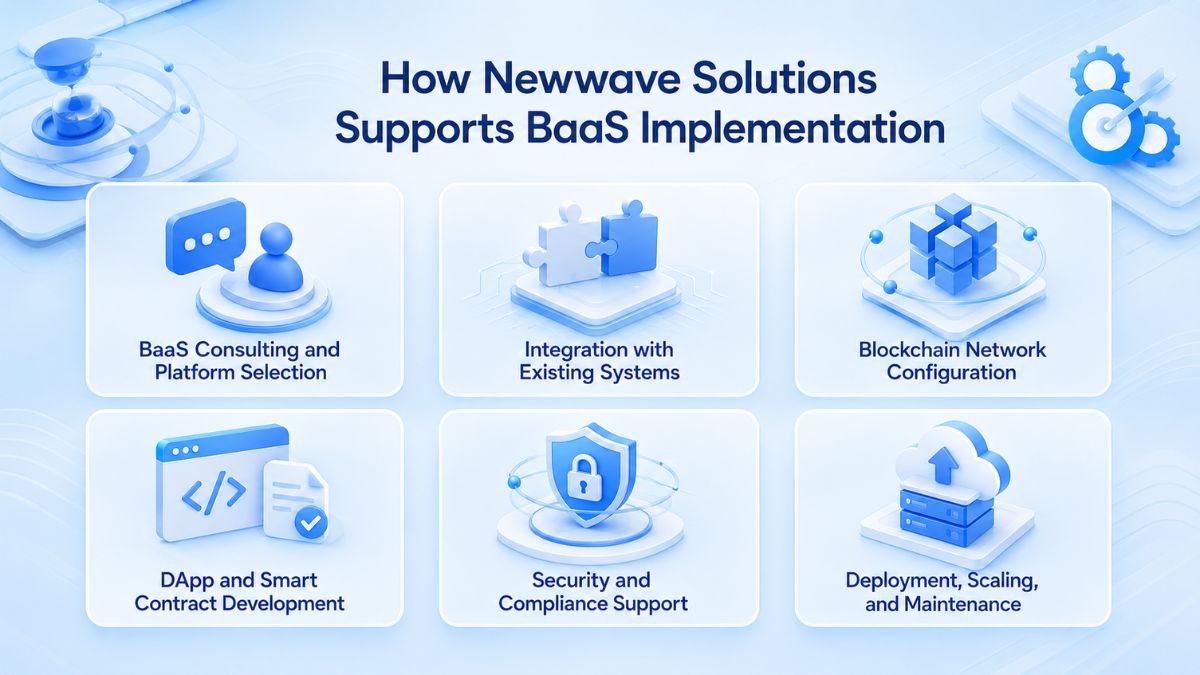
- BaaS Consulting and Platform Selection: We assess your business case, technical requirements, compliance needs, and expected transaction volume to recommend a suitable BaaS platform and implementation approach.
- Integration with Existing Systems: Our developers connect BaaS platforms with enterprise applications, cloud infrastructure, databases, APIs, ERP systems, and legacy environments to enable secure data exchange.
- Blockchain Network Configuration: We configure blockchain networks, permission models, consensus mechanisms, nodes, data storage, and governance rules based on your operational requirements.
- DApp and Smart Contract Development: Newwave Solutions designs and develops decentralized applications and smart contracts that automate workflows, improve traceability, and support secure transactions.
- Security and Compliance Support: We implement access controls, encryption, smart contract testing, monitoring, and data protection measures to reduce technical and regulatory risks.
- Deployment, Scaling, and Maintenance: Our team supports testing, deployment, performance optimization, infrastructure scaling, updates, and ongoing maintenance throughout the BaaS lifecycle.
Ready to integrate BaaS into your existing systems? Contact Newwave Solutions to discuss a secure, scalable blockchain implementation tailored to your business needs.
FAQ
1. How does BaaS integrate with existing enterprise systems?
BaaS platforms connect with enterprise applications, databases, cloud services, and legacy systems through APIs, middleware, and integration tools. A well-planned architecture allows blockchain data and workflows to operate alongside existing systems without requiring a complete infrastructure replacement.
2. Which industries can benefit most from BaaS?
BaaS is particularly valuable for finance, supply chain, healthcare, real estate, logistics, gaming, and legal services. These industries often require secure data sharing, transaction traceability, automated agreements, and collaboration among multiple stakeholders.
3. How does BaaS differ from building a blockchain in-house?
BaaS provides pre-configured cloud infrastructure and transfers node management, maintenance, security, and updates to a third-party provider. Building a blockchain internally offers greater control and customization but requires more investment, technical expertise, and operational resources.
4. Is using BaaS secure for enterprise-grade applications?
BaaS platforms can support enterprise-grade security through encryption, identity management, permission controls, network monitoring, and data protection features. Businesses should still assess the provider’s certifications, security architecture, data residency policies, and smart contract auditing practices.
5. How much does a BaaS platform cost?
BaaS costs vary depending on the provider, network type, number of nodes, transaction volume, storage, integrations, and support requirements. Pricing may range from usage-based developer plans for small pilots to custom enterprise contracts for large, regulated, or high-volume deployments.
Final Thoughts
The ongoing evolution of BaaS platforms ensures that businesses can now integrate blockchain functionality with unprecedented speed and cost-effectiveness. By selecting a reliable partner, your organization can effectively navigate the decentralized landscape and maintain a competitive edge through secure, scalable solutions.
Newwave Solutions always stands ready to support your business in developing and deploying professional blockchain-related solutions like customized BaaS, blockchain development, dApp development services, smart contract audit, or non-fungible token development. Contact us to discuss your project requirements and optimize your blockchain infrastructure.
To Quang Duy is the CEO of Newwave Solutions, a leading Vietnamese software company. He is recognized as a standout technology consultant. Connect with him on LinkedIn and Twitter.



Read More Guides
Get stories in your inbox twice a month.
Let’s Build Something Extraordinary
Sign up for a 30 min no-obligation strategic session with us. Transform your Ideas into scalable reality.
Leave a Reply