


Ecommerce Mobile App Development Complete Guide: Key Factors and Trends
Ecommerce mobile app development is becoming essential as mobile commerce continues to dominate global shopping behavior. More customers now expect fast, intuitive, and personalized experiences that only a dedicated mobile app can deliver. The purpose of this guide is to help businesses understand how ecommerce apps are built, which features matter most, what factors influence success, and which trends are shaping the future of mobile commerce. Keep reading to explore everything you need to create a high-performing ecommerce app that drives conversions, strengthens loyalty, and supports long-term growth.
What is Ecommerce Mobile App Development?
Ecommerce mobile app development is the process of designing, building, and optimizing mobile applications that enable customers to browse products, make purchases, and manage their shopping activities directly on smartphones and tablets. It focuses on creating fast, intuitive, and secure shopping experiences that drive higher conversions and customer engagement. As mobile becomes the dominant channel for digital commerce, ecommerce app development is now a core strategy for businesses aiming to scale their online presence.
Unlike standard websites, ecommerce apps are built to deliver seamless navigation, personalized recommendations, one click checkout, and real time order tracking. They leverage device capabilities such as biometrics, push notifications, voice input, and mobile wallets to create a superior shopping journey. Modern development follows a structured SDLC with careful attention to UI and UX, backend performance, security, and integration with existing commerce platforms.
Below are the key services included in mobile app development for ecommerce, typically offered by professional ecommerce mobile app development services or digital product teams:
- Custom App Architecture & Technical Planning: Defining the app structure, APIs, database models, and selecting the right Mobile App Development Languages based on business needs.
- UI/UX Design Solutions for Ecommerce Experiences: Designing intuitive user flows, wireframes, visual layouts, and prototypes that ensure simple, conversion-focused interactions.
- Frontend Mobile Development: Building the customer-facing interface using native or cross-platform frameworks for consistent performance across devices.
- Backend Development & API Integration: Connecting the app to ecommerce platforms (Shopify, WooCommerce, Magento), inventory systems, CRM, and external services such as payment gateways.
- Secure Payment Implementation: Integrating digital wallets, credit card payments, one-click checkout, and PCI-compliant transaction processing.
- MVP Development solutions: Creating an initial product version with core features to validate the concept quickly, minimize mobile development cost, and gather early user feedback.
- Analytics & Personalization Engine Setup: Implementing tracking tools and AI-based recommendation systems to optimize product visibility and customer engagement.
- Testing & QA: Ensuring functionality, performance, security, and device compatibility across platforms.
- Maintenance & Continuous Improvements: Regular updates, feature enhancements, monitoring, and optimization to maintain long-term app performance.
- Consulting & Technology Advisory: Helping businesses define goals, choose development approaches, estimate budgets, and plan scalable solutions.
Why your business needs an Ecommerce Mobile App Development?
Mobile commerce is expanding faster than any other digital channel, with smartphones driving the majority of online purchases worldwide. Customers expect speed, personalization, and convenience — and they increasingly prefer apps over mobile websites because apps deliver smoother shopping flows and higher trust. For businesses, adopting ecommerce mobile app development is no longer simply an upgrade but a strategic requirement to remain competitive in a market shaped by rising customer expectations and rapid technological change.
Below are the key reasons why developing an ecommerce mobile app creates measurable impact:
Higher Sales Conversions
Mobile apps convert at significantly higher rates than mobile websites. Their optimized interfaces, faster load times, and frictionless checkout flows help reduce bounce rates and cart abandonment. Dedicated ecommerce apps simplify product discovery and purchasing, allowing customers to complete orders in seconds. This efficiency directly increases transactions and repeat sales.
Deeper Customer Engagement
A mobile app sits directly on the user’s home screen, offering constant brand presence and direct engagement. Push notifications allow you to deliver personalized messages, discounts, restock alerts, and cart reminders at the perfect time. This creates a proactive communication channel that keeps users returning more often than traditional web traffic sources.
How engagement increases?
- Push notifications offer timely promotions, limited-time deals, and abandoned-cart reminders that bring users back immediately.
- In-app loyalty points, exclusive discounts, and personalized banners create stronger incentives to keep interacting.
- The app becomes a dedicated space where customers can shop, track orders, and manage preferences without distractions.
Result: Higher retention rates and stronger customer loyalty over time.
Rich, Personalized Shopping Experiences
Modern ecommerce apps personalize recommendations using AI, user browsing patterns, purchase history, and in-app behavior. This gives shoppers more relevant product suggestions, which increases loyalty and upsell opportunities. Features like AR try-on, image search, and voice search elevate the shopping journey beyond what is possible on a website.
Personalization opportunities
- AI-driven recommendations display the most relevant products.
- AR development tools help customers preview items before purchasing.
- Voice search and image recognition simplify how users discover products.
Result: Higher customer satisfaction and increased conversion rates.
Faster and More Secure Checkout
Checkout complexity is one of the biggest drivers of cart abandonment. Apps dramatically improve this step through simplified flows and built in security features.
Key advantages
- One-tap payments with Apple Pay, Google Pay, and popular wallet services reduce effort and time.
- Auto-filled customer information prevents repetitive typing and checkout mistakes.
- Encrypted transactions and PCI-compliant integrations protect customer data at every step.
Result: Smooth, trusted transactions and fewer abandoned carts.
Valuable Data and Business Insights
Ecommerce apps generate detailed, real-time data that helps businesses understand user behavior and optimize the entire buying experience. These analytics help optimize product catalogs, refine marketing strategies, and increase operational efficiency.
Insights you can capture
- Which products attract the most views and purchases.
- At what step users abandon their carts.
- Customer lifetime value trends and retention patterns.
Result
Smarter decision-making in marketing, product planning, and operations.
Competitive Positioning and Brand Differentiation
In competitive markets, an app helps brands stand out with superior user experience, consistent design, and exclusive features like member rewards or subscription benefits. Customers perceive brands with well-designed apps as more trustworthy, modern, and professional, strengthening long-term loyalty.
Why it strengthens competitiveness?
- A polished, well-designed app signals credibility, especially for new customers evaluating your brand.
- Advanced features—such as personalized homepages, fast reordering, wishlist syncing, and AR previews—make your shopping experience stand out from competitors offering only websites.
- Consistent app performance and a visually appealing interface increase customer trust and reinforce your brand identity every time the app is opened.
- The app becomes a dedicated “owned channel” where no competitor ads, search results, or marketplace distractions can pull users away.
Result: A stronger brand presence, higher customer loyalty, and a sustainable competitive advantage.
Which core features may be needed in an Ecommerce Mobile App?
A successful ecommerce mobile app development is built on features that support the full shopping journey — from onboarding to product discovery, checkout, delivery tracking, and ongoing customer engagement. These core components ensure that users can interact with your brand smoothly, find what they need quickly, and complete purchases with minimal effort. Below are the essential features that form the foundation of any modern ecommerce mobile application.
User Onboarding and Account
A smooth onboarding experience sets the tone for how customers perceive your app. If the first steps feel complicated or time-consuming, users leave before exploring your products. Effective onboarding minimizes friction while offering options that fit different user preferences.
What this feature includes?
- Flexible registration methods: Users can sign up via email, phone number, or social accounts (Google, Apple, Facebook), reducing barriers to entry.
- Guest checkout for convenience: Allows users to complete a purchase without committing to an account—critical for first-time buyers.
- Comprehensive profile management: Enables users to save addresses, track orders, manage payment methods, and personalize settings.
- Biometric authentication: Fingerprint or Face ID makes login instant and secure, improving return-user experience.
Why it matters?
User onboarding is the moment users decide whether the app feels intuitive and trustworthy. A clean, flexible onboarding flow increases early retention and boosts the number of users who complete their first purchase.
Product Discovery
Product discovery is the heart of the shopping experience. Even with a great catalog, poor discovery features can cause frustration and lower sales. An ecommerce app must guide users smoothly from browsing to finding the exact product they want.
What this feature includes?
- Advanced search capabilities: Auto-suggestions, typo correction, and ranked results help users find items quickly.
- Robust filtering and sorting: Users can narrow products by category, price, availability, brand, size, or features.
- High-quality visuals and descriptions: Detailed images, videos, and rich descriptions help users evaluate products confidently.
- Social proof elements: Ratings, reviews, and Q&A sections build trust and influence purchase decisions.
- AI-enhanced discovery: Personalized product feeds, voice search, and image-based search reduce friction for users who know what they want but lack keywords.
Why it matters?
Strong product discovery reduces decision fatigue, increases user satisfaction, and significantly boosts add-to-cart rates. The faster customers find relevant items, the higher the chance they will buy.
Cart and Checkout
The cart and checkout process directly influences your revenue. Even small friction points—slow loading, too many steps, limited payment options—can cause users to abandon their purchase. Optimizing this stage is critical to maximizing conversion rates.
What this feature includes?
- Smart cart management: Users can easily update quantities, save items for later, or apply discount codes.
- Multiple payment integrations: Credit cards, bank transfers, e-wallets, Apple Pay, Google Pay, and regional payment solutions.
- One-click purchasing: Returning customers can complete an order instantly using saved details.
- Address auto-fill: Pulls from user profiles or device data to remove manual entry.
- “Buy Now” shortcuts: Direct-to-checkout options reduce unnecessary steps.
Why it matters?
A streamlined, predictable checkout experience reduces friction and cart abandonment. When customers feel the process is simple and secure, they are far more likely to complete the purchase and return again.
Post-Purchase
A great app maintains engagement even after a transaction is complete. The post-purchase phase builds trust, transparency, and satisfaction—key drivers of repeat business.
What this feature includes?
- Real-time order tracking: Updates at every stage—processing, packaging, shipping, and delivery—to keep customers informed.
- Easy access to past orders: Users can review purchases or reorder favorite items in one tap.
- Streamlined return and refund processes: A clear, simple flow reduces customer frustration and increases overall trust.
- Integrated loyalty and rewards programs: Encourages users to continue purchasing through points, vouchers, or exclusive benefits.
Why it matters?
Post-purchase consistency builds long-term loyalty. Customers who trust the delivery and return process are far more likely to shop again and recommend your brand to others.
Support and Engagement
Support features ensure customers can get help when needed, while engagement tools keep them connected to your brand beyond browsing. When done right, these features strengthen customer relationships and drive repeat usage.
What this feature includes?
- In-app chat and help center: Offers quick access to FAQs, policies, or human agents when necessary.
- AI-powered chatbots: Provide 24/7 instant responses for common questions, reducing support workload.
- Push notifications: Notify users about promotions, restocked items, delivery updates, and personalized recommendations.
- Behavior-driven engagement: Automated prompts when a user abandons a cart, views a product frequently, or shows signs of inactivity.
Why it matters?
Strong support reduces frustration, while personalized engagement keeps customers active and interested. Effective communication channels significantly increase app stickiness and customer lifetime value.
How to get the best ecommerce mobile app development?
Building a successful ecommerce mobile application requires more than choosing a development team and starting design work. To compete in a market where user expectations are rising and new technologies shape shopping habits, businesses need a clear strategy, a structured development approach, and a deep understanding of what drives mobile success. From technical decisions to budget planning and feature prioritization, every step influences how well the final product performs.
Below are the essential considerations and processes to ensure your ecommerce mobile app development delivers measurable results:
Key factors need to consider before starting
Before any development begins, businesses must define the foundation of the project. These factors determine the scope, cost, timeline, and long-term value of the app. A well-prepared strategy reduces risk, prevents unnecessary rework, and leads to better outcomes across the SDLC.
A clear understanding of these key factors will guide your technical decisions, ensure your investment aligns with business goals, and set realistic expectations.
Key factors to consider:
- Your Target Audience and Buying Behaviors: Identify who you’re building the app for, how they shop, and what devices they use. This shapes UX decisions, features, and platform selection.
- Your Core Business Objectives: Clarify whether your app focuses on acquisition, retention, brand visibility, or increasing repeat purchases. Each objective influences the roadmap.
- Feature Prioritization: Start by separating essential features from optional enhancements. This helps build a strong MVP development plan without inflating cost or timeline.
- Choice of Technology Stack: Select between native (iOS/Android), cross-platform, or low-code options based on performance needs, timeline, and internal resources.
- Integration Requirements: Determine which systems the app must connect to—such as inventory, CRM, payment gateways, shipping, and analytics platforms.
- Security and Compliance Needs: Consider encryption, secure login methods, PCI requirements, and data protection regulations to ensure customer safety from day one.
- Budget and Mobile Development Cost: Estimate expected costs across design, development, QA, content, and maintenance. Avoid unrealistic budgets that limit quality.
- Scalability and Long-Term Maintenance: Plan for growth. Your app should handle increased users, product expansions, and new features without requiring costly rebuilds.
Your Strategic Roadmap to Get Started
A roadmap provides direction and keeps every team aligned. It connects your business vision to the technical decisions that turn your ecommerce idea into a functional, scalable product.
This roadmap ensures you invest wisely, build features that matter, and deliver value to users through every stage of the SDLC:
- Set Clear Goals and KPIs: For example, increase mobile conversion by 20 percent, reduce cart abandonment, or grow app downloads by a specific target.
- Analyze Competitors and Market Trends: Study leading ecommerce apps to understand what works, what frustrates users, and where you can differentiate.
- Define User Personas and Customer Journeys: Map how different customer types discover products, evaluate them, and decide to purchase.
- Select the Right Development Approach: Decide between in-house development, outsourcing, or a hybrid model based on cost, timeline, and expertise.
- Plan Your Budget and Feature Timeline: Build in room for unexpected needs such as new compliance rules, added integrations, or design refinements.
- Validate with Prototypes Early: Before writing code, test wireframes and interactive prototypes to reduce design mistakes and improve usability.
- Start Lean with an MVP: Launch the core version first, gather feedback, and scale features gradually based on real user data.
A Step-by-Step Guide for Ecommerce Mobile App Development
Ecommerce app development follows a structured sequence of phases. Each phase contributes to product quality, technical stability, and user satisfaction. Below is a clear breakdown of what happens in each stage and how it supports your long-term success.
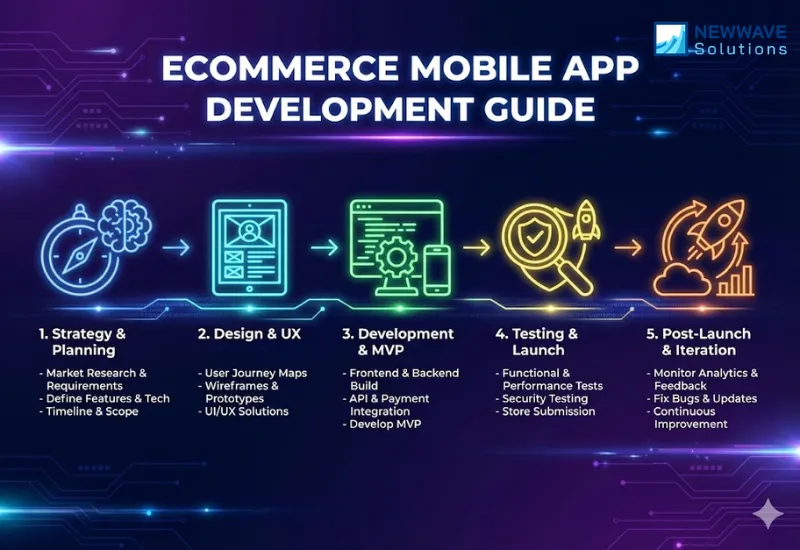
1. Strategy and Planning
This is the foundation of your project, where business requirements, technical direction, and product goals are fully defined. Strategic planning prevents misalignment and ensures your team understands what needs to be built—and why.
What happens in this phase?
- Conduct market research and identify gaps or opportunities.
- Define core features, non-functional requirements, and user flows.
- Select the development approach: native, cross-platform, or web-to-app conversion.
- Estimate timelines, resources, and your projected mobile development cost.
- Document the project scope for clarity across teams.
Insight tip:If you have a well-optimized mobile website, a conversion service can launch your app in weeks, not months. Decision: Building for both iOS and Android doubles cost/time; start with the platform your core customers use most.
2. Design
Design shapes how users interact with your app. This phase focuses on building a frictionless, intuitive, visually consistent experience that supports conversions.
What happens in this phase?
- Create user journey maps and app architecture diagrams.
- Develop wireframes and UI layouts for every key screen.
- Produce clickable prototypes for early usability testing.
- Apply UI/UX design solutions that align with brand identity and user needs.
POV: Don’t overcomplicate the UI (User Interface). A clean, intuitive design outperforms a cluttered one. The checkout process must be as simple as possible.
3. Development and MVP
This is when your app comes to life. Developers build both the frontend interface and backend services while integrating APIs, payment gateways, and databases.
What happens in this phase?
- Implement the app’s UI and interaction logic.
- Build backend systems, authentication, product listings, and cart logic.
- Integrate secure payment methods and third-party services.
- Develop the MVP first to release a functional app quickly.
- Apply coding best practices and scalable architecture standards.
Insight tip: An MVP lets you gather real user feedback early, ensuring further investment is guided by actual needs, not assumptions.
4. Testing and Launch
Quality assurance ensures the app performs consistently across devices and scenarios. Thorough testing reduces user frustration and protects your brand reputation.
What happens in this phase?
- Conduct functional testing to verify features.
- Run performance tests to ensure fast load times and stable sessions.
- Perform security testing to protect sensitive customer data.
- Fix bugs, refine interactions, and prepare release builds.
- Submit the app to App Store and Google Play with optimized ASO content.
Critical: Security testing is non-negotiable. Use SSL, encryption, and comply with standards like PCI DSS for payments.
5. Post-Launch and Iteration
After launch, continuous improvement becomes essential. An ecommerce app must evolve with new features, performance optimizations, and shifting customer expectations.
What happens in this phase?
- Monitor analytics to understand user behavior and conversion patterns.
- Collect customer feedback through in-app prompts or reviews.
- Fix bugs and performance issues that appear after launch.
- Release regular updates for features, security patches, and OS changes.
- Expand the product gradually based on your growth roadmap.
Key to Growth: Treat your app as a living product. The most successful apps iterate continuously based on user data and changing trends.
Common Challenges, Risks, and Mitigation Strategies
Building an ecommerce mobile app involves many moving parts — technology choices, UX decisions, integrations, performance requirements, and security expectations. While the opportunity is huge, the development process can present challenges that affect cost, timelines, and the overall success of the product. Understanding these risks early allows businesses to plan effectively and avoid issues that may slow down launches or reduce user satisfaction.
Below are the most common challenges in ecommerce mobile app development, along with their potential impacts and recommended mitigation strategies:
Poor User Experience (UX)
A confusing interface, slow response times, or inconsistent navigation can frustrate users and cause them to leave the app quickly. Since mobile shoppers expect fast and intuitive interactions, poor UX directly damages your ability to convert and retain customers.
Potential impact
- High bounce rates as users fail to find products easily.
- Increased cart abandonment due to friction in checkout flows.
- Negative reviews and reduced app store rankings.
- Lower long-term retention and revenue.
Mitigation strategy
- Conduct user research early to understand customer behavior.
- Build clear navigation, clean layouts, and frictionless flows.
- Test wireframes and prototypes before development to catch issues early.
- Make UX optimization an ongoing process after launch.
Security Vulnerabilities
Ecommerce apps handle sensitive data such as payment information, personal details, and order history. Any security gap can lead to breaches or fraud, severely damaging customer trust and exposing the business to legal risks.
Potential impact
- Loss of user data and financial information.
- Reputational damage that discourages new customers.
- Potential fines for non-compliance with data protection laws.
- Decreased customer trust and lower conversion rates.
Mitigation strategy
- Implement strong encryption and secure authentication methods.
- Use PCI-compliant payment gateways.
- Conduct regular security audits and penetration testing.
- Monitor for suspicious activity and update security patches often.
Performance Issues
Slow pages, laggy animations, and app crashes create immediate frustration. Performance is one of the top reasons users abandon shopping apps, especially during busy periods like product launches or holiday sales.
Potential impact
- Lower engagement due to slow browsing and product loading.
- Lost revenue from customers who leave mid-session.
- Higher uninstall rates, hurting retention metrics.
- Poor app store ratings, reducing visibility and organic downloads.
Mitigation strategy
- Optimize images, code, and database queries to reduce loading time.
- Use a CDN for faster content delivery.
- Run stress tests to simulate high-traffic scenarios.
- Select scalable infrastructure that grows with user demand.
Lack of Scalability
An ecommerce app must handle increasing catalog sizes, higher order volumes, new features, and a growing user base over time. A non-scalable architecture becomes expensive and time-consuming to fix later.
Potential impact
- App slowdowns or downtime during traffic spikes.
- Difficulty adding new features without breaking existing ones.
- Higher maintenance and redevelopment costs long-term.
- Inability to meet user expectations as the business grows.
Mitigation strategy
- Build modular architecture that supports incremental feature releases.
- Use scalable backend solutions such as cloud hosting.
- Cache frequently accessed data for faster performance.
- Conduct regular architecture reviews as new features are introduced.
Complex Checkout Process
Checkout is the most sensitive stage of the shopping journey. If the process feels long or complicated, users leave — even if they like the product. Checkout friction is one of the biggest contributors to lost revenue in ecommerce.
Potential impact
- Sudden drop-offs during the final step of the purchase.
- Lower conversion rates even with strong user engagement.
- Customer frustration and reduced trust in your platform.
- Increased reliance on customer support for payment issues.
Mitigation strategy
- Minimize the checkout steps and reduce required fields.
- Offer multiple payment methods, including wallets and one-click options.
- Allow guest checkout for first-time customers.
- Implement address auto-fill and fast payment integrations.
Key Trends Shaping the Ecommerce Mobile App Development Future
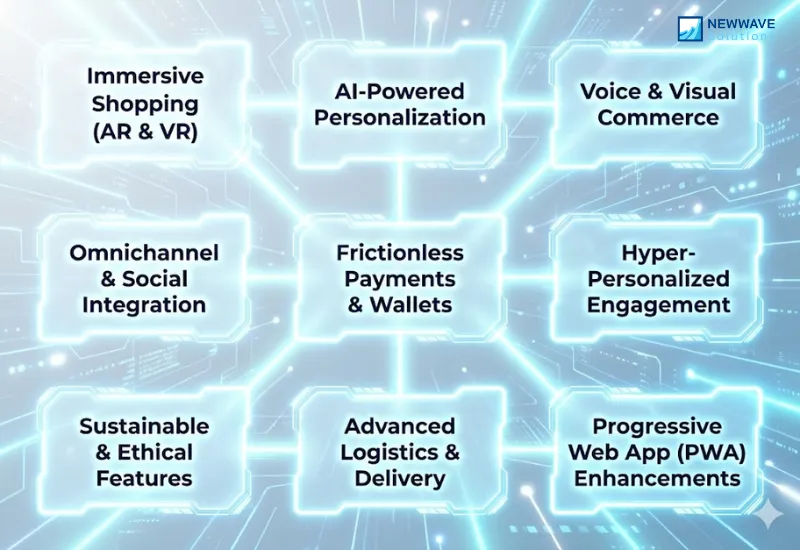
The future of ecommerce mobile app development is being shaped by rapid advancements in mobile technology, evolving user expectations, and the growing integration of intelligent digital experiences. As shoppers become more comfortable with mobile-first commerce, businesses must adapt by offering features that are faster, smarter, and more immersive. These emerging trends not only improve user experience but also open new opportunities for personalization, engagement, and operational efficiency. Staying ahead of these shifts will help brands build apps that remain relevant, competitive, and future-ready.
Below are the key trends transforming the ecommerce mobile app landscape:
- Immersive Shopping with AR and VR: Augmented reality allows customers to visualize products in real-world environments, reducing uncertainty and lowering return rates. Virtual try-ons, 3D previews, and interactive product models are becoming standard expectations for fashion, furniture, and beauty brands.
- AI-Powered Personalization and Automation: Artificial intelligence is improving search relevance, recommendation accuracy, and customer support. Apps can now predict what users want, offer personalized homepages, and automate routine interactions through smart chatbots.
- Voice and Visual Commerce: Users increasingly rely on voice assistants and image recognition to find products quickly. These tools simplify discovery, especially when customers don’t know the exact product name or want alternatives.
- Omnichannel and Social Commerce Integration: Apps are evolving into unified retail hubs where users can shop across channels, redeem rewards, and interact with a brand seamlessly. Shopping directly within social platforms and syncing app activity with in-store experiences are becoming essential.
- Frictionless Payments and Wallet Adoption: Mobile wallets, one-tap purchases, transparent subscription management, and tokenized payments enhance trust and speed. The future of checkout is fast, invisible, and secure.
- Hyper-Personalized Engagement: Push notifications and email marketing are becoming behavior-driven and contextual. Apps use real-time signals — such as browsing patterns, location, and past purchases — to deliver messages at exactly the right moment.
- Sustainable and Ethical Commerce Features: Users increasingly value brands that promote eco-friendly practices. Apps now highlight sustainable product lines, carbon-neutral shipping options, and transparent sourcing details.
- Advanced Logistics and Delivery Innovation: Same-day delivery, live courier tracking, automated fulfillment, and warehouse robotics are reshaping customer expectations. Apps must stay integrated with logistics platforms to support these capabilities.
- Progressive Web App Enhancements: PWAs continue improving, offering near-native speed and features. Some brands adopt hybrid models combining native apps with PWA components for performance and flexibility.
How Newwave Solutions gets you in Ecommerce Mobile App Development?
Ecommerce mobile app development is now a strategic requirement for any business that wants to grow in a mobile-first marketplace. From improving customer engagement to increasing conversions and enabling richer, more personalized shopping experiences, the right mobile app can transform the entire digital journey. But achieving this level of performance requires a strong technical foundation, a thoughtful SDLC, and a development partner who understands both business goals and modern ecommerce demands.
Newwave Solutions helps companies build high-performing ecommerce applications through a complete suite of mobile app development services. Our team in Vietnam combines technical expertise, creative UI/UX design solutions, and years of industry experience to deliver mobile apps that are fast, secure, and built for scale. Whether you’re launching a new product, upgrading an existing platform, or exploring online shopping app development, we guide you from strategy through deployment — and beyond.
As one of the trusted mobile app development companies in Vietnam, we provide end-to-end capabilities that include product strategy, design, development, testing, and ongoing maintenance. Our approach focuses on building flexible architectures, optimizing mobile development cost, and applying best practices in Mobile App Development Languages to ensure your app performs reliably as your business grows. For companies seeking to validate ideas quickly, our MVP development process helps you launch faster and refine your product using real customer feedback.
By partnering with Newwave Solutions, you gain access to a dedicated team that understands what is mobile app development in a business context. We deliver ecommerce mobile app development services tailored to your goals, powered by strong technical skills and a deep commitment to quality. Whether you need custom features, complex integrations, or a long-term roadmap for growth, we build solutions that support your success today and scale for tomorrow.
If you are ready to create an ecommerce mobile app that elevates your brand and strengthens your relationship with customers, Newwave Solutions is ready to help you build it with confidence and clarity.
To Quang Duy is the CEO of Newwave Solutions, a leading Vietnamese software company. He is recognized as a standout technology consultant. Connect with him on LinkedIn and Twitter.



Read More Guides

Get stories in your inbox twice a month.
Let’s Connect
Let us know what you need, and out professionals will collaborate with you to find a solution that enables growth.
Leave a Reply