


Insourcing vs Outsourcing: Best Practices for CTOs
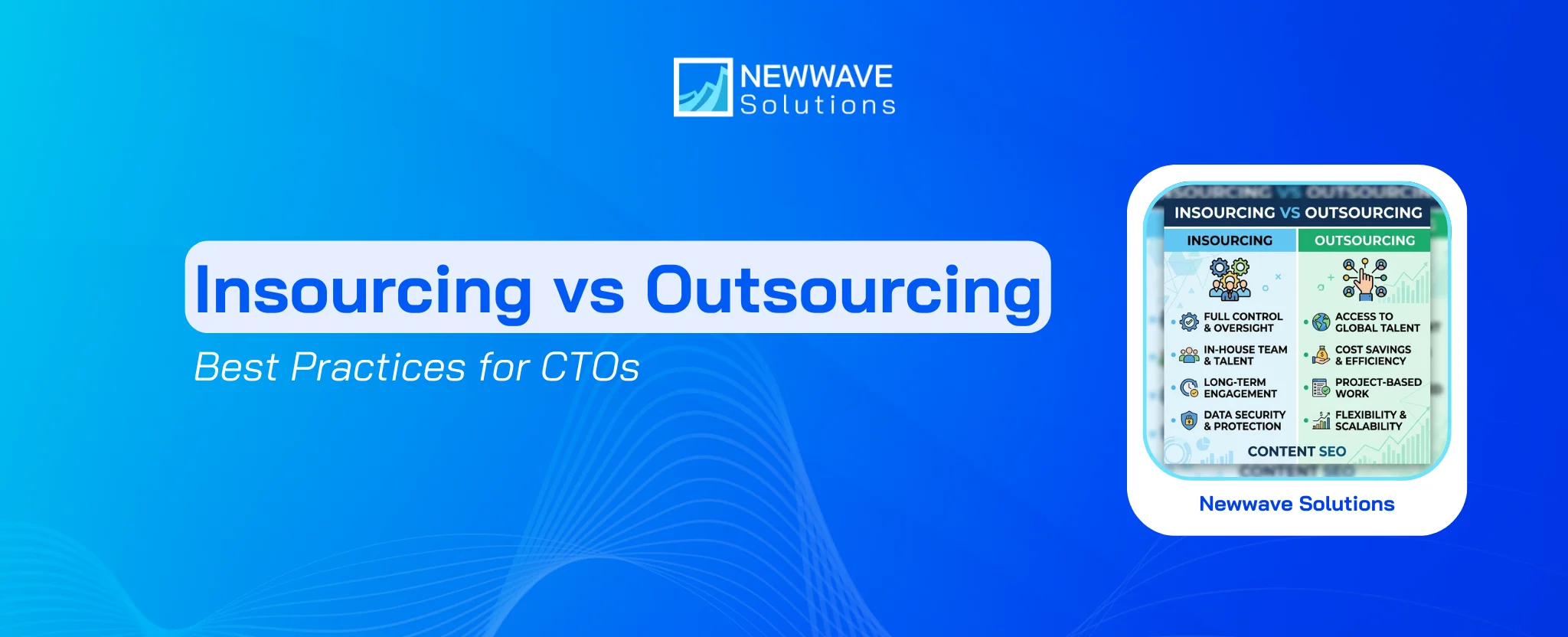
As technological advancements reshape industry expectations in 2026, enterprises must decide between strengthening internal teams or leveraging external expertise in order to keep pace with innovation. While investing in internal talent through insourcing offers direct oversight, outsourcing initiatives can unlock specialized capabilities that may otherwise be unavailable, though they also require careful management of control and security concerns. This comprehensive comparison of insourcing vs outsourcing will guide your IT strategy by outlining the key benefits, challenges, and decision criteria for each model.
Insourcing vs Outsourcing: Definition
What is Insourcing?
Insourcing in the IT context refers to the practice of assigning technology work, projects, or services internally to employees and resources within the organization rather than engaging external third-party providers, which enhances direct control and alignment with business strategy. This approach is often chosen when work involves sensitive systems, long-term strategic initiatives, or requires deep domain knowledge that internal teams possess.
Common forms of insourcing include building internal development squads, maintaining dedicated infrastructure teams, and establishing in-house support centers for software and systems operations.
Example: Google maintains its core search algorithms and proprietary AI infrastructure through insourcing, keeping these critical functions strictly under its internal engineering teams. This strategy ensures absolute control over their primary intellectual property and has enabled them to achieve a dominant 90% share of the global search engine market through constant, secure innovation.
What is Outsourcing?
Outsourcing in IT involves engaging external partners or specialist service providers to perform tasks or manage functions that would typically be handled within the organization, which can offer cost advantages, access to specialized skills, and faster scaling of technical capacity. Unlike insourcing, outsourcing requires the organization to trust and govern work through contracts, service level agreements, and performance metrics, which can introduce risks related to communication, quality, and security.
Typical categories of outsourcing include onshore, nearshore, and offshore models that vary based on proximity and collaboration convenience.
Example: In its early stages, Slack utilized outsourcing by partnering with the design firm Metalab to transform its early prototype into a market-ready web and mobile application. This strategic collaboration allowed Slack to leverage world-class UI/UX expertise without the overhead of a large in-house team, ultimately fueling their rapid growth to a $27.7 billion acquisition by Salesforce.
Pros & Cons of Insourcing vs Outsourcing
Every operational model acts as a double-edged sword, offering distinct advantages while carrying inherent risks that leaders must carefully weigh. Understanding these trade-offs is crucial to preventing unnecessary resource drainage and aligning your technical capabilities with long-term business objectives. Below is a comprehensive breakdown of the strengths and weaknesses of both methods to help you navigate this strategic choice.
Pros & Cons of Insourcing
Pros:
- Direct Strategic Control — Keeping IT work in-house allows organizations to govern technical direction and adjust priorities instantly based on business needs.
- Enhanced Data Security — Insourcing minimizes exposure to external vulnerabilities since all sensitive data and systems are managed internally.
- Deep Organizational Knowledge — Internal teams retain institutional experience and contextual understanding that can improve long-term solutions.
- Strong Cultural Alignment — Insourced teams operate within the company culture, which fosters shared values and team cohesion.
- Improved Quality Oversight — Direct supervision of code, architecture, and processes enhances quality control across IT projects.
- Long-Term Capability Building — Investing in internal talent builds enduring technical competencies that support future initiatives.
- Immediate Internal Feedback Loops — Internal teams can collaborate rapidly without relying on external communication channels.
Cons:
- Higher Operational Costs — Insourcing often requires significant upfront investment in salaries, training, and infrastructure.
- Limited Scalability — Expanding internal teams requires recruitment and onboarding that can slow project pace.
- Talent Shortages — Finding and retaining specialized IT talent may be difficult in competitive labor markets.
- Resource Diversion from Core Work — Internal teams might split focus between strategic goals and routine tasks, reducing efficiency.
Pros & Cons of Outsourcing
Pros:
- Cost Efficiency — Outsourcing often reduces operational expenses by leveraging external partners with shared infrastructure and flexible engagement models.
- Access to Specialized Expertise — External providers can bring technical skills and best practices that are not readily available in-house.
- Rapid Scalability — Outsourcing allows organizations to scale team size quickly based on project demand without long-term commitments.
- Focus on Core Priorities — By outsourcing non-core tasks, internal teams can concentrate on strategic initiatives.
- Flexible Workforce Models — External teams can adapt to changing workloads without internal personnel complexity.
- Innovation Through Diversity — Outsourced teams may introduce varied perspectives and methodologies that spur technical innovation.
- Global Talent Access — Outsourcing enables hiring across regions to tap into international expertise and resource pools.
Cons:
- Control and Oversight Gaps — Outsourcing may limit direct supervision of day-to-day technical execution and decision-making.
- Security and Compliance Risks — Sharing sensitive system access with external parties introduces additional data governance concerns.
- Communication Barriers — Differences in time zones, language, and processes can slow collaboration and create misunderstandings.
- Quality Variability — External providers may prioritize contractual deliverables over deeper product quality and integration nuances.
- Dependency Risks — Relying heavily on third parties can expose organizations to vendor lock-in if contracts are not well structured.
Insourcing vs Outsourcing: Core Differences in IT Services
While both models aim to complete projects and drive growth, their operational workflows, cash flow patterns, and management mechanisms differ significantly. These distinctions become even more pronounced in specialized IT services such as custom software development or cloud infrastructure management. Let’s explore the core differences that define the boundaries between insourcing and outsourcing in the modern tech landscape.
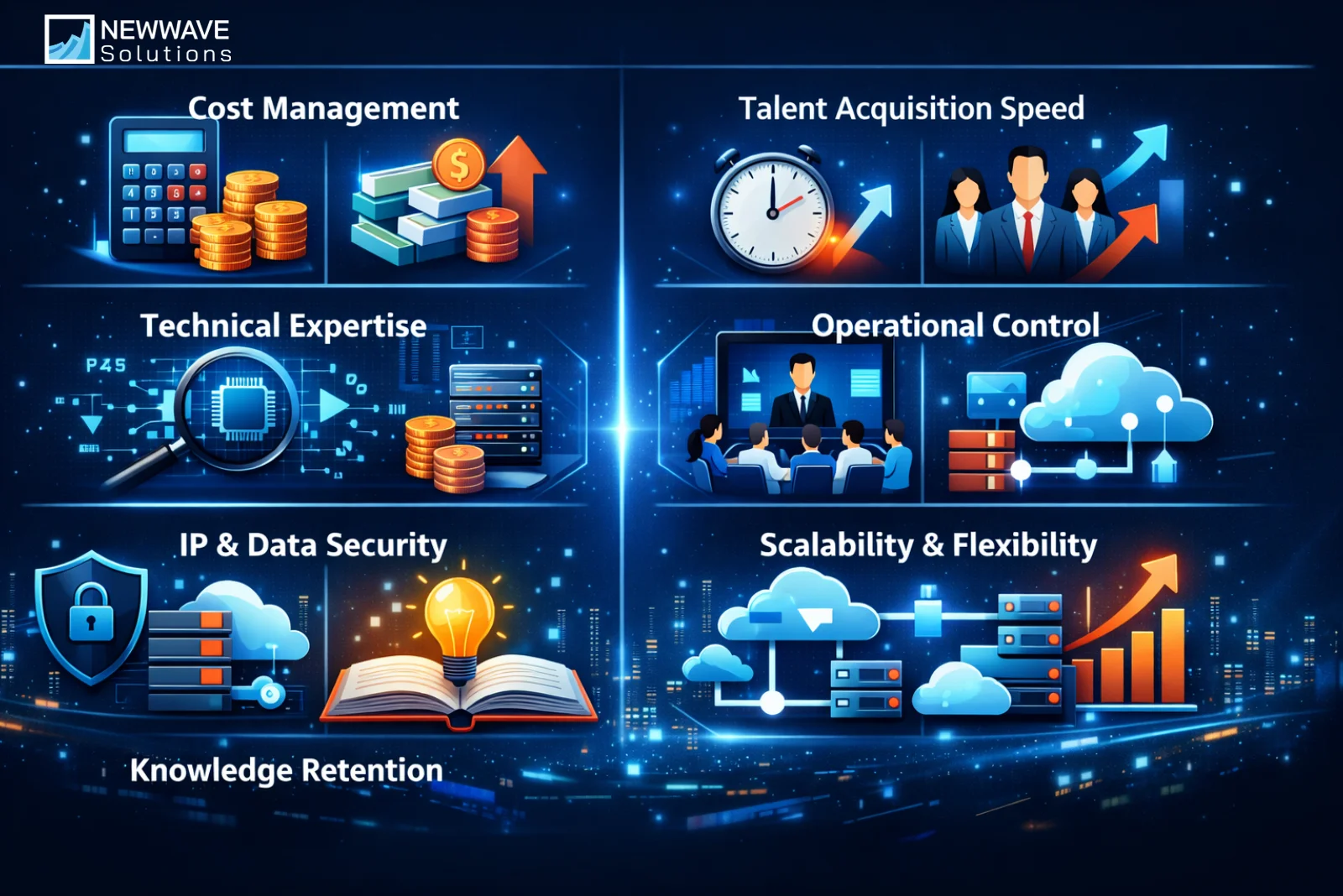
1. Cost Structure and Financial Management
Insourcing involves a heavy Capital Expenditure (CapEx) model, requiring significant upfront investment in recruitment, full-time salaries, comprehensive benefits, and physical office infrastructure. Beyond the initial hire, businesses must also account for long-term fixed costs such as taxes, training, and hardware upgrades, which remain constant regardless of the actual project volume or fluctuating market demands.
Outsourcing operates on an Operational Expenditure (OpEx) model, allowing enterprises to pay specifically for delivered outputs or defined man-hours rather than maintaining a permanent payroll. This approach transforms fixed overheads into variable costs, providing a highly predictable and flexible budget that can be adjusted in real-time based on the strategic needs of the business.
>>> Verdict: Outsourcing wins for financial agility, as it minimizes fixed liabilities and allows for more efficient capital allocation.
2. Speed of Talent Acquisition and Scaling
The recruitment cycle for IT insourcing is notoriously lengthy, often taking three to six months to find, vet, and onboard specialized developers within a local market. This slow progression is further complicated by the “talent war,” where high-demand roles like DevOps or AI engineers are difficult to secure, often resulting in delayed project start dates and missed market opportunities.
Outsourcing provides immediate access to vast, pre-vetted global talent pools, enabling teams to be deployed and fully operational within a matter of days or weeks. Leading partners like Newwave Solutions maintain ready-to-work benches of experts, allowing companies to bypass the administrative burden of local labor laws and jump straight into the development phase.
>>> Verdict: Outsourcing wins for speed-to-market, offering a “plug-and-play” talent solution that responds instantly to urgent business requirements.
3. Depth of Specialized Technical Expertise
Internal teams develop a profound, specialized understanding of your specific product’s business logic; however, they often lack exposure to diverse technologies or the latest cross-industry trends. Keeping an in-house team updated on emerging technologies like Blockchain, AI, or Serverless architectures requires continuous, expensive training programs that may distract from core development tasks.
Outsourcing partners bring a wealth of diverse experience gained from working across multiple industries and varied tech stacks for global clients. By partnering with an external expert, you gain instant access to high-level technical proficiency and battle-tested solutions that have been refined through hundreds of different project environments, ensuring your product remains on the cutting edge.
>>> Verdict: Outsourcing wins for innovation, providing immediate access to niche skills without the time and cost of an internal learning curve.
4. Operational Control and Direct Supervision
Insourcing grants managers absolute, minute-by-minute oversight of daily workflows, enabling real-time adjustments and immediate face-to-face communication during critical project phases. This hands-on approach ensures that every line of code and every design choice aligns perfectly with the company’s internal culture, coding standards, and subtle strategic nuances.
Outsourcing typically relies on Service Level Agreements (SLAs) and structured project milestones, focusing more on the quality of the final output than the micro-management of daily tasks. While professional teams use advanced project management tools to maintain transparency, communication often happens in scheduled sync-ups, which may introduce minor feedback loops across different time zones.
>>> Verdict: Insourcing wins for project control, offering the highest level of transparency and the ability for immediate management intervention.
5. Intellectual Property (IP) and Data Security
When projects are insourced, all sensitive data and proprietary source code remain within the company’s internal servers and firewall, significantly minimizing the risk of exposure to third parties. Employees are bound by direct, local employment contracts, making it much simpler to enforce non-disclosure agreements (NDAs) and maintain strict internal compliance standards.
Outsourcing requires sharing sensitive business logic and data with an external entity, necessitating rigorous security audits and international legal frameworks to protect your assets. Although reputable outsourcing firms utilize high-end encryption, secure VPNs, and ISO-certified processes, the involvement of an outside partner naturally increases the potential attack surface that must be managed.
>>> Verdict: Insourcing wins for high-security projects, particularly for industries where total data isolation and IP protection are non-negotiable requirements.
6. Resource Elasticity and Scaling Flexibility
Scaling an internal team down is an arduous and costly process involving severance pay, potential legal disputes, and a significant negative impact on remaining staff morale. Conversely, scaling up requires another cycle of intense recruitment and training, which often creates a bottleneck that slows down the momentum of rapidly growing projects.
Outsourcing offers ultimate elasticity, allowing businesses to ramp up development resources during peak feature-building phases and downsize them instantly once the product enters a maintenance stage. This on-demand resource model ensures that the company never pays for idle “bench time” or maintains a larger workforce than what is strictly necessary for current objectives.
>>> Verdict: Outsourcing wins for scalability, providing the most efficient mechanism to manage fluctuating workloads without long-term labor commitments.
7. Long-term Knowledge Retention
In-house employees serve as the “institutional memory” of the organization, retaining deep knowledge of the codebase, historical project failures, and unique business logic over many years. This permanent foundation of technical wisdom ensures seamless continuity for long-term maintenance and allows for the natural evolution of the product within the same team.
Outsourcing partners provide thorough documentation, but the departure of a specific vendor or the rotation of their staff can occasionally lead to a knowledge gap if the handover process is not perfectly managed. Relying heavily on external teams for core logic can create a “black box” scenario, where the client may become overly dependent on the vendor to understand how their own system functions.
>>> Verdict: Insourcing wins for product longevity, as it builds a permanent internal foundation of project history and technical expertise
When to Choose Insourcing vs Outsourcing to boost your IT niche
There is no “one-size-fits-all” formula for every enterprise; the right choice depends entirely on your current growth stage and the complexity of the technology you are pursuing. Selecting the wrong model at a critical juncture can stifle your project’s momentum and hinder your competitive edge. The following scenarios will help you identify the “golden timing” to commit to either insourcing or outsourcing for your specific niche.
When to Choose Insourcing
- When internal project goals require tight integration with corporate strategy and cultural alignment.
- When data security or intellectual property protection is paramount.
- When building long-term institutional expertise is a priority.
- When budget and timelines allow for internal capacity growth.
When to Choose Outsourcing
- When rapid access to specialized technical skills is needed.
- When cost control and predictable operational spend matter most.
- When scaling a project quickly is essential.
- When internal teams are at capacity and cannot absorb additional workload.
IT Outsourcing and Hybrid Strategies
Many modern organizations adopt hybrid models that combine aspects of both insourcing and outsourcing, allowing them to balance control, flexibility, and cost. In such strategies, core IT functions — such as architecture design, cybersecurity policy, or strategic planning — remain insourced to preserve oversight and alignment, while non-core or overflow work — such as routine maintenance, infrastructure support, or niche development tasks — is outsourced to specialist partners.
This hybrid approach enables enterprises to maintain the strengths of their internal teams while leveraging external expertise and scalability, ultimately creating a more resilient and adaptable technology organization.
The Future Trends of Insourcing vs Outsourcing
With the explosion of AI and the stabilization of remote work models, the lines between internal teams and external partners are becoming increasingly blurred. Recognizing these shifting trends will empower enterprises to proactively build a more sustainable and resilient human resource structure. We will now examine the emerging trends that are set to redefine the insourcing and outsourcing market through 2026 and beyond:
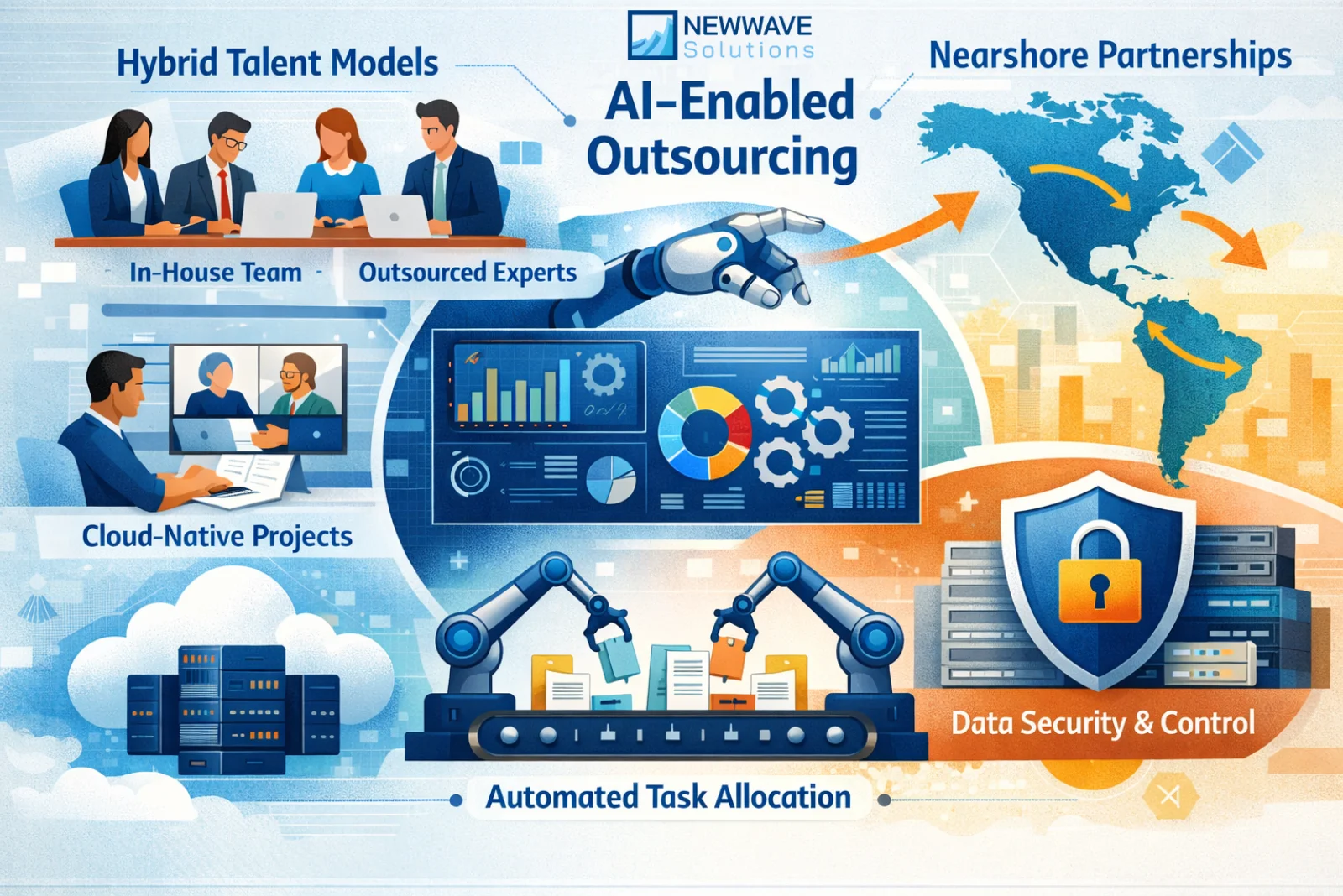
- Many enterprises will adopt hybrid talent models, blending insourced teams with outsourced specialists for optimal agility.
- AI-enabled outsourcing platforms will transform how outsourced IT tasks are tracked and managed.
- Nearshore collaborations will grow as companies seek better time-zone alignment without sacrificing cost benefits.
- Cloud-native project demands will push outsourcing toward more specialized technology providers.
- Insourcing will be prioritized for strategic platforms where data control remains critical.
- Organizations will increasingly automate task classification to determine which work should be insourced or outsourced.
Newwave Solutions – One of the best IT Outsourcing Companies in 2026
Choosing an outsourcing model is the most strategic move when your enterprise lacks the internal experience, specialized manpower, or technical infrastructure to handle complex projects in-house. In the fast-paced tech industry, making a “perfect” outsourcing decision hinges entirely on finding a reputable partner that balances quality with reliability. To identify a top-tier provider, you should prioritize criteria such as proven industry reputation, a diverse portfolio of successful case studies, transparent communication protocols, and a robust pool of certified technical talent.
Fortunately, Newwave Solutions comprehensively meets and exceeds these selection criteria to act as your dedicated technology pillar. Backed by 14+ years of proven expertise in various technologies like Java, we’ve partnered with global enterprises and ambitious startups alike to deliver solutions that truly transform operations. With a strong background in delivering software development solutions and long-term support, we deeply understand the scalability and efficiency that B2B clients need to thrive in a competitive market.
Why Choose Newwave Solutions?
- Access to Top-Quality Tech Talent: Gain immediate entry to a powerhouse of 300+ developers, QA engineers, and architects skilled in the latest tech stacks.
- Flexible Engagement Models: Choose from dedicated teams, project-based contracts, or staff augmentation to perfectly fit your budget and project scope.
- Cost Efficiency & Transparency: Reduce your operational overhead by up to 50% while maintaining full visibility through our professional management reporting.
- Faster Time-to-Market: Leverage our agile methodologies and ready-to-work infrastructure to launch your products ahead of the competition.
- Comprehensive Post-Launch Support: Ensure your systems remain resilient with our 24/7 maintenance and specialized big data handling services.
As your strategic partner, Newwave Solutions is the optimal choice to help your business access high-quality IT outsourcing services that significantly improve the workflow, quality, and delivery speed of your tech projects.
Conclusion
The choice between Insourcing and Outsourcing does not have a one-size-fits-all answer, as it depends entirely on your unique strategic goals and specific financial capabilities. If you are seeking the perfect balance between the flexibility of outsourcing and the direct control of an internal team, models like IT Staff Augmentation represent the optimal solution in today’s market.
Do not hesitate to contact the experts at Newwave Solutions today to receive a consultation on the most cost-effective and optimized technology development roadmap for your next project.
To Quang Duy is the CEO of Newwave Solutions, a leading Vietnamese software company. He is recognized as a standout technology consultant. Connect with him on LinkedIn and Twitter.



Read More Guides
Get stories in your inbox twice a month.
Let’s Connect
Let us know what you need, and out professionals will collaborate with you to find a solution that enables growth.
Leave a Reply