


iOS vs Android Development: Which Platform to Choose?

The iOS vs Android development debate sits at the heart of mobile strategy, and the difference between Android and iOS app development directly shapes cost, timeline, user reach, and ROI. Choosing correctly matters because your platform decision influences monetization potential, security posture, and long-term scalability. Follow this article to compare key differences, pros & cons, costs and timelines, plus market share and user demographics—so you can make the right call with confidence.
Market Overview of iOS vs Android Development
As of the latest 2025 report from StatCounter Global Stats, Android dominates the global user base, while iOS concentrates its strength in higher-income regions. As of August 2025, Android accounts for ~73.9% of worldwide mobile OS share versus ~25.7% for iOS; regionally, Android leads most of Asia, Africa, and South America, whereas iOS holds stronger positions in North America and Oceania, with a mixed picture in Europe.
On revenue, however, iOS continues to outperform: Sensor Tower’s 2025 report shows global consumer spend across iOS and Google Play reached about $150B in 2024 (+13% YoY), and external tallies indicate the App Store captured the majority of that spend (e.g., ~$91.6B App Store vs. ~$35.7B Google Play in 2024). These dynamics matter for strategy: Android maximizes reach; iOS often maximizes ARPU and monetization.
Quick verdict: There’s no single “winner.” If your priority is maximum reach, Android is often first pick; if your priority is revenue per user and premium markets, iOS usually leads. Many teams now start cross-platform (Flutter/React Native) to balance reach and ROI, then optimize natively where it counts.
Pros & Cons of iOS vs Android Development
Exploring the pros and cons of Android app development vs iOS app development is essential for any business aiming to launch a successful mobile solution. By weighing these factors, organizations can make a well-informed decision that aligns with their target audience, budget, and long-term growth strategy.
|
Platform |
Pros |
Cons |
|
iOS Development |
Higher Revenue Potential – iOS users typically spend more on apps and in-app purchases, making it attractive for monetization. | Smaller Global Market Share – iOS has fewer users globally compared to Android, limiting audience reach in some regions. |
| Stronger Security – Apple’s closed ecosystem and strict app store guidelines reduce risks of malware and fraud. | Strict App Store Approval – Apple’s review process can delay launches or reject apps not meeting guidelines. | |
| Consistent User Experience – Limited device models mean apps run smoothly and consistently across iPhones and iPads. | Higher Development Costs – Specialized skills in Swift or Objective-C may raise costs compared to cross-platform or Android projects. | |
| Faster Development & Testing – Fewer devices and OS versions reduce fragmentation, making coding and QA more efficient. | ||
| Engaged User Base – iOS users often adopt new technologies quickly and show higher loyalty to premium apps. | ||
| Brand Prestige – Building an iOS app can strengthen brand image in markets where Apple dominates, such as the U.S. and Europe. | ||
|
Android Development |
Wider Global Reach – With nearly 74% global market share, Android dominates in Asia, Africa, and South America. | Fragmentation Issues – Supporting thousands of devices and OS versions can complicate development and QA. |
| Flexible Customization – Open-source ecosystem allows greater freedom to design unique features and integrations. | Lower Average Revenue Per User – Android apps typically earn less per user compared to iOS, especially in in-app purchases. | |
| Lower Barriers to Publish – Google Play’s approval process is quicker and less restrictive than Apple’s App Store. | Higher Security Risks – Open ecosystem and less stringent app vetting can increase exposure to malware. | |
| Diverse Device Ecosystem – Supports a wide range of devices, from low-cost to premium, expanding potential user segments. | Inconsistent User Experience – Device diversity can result in variable app performance and visual quality. | |
| Cost-Effective Tools – Many free or open-source development tools reduce entry costs for startups and SMEs. | ||
| Strong Presence in Emerging Markets – Android is the go-to choice where affordability and accessibility drive adoption. |
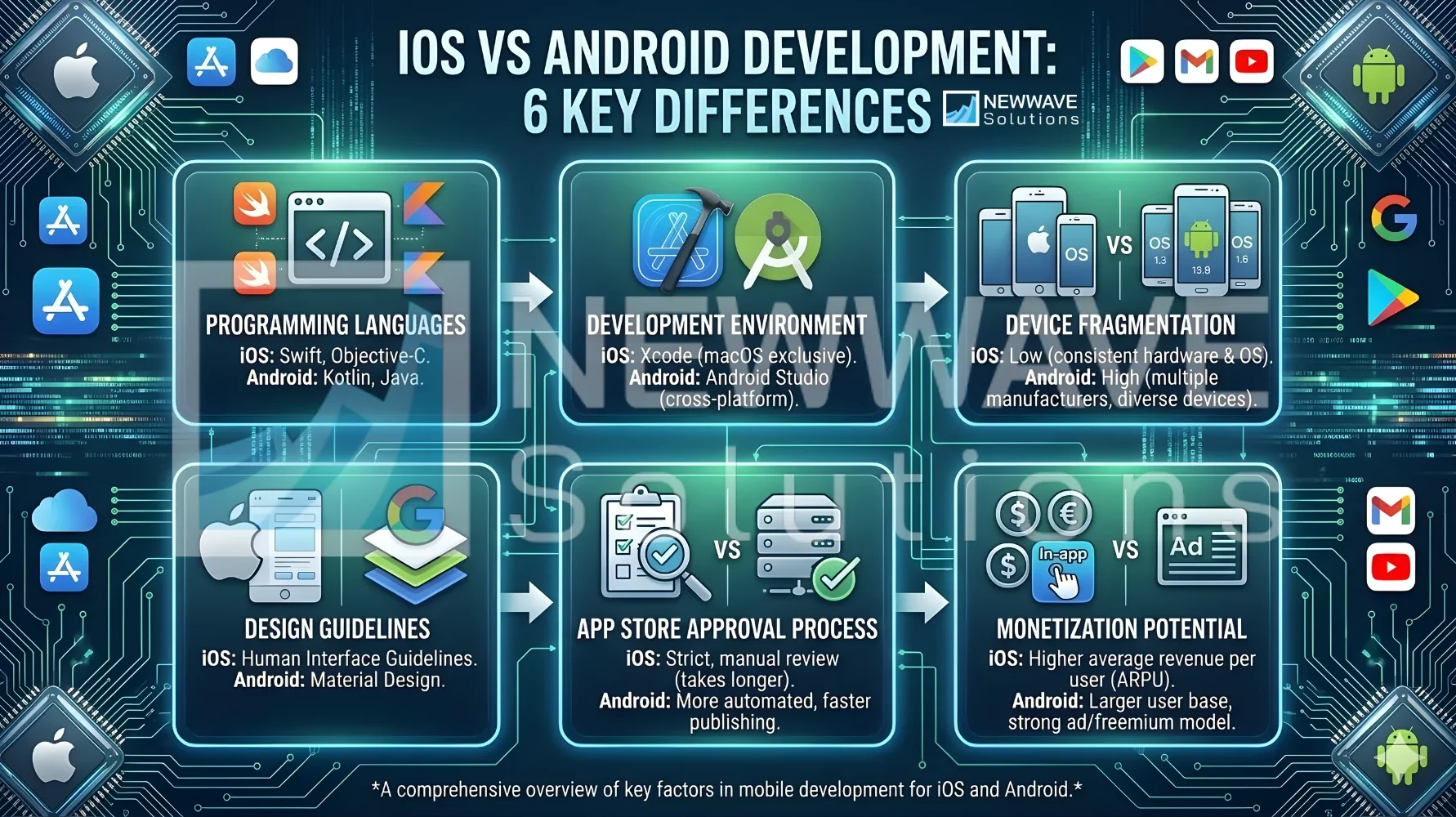
iOS vs Android Development: 6 Key Differences
Understanding the difference between Android and iOS development is vital for businesses and developers who want to make the right strategic choice. Below, we’ll break down the most important factors that separate the two platforms, with clear explanations to help you see which option might fit your needs best.
|
Factor |
iOS Development | Android Development |
Winner |
|
Programming Languages |
Swift (simple, safe) | Kotlin/Java (flexible) |
iOS (faster coding) |
|
Development Environment |
Xcode (streamlined) | Android Studio (flexible) | Android |
|
Device Fragmentation |
Limited, consistent devices |
Thousands of devices, varied OS |
iOS |
|
Design Guidelines |
Human Interface Guidelines (uniform) |
Material Design (customizable) |
iOS |
|
App Store Approval |
Strict, ensures quality |
Faster, less restrictive |
iOS |
|
Monetization |
Higher spending per user | Larger user base, ad revenue |
iOS |
1. Programming Languages
iOS development primarily uses Swift (and previously Objective-C), while Android relies on Kotlin and Java. Swift is known for its simplicity and safety features, making development faster and less error-prone, whereas Kotlin is powerful and versatile, with strong community support.
>>> Verdict: iOS has a slight edge in speed of coding and reliability with Swift, but Android remains a solid option thanks to Kotlin’s flexibility.
2. Development Environment
Apple offers Xcode as its official integrated development environment (IDE), while Android developers use Android Studio. Xcode is highly polished and tailored for iOS apps, while Android Studio provides deep customization and works well across multiple operating systems.
>>> Verdict: Android takes the lead for flexibility, while iOS is better if you want a streamlined, all-in-one tool.
3. Device Fragmentation
iOS apps are designed for a limited number of Apple devices with consistent hardware and software updates. Android apps, on the other hand, must support thousands of devices with different screen sizes, performance levels, and OS versions.
>>> Verdict: iOS is the winner here because less fragmentation means faster testing, easier maintenance, and a more consistent user experience.
4. Design Guidelines
Apple follows its Human Interface Guidelines, which emphasize simplicity, clarity, and uniformity, while Android uses Material Design, which allows more customization and flexibility. iOS apps often look cleaner and more consistent, whereas Android apps can feel more varied depending on how developers implement design choices.
>>> Verdict: iOS is better for consistent design standards, while Android allows greater freedom if customization is your priority.
5. App Store Approval Process
Submitting an app to Apple’s App Store involves a strict review process, which can delay approval but ensures higher quality and security standards. Google Play’s review process is much faster and less restrictive, allowing quicker releases but sometimes leading to lower-quality apps being published.
>>> Verdict: iOS ensures higher trust and security, but Android is better for speed and flexibility in publishing.
6. Monetization Potential
iOS users tend to spend more on apps and in-app purchases, while Android users rely more on ad-supported revenue. For businesses targeting premium markets and higher average revenue per user, iOS is more profitable. Android, however, benefits from sheer volume in emerging markets.
>>> Verdict: iOS wins for revenue per user, while Android is the leader for market reach.
Cost and Time Considerations in iOS vs Android Development
When I first estimated a project’s budget, I noticed that the difference between iOS and Android app development was often more than just hourly rates—it involved device testing, OS versions, and design consistency. Based on both my hands-on experience and expert reports, iOS tends to require a higher upfront cost but often delivers a faster time-to-market due to less fragmentation; Android may cost less per developer hour but often stretches time and testing costs.
|
Measure |
iOS Development |
Android Development |
|
Average Initial Cost (Simple/Mid Complexity) |
Around US$50,000 for a moderate complexity app. | Generally lower—often US$23,000-US$40,000 for similar functionality. |
|
Development Time |
Typically 1.5-3 months for simple-to-mid apps. | Often somewhat longer due to needing to support more device models—about 2-4 months or more, depending on complexity. |
|
Ongoing Maintenance Cost |
Lower maintenance cost overall due to fewer devices and OS versions to support. | Higher maintenance costs because of device fragmentation, OS diversity, and the need to test across many configurations. |
Key features affecting cost & time:
- App Complexity: More features, animations, real-time sync, databases, and integrations increase both cost and development time significantly, whether on iOS or Android.
- Device Fragmentation & OS Versions: Android apps must support many device types, screen sizes, and OS versions, requiring more testing; iOS apps deal with a more limited, unified device set, reducing testing overhead.
- Design & UX Requirements: Wider variation in screen sizes on Android means more effort in responsive design; iOS benefits from more standardization in UI components, making design flows faster in many cases.
- Developer Rates & Team Location: Hourly rates differ widely depending on the region. Developers in North America or Western Europe cost more than those in Eastern Europe, Southeast Asia, or Latin America—affecting both Android and iOS projects.
- Publishing & Store Approval Times: Getting an app approved on Apple’s App Store often takes longer because of stricter guidelines. Google Play tends to be faster, though quality and security checks are improving.
- Maintenance, Updates & Support: Post-launch issues (bugs, OS upgrades, new device compatibility) tend to cost more for Android over time. iOS, while having fewer device models, still requires effort for updates and adherence to Apple’s evolving policy and OS changes.
When to Choose iOS vs Android Development for Your Business
After exploring the costs, timelines, and differences, you now have a clearer picture of which platform may fit your needs. To make it even easier, here’s a breakdown of situations where Android apps vs iOS apps prove to be the better choice.
Best Cases for Choosing iOS Development
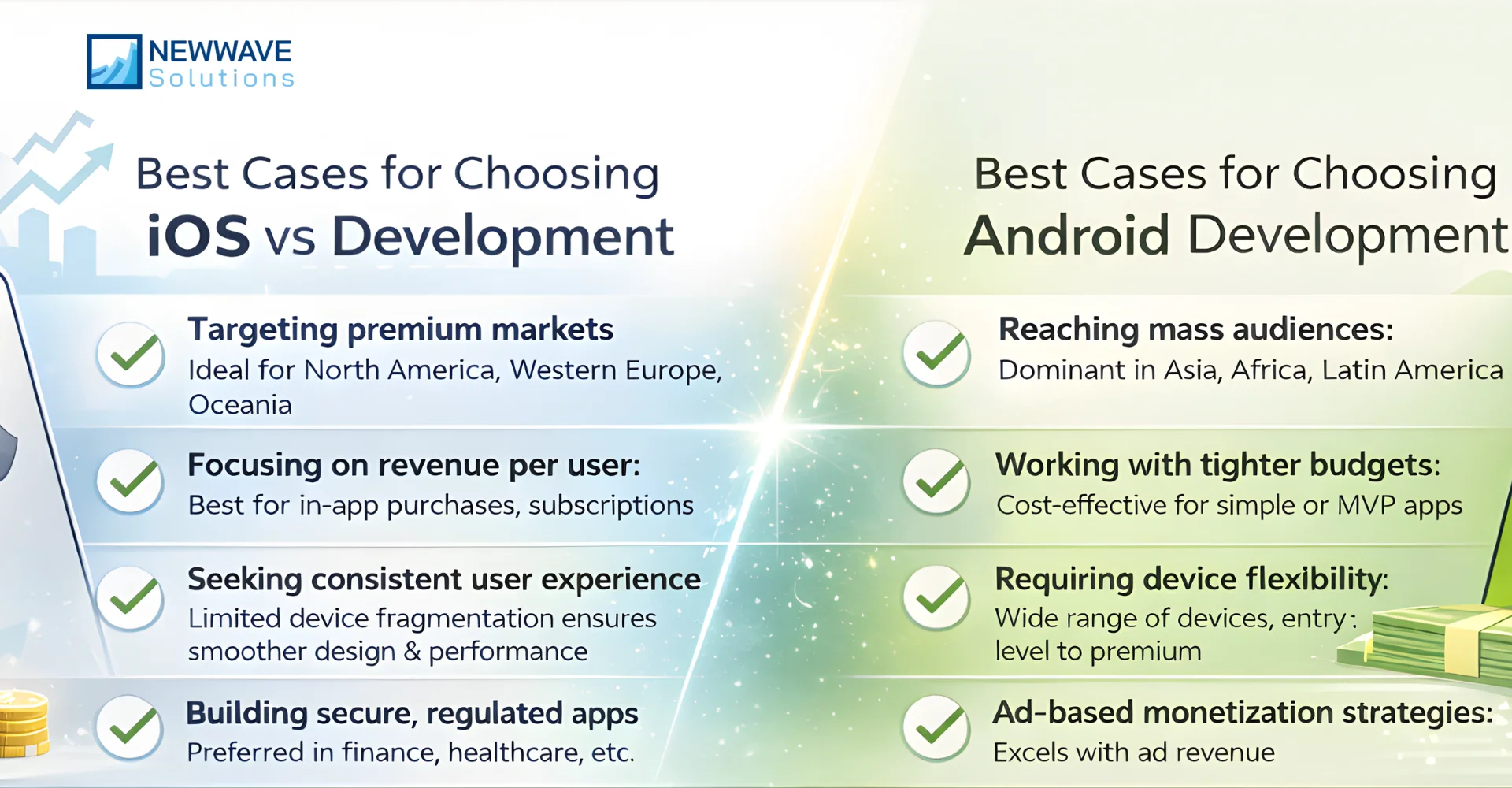
- Targeting premium markets: Ideal if your audience is in North America, Western Europe, or Oceania, where iOS adoption is strong.
- Focusing on revenue per user: Best for businesses relying on in-app purchases or subscriptions, as iOS users spend more.
- Seeking consistent user experience: Limited device fragmentation ensures smoother design and performance.
- Building secure, regulated apps: Preferred in industries like finance or healthcare due to Apple’s strict security standards.
- Wanting early adopters of technology: iOS users tend to adopt updates and new apps faster, helping with innovation.
Best Cases for Choosing Android Development
- Reaching mass audiences: Dominant in Asia, Africa, and Latin America, with the largest global market share.
- Working with tighter budgets: Development can be more cost-effective, especially for simple or MVP apps.
- Requiring device flexibility: Perfect for apps that need to run on a wide range of devices, from entry-level to premium.
- Ad-based monetization strategies: Android excels where ad revenue is the main business model.
- Building for emerging markets: Strong adoption in regions where affordable devices drive user growth.
The Future Trends in App Development
One of the most important shifts in mobile technology is the rise of cross-platform development frameworks such as Flutter, React Native, and Xamarin. Instead of choosing between iOS and Android, businesses can now build a single codebase that runs smoothly on both platforms. This approach significantly reduces development time, cuts costs, and ensures faster go-to-market—while still delivering a native-like experience for end users.
The impact of this trend is profound: companies no longer need to maintain two separate development teams or face the risk of alienating parts of their audience. By adopting cross-platform tools, enterprises can reach wider markets, maintain design and feature consistency, and adapt quickly to user feedback. This future-oriented approach solves the dilemma of platform choice, making app development more accessible, scalable, and efficient for businesses of all sizes.
Bonus: Newwave Solutions can support either iOS or Android app development
Once you have decided whether iOS or Android is the right platform for your product, the next challenge is finding a reliable partner to bring your vision to life. Many businesses struggle with where to begin—strategy, design, coding, or deployment. This is where Newwave Solutions comes in.
With 14+ years of experience and a proven track record of delivering 800+ successful projects worldwide, we are recognized as one of the leading software outsourcing companies. Our team of experts helps enterprises and startups alike turn ideas into scalable, secure, and market-ready mobile applications.
iOS App Development Services
With a strong focus on Apple’s ecosystem, we provide end-to-end iOS app development services to meet the demands of enterprise-level clients and innovative startups. Our services include:
- Custom iOS App Development – Tailored applications for iPhone, iPad, Apple Watch, and Apple TV that match your business needs.
- UI/UX Design for iOS – Intuitive and engaging designs that comply with Apple’s Human Interface Guidelines, improving user adoption and satisfaction.
- App Integration Services – Seamless integration with third-party APIs, enterprise software, and IoT devices.
- Migration & Modernization – Upgrade legacy apps or migrate existing solutions to iOS with improved functionality and security.
- App Testing & Quality Assurance – Rigorous testing to ensure high performance, stability, and compliance with App Store requirements.
- App Store Deployment & Support – From compliance checks to submission, we handle the publishing process and provide long-term maintenance.
Android App Development Services
Android powers the majority of smartphones worldwide, making it essential for businesses aiming for maximum market reach. We offer comprehensive Android app development services, including:
- Custom Android App Development – Native apps for smartphones, tablets, wearables, and Android TV tailored to business requirements.
- Cross-Device Compatibility – Building apps that deliver consistent performance across the diverse Android ecosystem.
- Enterprise App Solutions – Scalable apps with secure backend integration to streamline operations for large organizations.
- Migration & App Modernization – Transforming outdated systems into modern Android applications.
- App Testing & Performance Optimization – Comprehensive QA to ensure smooth functionality across multiple devices and OS versions.
- Google Play Store Deployment & Post-Launch Support – End-to-end assistance from publishing to long-term updates and performance monitoring.
Beyond our core offerings, Newwave Solutions provides specialized hire Android developer services and hire iOS developer services to equip businesses with high-quality, elite technical teams capable of managing complex projects with maximum efficiency. You can fully trust Newwave Solutions as your prestigious partner to boost any iOS-based or Android-based initiative while significantly optimizing your development costs, productivity, and overall market performance.
Conclusion
When viewed through the lens of iOS vs Android development, the trade-offs become clear: costs and fragmentation favor iOS in consistency, while Android wins on global reach and device diversity. In the matchup of Android app development vs iOS app development, Android is often best for mass markets and price-sensitive regions, whereas iOS suits premium audiences and higher in-app spending.
As a rule of thumb, pick iOS when you need tight security and predictable UX; choose Android for the widest distribution and rapid iteration. Increasingly, teams adopt cross-platform frameworks (e.g., Flutter, React Native) to meet users wherever they are while optimizing budget and time-to-market. Contact Newwave Solutions if you wish to receive professional support for either iOS or Android app development projects.
FAQs
1. Which is easier to develop for, iOS or Android?
iOS is generally easier because there are fewer devices to support, and Apple’s ecosystem is more consistent. Android requires more testing due to the many device types and OS versions.
2. Which platform generates higher revenue?
iOS typically generates higher revenue per user through in-app purchases and subscriptions, while Android earns more total revenue globally because of its larger user base.
3. How different are the approval processes for App Store vs Google Play?
Apple’s App Store has a stricter, longer review process with higher rejection risks. Google Play’s process is faster and less strict, but it may allow lower-quality apps through.
4. Do businesses usually build for iOS or Android first?
It depends on the target market. Businesses focusing on premium markets often start with iOS, while those targeting mass audiences in emerging regions usually begin with Android.
5. Is cross-platform development a better alternative?
Cross-platform frameworks like Flutter or React Native can be a smart choice. They reduce cost and time by allowing one codebase for both platforms, though very complex apps may still perform better when built natively.
To Quang Duy is the CEO of Newwave Solutions, a leading Vietnamese software company. He is recognized as a standout technology consultant. Connect with him on LinkedIn and Twitter.



Read More Guides
Get stories in your inbox twice a month.
Let’s Connect
Let us know what you need, and out professionals will collaborate with you to find a solution that enables growth.
Leave a Reply