


IT Offshoring Trends 2026: What Enterprises Need to Know

IT offshoring remains a cornerstone of global technology strategy, enabling enterprises to access specialized talent, scale operations, and accelerate innovation beyond the constraints of local labor markets. In 2026, IT offshoring trends are increasingly shaped by persistent global talent shortages and the rapid adoption of AI-driven workflows, prompting organizations to rethink traditional delivery models and expand their strategic capabilities. This blog will provide the latest insights into IT offshoring trends in 2026, highlight key drivers behind these shifts, identify emerging regional hubs, and explore what the near-future holds for this dynamic niche.
The Current Landscape of IT Offshoring in 2026
The global IT offshoring and outsourcing market continues to expand rapidly as companies seek ways to scale capabilities, access specialized talent, and drive digital transformation beyond the limitations of local labor pools. In 2025, the global IT outsourcing service market segment alone was valued in the hundreds of billions of dollars and is expected to grow steadily through the end of the decade, reflecting how deeply integrated offshore delivery has become in enterprise technology strategy.
This expansion is driven by the increasing demand for software development, cloud services, cybersecurity, and AI-related expertise, all of which are difficult to satisfy solely with domestic resources. When comparing Outsourcing vs Offshoring,
>>>Read more: Top 10+ IT Outsourcing Trends to innovate your Business
7 Major IT Offshoring Trends To Consider
As enterprises continue to refine their global delivery strategies, several key IT offshoring trends have emerged that will shape how companies recruit, manage, and scale offshore capabilities in 2026 and beyond. Below are the most impactful developments you need to understand to stay competitive.
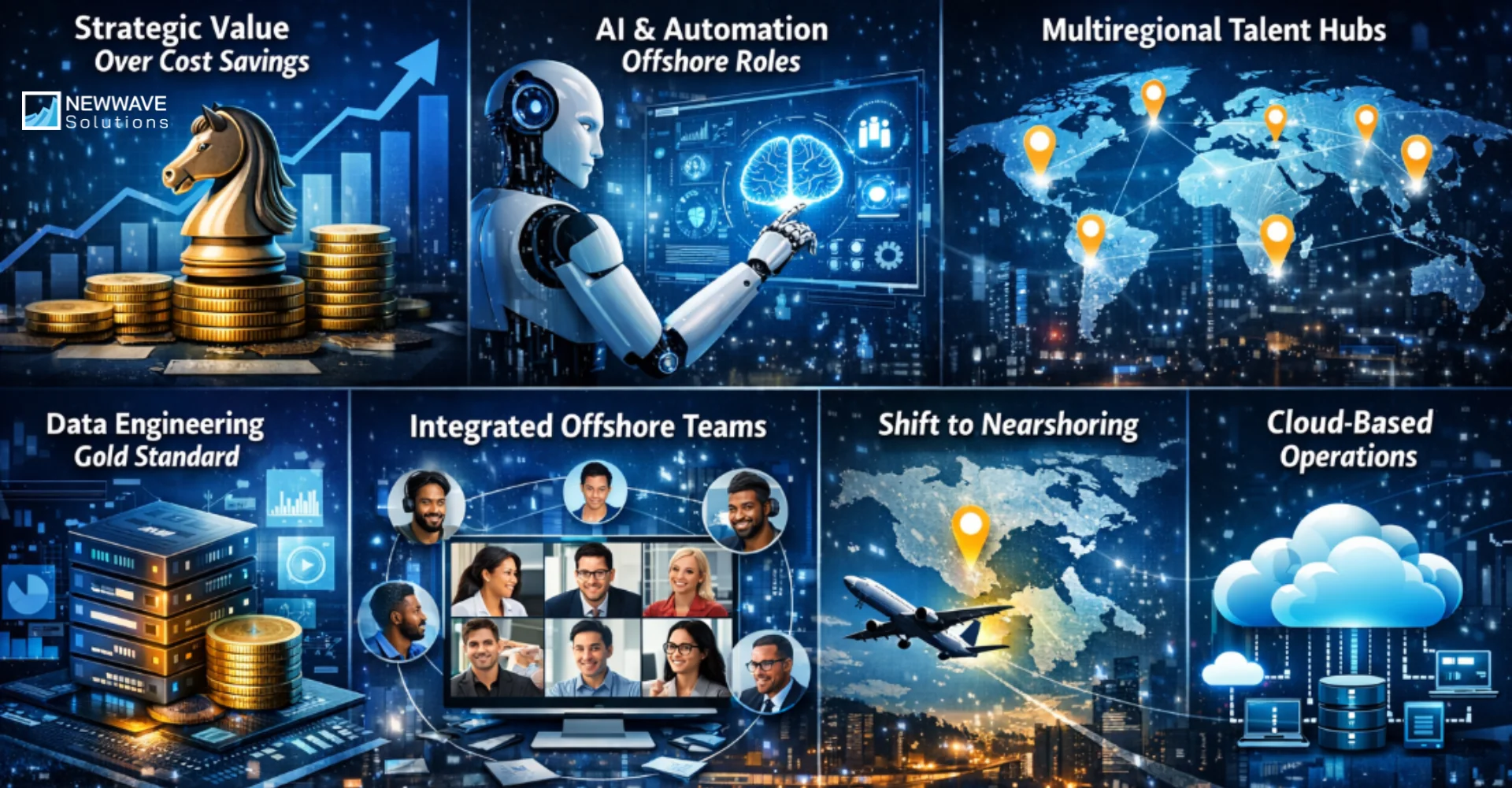
1. Strategic Value Over Pure Cost Savings
The nature of IT offshoring is shifting from simply reducing labor costs to becoming a source of strategic value, where offshore teams contribute directly to core product development and innovation initiatives. This transition reflects a broader trend in enterprise technology where speed, quality, and global expertise matter more than short-term cost gains.
This strategic emphasis creates opportunities for companies to build deeper, longer-term partnerships with offshore teams, enabling them to accelerate innovation while maintaining operational efficiency. However, it also introduces challenges in aligning offshore partners with internal strategic goals and ensuring that collaborative decision-making processes are effective across distributed environments.
Cost reduction alone is no longer a sufficient reason to offshore — enterprises that treat it as the primary driver often run into friction that erodes the savings over time. Understanding the hidden costs of offshoring is what separates organizations that scale their offshore operations successfully from those that quietly pull back.
2. AI & Automation Shaping Offshore Roles
AI and automation technologies are increasingly integrated into offshore workflows, transforming the nature of roles and elevating expectations for technical proficiency. Offshore teams are now expected to work alongside AI tools, automate repetitive tasks, and contribute to more advanced engineering functions that require critical thinking rather than manual execution.
This trend enables offshore teams to deliver higher productivity and better quality outcomes, but it also requires companies to invest in reskilling and continuous learning to keep pace with evolving technology stacks. Enterprises that successfully blend human expertise with automation stand to benefit most, yet those that fail to adapt may face skill gaps and reduced competitiveness in a rapidly automating world.
3. Rise of Multiregional Talent Hubs
Enterprises are increasingly diversifying their offshoring destinations beyond traditional centers to include emerging talent hubs across Southeast Asia, Latin America, and Eastern Europe. This multiregional approach allows companies to balance cost, time zone alignment, language capabilities, and specialized skill availability in a way that a single location simply cannot match.
While tapping into multiple talent hubs enhances resilience and provides access to specialized expertise, it also adds complexity in terms of governance, cultural integration, and operational coordination. Organizations must therefore implement strong cross-regional communication frameworks and standardized processes to ensure consistent performance across diverse teams.
4. Data Engineering as the “Gold Standard.”
Data engineering roles have rapidly become one of the most sought-after skill sets in IT offshoring, driven by enterprises’ growing reliance on data pipelines, analytics platforms, and AI applications. Offshore data engineers help organizations scale complex data architectures, integrate disparate sources, and maintain high performance in distributed environments.
This trend creates significant opportunities for businesses to unlock deeper insights and improve agility in decision-making, but it also places pressure on offshore teams to demonstrate strong domain expertise and familiarity with modern data tools and frameworks. Companies that cultivate data proficiency within their offshore ecosystem can drive considerable competitive advantage in an increasingly data-centric world.
5. Integrated Offshore Team Models
Rather than relying on transactional or project-based arrangements, many enterprises are adopting fully integrated offshore team models where remote engineers operate as extensions of internal teams. This approach improves alignment with core business processes, enhances knowledge continuity, and supports long-term innovation strategies.
However, integrating offshore teams closely with internal teams requires thoughtful onboarding, shared tooling, and effective leadership practices to avoid miscommunication or disconnects. Enterprises that successfully foster cohesion between distributed teams benefit from higher productivity and more seamless delivery.
6. Shift Towards Nearshoring
While offshoring remains a strategic choice, there is growing interest in nearshoring as companies balance the benefits of global talent access with the desire for closer geographic and cultural proximity. Nearshoring offers advantages in overlapping work hours and communication ease, which can improve collaboration for certain types of technical work.
The rise of nearshoring does not replace traditional offshoring, but rather complements it as enterprises build multilayered delivery strategies. Organizations that intelligently combine onshore, nearshore, and offshore resources can tailor solutions according to the specific demands of each project or technology stack.
7. Cloud-Based Operations
Cloud computing continues to shape IT offshoring trends by enabling distributed teams to work on shared platforms, tools, and environments with minimal friction. Cloud-native workflows support remote collaboration, real-time testing, and scalable infrastructure that align with modern development practices.
The shift toward cloud-centric delivery enhances speed and reliability, but also necessitates stronger governance and cloud security practices to protect distributed systems. Offshore teams must therefore be proficient in cloud technologies and security principles to fully realize the benefits of this trend.
Key Drivers for the IT Offshoring Trends
The evolution of IT offshoring trends is propelled by a combination of both external market forces and internal enterprise demands, all of which shape how organizations access talent, manage cost pressures, and build competitive capabilities. Below are the primary drivers behind these shifts and why they matter for global IT offshoring:
- Severe local talent shortages: Many markets struggle to find qualified IT professionals, with executives reporting significant difficulty in hiring skilled technology workers, which pushes companies to look internationally for solutions. This persistent gap compels enterprises to build offshore teams to meet project demands and scale development capacity.
- Need for specialized skills: As technology stacks become more complex with AI, cloud, and cybersecurity, the demand for highly specialized expertise outpaces local supply, driving enterprises to offshore roles that require advanced technical proficiency. Offshore engagements allow companies to tap into global talent pools that are rich in these niche capabilities.
- Cost reduction and operational efficiency: Historically a central motivation, cost savings remain a significant factor as organizations reduce labor and infrastructure expenses, making offshoring a compelling strategy to optimize budgets without sacrificing quality. Offshore resources often provide a lower cost base while sustaining high levels of technical output.
- Pressure for agility and speed to market: The competitive environment of digital transformation demands faster delivery cycles and responsiveness, prompting enterprises to build distributed teams that can accelerate product development and shorten time-to-market. Offshore teams extend development capacity and flexibility, enabling continuous progress around the clock.
- Strategic capability development: Organizations are increasingly using offshoring not just for labor arbitrage but as a strategic lever to access innovation, long-term engineering capacity, and global knowledge networks. This shift transforms offshoring from a cost tactic to an enabler of enterprise growth and technological leadership.
Regional Hotspots for IT Offshoring Shiftment
Alongside shifts in IT offshoring trends, enterprises are paying closer attention to which regions and countries serve as ideal destinations for offshore IT talent. Below are some key regional hotspots that are benefiting from the global offshoring movement, each offering distinct advantages for enterprise tech teams:
- LATAM Talent Hub: Latin America has emerged as a major destination for U.S. nearshoring due to its favorable time zone alignment, strong cultural compatibility with North American teams, and a rapidly expanding pool of IT professionals. Many U.S. companies are nearshoring software development and IT roles to Mexico, Colombia, and Costa Rica to reduce costs by 20–40% while maintaining productivity and collaboration.
- Eastern Europe Engineering Base: Countries such as Poland, Romania, and the Czech Republic are popular nearshore and offshore destinations for European firms due to high-quality engineering talent, strong STEM education, and competitive price points. Eastern Europe’s workforce is especially attractive for complex software development and cybersecurity roles, contributing to its reputation as a reliable tech talent hub.
- India & Southeast Asia Scale Engine: India continues to dominate as a large-scale offshore destination with deep pools of developers, cloud specialists, and data engineers, supported by thousands of global capability centers. Regions such as the Philippines and Vietnam also provide significant contributions, with the Philippines alone employing over 1.3 million in IT-BPM roles and delivering high English proficiency and service quality for international partners.
- Emerging Central & Eastern European Niches: Beyond the established hubs, countries such as Ukraine and Romania benefit from a growing IT sector with strong technical skills, competitive costs, and increasing investments in technology education. These regions offer enterprises a balance of quality and affordability, making them compelling alternatives for specific engineering domains.
Each of these regional hotspots reflects a combination of talent availability, cost efficiency, and strategic alignment with enterprise offshoring goals, reinforcing the evolving geographies of global IT delivery.
Best Practices for Successful IT Offshoring
To maximize the benefits of IT offshoring while minimizing risk, enterprises should adopt disciplined strategies that align people, processes, and technology. The following best practices have been proven to support effective offshore collaboration and sustainable delivery outcomes:
- Strategic Partner Selection: Clearly define your business objectives and technical requirements before selecting an offshore partner so that project goals, cultural fit, and long-term alignment are well matched from the outset. This alignment reduces onboarding friction and ensures that both teams share ownership of deliverables from day one.
- Governance & Communication Frameworks: Establish structured governance practices and communication protocols that enable clear accountability, regular feedback loops, and performance tracking across teams. Consistent KPIs, daily stand-ups, and shared documentation platforms help bridge distances and improve coordination.
- AI & Automation Alignment: Integrate AI tools and automation frameworks into offshore workflows to enhance productivity, reduce manual overhead, and standardize routine tasks. By embedding AI-enabled processes into both onshore and offshore development cycles, enterprises can accelerate delivery velocity while maintaining quality standards.
- Continuous Upskilling & Knowledge Transfer: Invest in ongoing training and collaborative learning opportunities to ensure offshore teams stay current with evolving technologies and business priorities. Structured knowledge transfer sessions and shared learning resources help create a unified capability base across locations.
- Security & Compliance Protocols: Adhere to global data protection standards and implement robust security controls throughout the offshoring lifecycle, including identity management, encryption, and compliance auditing. This proactive approach safeguards sensitive data and builds trust with partners and end users.
By leveraging these best practices, enterprises can build more resilient, scalable, and productive offshore partnerships that support both short-term execution and long-term strategic goals.
The Future of IT Offshoring: Hybrid & Human-AI Collaboration
IT offshoring in 2027 and beyond will be shaped by the convergence of hybrid working models, advanced AI capabilities, and global talent networks that blend human expertise with intelligent automation. In this context, it is important to distinguish outsourcing vs offshoring, as outsourcing refers broadly to delegating services to an external provider, while offshoring specifically involves relocating those services to talent pools in other countries to optimize cost, scale, and expertise.
As enterprises adopt flexible remote and distributed teams, offshore development will no longer be defined solely by geography but by performance, agility, and technological leverage, which ultimately transforms offshoring into a strategic capability rather than a purely operational model.
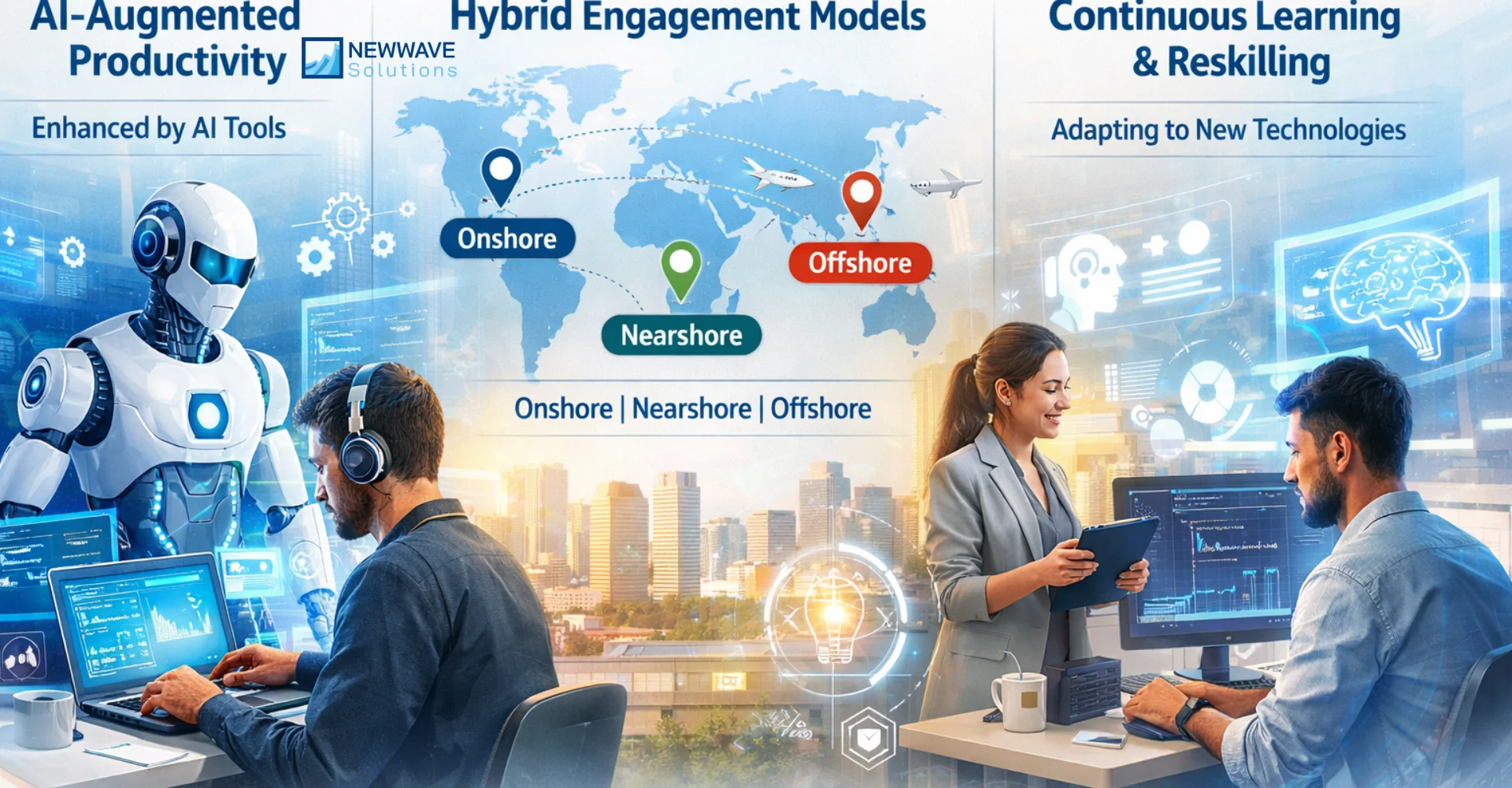
This hybrid future will likely emphasize human-AI collaboration, where AI assists with routine coding, testing, and documentation tasks while human engineers focus on creative problem‐solving and architectural design. Offshore teams that embrace these capabilities will be better equipped to deliver higher-value outcomes and adapt to rapid market changes.
Key implications for enterprise decision makers include:
- AI-augmented productivity: Offshore engineers equipped with AI tools will deliver more with less manual effort.
- Flexible hybrid engagement models: Combining onshore, nearshore, and offshore talent allows enterprises to balance cost, time-zone alignment, and expertise depth.
- Emphasis on continuous learning: Human-AI collaboration requires ongoing reskilling to ensure offshore teams can effectively harness emerging technologies.
Together, these trends point toward a future where offshoring is not just a cost strategy but a dynamic driver of innovation and competitive differentiation in the global tech economy.
The line between outsourcing and offshoring is blurring fast as hybrid delivery models and AI-assisted workflows reshape how global teams operate. Getting clear on how outsourcing and offshoring actually differ is a practical starting point before mapping out what a future-ready engagement model looks like for your organization.
Newwave Solutions – Your Trusted Partner in Offshoring Software Development
If your enterprise is struggling to adapt to the evolving landscape of IT offshoring and finding a reliable offshore software development partner, then narrowing down to the most credible providers becomes essential for long term success. Among a limited number of qualified options, Newwave Solutions stands out as a trusted partner with years of proven experience in IT outsourcing and offshoring, particularly in delivering high-quality offshore software development services to global clients.
With over 14 years of experience in the technology industry, Newwave Solutions has built a strong team of skilled developers, architects, and QA engineers who consistently deliver scalable and secure digital solutions. Moreover, our ISO 9001:2015 and ISO 27001:2022 certifications for Quality Management and Information Security demonstrate our commitment to excellence, structured processes, and full protection of client data throughout every offshore engagement.
The USP of Our Offshore Software Development Services
- Dedicated Teams – Our offshore developers work exclusively on your project, fully aligned with your goals, workflows, and delivery timelines to ensure focused and consistent progress.
- Staff Augmentation – We quickly reinforce your in-house team with offshore specialists who bring niche technical skills or provide immediate support for urgent project needs.
- Project Delivery – Our teams manage end-to-end offshore projects from initial planning to deployment, ensuring a clearly defined scope, deadlines, and measurable quality standards.
- Managed Services – We provide a comprehensive offshore solution that covers development, testing, monitoring, and long-term product support under a unified governance model.
- Product Development – Our offshore engineers build custom software solutions, from MVPs to complex enterprise platforms, using scalable architectures and agile methodologies.
- QA & Testing – Our offshore QA experts conduct both manual and automated testing to ensure system performance, reliability, and security before and after deployment.
- Maintenance Support – We offer continuous offshore maintenance, including updates, bug fixes, and performance optimization to sustain product stability post launch.
- DevOps Offshore – Our teams establish CI/CD pipelines, cloud infrastructure, and automation frameworks that streamline development and deployment cycles.
- R&D Offshore – We enable rapid prototyping, emerging technology integration, and innovation through dedicated offshore research and development capabilities.
Partner with Newwave Solutions to stay ahead of the latest IT offshoring trends and elevate your offshore software development projects with efficiency, scalability, and strategic impact!
Conclusion
Monitoring IT offshoring trends is essential for enterprise technology strategy, as these shifts directly impact talent access, operational agility, and competitive advantage in a rapidly evolving digital economy. Forward-looking decision makers who adopt strategic offshoring approaches are better positioned to leverage global expertise while mitigating workforce gaps and driving innovation.
To achieve this, choosing a professional and reputable partner like Newwave Solutions can elevate your offshore software development efforts, ensuring alignment with the latest trends, technologies, and quality standards. Approach us to discuss your unique business requirements in detail so that we can collaborate effectively on your upcoming IT offshoring initiatives.
To Quang Duy is the CEO of Newwave Solutions, a leading Vietnamese software company. He is recognized as a standout technology consultant. Connect with him on LinkedIn and Twitter.



Read More Guides

Get stories in your inbox twice a month.
Let’s Connect
Let us know what you need, and out professionals will collaborate with you to find a solution that enables growth.
Leave a Reply