


JSP Servlet: The Foundation of Modern Enterprise Java Apps
Behind the dynamic websites you use daily lies a critical foundation: the powerful, time-tested duo of JSP Servlet technology. While modern frameworks grab headlines, this bedrock powers countless high-traffic web applications. This article cuts through the noise to give you a clear, strategic view of what JSP Servlet is, why they matter, and how they underpin the digital world.
What is JSP Servlet?
JSP and Servlet represent two complementary technologies within the Java ecosystem that work together to create dynamic web applications.
A servlet is a Java program that runs on a web server and handles HTTP requests and responses, acting as the middleware between web clients and backend resources. JSP (JavaServer Pages), on the other hand, is a technology that allows you to embed Java code directly into HTML pages, making it easier to create dynamic web content without writing extensive servlet code.
The history of these technologies dates back to the late 1990s when Sun Microsystems introduced servlets as part of Java 2 Enterprise Edition (J2EE) to address the limitations of CGI scripts. JSP followed shortly after in 1999 as a higher-level abstraction that simplified web development by allowing developers to write HTML-like pages with embedded Java code, which would then be compiled into servlets behind the scenes.
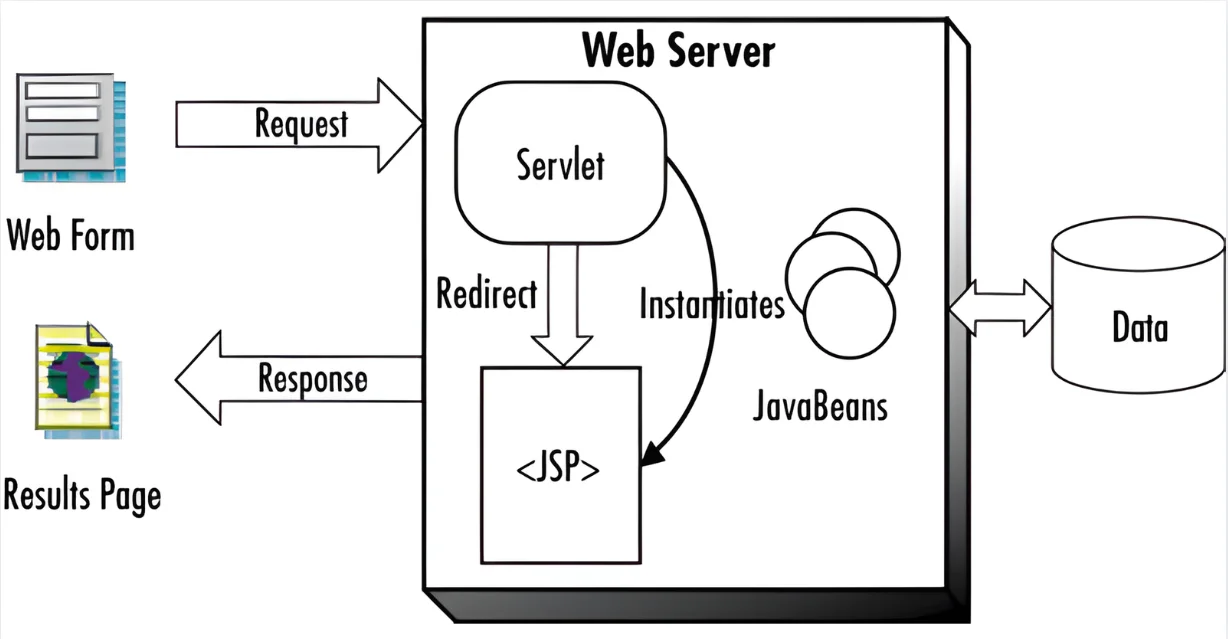
Thinking of JSP and Servlets as competitors is a common misconception. In reality, they are two sides of the same coin, designed to work together in the Model-View-Controller (MVC) architectural pattern.
- Servlet as the Controller: The Servlet acts as the controller. It receives the initial HTTP request (e.g., a form submission), contains the business logic, interacts with databases and other backend systems (the Model), and decides what to do next (e.g., forward the request to a JSP page).
- JSP as the View: The JSP acts as the view layer. Its sole responsibility is to present the data prepared by the Servlet. It generates the HTML, CSS, and JavaScript that is sent back to the user’s browser.
This separation is crucial. It allows Java developers to focus on complex application logic in Servlets, while front-end developers or designers can work on the presentation layer in JSPs with minimal Java knowledge. This clean separation makes applications easier to maintain, scale, and debug.
If you need seasoned developers who understand these foundational principles, explore our dedicated Hire Java Developer services to build a stronger team.
When Should I Use JSP and Servlet?
While these technologies complement each other beautifully, understanding their fundamental differences and knowing when to leverage each one’s strengths can dramatically impact your project’s success, development velocity, and long-term maintainability.
1. What are the Key Differences Between JSP and Servlet?
Choosing the right tool starts with understanding its specializations. The table below compares JSP and Servlets to help you make an informed architectural decision.
| Aspect | JSP |
Servlet |
| Primary Purpose | Presentation layer and view generation | Business logic and request handling |
| Code Structure | HTML with embedded Java code | Pure Java classes |
| Development Speed | Faster for UI development | More time-intensive for complex logic |
| Maintenance | Easier for designers and front-end developers | Better for complex business operations |
| Performance | Slight overhead during first request (compilation) | Direct execution, no compilation overhead |
| Debugging | Can be challenging due to mixed HTML/Java | Standard Java debugging tools work seamlessly |
| Reusability | Limited to specific presentation contexts | Highly reusable across different interfaces |
2. JSP vs Servlet: When to Choose?
The decision isn’t about choosing one over the other but about understanding which one to use for a specific task within your application.
Use a Servlet when your task involves:
- Request Processing: Handling form data, managing session data, and controlling application flow.
- Business Logic: Performing calculations, making database calls, or integrating with other services.
- Generating Non-HTML Content: Servlets are excellent for producing outputs like PDF files, Excel spreadsheets, or XML/JSON responses for web development services.
Use a JSP when your task involves:
- Rendering the User Interface: Creating the final HTML that the user sees in their browser.
- Displaying Dynamic Data: Showing user-specific information, product catalogs, or data tables that are prepared by a Servlet.
- Leveraging Tag Libraries: Using JSTL (JSP Standard Tag Library) or custom tags to keep the page clean and free from scriptlets (embedded Java code).
The insight here is that a well-architected application uses both. A Servlet handles the initial request, processes it, and then forwards the result to a JSP for presentation. This is the classic MVC pattern that frameworks later standardized and simplified.
What are the Enduring Benefits of JSP Servlet?
Despite the rise of newer frameworks, JSP and Servlet technology remains relevant due to several foundational advantages that translate directly into business value. These benefits are not just technical quirks; they are reasons why major enterprises have built stable, long-lasting systems on this platform.
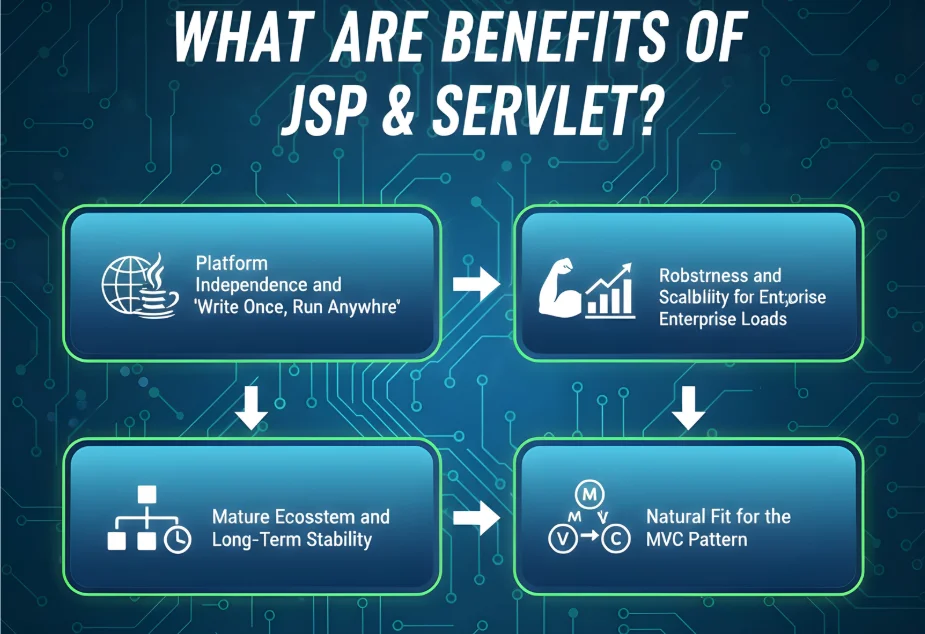
1. Platform Independence and “Write Once, Run Anywhere”
As core Java technologies, JSP and Servlets inherit the fundamental Java benefit of platform independence. The application you develop on a Windows machine will run without modification on a Linux server. This eliminates vendor lock-in and provides tremendous flexibility in choosing hosting infrastructure, which can lead to significant cost savings and negotiating power with IT vendors. The impact is a more resilient and portable application portfolio.
2. Robustness and Scalability for Enterprise Loads
Servlets are managed by a Java Virtual Machine (JVM). Unlike older CGI scripts that spawned a new process for every request, Servlets run within a lightweight thread inside the JVM. This model is immensely more efficient with memory and CPU resources, allowing a single server instance to handle thousands of concurrent users. For businesses, this translates directly to lower hardware costs and the ability to scale to meet user demand without a complete architectural overhaul.
3. Mature Ecosystem and Long-Term Stability
JSP and Servlets are a mature, standardized part of Jakarta EE. This means they are backed by a vast ecosystem of application servers (like Apache Tomcat, IBM WebSphere, Oracle WebLogic), monitoring tools, and a global community of developers. Choosing a mature technology reduces project risk. You are building on a stable, well-documented foundation with predictable long-term support, which is a critical consideration for IT decision-makers planning for applications with a lifespan of a decade or more.
4. Natural Fit for the MVC Pattern
As discussed, the inherent separation between Servlet (controller) and JSP (view) encourages a clean architectural pattern. This separation of concerns makes code easier to read, test, and maintain. For development teams, this means faster onboarding of new developers and reduced costs associated with maintaining and enhancing the application over its lifetime. It’s a design principle that pays continuous dividends.
What are the Key Challenges of JSP Servlet?
No technology is without its drawbacks. Acknowledging these challenges is crucial for making an informed decision and understanding why JSP and Servlet gained popularity.
1. The Verbosity of Java and Configuration
Traditional Servlet development can involve writing a considerable amount of boilerplate code to handle simple tasks. Before Java annotations (introduced in Servlet 3.0), configuration was done via verbose XML files (web.xml). This verbosity can slow down initial development and increase the potential for configuration errors. Modern practices using annotations have mitigated this, but the perception of Java being “verbose” remains a challenge compared to more concise languages.
2. Mixing Logic and Presentation in JSP
While JSP was designed to separate presentations, it’s notoriously easy to write poorly structured JSP pages that are filled with Java code (scriptlets). This leads to “spaghetti code” where business logic is tangled with HTML, making the application difficult to maintain and test. The solution is strict adherence to best practices, primarily using JSTL and custom tags to eliminate scriptlets entirely, enforcing the JSP’s role as a pure view technology.
3. Perception as a “Legacy” Technology
For many developers, especially those new to the field, JSP and Servlets are perceived as old-fashioned. The excitement and innovation are often centered around JavaScript-heavy single-page applications (SPAs) like React or Angular. This can make it challenging to attract young talent to work on a codebase built with these core technologies. The counterargument is that understanding these fundamentals makes one a better Java developer and is essential for maintaining the vast ecosystem of existing enterprise applications.
4. The Learning Curve for Best Practices
Building a simple “Hello World” application is easy. Architecting a large-scale, secure, and maintainable application using pure JSP and Servlets requires deep knowledge of design patterns like MVC, Front Controller, and Data Access Object (DAO). Without this discipline, projects can quickly become unmanageable. This is precisely the gap that modern frameworks filled by providing a structured, opinionated way of building applications on top of the Servlet API.
What are JSP and Servlets used for?
The true test of a technology is its application in the real world. JSP and Servlets form the foundation for a staggering variety of web applications, many of which you likely use regularly.
1. Enterprise Web Applications and Portals
Large-scale enterprise web applications represent one of the most compelling use cases for JSP servlet technology, particularly in scenarios requiring complex user management, extensive integration with backend systems, and sophisticated security requirements.
Consider the case of a multinational corporation implementing an employee self-service portal that needs to integrate with HR systems, payroll databases, and directory services while supporting thousands of concurrent users across different time zones.
JSP servlet technology excels in this environment through several key advantages:
- Mature session management – Handles complex user authentication and role-based access across multiple business units
- Robust security integration – Seamlessly connects with LDAP, Active Directory, and single sign-on systems
- Enterprise component compatibility – Native support for EJB, JMS, and other Java EE technologies
- Scalable architecture – Proven ability to handle thousands of concurrent sessions without performance degradation
The servlet layer handles complex business logic like authorization workflows and data validation, while JSP pages provide personalized user interfaces that adapt based on user roles and preferences.
Companies like IBM and Oracle have built their enterprise portal solutions on JSP servlet foundations specifically because the technology provides the reliability and scalability required for mission-critical business operations.
2. E-commerce and Online Retail Platforms
The e-commerce sector has been a major adopter of JSP servlet technology, particularly for platforms requiring high transaction volumes, complex product catalogs, and sophisticated inventory management. Amazon’s early architecture heavily utilized servlet-based components for handling product searches, shopping cart management, and order processing, demonstrating the technology’s capability to scale to unprecedented levels.
Key reasons why JSP servlet proves invaluable in e-commerce scenarios include:
- Fine-grained request control – Enables optimization of critical user journeys like checkout processes and product browsing
- Custom caching strategies – Servlet-level caching improves performance for high-traffic product pages
- Template-based generation – JSP’s approach allows personalized shopping experiences with dynamic content
- Session persistence – Maintains shopping cart state and user preferences across browsing sessions
- Payment processing integration – Secure handling of sensitive financial data through established Java security frameworks
The combination of servlet performance optimization and JSP’s template flexibility allows e-commerce platforms to deliver personalized shopping experiences while maintaining optimal performance under heavy load conditions. This architectural approach has enabled companies to process millions of transactions daily while providing responsive user experiences that drive conversion rates.
3. Banking and Financial Services Applications
Financial institutions have embraced JSP servlet technology for developing customer-facing applications and internal trading systems that demand ultra-high reliability, stringent security requirements, and real-time transaction processing capabilities.
The success of JSP servlets in financial software development solutions/ applications stems from several critical factors:
- Transaction management – Built-in support for ACID properties ensures data consistency across complex financial operations
- Comprehensive logging – Detailed audit trails meet regulatory compliance requirements for financial transactions
- Message queuing integration – Seamless connectivity with enterprise messaging systems for real-time processing
- Security frameworks – Multi-layered security including encryption, authentication, and authorization controls
- Error handling and rollback – Sophisticated exception management prevents data corruption during transaction failures
- Regulatory compliance – Support for industry standards like PCI DSS, SOX, and Basel III requirements
Servlet components handle sensitive operations like fund transfers and account inquiries with built-in error handling and rollback mechanisms, while JSP pages provide secure, personalized interfaces that adapt to different customer segments and regulatory requirements across multiple jurisdictions.
JSP and Servlet Tutorial
Getting started with JSP servlet development requires a structured approach that builds foundational knowledge while providing practical experience with real-world scenarios.
- Development Environment Setup: Begin by installing Java Development Kit (JDK) version 8 or higher, followed by Apache Tomcat as your servlet container. Configure your IDE (Eclipse, IntelliJ IDEA, or NetBeans) with the appropriate server integration plugins. Create a new dynamic web project and familiarize yourself with the standard directory structure: WEB-INF for configuration files, src for Java sources, and WebContent for static resources.
- Creating Your First Servlet: Start with a simple HTTP servlet that handles GET and POST requests. Extend the HttpServlet class and override the doGet() and doPost() methods to process incoming requests. Configure servlet mapping in web.xml or use annotations for a more modern approach. Implement basic request parameter handling and response generation to understand the fundamental request-response cycle.
- Developing JSP Pages: Create JSP pages that demonstrate scriptlets, expressions, and directives. Practice using JSP standard tag library (JSTL) for common operations like iteration and conditional logic. Implement form handling that connects JSP pages to servlet controllers, establishing the foundation for MVC architecture patterns.
- Session Management and Database Integration: Implement user authentication using session management techniques. Connect to a database using JDBC, implementing the data access objects (DAO) pattern for clean separation of data access logic. Practice transaction management and error handling to build robust, production-ready applications.
Final Thoughts
JSP and Servlets are more than legacy code; they are the foundation of enduring enterprise Java. The principles they embody—separation of concerns, stability, and scalability—remain vital. Understanding this core technology is key to maintaining critical systems and making informed architectural decisions for the future.
Are you facing a challenge with a legacy JSP Servlet application or planning a new enterprise project and need expert guidance? Newwave Solutions’ web development service has the deep expertise to modernize, maintain, and architect robust Java web applications that drive your business forward. Our experts ensure to cover all of your issues and boost your Java-based project effectively.
Contact us today for a long-term collaboration!
To Quang Duy is the CEO of Newwave Solutions, a leading Vietnamese software company. He is recognized as a standout technology consultant. Connect with him on LinkedIn and Twitter.



Read More Guides


Get stories in your inbox twice a month.
Let’s Connect
Let us know what you need, and out professionals will collaborate with you to find a solution that enables growth.
Leave a Reply