


Low Code vs No Code: How to Choose the Right Platform
By 2026, an estimated 75% of new enterprise applications will be built using some form of low code or no code tooling — yet these two terms are still used interchangeably in most vendor conversations, which leads teams to adopt platforms that do not match what they actually need. The low code vs no code decision is not about which approach is more advanced; it is about which one fits the specific project, team, and organizational context. This guide breaks down the real differences, compares the leading platforms, and provides a practical framework for making the right choice.
What Are Low Code and No Code Platforms?
Low code is a visual-first development environment that reduces the amount of hand-written code required to build an application, while still allowing developers to add custom code when needed. It targets developers and technical business analysts who want to build faster without abandoning the flexibility of traditional development. Representative platforms include OutSystems, Mendix, Microsoft Power Apps, Retool, and Appian.
Example: Siemens MindSphere platform uses low-code development through Mendix to rapidly build IoT applications for industrial equipment monitoring, where engineers drag-and-drop visual workflows to create custom dashboards connecting 1M+ sensors. This approach accelerated application delivery by 10x from 6 months to 3 weeks while reducing development costs by 70% across 300+ global factories.
No code goes a step further — it eliminates the requirement for programming entirely. Applications are built through graphical interfaces, drag-and-drop components, and pre-built workflow templates, making it accessible to non-technical business users with no developer support required. Representative platforms include Bubble, Webflow, Glide, AppSheet, and Airtable.
Example: Netflix leverages Airtable’s no-code platform for content operations teams to manage production schedules and talent databases without developer intervention, enabling non-technical staff to build relational databases with automation rules linking 10,000+ assets. The implementation cut reporting cycles from 2 weeks to 2 hours, supporting 200M+ subscribers with zero custom coding overhead.
Low Code vs No Code: Key Differences That Actually Matter
Surface-level descriptions of both approaches make them sound similar — but the operational differences become significant at the moment a project grows beyond its initial scope. These are the dimensions that most directly determine whether a platform choice holds up at production scale.
|
Dimension |
Low Code |
No Code |
| Target user | Developers + business analysts | Business users, citizen developers |
| Customization level | High — custom code extensions supported | Limited — within platform constraints |
| Technical ceiling | Scales to complex enterprise systems | Best for simple to moderate complexity |
| Integration capability | APIs, webhooks, legacy system connectors | Pre-built SaaS connectors primarily |
| Speed to first version | Fast | Fastest |
| Long-term scalability | Strong | Moderate — may require re-platforming |
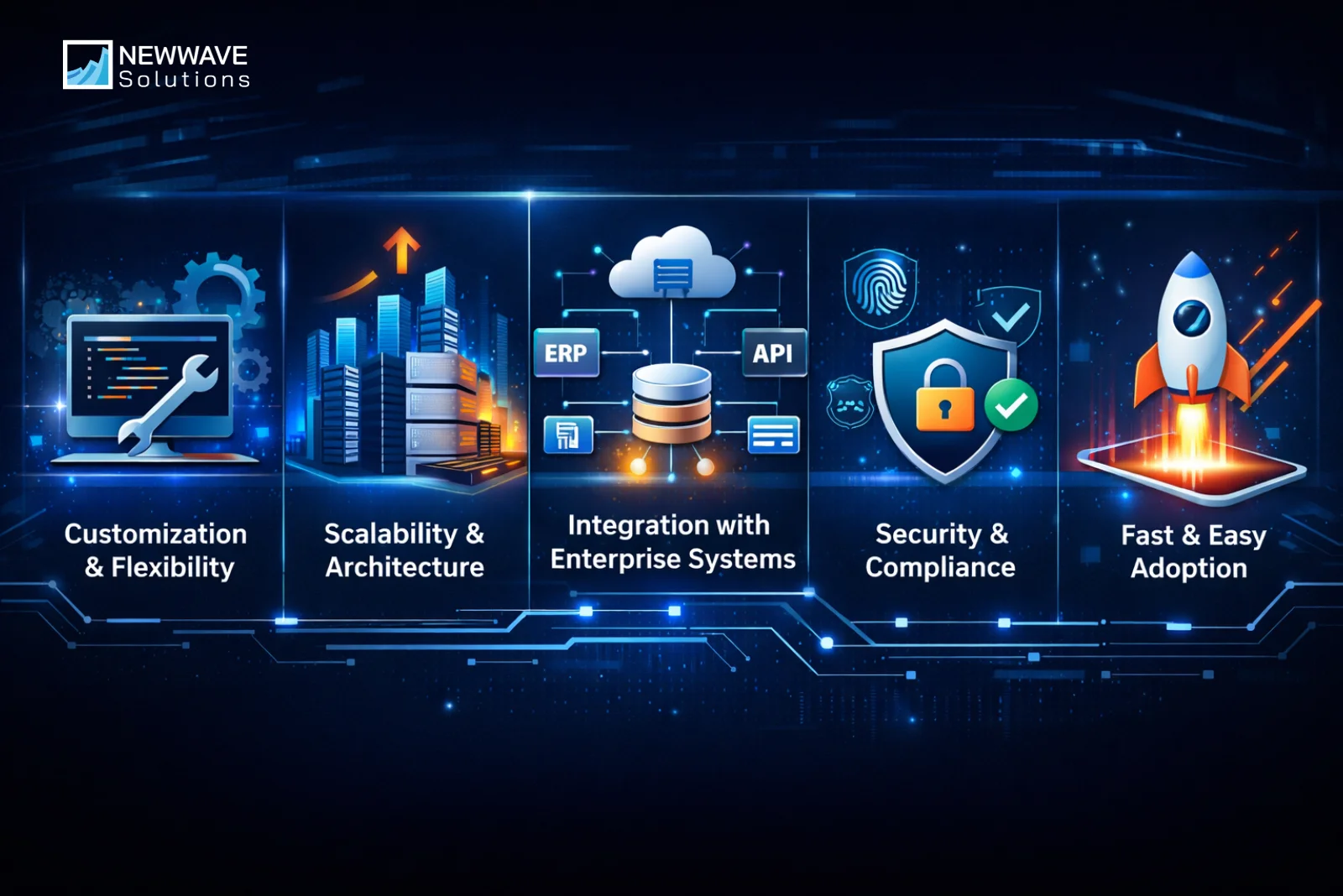
1. Customization and Flexibility
Low code platforms allow developers to extend functionality through custom code whenever the visual builder reaches its limit. No code platforms do not offer this escape hatch. For organizations with unique business logic, non-standard data models, or integrations that go beyond what pre-built connectors support, this ceiling transitions quickly from a theoretical concern to a hard operational constraint.
2. Scalability and Long-Term Architecture
No code platforms store application logic in proprietary formats tied to the vendor’s infrastructure. This creates re-platforming risk as requirements grow — a risk that many organizations discover 12–18 months after launch, when the cost of migration is already significant. Low code platforms support independent database architectures, private cloud deployments, and custom API layers, making them a more durable foundation for applications that are expected to evolve.
3. Integration with Enterprise Systems
Most enterprise environments include a mix of SAP, Salesforce, legacy ERPs, and proprietary internal systems — none of which have simple plug-and-play connectors. Low code platforms are built to handle this reality, with support for custom API development, middleware integration, and direct database connections. No code platforms rely on pre-built connector libraries that frequently fall short when the integration requirement involves a non-standard or legacy system.
4. Security and Compliance
Low code platforms support private cloud deployment, VPC configurations, granular role-based access controls, and compliance certifications relevant to regulated industries. No code platforms provide vendor-managed baseline security, which is sufficient for internal tools and prototypes but frequently inadequate for customer-facing applications or environments with GDPR, HIPAA, or SOC 2 requirements.
5. Speed and Ease of Adoption
No code wins at raw speed to the first working version. A non-technical business user can build a functional prototype in days without any developer involvement — which makes it genuinely useful for validating ideas quickly. Low code is still considerably faster than traditional development, but it requires at least some developer input, which slows down the prototype stage while significantly expanding what the finished product can do.
Best Low Code vs No Code Platforms in 2026
The market has matured considerably, and a clear set of leading platforms has emerged in both categories. Knowing which tools exist — and what each one is actually optimized for — is essential before any evaluation begins.
Best Low Code Platforms
|
Platform |
Best For | Key Strength |
Pricing |
| Microsoft Power Apps | Microsoft-stack enterprises | Native M365 and Azure integration | From $20/user/month |
| OutSystems | Large enterprise applications | Scalability and governance tooling | Enterprise pricing |
| Mendix | Complex enterprise systems | Full-lifecycle low code support | Enterprise pricing |
| Retool | Internal tools and dashboards | Developer experience, data connectivity | Free tier + from $10/user/month |
| Appian | Process automation | BPM combined with low code | Enterprise pricing |
Best No Code Platforms
| Platform | Best For | Key Strength | Pricing |
| Bubble | Full web app prototypes | Design flexibility, full-stack no code | Free tier + from $29/month |
| Webflow | Marketing sites and CMS | Visual design quality, CMS capability | Free tier + from $14/month |
| Glide | Mobile apps from spreadsheets | Speed and simplicity | Free tier + from $49/month |
| AppSheet | Google Workspace users | Spreadsheet-to-app conversion | From $5/user/month |
| Airtable | Database-driven workflows | Spreadsheet UX combined with automation | From $24/month |
Hybrid Platforms That Offer Both
Some platforms — including Kissflow, Zoho Creator, and Betty Blocks — offer a hybrid model that allows business users to build with no code components while IT teams extend those applications with low code when requirements grow. This “fusion team” model is gaining traction in enterprise environments where speed and scalability need to coexist in the same product.
When to Choose Low Code vs No Code
The platform decision ultimately comes down to one question: does the project’s complexity, integration requirements, and long-term roadmap fit within what a no code environment can support — or does it require the extensibility that only low code provides? The criteria below make that question answerable.
Choose no code when:
- The primary builder is a non-technical business user with no developer support available
- The project is a prototype, MVP, or internal workflow tool with straightforward logic
- Speed to first working version is the overriding priority
- The application does not need to connect to legacy systems or proprietary enterprise infrastructure
- Long-term scalability is not a concern for the foreseeable future
Choose low code when:
- The project requires custom business logic, complex integrations, or enterprise-grade security
- The team includes developer capability that can maximize the platform’s extensibility
- The application must connect to existing enterprise infrastructure — ERPs, CRMs, legacy databases
- Scalability, data governance, or regulatory compliance are organizational requirements
- The organization plans to grow the application significantly over a multi-year horizon
Decision framework by use case:
|
Use Case |
Recommended Approach |
Example Platform |
| Internal workflow tool | No code | Airtable, Glide |
| Department form or dashboard | No code | AppSheet, Webflow |
| Customer-facing web application | Low code or Hybrid | Bubble, Retool |
| Enterprise integration project | Low code | OutSystems, Mendix |
| Regulated industry application | Low code | Appian, Power Apps |
| Startup MVP — validate then scale | No code first → Low code | Bubble → Retool |
Limitations and Risks of Both Approaches
Even the best low code vs no code platforms carry real limitations — and the organizations that discover these limitations after committing to a platform typically pay a significant price in re-platforming cost and lost development time. This section covers the risks that matter most at production scale.
- Vendor lock-in — Both approaches store application logic in proprietary formats, making migration to another platform expensive. The risk is structurally higher with no code, where data and architecture are more tightly coupled to the vendor’s infrastructure, and there is no code export path.
- Scalability ceiling for no code — No code platforms work well within their design parameters — but they hit hard limits when complexity grows. Organizations that outgrow their no code platform frequently face complete rebuilds rather than incremental upgrades, at costs that erode the initial speed advantage significantly.
- Shadow IT and governance risk — The ease of building on these platforms creates proliferation risk. Teams across the organization build ungoverned applications that introduce security gaps, duplicate data, and create maintenance debt. Gartner estimates that by 2026, citizen developers outside IT will represent over 80% of the low code user base — making governance a first-priority requirement for enterprise adoption, not an afterthought.
- Performance limitations — Neither low code nor no code is optimized for high-performance, compute-intensive applications. Custom-coded architectures remain superior for applications with strict latency, throughput, or data processing requirements.
- Security exposure in no code — Vendor-managed security is sufficient for many internal use cases but cannot match the granular control available in low code platforms. For regulated industries or applications handling sensitive customer data, this limitation is a genuine compliance risk.
How to Choose the Right Low Code or No Code Platform for Your Organization
With dozens of platforms competing for enterprise attention, the selection process requires a structured framework rather than a demo-driven shortlist. These are the criteria that most consistently determine whether a platform delivers its promises at scale.
- Define application complexity first — Simple workflows and internal tools are strong with no code candidates; applications requiring custom logic, enterprise integrations, or compliance controls need low code. This single evaluation narrows the field significantly before any platform demos begin.
- Assess who will actually build and maintain it — No code works for non-technical users; low code requires at least some developer involvement for customization and ongoing maintenance. Honest assessment of the team’s technical profile prevents platform mismatches that become apparent only after launch.
- Map integration requirements before shortlisting — Every system the application must connect to should be documented before platform evaluation begins. If the list includes legacy systems, proprietary APIs, or enterprise databases, only low code platforms will reliably support the required depth of integration.
- Model the three-year total cost of ownership — Entry-level pricing is consistently misleading. Per-user fees, usage-based charges, enterprise feature add-ons, and the engineering hours required to build, maintain, and eventually migrate to the application all need to be included in a realistic cost model.
- Test governance and security controls directly — Enterprise buyers should evaluate admin controls, audit logging, data residency options, and compliance certifications during the trial period — not after purchase. Security capability that is not verifiable before commitment is a risk, not a feature.
- Plan for the scale scenario from day one — Choosing a platform that fits today’s requirements but hits a ceiling at twice the scale creates expensive decisions later. If growth is anticipated, building a platform with a clear extensibility path — or starting with low code — is the more durable investment.
Low Code and No Code Trends to Watch in 2026
The boundary between low code and no code is already blurring, and the rapid integration of AI-native capabilities is accelerating that convergence in ways that will reshape the platform landscape over the next 12–24 months.
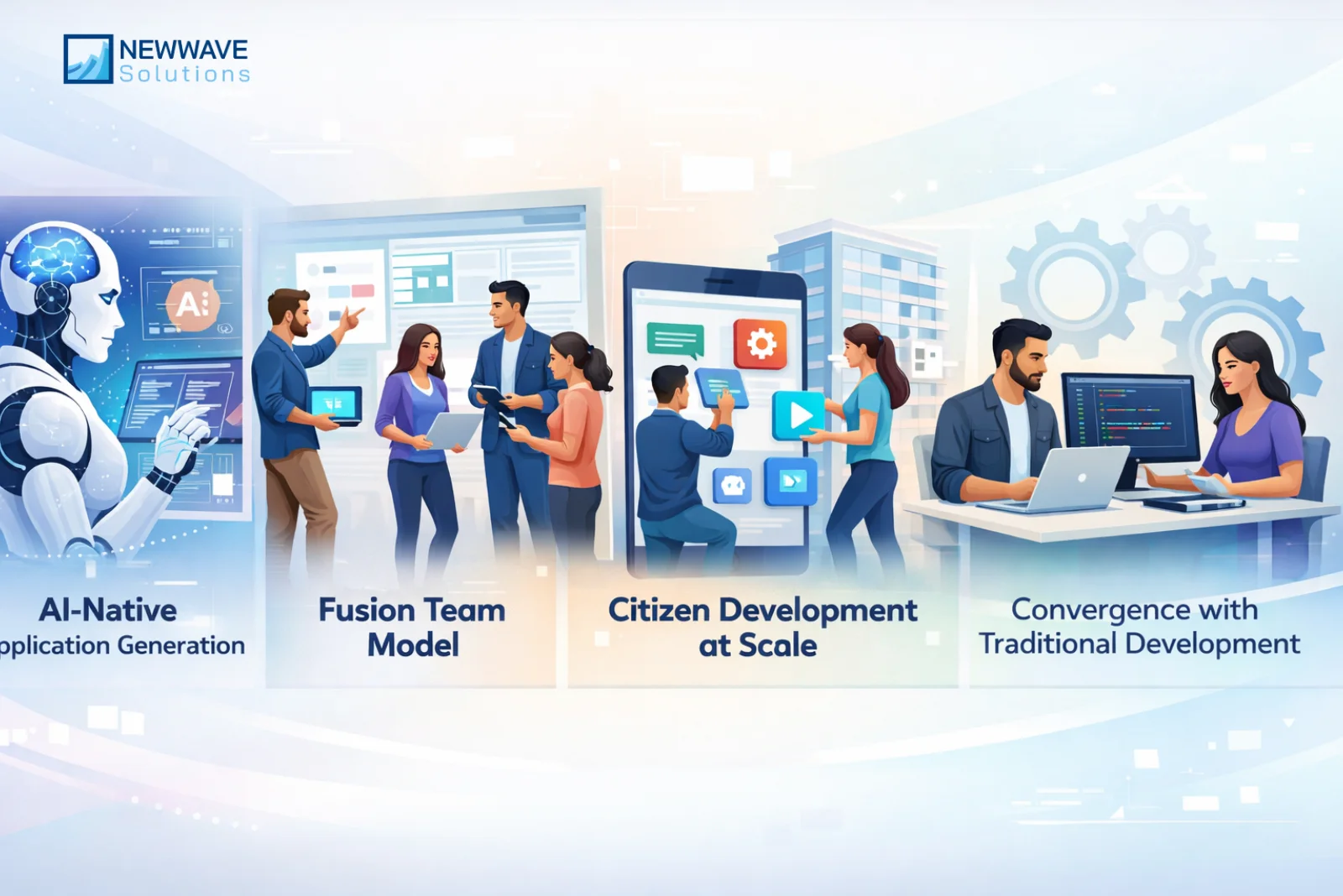
- AI-native application generation — Leading platforms now support natural language prompts that generate entire application components, database schemas, and workflow logic without any visual building. This is compressing the speed advantage of no code further while enabling low code platforms to tackle more complex tasks with significantly less manual configuration.
- The fusion team model — Enterprises are increasingly adopting hybrid platforms that allow business users to build with no code tools while IT teams extend those applications with low code components — eliminating the handoff friction that slows most traditional digital transformation programs.
- Citizen development at enterprise scale — With 80%+ of the low code user base projected to sit outside formal IT departments by 2026, governance frameworks have moved from a best practice to a baseline requirement for any serious enterprise adoption program.
- Convergence with traditional development — The line between low code platforms and standard IDEs is narrowing as platforms add code-export capability, Git integration, and custom runtime support. The practical implication is that a significant class of enterprise applications will be built on low code platforms as a default — not as an exception — within the next several years.
Why Enterprises Partner with Newwave Solutions for Low Code and No Code Implementation?
Choosing the right platform is the first decision — but turning that choice into a delivered, production-ready product is where most implementation programs encounter friction. The gap between “we selected a platform” and “we are shipping value on it” is wider than most organizations expect and bridging that gap requires both technical delivery capability and strategic experience with how these platforms actually behave under enterprise requirements.
Newwave Solutions brings that combination to every engagement. As a Vietnam-based offshore software development service partner with deep roots in enterprise application delivery, Newwave works with CTOs, engineering leads, and product organizations to design, build, and scale applications on both low code and no code platforms — tailoring the engagement to the client’s specific technical context, regulatory environment, and long-term roadmap. The team’s offshore delivery model provides enterprise-grade technical capability at competitive rates, making professional low code and no code implementation accessible to organizations that cannot justify the cost of a domestic specialist team for every build.
What sets Newwave Solutions apart for low code and no code projects:
- Platform-agnostic advisory from day one — Rather than recommending a specific platform based on existing vendor relationships, the team conducts objective capability assessments that align platform selection with the actual complexity, integration requirements, and scalability goals of each project.
- End-to-end delivery ownership — Newwave manages the full project lifecycle — from requirements analysis and architecture design through build, integration, QA, and deployment — so that clients receive a working product, not a partially assembled prototype that requires internal team completion.
- Deep enterprise integration expertise — Many low code and no code projects stall at the integration phase, where connections to legacy custom ERP development services, proprietary databases, or complex third-party APIs exceed the platform’s native connector capability. Newwave’s integration specialists close that gap through custom API development and middleware engineering built specifically for the platform’s architecture.
- Offshore team scalability — When a project requires rapid scale — additional developers for a compressed timeline, or a larger team to handle parallel workstreams — Newwave’s offshore talent pipeline supports that expansion without the recruitment delay or overhead of building an in-house team.
- Governance and compliance by design — For enterprises in regulated industries, Newwave builds access controls, audit logging, and data handling practices into the application architecture from the project’s inception — rather than adding them as a retrofit after the initial build is complete.
- Cost-transparent engagement model — Every engagement includes full visibility into project cost structure, including development hours, infrastructure requirements, and ongoing maintenance estimates — giving clients the financial predictability they need to present defensible business cases internally.
Conclusion
The low code vs no code decision is ultimately about fit — fit between the platform’s capabilities and the project’s actual requirements, the team’s technical profile, and the organization’s long-term scalability goals. Teams that evaluate both approaches against these dimensions consistently make better platform choices and avoid the re-platforming costs that undermine most first-generation implementations.
Choosing the right platform is the first step; partnering with an experienced delivery team is what turns that choice into outcomes. For enterprises ready to move forward with confidence, Newwave Solutions software development outsourcing services provide the technical depth, integration expertise, and cost transparency that low code and no-code initiatives require to succeed at scale.
Connect with Newwave Solutions and discover a better way to plan, build, and scale your IT projects — with transparent budgeting, proven delivery expertise, and a partnership model designed around your growth.
To Quang Duy is the CEO of Newwave Solutions, a leading Vietnamese software company. He is recognized as a standout technology consultant. Connect with him on LinkedIn and Twitter.



Read More Guides
Get stories in your inbox twice a month.
Let’s Connect
Let us know what you need, and out professionals will collaborate with you to find a solution that enables growth.
Leave a Reply