


Monolithic Architecture vs Microservices: Optimal Approach For Your Business
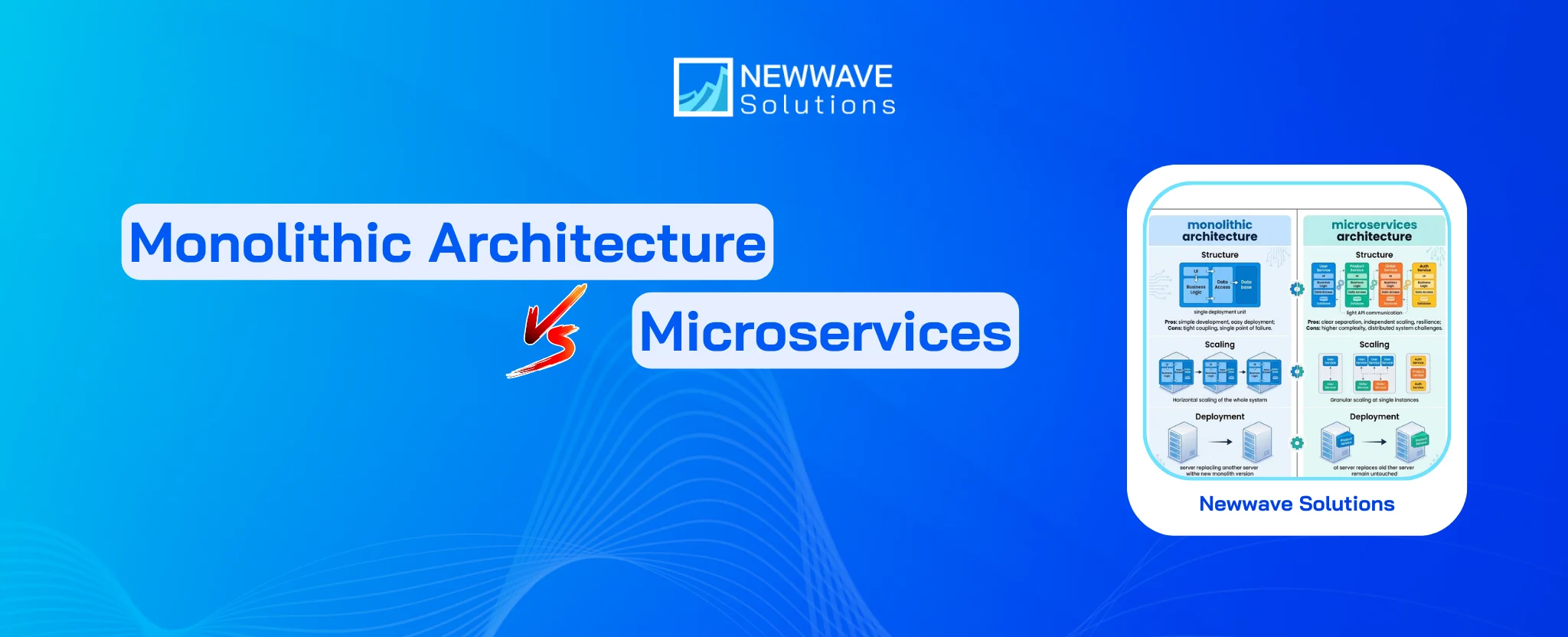
As enterprise software systems grow in complexity and scale, many organizations face increasing difficulty in choosing an application architecture that supports long-term performance, maintainability, and growth. Consequently, the discussion around monolithic architecture vs microservices has become a critical consideration for businesses building new applications or modernizing legacy systems. Through this article, you will gain a clear understanding of both approaches, so that your organization can confidently select the most suitable architecture or plan a strategic transition when necessary.
What Is Monolithic Architecture
Monolithic architecture is a software design approach where all application components are built, deployed, and managed as a single unified system. In practice, many enterprises use this model for applications that require simple deployment, centralized control, and tightly integrated functionality.
Explore the Modular vs Monolithic Blockchain comparison if you are interested in Monoilithic applications in Blockchain.
Core Characteristics of Monolithic Systems
- Single Codebase and Deployment Unit: The entire application is developed, tested, and deployed as one cohesive package.
- Tightly Coupled Components: Application modules depend closely on each other, making changes affect the whole system.
- Centralized Data Management: All components typically share a single database or data layer.
- Simplified Development and Testing: Developers work within one system, which reduces initial setup and integration effort.
What Is Microservices
Microservices architecture is a design approach where an application is composed of independent, loosely coupled services that communicate through APIs. Enterprises often adopt this model to improve scalability, resilience, and development agility across large and evolving systems.
Core Characteristics of Microservices
- Independently Deployable Services: Each service can be developed, deployed, and updated without affecting others.
- Loose Coupling via APIs: Services communicate through well-defined interfaces rather than direct dependencies.
- Decentralized Data Management: Each service often manages its own database to reduce cross-service dependencies.
- Scalable and Resilient Design: Individual services can scale or fail independently without bringing down the entire system.
>>> Read more: Scalable Software Architecture: Key Patterns for Future-Proof Apps
Pros & Cons of Microservices vs Monolithic Architecture
| Architecture Model | Pros |
Cons |
| Monolithic Architecture | Simple architecture and centralized control | Limited scalability at the component level |
| Faster initial development and setup | High risk during full-system deployments | |
| Easier testing and debugging in early stages | Tight coupling slows long-term changes | |
| Lower infrastructure and DevOps overhead | Difficult to adopt modern cloud practices | |
| Microservices Architecture | Independent scalability for each service | Higher operational and infrastructure cost |
| Faster innovation with parallel development | Increased system and data complexity | |
| Better fault isolation and resilience | Requires mature DevOps and monitoring | |
| Strong fit for cloud-native environments | More complex testing and integration |
Monolithic Architecture vs Microservices – Key Differences
To determine whether monolithic architecture or microservices is the right fit, enterprises must understand the core differences that directly affect scalability, development efficiency, system stability, and long-term maintenance. The following comparisons highlight how each architecture performs across critical technical dimensions, helping organizations choose the most suitable model for their application and growth strategy.
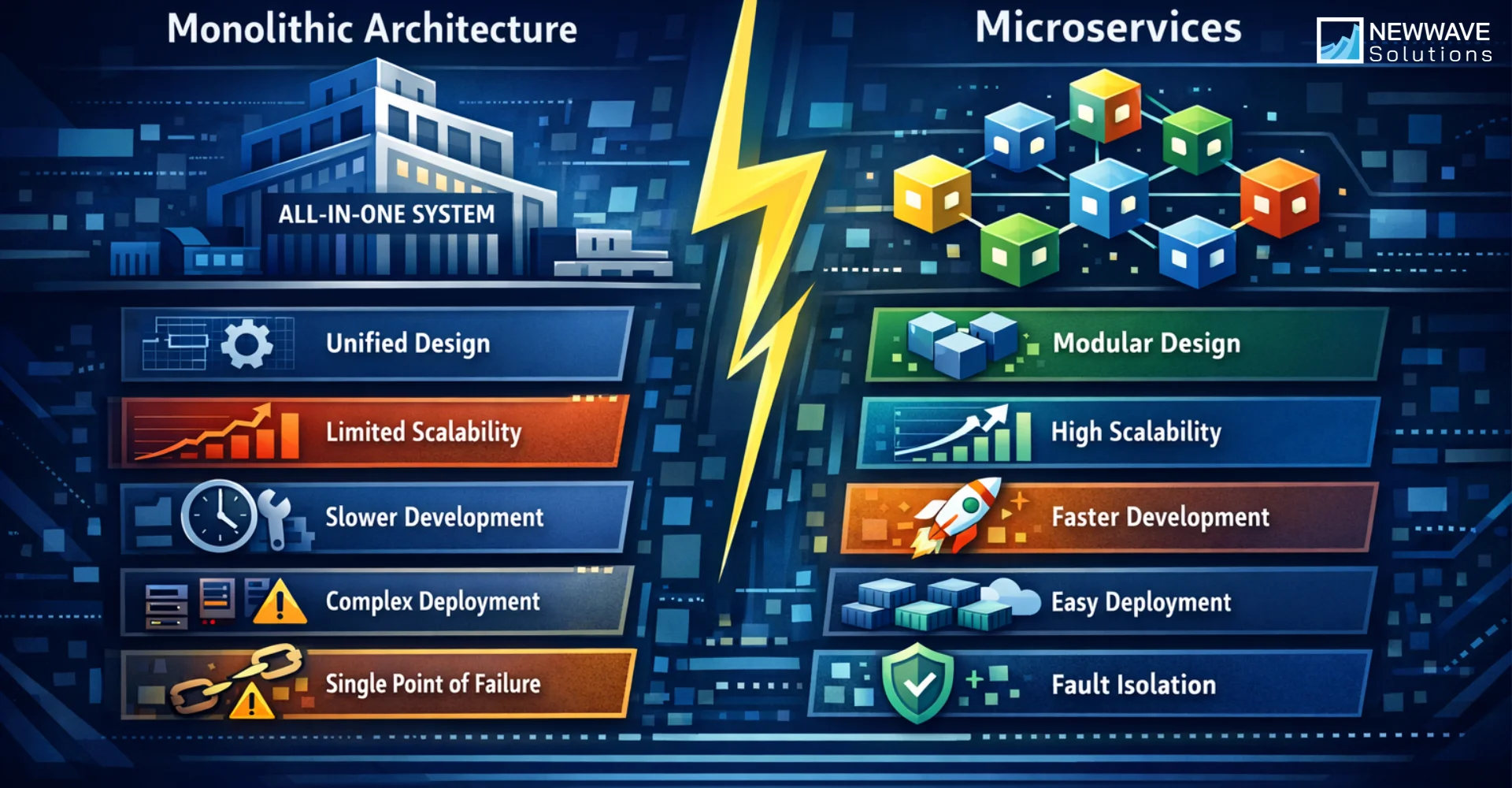
1. Architecture and System Design
Monolithic architecture is designed as a single, unified system where all components are tightly integrated and deployed together. This approach simplifies overall system design but increases dependency across modules, which can slow down architectural changes as the system grows.
Microservices architecture, by contrast, breaks the application into independently designed services that communicate through APIs. This enables more flexible system evolution, although it introduces additional design considerations such as service boundaries and inter-service communication.
>>> Verdict: Microservices offer a more adaptable system design for large or evolving applications, while monolithic architecture remains suitable for simpler systems with stable requirements.
2. Scalability and Performance
In a monolithic architecture, scaling typically requires replicating the entire application, even if only one component experiences high load. This can lead to inefficient resource usage and higher infrastructure costs at scale.
In contrast, Microservices allow individual services to scale independently based on demand, which aligns well with cloud-native infrastructure and container orchestration platforms. Enterprises using microservices can reduce infrastructure waste by 20–30% through targeted scaling.
>>> Verdict: Microservices provide superior scalability and resource efficiency for high-traffic or variable-load systems.
3. Development Speed and Team Structure
Monolithic systems often enable faster development in the early stages because teams work within a single codebase and shared tooling. However, as the application grows, coordination overhead and code dependencies can significantly slow development velocity.
Meanwhile, Microservices support parallel development by allowing multiple teams to work on separate services independently. Organizations with mature microservices practices can improve feature delivery speed by up to 40% in multi-team environments.
>>> Verdict: Monolithic architecture favors small teams and early-stage products, while microservices accelerate delivery in large, distributed teams.
4. Deployment and Maintenance Complexity
Deploying a monolithic application requires rebuilding and redeploying the entire system, which increases downtime risk and complicates maintenance as the codebase expands. Maintenance tasks often become more expensive over time due to tight coupling.
Microservices introduce more complex deployment pipelines but allow teams to deploy services independently without impacting the entire system. With modern CI/CD and container platforms, enterprises can significantly reduce deployment risk and maintenance disruption.
>>> Verdict: Microservices are better suited for environments requiring frequent updates and continuous delivery, provided DevOps maturity is in place.
5. Fault Isolation and Reliability
In monolithic architecture, a failure in one component can potentially impact the entire application, increasing the risk of system-wide outages. This limitation becomes more pronounced as systems grow in complexity.
Microservices isolate failures at the service level, preventing localized issues from cascading across the system. Reliability engineering practices such as circuit breakers and service monitoring further strengthen this advantage.
>>> Verdict: Microservices deliver higher fault tolerance and reliability for mission-critical enterprise systems.
When to Use Monolithic Architecture vs Microservices
Choosing the right architecture model is a critical step to ensure your application or software development service operates efficiently and aligns with long-term business goals. After reviewing the detailed comparison of monolithic architecture vs microservices above, organizations that are still uncertain about the best fit for their context can refer to the practical guidelines below to make a more informed decision.
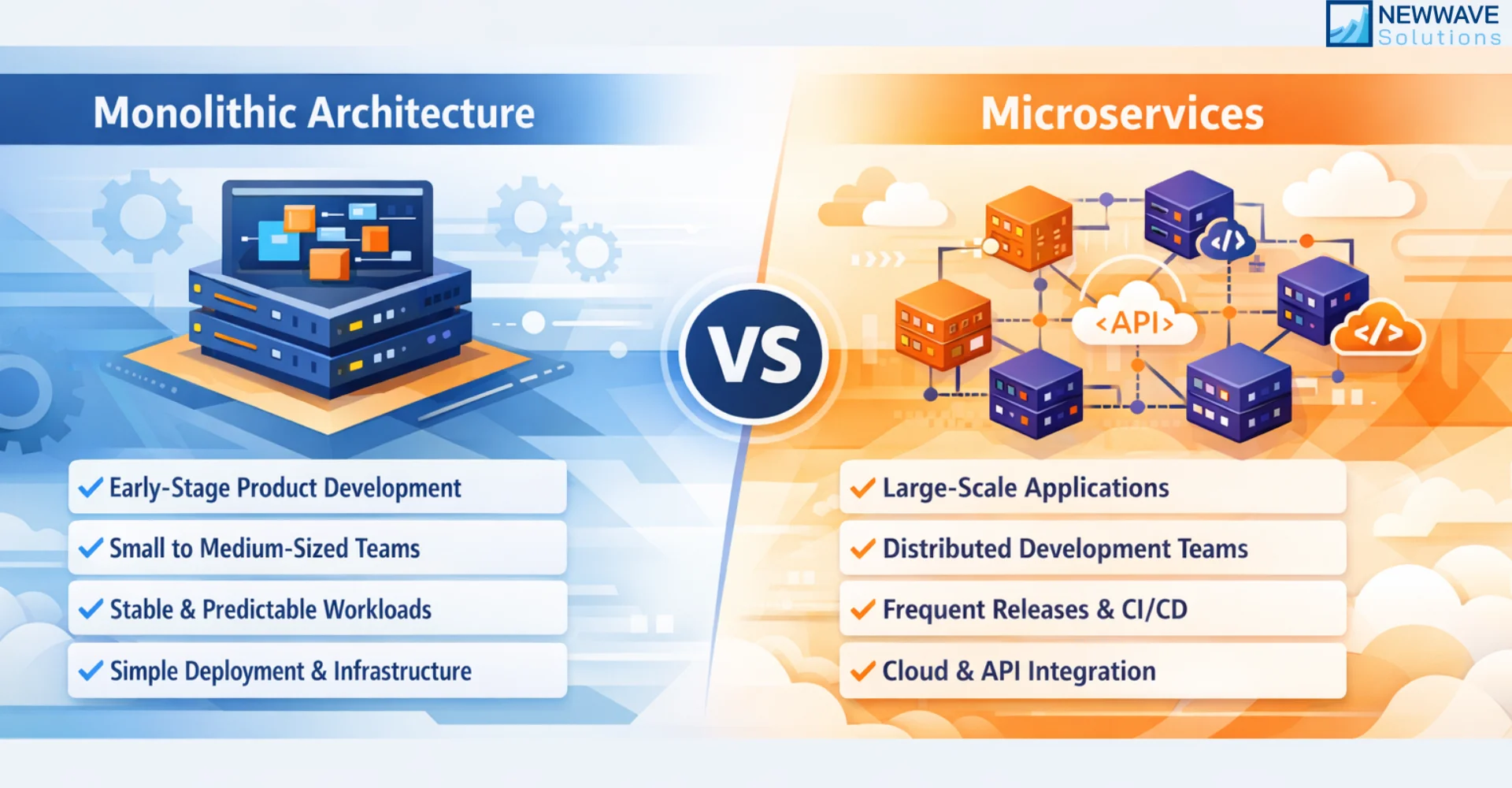
When to Choose Monolithic Architecture
- Early-Stage Product Development: Monolithic architecture allows teams to build and iterate quickly with minimal architectural overhead. This approach works best when requirements are still evolving, and rapid validation is more important than long-term scalability.
- Small to Medium-Sized Development Teams: A monolithic system reduces coordination complexity by keeping all components within a single codebase. Teams can focus on feature development without managing distributed services or complex DevOps pipelines.
- Applications with Stable and Predictable Workloads: Monolithic architecture is well-suited for systems where traffic patterns are consistent and do not require independent scaling. This helps keep infrastructure costs and operational complexity under control.
- Limited DevOps and Infrastructure Maturity: Organizations without advanced CI/CD, monitoring, or container orchestration capabilities benefit from the simpler deployment model of monolithic systems.
When to Choose Microservices
- Large-Scale or Rapidly Growing Applications: Microservices enable individual components to scale independently as demand increases. This approach supports long-term growth without forcing a complete system redesign.
- Multiple or Distributed Development Teams: Microservices allow teams to work autonomously on separate services, reducing bottlenecks and improving development velocity. This structure is especially effective for globally distributed engineering teams.
- Frequent Feature Releases and Continuous Delivery: Independent service deployment makes it easier to release updates without impacting the entire system. This supports agile development and faster time-to-market.
- Cloud-Native and API-Driven Platforms: Microservices align naturally with cloud infrastructure and API-based integrations, making them ideal for modern digital platforms and ecosystem-driven products.
Migration Considerations – From Monolith to Microservices
As digital products scale and business requirements evolve, many organizations gradually transition from monolithic systems to microservices to improve scalability, resilience, and development agility. However, migrating from a monolith to microservices is a complex transformation that requires careful planning, technical readiness, and organizational alignment.
If your business currently operates on a monolithic architecture and is considering a move toward microservices, the following considerations are essential:
- Clear Service Boundaries: Enterprises must identify well-defined domains and responsibilities within the monolith before splitting services. Poor boundaries often lead to tightly coupled microservices that recreate monolithic problems.
- DevOps Software Development and Automation Readiness: A successful migration requires mature CI/CD pipelines, automated testing, and deployment workflows. Without these foundations, microservices can increase operational overhead instead of improving agility.
- Data Ownership and Architecture: Each microservice should own its data to avoid hidden dependencies and synchronization issues. Shared databases across services significantly reduce scalability and independence.
- Incremental Migration Strategy: Gradually extracting services while keeping the core system stable reduces risk and disruption. Most enterprises achieve better outcomes with phased migration rather than full re-architecture.
- Organizational and Team Alignment: Microservices demand changes in team ownership, communication, and accountability. Technical migration without organizational readiness often limits long-term success.
Conclusion
The choice between monolithic architecture vs microservices depends largely on your system scale, team structure, and long-term growth strategy. While monolithic architecture can be effective for simpler, tightly coupled systems, microservices are better suited for complex, scalable platforms that require independent deployment and rapid evolution.
However, when your internal team lacks hands-on experience in designing, implementing, or migrating between these architectures, partnering with a trusted technology provider becomes a practical solution. With over 14 years of experience and a team of 300+ highly specialized engineers, Newwave Solutions provides end-to-end offshore software development services that help businesses reduce costs, accelerate delivery, and access global talent to successfully apply monolithic or microservices architectures in real-world projects.
To Quang Duy is the CEO of Newwave Solutions, a leading Vietnamese software company. He is recognized as a standout technology consultant. Connect with him on LinkedIn and Twitter.



Read More Guides



Get stories in your inbox twice a month.
Let’s Connect
Let us know what you need, and out professionals will collaborate with you to find a solution that enables growth.
Leave a Reply