


What Is Onshore Outsourcing? A Comprehensive Industry Guide
As businesses accelerate digital transformation, outsourcing has become a strategic tool for accessing talent, improving operational efficiency, and speeding up delivery. Among the available models, onshore outsourcing stands out for organizations that prioritize close collaboration, regulatory compliance, and real-time communication. This guide provides a comprehensive look at onshore outsourcing. You will learn how it compares with offshore and hybrid alternatives, and when an onshore partner is the right choice.
What exactly is Onshore Outsourcing?
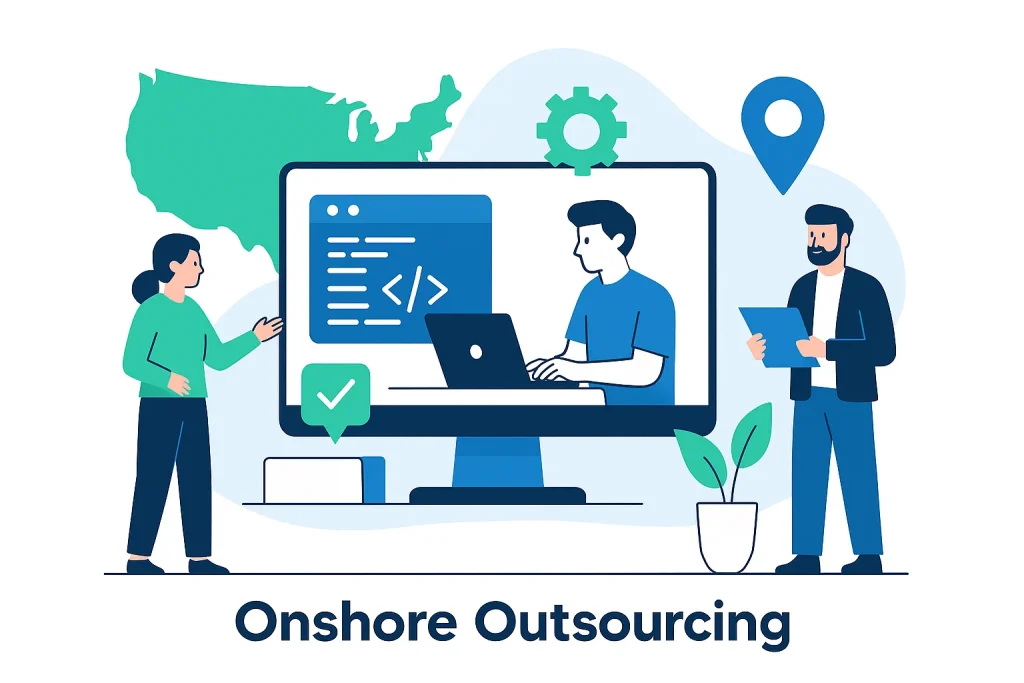
Onshore outsourcing, also known as domestic outsourcing or homeshoring, is the practice of hiring external service providers within your own country to handle specific business processes or functions. Because these providers operate domestically, they share the same language, cultural context, time zones, and legal frameworks as your organization.
How Onshore Outsourcing Works in Tech Industry
Onshore outsourcing is gaining traction in the tech industry as businesses seek stronger control, faster communication, and closer alignment with local regulations.
It usually works as a structured partnership between the client’s internal team and a domestic technology vendor. The vendor may support strategy, UI/UX design, development, QA, cloud setup, maintenance, or team extension, depending on the company’s technical needs and internal capacity.
|
Step |
What Happens |
| 1. Requirement discovery | The company defines business goals, technical scope, project challenges, timeline, and expected outcomes. |
| 2. Vendor selection | The business evaluates onshore tech vendors based on expertise, portfolio, industry knowledge, security standards, and collaboration style. |
| 3. Team setup | The vendor assigns developers, designers, QA engineers, project managers, or cloud specialists based on project needs. |
| 4. Planning and alignment | Both sides agree on workflow, communication channels, sprint planning, reporting methods, milestones, and delivery responsibilities. |
| 5. Development execution | The onshore team works closely with the client to build, test, review, and improve the software through regular feedback cycles. |
| 6. Quality assurance | The vendor performs testing, bug fixing, security checks, performance validation, and user acceptance support. |
| 7. Delivery and support | The final product is deployed, documented, and handed over, with ongoing support or maintenance if required. |
Critical Benefits of Onshore Outsourcing
Choosing onshore outsourcing offers multiple advantages, particularly for companies that prioritize operational alignment, regulatory security, and direct collaboration. Let’s explore the key advantages in detail below:
Enhanced Communication and Collaboration
Onshore partners support faster communication through shared time zones, real time code reviews, quicker bug resolution, and smoother sprint planning. Native language proficiency also reduces misunderstanding in complex technical discussions, helping teams align better on architecture, APIs, database design, and system integrations.
Simplified Regulatory Compliance
Domestic providers operate under the same national regulations as your business. This makes compliance with labor laws, data protection standards, and industry-specific mandates easier to manage, reducing legal risks. It’s also particularly valuable for fintech, healthtech, and enterprise software companies where regulatory missteps can derail product launches.
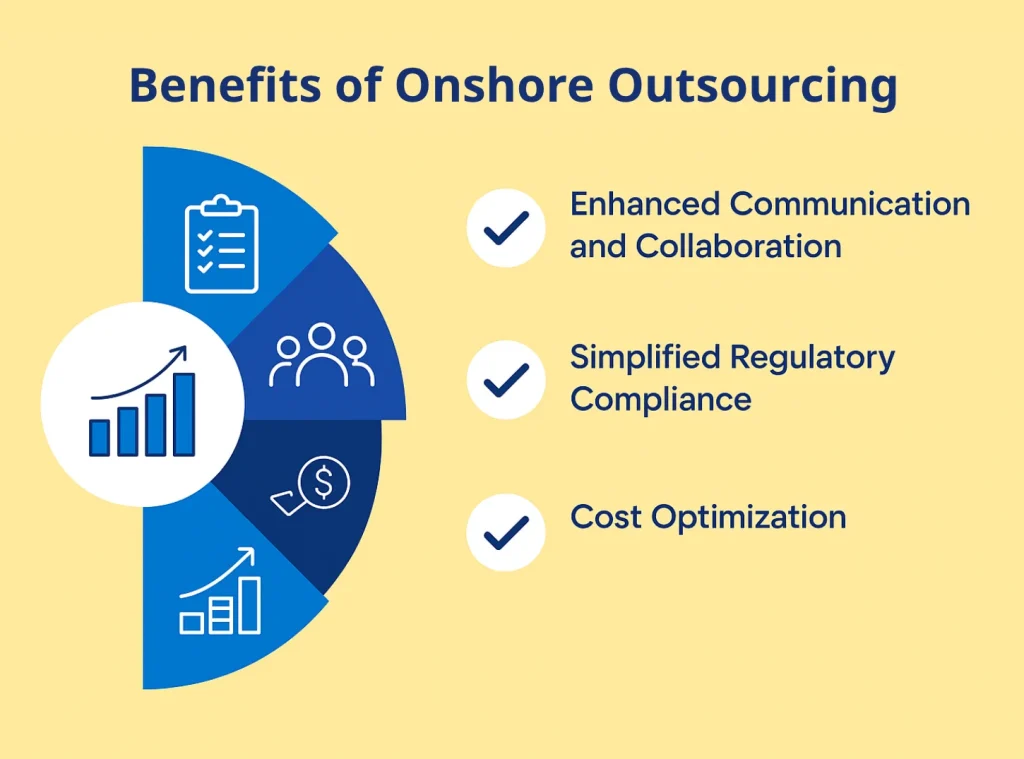
Cost Optimization
Onshore teams can reduce hidden costs from technical debt, long QA cycles, and heavy project management. With clearer communication, predictable pricing, and faster onboarding, businesses can improve delivery speed and achieve better development ROI.
Extra additional benefits
Besides core benefits above, choosing onshore outsourcing services also give you other benefits include:
- Faster onboarding through in-person training and local site visits.
- Higher quality control with easier oversight and performance monitoring.
- Brand alignment through closer cultural and market understanding.
- Stronger customer trust from visibly investing in domestic talent.
Onshore vs Offshore vs Hybrid Outsourcing Models
Onshore, offshore, and hybrid outsourcing models differ mainly in location, cost, collaboration speed, and control. Onshore outsourcing offers closer communication and stronger local alignment, offshore outsourcing provides wider talent access and cost efficiency, while hybrid outsourcing combines local coordination with offshore delivery capacity.
|
Model |
Pros | Cons |
Best For |
| Onshore Outsourcing | Easier communication, same or similar time zone, stronger cultural and regulatory alignment, faster stakeholder collaboration. | Higher development cost and smaller talent pool compared with offshore markets. | Complex projects that require close collaboration, strict compliance, frequent meetings, or local market understanding. |
| Offshore Outsourcing | Lower development cost, larger global talent pool, flexible scaling, access to specialized technical skills. | Time zone gaps, communication challenges, cultural differences, and higher management effort. | Cost sensitive projects, long term development, team extension, maintenance, QA, and scalable product delivery. |
| Hybrid Outsourcing | Balances onshore control with offshore cost efficiency, supports both strategic alignment and scalable execution. | Requires clear governance, strong project management, and well defined responsibilities between teams. | Businesses that need local consulting or project ownership while using offshore teams for development, QA, or support. |
Critical Use Cases: When You Should Choose an Onshore Partner?
While project requirements often determine whether onshore outsourcing is necessary, certain industries benefit significantly from local expertise, regulatory familiarity, and real time collaboration. In these sectors, the advantages of onshore outsourcing often outweigh the higher delivery costs.
- Regulated industries (Finance, Healthcare, and Government): Onshore outsourcing supports projects with strict local regulations, data protection laws, and compliance standards like HIPAA, GDPR, or PCI DSS. It is useful for secure data handling, audit readiness, and direct coordination with regulators.
- Customer support and contact centers: Onshore partners are ideal when customer service requires native language fluency, cultural understanding, and real time issue resolution.
- Marketing and creative services: Onshore creative teams understand local culture, language nuance, media trends, and consumer behavior. They can support brand messaging, campaign localization, market research, and fast stakeholder feedback.
- Engineering and technical services: Engineering projects often require site visits, local permits, and compliance with regional standards. Onshore teams can coordinate directly with clients, contractors, and regulatory bodies.
What are the Possible Challenges in Onshore Outsourcing?
Onshore outsourcing brings clear advantages such as easier communication, stronger cultural alignment, closer quality control, and better familiarity with local regulations. However, these benefits often come with higher costs and tighter resource availability. Businesses should understand these trade offs before choosing an onshore partner.
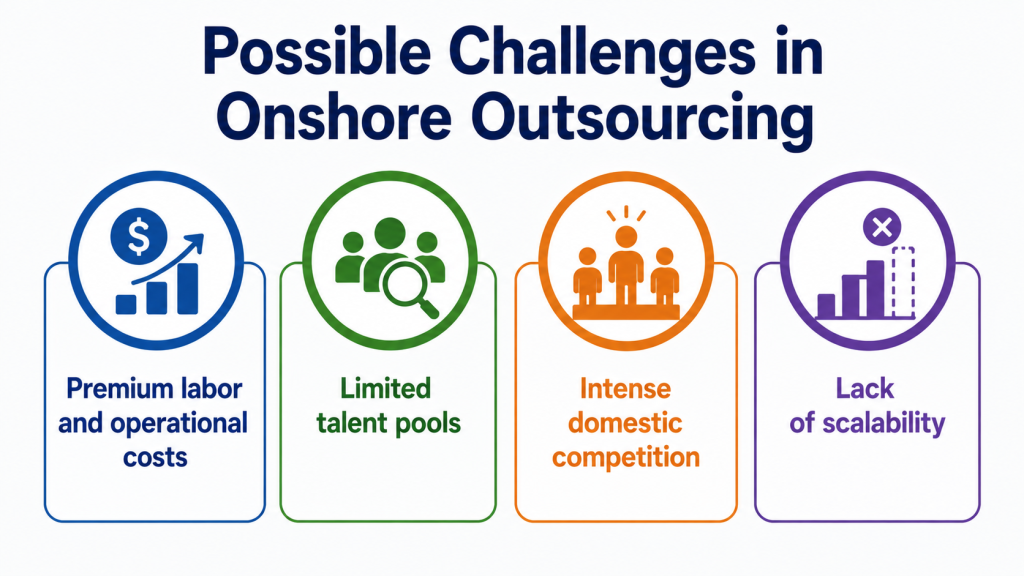
- Premium labor and operational costs: Onshore providers usually charge higher rates because they operate in the same domestic market with local salary levels, office costs, and business expenses. This can make the model less suitable for cost sensitive or large scale projects.
- Limited talent pools: The available talent pool may be smaller than in global outsourcing markets, especially for specialized roles. Businesses may face difficulty finding experts in niche areas such as advanced analytics, automation, cybersecurity, or industry specific consulting.
- Intense domestic competition: Many companies compete for the same local vendors and skilled professionals. This demand can increase service fees, extend onboarding timelines, and make it harder to secure the right team at the right time.
- Lack of scalability: Onshore outsourcing may not scale as quickly as offshore or hybrid models. When a business needs to expand capacity fast across multiple functions, relying only on local resources can limit speed, flexibility, and cost efficiency.
The Hybrid Delivery Model: Maximizing Onshore Quality with Offshore Cost-Efficiency
While onshore outsourcing offers stronger collaboration and local alignment, it can be costly for large scale development. Offshore outsourcing reduces costs and expands talent access, but may create communication and coordination gaps. As a result, many businesses are adopting a hybrid delivery model that combines the strengths of both approaches.
In a hybrid model, onshore teams manage strategy, architecture, compliance, and stakeholder communication, while offshore teams handle development, QA, maintenance, and scalable delivery.
A hybrid approach is often the best choice when:
- You need local experts to work directly with stakeholders while development is performed by a larger offshore team.
- The project requires strict compliance, governance, or business oversight but also demands cost optimization.
- Your organization wants to accelerate product delivery without significantly increasing internal hiring.
- You need specialized technical skills that may be difficult or expensive to source locally.
- The project involves long term development where balancing quality, speed, and budget is critical.
- You want a scalable delivery model that can adapt as project requirements evolve.
Scale Faster with Newwave Solutions’ IT Outsourcing Services
If you are looking to combine local business alignment with global delivery capabilities, Newwave Solutions is a suitable choice. With 14+ years of experience, 300+ technology professionals, and 800+ successful projects, Newwave Solutions helps businesses gain the key benefits of onshore outsourcing while improving cost efficiency through flexible IT outsourcing models.
What we can do for you?
- Full-cycle software development with onshore teams.
- Regulatory-compliant IT and data security services.
- Localized project management for agile delivery.
- Flexible engagement models to fit your goals and budget.
Are you ready to explore how the right outsourcing partnership can transform your business operations? Contact us today for a comprehensive consultation and discover how our proven expertise can accelerate your growth while optimizing your operational efficiency.
Conclusion
In conclusion, onshore outsourcing offers businesses the ability to leverage external expertise while maintaining cultural alignment, compliance, and strong communication. By understanding its benefits, comparing it to offshore models, and selecting the right partner, companies can unlock efficiency and growth without sacrificing control or quality.
Whether you need onshore software development, customer service, or specialized project support, the key is finding a provider that aligns with your operational goals, and that’s where trusted partners like Newwave Solutions excel.
FAQs
1. Which is better, offshore or onshore?
Neither model is always better. Onshore outsourcing is better for close collaboration, strict compliance, and real time communication, while offshore outsourcing is better for cost efficiency, larger talent access, and scalable delivery.
2. What industries benefit most from onshore outsourcing?
Industries with strict regulations or sensitive data benefit most, such as healthcare, finance, legal, government, insurance, and enterprise technology. These sectors often need local compliance knowledge, stronger control, and faster stakeholder alignment.
3. How do I manage quality control with onshore outsourcing partners?
Set clear requirements, delivery milestones, coding standards, review processes, and quality metrics from the beginning. Regular sprint reviews, QA testing, documentation, and direct communication help keep quality consistent.
4. How does onshore outsourcing protect sensitive data?
Onshore outsourcing can support stronger data protection through local legal alignment, clearer contracts, NDAs, access control, and compliance with domestic regulations. Businesses should still verify the vendor’s security policies, certifications, and data handling process.
5. Can I combine onshore with offshore or nearshore models?
Yes. Many businesses use a hybrid model where onshore teams manage strategy, communication, and compliance, while offshore or nearshore teams handle development, QA, and maintenance to improve cost efficiency.
To Quang Duy is the CEO of Newwave Solutions, a leading Vietnamese software company. He is recognized as a standout technology consultant. Connect with him on LinkedIn and Twitter.



Read More Guides
Get stories in your inbox twice a month.
Let’s Build Something Extraordinary
Sign up for a 30 min no-obligation strategic session with us. Transform your Ideas into scalable reality.
Leave a Reply