


Outsource Product Development: Benefits, Tips & Trends
Outsource product development has become a strategic method for companies that want to accelerate innovation, scale efficiently, and access specialized expertise without expanding internal headcount. By partnering with an experienced outsourced product development company, you can leverage a dedicated product development team to bring high-quality results, speed up your timeline, and meet essential business goals. At Newwave Solutions, we help you understand the pros, cons, and best practices of outsourcing a product for impactful growth.
What is Outsource Product Development?
Outsource product development is the practice of partnering with an external specialist company to design, engineer, test, and launch a software product or digital application. Instead of relying entirely on an internal team, companies delegate selected or full stages of their product lifecycle to external experts. This approach is known as outsourced software product development, and its purpose is to accelerate delivery, enhance innovation, reduce costs, and extend technical capabilities.
A product development outsourcing partner typically supports all major stages: business analysis, UX research, UI/UX design, software architecture, backend and frontend development, AI integration, cloud deployment, cybersecurity, quality assurance, release management, and long-term maintenance. Their expertise spans multiple technologies, frameworks, and product environments, enabling businesses to build scalable and secure digital solutions faster.
Which services can be outsourced in product development?
Below are the common services typically included in outsourced product development:
- UI and UX Design: Creating intuitive interfaces and user-centered experiences that improve engagement and retention.
- Software Development: Building custom applications, web platforms, SaaS products, and mobile apps across modern technologies.
- AI Integration: Adding intelligent features such as predictive analytics, NLP, automation engines, or personalized recommendations.
- Cloud Engineering: Architecture design, migration, DevOps, infrastructure optimization, and ongoing cloud service management.
- Cybersecurity: Security assessment, vulnerability management, threat detection, compliance audit, and secure deployment.
- Quality Assurance and Testing: Manual and automated testing to ensure stability, performance, and reliability before launch.
- Legacy Modernization: Transforming outdated systems into modern, scalable architectures to improve performance and maintainability.
Who needs outsource product development?
Outsourced product development is suitable for multiple business scenarios, each driven by strategic priorities:
- Tech startups that need to accelerate time to market, extend runway, or validate an MVP quickly, when speed, focus, and cost efficiency are top priorities.
- Scale-ups and SMEs needing specialized expertise—AI, cloud, cybersecurity, mobile, or data engineering—without hiring full-time roles.
- Enterprises pursuing digital transformation, cloud migration, or modernization but lacking internal bandwidth.
- Non-tech businesses building software products to support operations, customer experiences, or new business models.
- Companies expanding globally that want offshore development services to reduce cost and access larger talent pools.
Outsource product development is used by startups validating a concept, SMEs needing additional engineering capacity, and enterprises modernizing complex systems. It is especially valuable when organizations need niche technical skills or want to move faster than internal hiring cycles allow. Organizations choose outsource product development because it reduces development risks, accelerates delivery, and grants access to world-class engineers who already understand complex product environments.
Why Outsource Product Development?
Outsource product development offers clear strategic advantages that go beyond traditional cost savings. Companies choose this model to accelerate innovation, fill technical skill gaps, improve delivery speed, and reduce operational burdens. A strong external engineering partner provides established workflows, domain expertise, and technical leadership that help you move from concept to launch with greater efficiency. Before examining each benefit in detail, it is important to understand that these advantages apply specifically to product development, not outsourcing in general. Product development outsourcing requires deep technical alignment, continuous collaboration, and shared ownership of outcomes. When managed correctly, it becomes a growth engine for businesses of all sizes.
Faster Time to Market
Outsourced product development lets you leverage teams with proven processes, reusable components, and ready-to-deploy expertise. This reduces the time needed to assemble internal teams or train new members. External partners accelerate development cycles through agile delivery, established toolchains, DevOps automation, and parallel workflows. The result is a shorter path from idea to release, allowing your product to reach customers faster and capture early market opportunities.
Cost Optimization
Budget efficiency is one of the primary reasons companies choose outsource product development. Instead of investing heavily in recruitment, salaries, training, and infrastructure, businesses convert these fixed costs into flexible, variable expenses. Software product development outsourcing often reduces overall development costs by 40–60 percent, especially when leveraging offshore engineering talent. You pay only for the skills and capacity needed at each stage of the SDLC (Software Development Life Cycle), making the model financially sustainable for startups and enterprises.
Access to Specialized Expertise
Product development often demands niche capabilities such as AI engineering, blockchain, advanced cloud architecture, cybersecurity, and data science. Hiring these experts internally is expensive and time-consuming. Outsourcing gives immediate access to global specialists who already have deep experience in these areas. This allows companies to innovate confidently, adopt modern technologies faster, and bring high-quality products to market without costly learning curves.
Focus on Core Business Priorities
Developing a digital product requires significant time and attention. By trusting a qualified partner with engineering and execution, your internal teams can focus on strategic initiatives such as market expansion, customer development, investor relationships, and long-term vision. Outsourced product development enables leaders to concentrate on what matters most—business growth—while expert engineers handle the technical foundation.
Scalability and Flexibility
Product development needs fluctuate. During ideation or design, you may only need a few specialists. During implementation, you may need entire cross-functional teams. Outsourcing allows you to scale up or down instantly without long-term hiring commitments. It removes the constraints of internal staffing, enabling continuous progress regardless of workload. This flexible scaling is especially important for MVP development, rapid experiments, or product pivots.
Challenges May Face
While outsource product development offers many advantages, it also brings specific challenges that companies must manage proactively. These challenges relate directly to the requirements of building a product, not outsourcing in general. Creating a successful product requires alignment, clarity, and continuous technical communication. Without proper planning, companies may face issues in quality, communication, or project continuity. Understanding these challenges ensures smoother collaboration and a more predictable delivery journey.
Communication Barriers
Product development depends on clarity in requirements, user stories, and acceptance criteria. Time zone differences, language gaps, or cultural misunderstandings can slow progress or create misinterpretations. If not managed well, these gaps may impact design accuracy, architecture decisions, or sprint outcomes.
Data Security and Intellectual Property Risks
Products often involve sensitive data, customer information, proprietary algorithms, or confidential market insights. Sharing this information with external teams introduces potential risks such as data leaks or unauthorized access. Strong agreements and compliance measures are required to safeguard your assets.
Quality Control and Code Standards
A product designed for scale requires clean architecture, reliable coding practices, and strict QA. Without clear code standards or continuous testing, teams may produce inconsistent outputs, technical debt, or performance issues. These risks increase for long-term or multi-team collaboration.
Hidden Costs and Budget Overrun
If the project scope is unclear or changes frequently, budgets may expand unexpectedly. Additional revision cycles, infrastructure fees, third-party tools, or increased complexity can drive costs beyond the initial estimate. Companies must maintain a transparent cost structure to avoid surprises.
Loss of Direct Control
When development is handled externally, business owners may feel disconnected from the daily progress. Lack of visibility can cause uncertainty. It is essential to maintain active involvement in sprint reviews, roadmap updates, and documentation to ensure alignment.
Product Development Outsourcing Models
Choosing the right model of outsource product development can help you keep the software product development outsourcing process appropriate, efficient, and effective. Here are three popular models of outsourcing where each model is designed for different project needs and requirements. A proper understanding of these models will help you make a correct decision based on your business goals and the scope of the project.
| Category | Fixed Price Model | Time & Material (T&M) | Dedicated Team Model |
|---|---|---|---|
| Description | The scope, requirements, and budget are well-defined at the very beginning. The client pays a fixed price for the entire project. | The client pays for the actual time and resources spent on the project, based on hourly or daily rates. | Hire a team of developers who work exclusively on your project. This model is suitable for long-term projects. |
| When to Choose | The project scope is well-defined and unlikely to change. Clear product requirements and specifications. Preference for predictable costs. | Requirements are likely to change or evolve. Prefer flexibility in scope and budget. Close collaboration with developers. | Long-term or ongoing projects. Need continuous development or support. Require close collaboration with developers. |
| Pros | Clear budget and cost predictability. Less administrative overhead. Fixed timelines. | Flexibility to adapt to changes. Continuous iteration and feedback. Easier to add new features. | High degree of control over the development process. Seamless integration with internal teams. Ideal for continuous updates. |
| Cons | Limited flexibility for scope changes. Quality may be compromised if vendors rush to meet deadlines. | Less predictable costs and timelines. Requires closer management to avoid overspending. Risk of scope creep. | Higher ongoing costs. Requires more management involvement. Time zone differences may pose challenges. |
This table gives a clear picture of the various outsourcing models for product development. With these models, a business will be able to choose the best option that fits its project requirements, budget, and business goals.
How to Outsource Product Development Best?
Outsource product development requires a structured, collaborative approach. The goal is not only to hire an external vendor but to build a strategic partnership where both sides share ownership of outcomes. Before you begin, set a foundation of clarity—defined requirements, clear roles, and measurable success criteria. This ensures that the collaboration remains smooth throughout the SDLC and aligned with your product vision.
Below are the essential steps to outsource product development effectively:
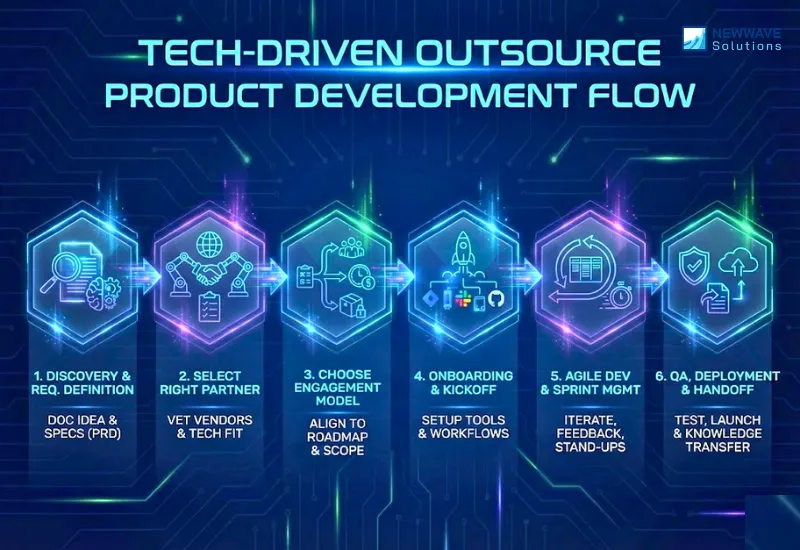
1. Discovery and Requirements Definition
Start by documenting your product idea, objectives, target audience, core features, and technical specifications. A detailed Product Requirements Document (PRD) prevents misunderstandings and provides clear direction. This step defines the “why” and “what” before development begins. It also reduces the risk of rework and timeline delays.
2. Selecting the Right Partner
Shortlist vendors with proven experience in your industry and technology stack. Examine their case studies, technical expertise, certifications, and communication processes. Platforms like Clutch, GoodFirms, and LinkedIn help you verify credibility. Interview team leads, architects, and project managers to assess alignment with your product goals.
3. Choosing an Engagement Model
Depending on your roadmap and scope, choose one of the following models:
- Dedicated Team – Best for long-term or complex projects that require continuous iteration.
- Time & Materials – Suitable for evolving requirements or exploratory development.
- Fixed Price – Ideal for clearly defined scopes and predictable deliverables.
The engagement model must match your risk profile, budget flexibility, and product complexity.
4. Onboarding and Project Kickoff
Set up communication channels, schedule weekly progress calls, define reporting structure, and establish collaboration tools such as Jira, Confluence, Slack, or GitHub. Align on workflow, documentation standards, sprint cadence, and acceptance criteria to ensure smooth execution.
5. Agile Development and Sprint Management
Most outsourced product development teams use Agile methodology. Participate in sprint planning, backlog refinement, daily stand-ups when needed, and demo sessions. Provide timely feedback to keep the product direction sharp and aligned with your business objectives.
6. QA, Deployment, and Handoff
Rigorous testing ensures the product is stable, secure, and ready for launch. After deployment, ensure full documentation is delivered, including architecture diagrams, source code, credentials, and environment details. Knowledge transfer ensures your internal team can take over if needed.
Key Considerations Before Starting
Before you begin outsource product development, it is important to prepare a clear foundation that protects your investment, reduces risk, and ensures that your partner can deliver exactly what you need. This stage combines strategic planning with practical assessments. Many outsourcing failures come from unclear expectations, misaligned goals, weak documentation, or insufficient security planning. By addressing these areas early, you reduce uncertainty and create a smoother development journey.
Key Factors Preparing
A strong outsourcing strategy begins with clarity: clarity of vision, clarity of scope, clarity of responsibilities, and clarity of communication. Below is a combination of detailed insights and a concise bullet list to guide your preparation.
Define Your Product Vision and Scope
You should never begin outsourced product development without a well-defined vision. Document the purpose of the product, user profiles, essential features, and expected outcomes. A clear direction minimizes misunderstandings and prevents scope creep, which is a common cause of delays and cost overruns. Make sure your PRD and roadmap are detailed enough for an external team to understand the full context of your product.
Prepare for Data Security and Compliance Requirements
If your product processes sensitive customer data or serves regulated industries such as healthcare, fintech, or insurance, you must evaluate your partner’s security capabilities. Confirm their compliance with standards like ISO 27001, SOC 2, GDPR, or HIPAA. Clarify encryption policies, access controls, secure hosting environments, and cybersecurity practices before any data transfer begins.
Verify Technical Leadership
The quality of your outsourced product depends heavily on the architects, senior engineers, technical leads, and QA specialists who work on it. Evaluate their experience with similar architectures, scaling models, and technology stacks. Strong technical leadership ensures your product is stable, maintainable, secure, and prepared for future growth.
Ensure Proper Documentation Standards
Product development demands continuous documentation—from architecture diagrams and API references to test cases and deployment guidelines. Insist on robust documentation so your internal team can easily take over or scale later. Documentation reduces dependency risks and keeps the project transparent.
Establish Clear Communication and Reporting
Miscommunication is a risk in any outsourcing model. Define how and when progress will be reported, who leads sprint reviews, which communication tools will be used, and how issues will be escalated. Transparent communication ensures alignment throughout the SDLC.
Key Considerations and Mistakes to Avoid
Below is a bullet list summarizing the essential points and common pitfalls:
- Lack of clear product vision: Avoid starting development without a detailed PRD and aligned goals.
- Choosing the cheapest partner: Low rates often lead to poor quality, delays, and hidden costs.
- Poor communication planning: Failing to define reporting routines or tools slows progress and causes misalignment.
- No security or IP protection: Always sign NDAs and contracts that clearly assign code ownership.
- Ignoring documentation: Without documentation, knowledge transfer becomes difficult and risky.
- Unclear scope or acceptance criteria: Vague requirements cause budget overrun and endless revisions.
- Not verifying technical leadership: unior-led teams may struggle with complex architecture decisions.
- Skipping MVP validation: Building too much before learning from real users increases risk.
Preparing well in advance ensures your outsourced product development project begins with structure, confidence, and efficiency.
Outsourced Product Development Trends
The landscape of outsourced product development is evolving fast. Global competition, rising digital transformation demands, and the rapid adoption of AI are reshaping how companies build products. To understand where the industry is going, you need to look at the broader outsourcing ecosystem and how these trends impact product-specific workflows. These trends help you anticipate changes, allocate resources, and choose the right partners who understand modern product engineering.
AI and Automation Integration
AI is becoming central to outsourced product development. Engineering partners now integrate AI into both development workflows and end products. This includes automated testing, code generation, anomaly detection, predictive analytics, recommendation engines, NLP solutions, and intelligent automation. AI speeds up delivery, reduces bugs, and enables more advanced digital products.
Strategic Product Partnerships Over Vendor Relationships
Businesses no longer want vendors who simply “take instructions.” They prefer partners who understand their business strategy, product vision, and long-term roadmap. Outsourced product development partners are now expected to act as strategic contributors—advising on architecture, scaling, user experience, and monetization.
Specialized Talent Demand in Advanced Technologies
As products become more complex, demand for niche expertise grows: AI, blockchain, IoT, cybersecurity, AR/VR, and cloud-native architecture. Outsourcing firms with deep specialization in these areas can deliver high-impact products with lower risk and faster execution.
Hybrid and Flexible Team Models
Companies increasingly combine onshore teams for product direction, nearshore software outsourcing for collaboration convenience, and offshore development services for cost efficiency and scale. This hybrid model supports continuous delivery across multiple time zones and ensures optimal performance.
Increased Emphasis on Cybersecurity
Security is now a major priority for outsourced product development. With rising cyber threats and international data regulations, clients expect partners to enforce strong security controls, follow global compliance standards, and adopt secure-by-design engineering practices from day one.
Outcome-Based Engagement Models
Instead of paying strictly hourly or per resource, businesses are moving to contracts tied to outcomes—feature completion, product milestones, performance metrics, or specific business objectives. This aligns incentives and improves delivery accountability.
Outsourced product development is shifting from simple cost-saving to value-driven innovation. Companies want external teams who contribute strategic insights, reduce technological complexity, and help deliver user-centric experiences. AI-driven automation, stronger security practices, hybrid team structures, and flexible engagement models are shaping the future of software product development outsourcing. Understanding these trends will help you plan your development roadmap more effectively, whether you’re choosing offshore outsourcing, hybrid models, or nearshore teams.
Why Newwave Solutions for Outsourcing Product Development?
Outsource product development is no longer just a way to reduce costs. It has become a strategic approach for companies that want to innovate faster, scale efficiently, access global expertise, and bring high-quality digital products to market with less risk. A strong partner supports every phase of the SDLC, from product discovery and MVP development to architecture, engineering, testing, cloud deployment, and long-term growth. As this guide shows, outsourced product development delivers real value when you work with a team that understands both technology and business outcomes.
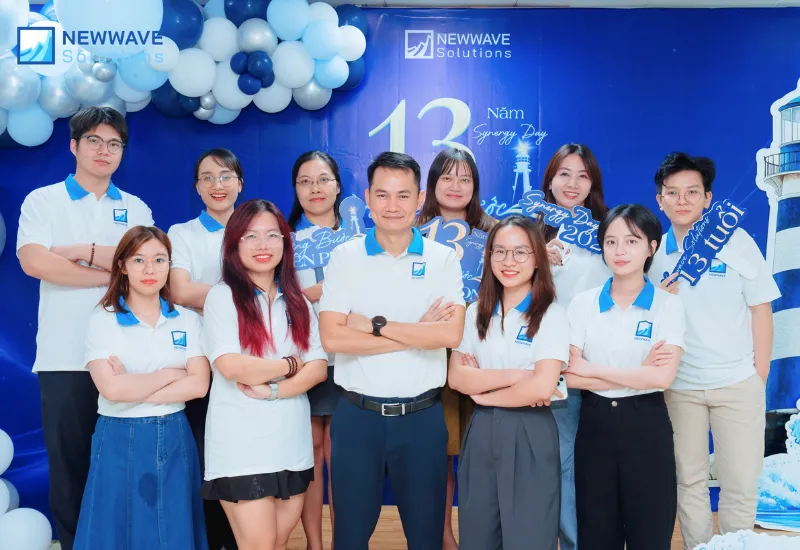
Newwave Solutions is that partner. As one of Vietnam’s leading engineering companies, we combine strong technical capability with the cost advantages of offshore outsourcing. Our teams bring deep experience in product software development services, cloud engineering, mobile and web applications, AI components, cybersecurity, and modernization projects. This allows us to deliver outsourced software product development that is stable, scalable, and aligned with your roadmap.
We offer flexible engagement models—from dedicated teams to fixed-scope builds—alongside secure workflows, ISO 27001 compliance, a strong English-speaking engineering team, and transparent delivery processes. Whether you need full product ownership or additional capacity to accelerate your release timeline, our offshore development services provide efficiency, quality, and reliable execution. For clients who prefer regional alignment, we also support hybrid and nearshore outsourcing models to ensure smooth collaboration.
If you are evaluating what is outsourced product development, planning to outsource product development for the first time, or considering whether tech startups should outsource product development, Newwave Solutions is ready to help. Our software outsourcing services support businesses at every stage—from idea validation to long-term evolution—so you can focus on strategy while we handle the engineering.
As you move forward, choose a partner who can deliver both technical excellence and business stability. Choose Newwave Solutions—and build your next digital product with confidence.
To Quang Duy is the CEO of Newwave Solutions, a leading Vietnamese software company. He is recognized as a standout technology consultant. Connect with him on LinkedIn and Twitter.



Read More Guides
Get stories in your inbox twice a month.
Let’s Connect
Let us know what you need, and out professionals will collaborate with you to find a solution that enables growth.
Leave a Reply