


Top 10 Software Development Languages: Trends & Guide
Software development languages are the foundation of every web app and software that exists. You might be surprised to learn that there are over 9000 software development languages in the world, some of which have been developed since the very first computer was created in the 1900s. Among those, there are 150 programming languages that are commonly used. Yet, learning about 150 of them is exhausting.
You might ask which programming languages are the most worth knowing about and which ones can empower your projects to adapt to the evolving demand of customers. In this article, we present the top 10 software development languages that are on the rise so you can pick the best one to develop your software product/ service. Let’s get started!
Why Language Choice Matters in Software Development
Here are the main reasons why choosing suitable languages for software development solutions is crucial for either new or expert businesses:
- Development speed impact: The choice of a software development language directly affects how quickly teams can deliver functional modules, which influences time-to-market and project momentum.
- Maintainability and codebase longevity: Different software development languages bring varying levels of code readability, modularity, and standardisation, which affect how easily code can be maintained or evolved over the years.
- Talent availability and outsourcing alignment: Enterprises selecting software development languages must consider how numerous and skilled the talent pool is, especially when outsourcing, since mismatches can raise costs and slow delivery.
- Ecosystem and integration support: The selected language must align with the broader stack, libraries, tooling, and other artefact types (e.g., database query languages, scripting or modelling languages) to ensure cohesive development across the lifecycle.
- Risk, performance, and scalability: Some software development languages deliver stronger performance or better concurrency support, which matters when building large-scale, mission-critical applications that require high reliability.
Main Types of Software Development Languages
Software development languages encompass a wide spectrum—from core programming languages to modelling, query, and scripting languages—and recognising their distinct roles helps enterprises choose the right stack. Below is a summary of the main types to assist your business in distinguishing each type and understanding its primary function.
1. Programming Languages
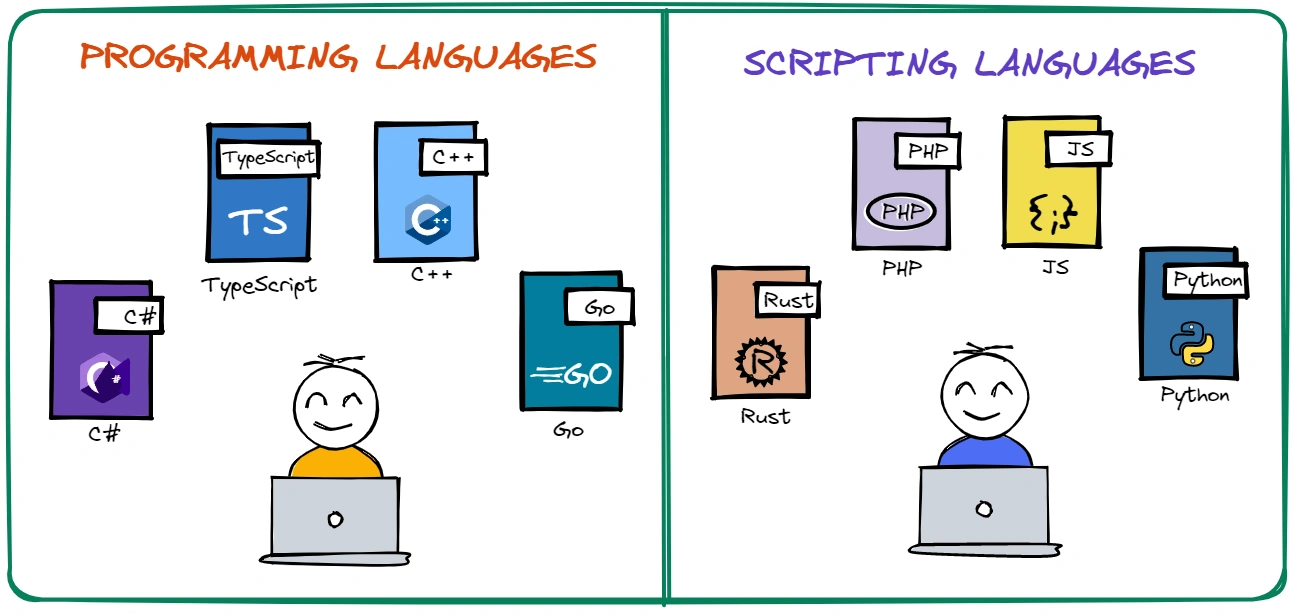
Programming languages are the core languages used to build software applications, platforms, and services; they define logic, control flow, and data structures for the system. Examples include Java, Python, C#, and Go, which enterprises use for backend, web, mobile, and embedded development. Because they form the foundation of the application, the choice of programming languages has long-term implications for scalability and maintainability.
2. Modelling Languages
Modelling languages (such as UML, SysML) enable architects and engineers to specify system structure, behaviour, and interactions at a high level before actual code is written. Enterprises use these languages to visualise system design, align stakeholders, and ensure correct architecture across distributed teams. For example, a large financial institution might use UML models to define business workflows prior to code development.
3. Query Languages
Query languages (such as SQL, GraphQL) facilitate data access, manipulation, and retrieval within applications, making them crucial for database-centric software systems. These languages allow development teams to write expressive statements to filter, join, aggregate, and transform data efficiently. For instance, an e-commerce business may rely on SQL to define complex analytics queries and optimise the performance of its customer data platform.
4. Scripting Languages
Scripting languages (like JavaScript, Bash, Python scripts) are used to automate tasks, glue components, orchestrate services, or provide dynamic front-end behaviour; they complement core programming languages. Organisations use scripting languages to build UI interactions, automate DevOps pipelines, or prototype features rapidly. For example, a SaaS provider might use JavaScript for client-side behaviour and Bash scripts for automated deployments.
Top 10 Software Development Languages
Let’s go deeper into the software development languages list and investigate some of the most trending ones recently. From this gathering, you can easily pick the best software development language for your upcoming development project.
1. Python
Python is a high-level, general-purpose software development language introduced in 1991 and popular for its readability, versatility, and rapid adoption across enterprise, automation, and data-centric development. Python software development is a common process among medium-to-large enterprises since this language is widely-used in multiple sections and areas worldwide.
Key features:
- Dynamic typing and concise syntax accelerate development.
- Extensive standard library and ecosystem for data science, web, and automation.
- Strong support for scripting, glue code, and small services.
- Cross-platform interpretation with minimal boilerplate.
Pros:
- Enables rapid prototyping and faster time to value.
- A large community and rich ecosystem simplify adoption.
- Scripting and automation are inherently streamlined.
- Developers ramp up quickly due to readability.
- Excellent support for data science and analytics.
Cons:
- Slower raw performance compared to compiled languages.
- Less strong concurrency support for CPU-intensive tasks.
- Potential scalability bottlenecks in large-scale systems.
Use cases:
- Web backend (e.g., Flask, Django).
- Data science and machine learning pipelines.
- Automation scripts and DevOps tooling.
- Rapid MVP or proof-of-concept development.
2. Java
Java is a mature, class-based object-oriented language launched in 1995 with the mantra “Write Once, Run Anywhere” and remains dominant in enterprise backend, mobile (Android), and large-scale systems.
Key features:
- Statically-typed, compiled to JVM byte-code for platform portability.
- Rich enterprise frameworks (Spring, Hibernate) support large systems.
- Extensive concurrency and thread-management mechanisms.
- Strong tooling, libraries, and enterprise architecture support.
Pros:
- High performance and robust under heavy load.
- Excellent support for large-scale enterprise systems.
- Long-term maintainability and code base stability.
- Vast talent pool and mature ecosystem.
- Suitable for regulated industries with audit and compliance.
Cons:
- Verbose syntax and slower initial development.
- Steeper learning curve for new developers.
- Less flexibility for rapid prototyping and change.
Use cases:
- Enterprise backend services and microservices architecture.
- Android mobile applications.
- Financial-services systems and high-availability platforms.
- Large distributed systems require high concurrency.
>>>Related post: Java Software Development – All you need to know for the Beginners
3. JavaScript
JavaScript started as a client-side scripting language for web browsers but has grown into a full-stack software development language used for web front-end, server-side (Node.js), and mobile hybrid applications.
Key features:
- Event-driven, asynchronous model fit for web interactions.
- Rich front-end libraries (React, Vue, Angular) for UIs.
- Unified language across front-end and backend (Node.js).
- Large package ecosystem (npm) for rapid development.
Pros:
- Single language across full stack simplifies team skillsets.
- Massive ecosystem and community support.
- Excellent for interactive web interfaces and real-time applications.
- Frequent updates and innovation drive modern development patterns.
- Easy to prototype and iterate quickly.
Cons:
- Weak typing and dynamic behaviour can lead to runtime errors.
- Performance limitations for CPU-intensive backend tasks.
- Large ecosystem can cause dependency complexity and maintenance overhead.
Use cases:
- Web front-end single-page applications (SPAs).
- Real-time applications (chat, dashboards).
- Backend microservices via Node.js.
- Hybrid mobile apps (React Native, Ionic).
4. C#
C# is a multi-paradigm, managed software development language developed by Microsoft in 2000 and widely used for Windows applications, enterprise services, games (Unity), and cross-platform development.
Key features:
- Strong object-oriented features, static typing, and .NET ecosystem integration.
- Cross-platform support via .NET Core and Xamarin for mobile.
- Rich tooling (Visual Studio) and language enhancements (async/await, LINQ).
- Game development support via the Unity engine.
>>>Read more: .NET Software Development: From Legacy to Cloud-Native
Pros:
- High productivity and developer tools support.
- Good for cross-platform business and game development.
- Strong ecosystem in enterprise Windows environments.
- Safe typing and modern language features facilitate maintainability.
- Effective for both web, desktop, and mobile projects.
Cons:
- Historically tied to the Microsoft stack (though improving).
- Smaller open-source community compared to some languages.
- Less prominent in data-science and scripting domains.
Use cases:
- Enterprise Windows-based back-end services.
- Game development in Unity.
- Cross-platform mobile apps via Xamarin.
- Web APIs and microservices in .NET.
5. Go (Golang)
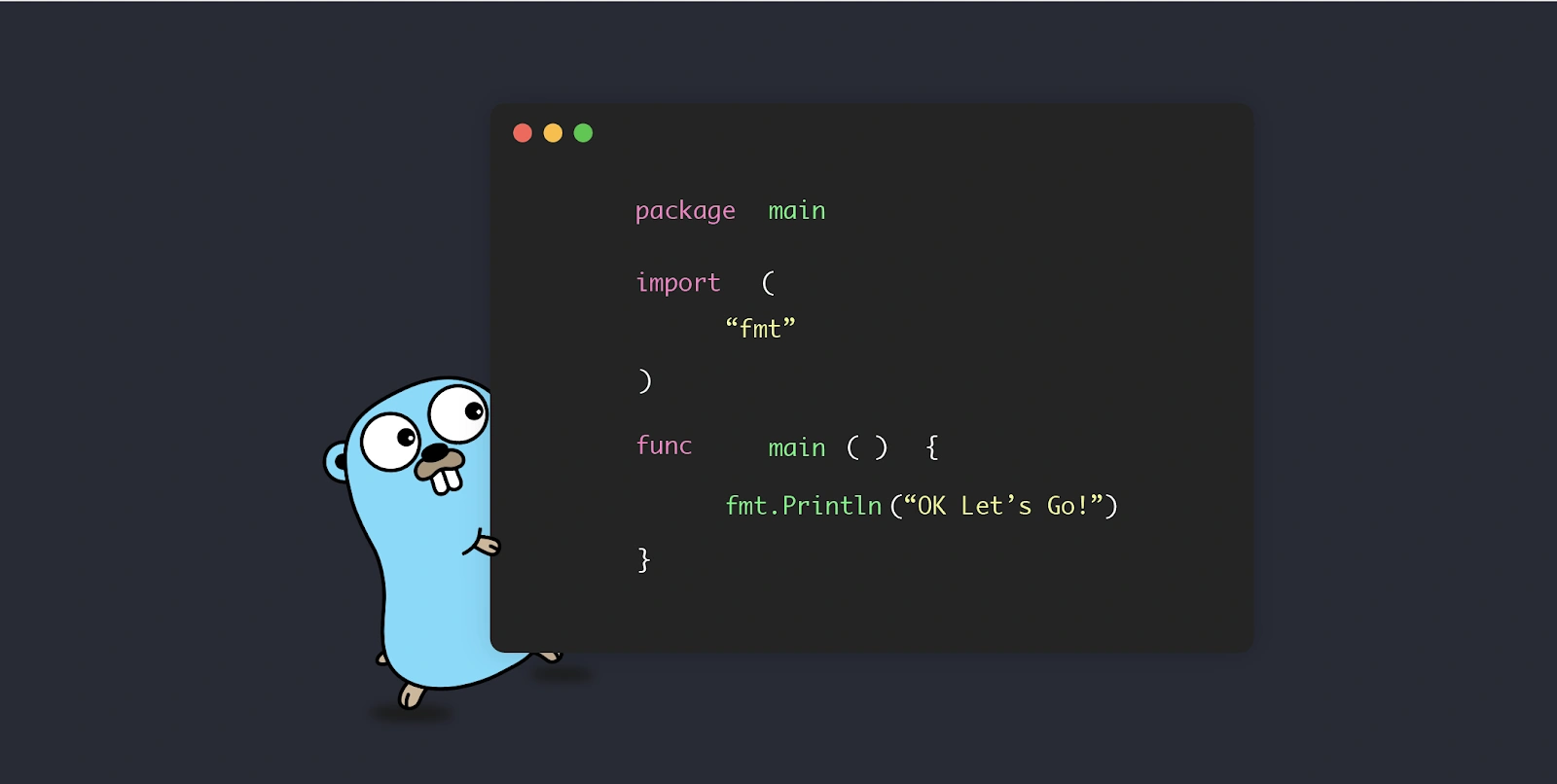
Go (or Golang) is a statically-typed software development language created by Google in 2009, designed for simplicity, concurrency, and performance—especially suited for cloud-native and microservices systems.
Key features:
- Built-in concurrency support (goroutines, channels) for parallel tasks.
- Fast compilation, simple syntax, and easy deployment.
- Efficient memory usage and minimal runtime overhead.
- Excellent for building networked services, APIs, and cloud infrastructure.
Pros:
- Excellent for high-performance backend services and microservices.
- Lightweight runtime and easy deployment promote scalability.
- Lower complexity and faster iteration for backend services.
- Strong standard library for networking and concurrency.
- Easy to maintain and onboard new developers.
Cons:
- Less mature ecosystem for UI or mobile compared to other languages.
- Limited generics (until recently) may hinder complex abstractions.
- Not yet the first choice in many regulated enterprise sectors.
Use cases:
- Cloud microservices and APIs.
- Backend infrastructure for startups or enterprises.
- Network-facing services and distributed systems.
- DevOps tooling, command-line utilities.
6. Swift
Swift is Apple’s open-source software development language introduced in 2014 to replace Objective-C for iOS and macOS applications, balancing performance with modern syntax.
Key features:
- Modern syntax, strong typing, and optionals enhance safety.
- Native performance for iOS and macOS applications.
- Interoperability with Objective-C and the Apple ecosystem.
- Performance optimised for mobile and GPU-accelerated tasks.
Pros:
- Excellent for native mobile applications in Apple’s ecosystem.
- Safe syntax and compile-time checks reduce runtime errors.
- Rapid iteration and modern tool support (Xcode, SwiftUI).
- Strong future support from Apple and the open-source community.
- Good performance for mobile and client-side apps.
Cons:
- Limited to Apple ecosystems (though server Swift exists).
- Smaller talent pool compared to established languages.
- Less suitable for cross-platform or backend services without additional frameworks.
Use cases:
- Native iOS and macOS apps.
- Mobile client-side heavy applications.
- Prototype apps for Apple platforms.
- Cross-platform via Swift for server or embedded systems.
7. Kotlin
Kotlin is a modern software development language built by JetBrains and officially supported by Google for Android development since 2017, offering better syntax, null-safety, and interoperability with Java.
Key features:
- Null-safety features reduce runtime crashes.
- Full interoperability with existing Java codebases.
- Concise syntax and expressive features (coroutines for concurrency).
- Suitable for both Android mobile and backend via Kotlin JVM.
Pros:
- Accelerates mobile development on Android with better language features than Java.
- Easy migration from Java and reuse of Java libraries.
- Strong concurrency support via coroutines.
- Improved developer productivity and fewer boilerplate codes.
- Growing ecosystem and community support.
Cons:
- Relatively younger ecosystem than Java in the enterprise backend.
- Some tooling and library maturity lags Java in certain domains.
- Larger organisations with legacy Java systems may face migration overhead.
Use cases:
- Android mobile applications.
- Backend services on JVM.
- Full-stack development with Kotlin + Ktor + frontend.
- Modernising legacy Java codebases.
8. Rust
Rust is a systems-level software development language introduced by Mozilla in 2015, focusing on memory safety, concurrency, and high performance for low-level and embedded systems.
Key features:
- Zero-cost abstractions and memory safety without garbage collection.
- Modern concurrency primitives and safe multithreading.
- Performance rivaling C++ with safer syntax.
- Strong tooling and an emerging ecosystem for embedded and systems programming.
Pros:
- Excellent for performance-critical systems, embedded applications, and IoT.
- Memory safety reduces bugs and security vulnerabilities.
- Growing ecosystem and community support in the systems domain.
- Powerful for large‐scale infrastructure and high-throughput tasks.
- Suitable for next-generation performance-demanding applications.
Cons:
- Steeper learning curve due to ownership and borrowing concepts.
- Smaller talent pool compared to mainstream languages like Java or Python.
- Less adoption in mainstream enterprise web applications yet.
Use cases:
- Embedded systems and IoT devices.
- Performance-critical backend services.
- Game engines and simulation systems.
- Infrastructure tooling and networking.
9. SQL
SQL (Structured Query Language) is a domain-specific language for managing and querying relational databases, dating back to the 1970s and remaining central to enterprise software development languages.
Key features:
- Declarative syntax for querying, joining, and aggregating data.
- Strong support for transactions and ACID compliance in enterprise systems.
- Extensive vendor support (Oracle, MySQL, PostgreSQL) and optimised performance.
- Integration with programming languages for embedded data logic and analytics.
Pros:
- Efficient data retrieval and manipulation in large enterprise databases.
- Mature tools and optimised performance for complex queries.
- Fundamental skill for application developers and data engineers.
- High compatibility and legacy support across enterprise systems.
- Reliable and consistent for data-critical applications.
Cons:
- Limited to relational modelling—less flexible for unstructured data.
- Performance may degrade on a massive scale without proper optimisation.
- Declarative nature may restrict control over algorithmic logic in some use cases.
Use cases:
- Enterprise data warehouses and business intelligence applications.
- Transaction processing systems (banking, finance).
- Web applications with relational backend.
- Analytics and reporting platforms.
10. TypeScript
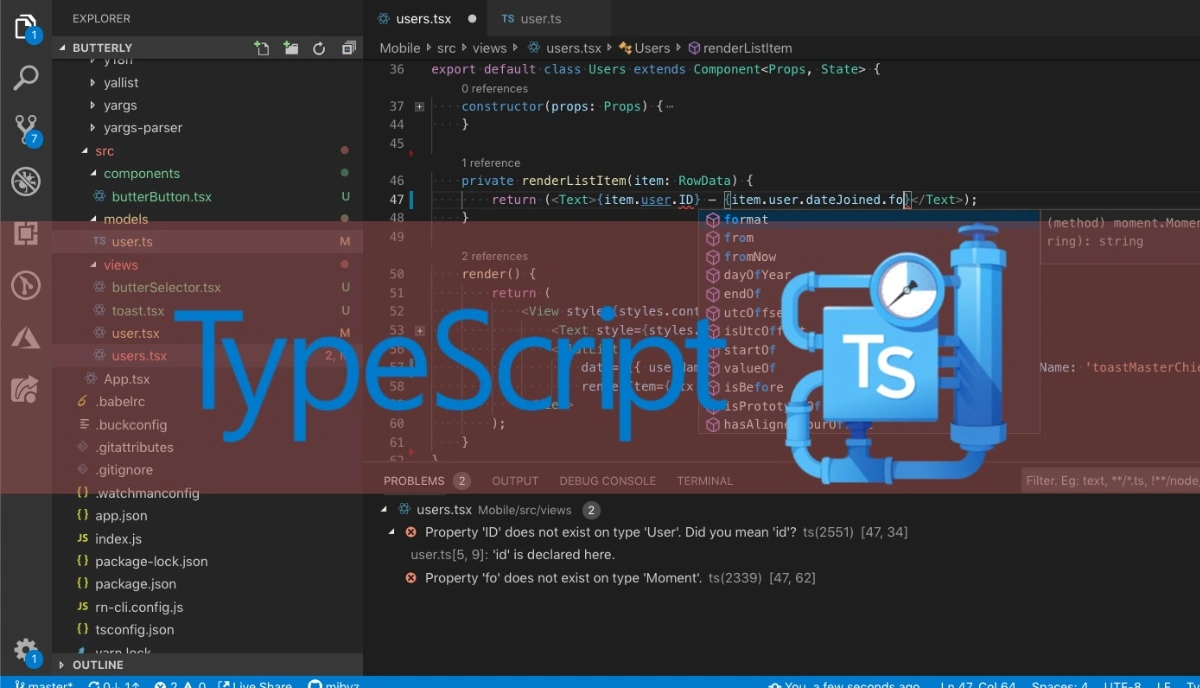
TypeScript is a statically-typed superset of JavaScript introduced by Microsoft in 2012, which enhances JavaScript with type safety and modern language features. It is widely adopted for large-scale web applications and enterprise front-end development, helping teams manage complexity and improve maintainability.
Key features:
- Static typing and interfaces that help catch errors early in development.
- Compatibility with existing JavaScript code and libraries, easing transition.
- Support for modern ECMAScript features and tooling (e.g., VS Code, transpilation).
- Improved maintainability for complex codebases and large teams.
Pros:
- Improves code quality and reduces runtime errors via compile-time checks.
- Integrates seamlessly with JavaScript ecosystems and frameworks like React or Angular.
- Enables scalable front-end architecture for enterprise applications.
- Supports gradual migration from JavaScript, making it flexible for legacy systems.
- Strong developer tooling and community support.
Cons:
- Requires transpilation and build steps, adding complexity to setup.
- Learning curve for teams unfamiliar with static typing or advanced features.
- May introduce overhead when used for small scripts or simple applications.
Use cases:
- Large-scale web front-end applications in an enterprise.
- Single-page applications (SPAs) require type safety.
- Migration from legacy JavaScript to maintainable modern codebases.
- Front-end teams require strict maintainability and scalable architecture.
How to choose the appropriate Software Development Languages
Choosing the right language from among the many software development languages–including programming, scripting, query and modelling languages–is crucial for project success. Below are five key criteria to guide your enterprise decision:
- Business domain alignment: The language must match the application’s business domain (e.g., fintech, e-commerce, IoT) because mismatches can increase cost or technical debt.
- Team capability and talent pool: The available skills, experience and team ramp-up capacity directly affect how successfully you can adopt a language and deliver your project.
- Project size and complexity: Large-scale or long-lifecycle projects may benefit from more mature languages, while small, fast-moving initiatives might choose more flexible options.
- Performance and latency requirements: Applications with strict performance, concurrency or real-time constraints need languages with strong runtime, ecosystem and optimisation capabilities.
- Ecosystem maturity and vendor support: Languages with rich libraries, frameworks, community support and long-term viability reduce risk and accelerate development.
How Newwave Solutions Supports Your Language Stack Decision
Choosing the appropriate software development languages is a vital decision—but successful execution demands experienced teams, processes, and resources. If your enterprise is facing challenges in software development, then outsourcing to a professional IT services provider is a strategic choice, and Newwave Solutions stands out among the best.
What Programming Development Services do we have?
Currently, Newwave Solutions are supporting several main programming development services, include:
- C# (C Sharp) Web Development Services
- Java Web Development Services
- Python Web Development Services
- Ruby Web Development Services
- PHP Web Development Services
Why choose Newwave Solutions?
With 14+ years of expertise, over 300 certified IT professionals, and more than 800 successful projects worldwide, Newwave Solutions offers scalable, cost-effective solutions delivered on schedule. We assess your project’s objectives, timeline, team structure, and technological ecosystem, then recommend an optimal language stack and full-cycle support—in languages such as Java, Python, or other software development languages relevant to your business. We provide services including architecture consulting, team augmentation, full-stack development across multiple languages, and modernization of legacy systems.
Final thoughts
We hope that this list of the top 10 software development languages will help you begin your journey to the digital transformation of your operation!
However, in case you are still not sure where to start, don’t worry, Newwave Solutions can do the heavy lifting for you and look through developer and market data from the past several years to identify trends and draw conclusions to make it easier for you to kick off. Reach out to us and let’s see what we can do for your business!
Contact Information:
- Head Office (Hanoi): 1F, 4F, 10F, Mitec Building, Cau Giay Ward, Hanoi City, Vietnam Branch Office (Tokyo): 1chōme118 Yushima, Bunkyo City, Tokyo 1130034, Japan
- Hotline: +84 985310203
- Website: https://newwavesolution.com
- Email: [email protected]
To Quang Duy is the CEO of Newwave Solutions, a leading Vietnamese software company. He is recognized as a standout technology consultant. Connect with him on LinkedIn and Twitter.



Read More Guides
Get stories in your inbox twice a month.
Let’s Connect
Let us know what you need, and out professionals will collaborate with you to find a solution that enables growth.
Leave a Reply